Showing posts sorted by relevance for query stratospheric ozone. Sort by date Show all posts

Monday, January 20, 2014

New paper says climate models 'robustly' predicted Antarctic sea ice to decrease, but Antarctic sea ice now near record highs

A paper published today in the Quarterly Journal of the Royal Meteorological Society notes that climate models "robustly" predicted that Antarctic sea ice would decrease in response to increased greenhouse gases and the ozone hole, but that the exact opposite has occurred with current Antarctic sea ice at near historical highs. 


The authors propose a mechanism to explain this via a changes in the Southern Annular Mode, which prior papers have linked to solar activity. In addition, other papers find stratospheric ozone is primarily related to solar activity rather than man-made chlorofluorocarbons [CFCs], explaining why the ozone hole has not recovered despite the Montreal Protocol.

Despite the now questionable link between man-made CFCs and the ozone hole, the authors claim "ozone recovery will figure prominently in future climate change, with its impacts expected to largely cancel the impacts of increasing greenhouse gases during the next half-century."

Climate System Response to Stratospheric Ozone Depletion and Recovery

Michael Previdi1,*, Lorenzo M. Polvani1,2

DOI: 10.1002/qj.2330

Abstract

We review what is presently known about the climate system response to stratospheric ozone depletion and its projected recovery, focusing on the responses of the atmosphere, ocean and cryosphere. Compared to well-mixed greenhouse gases (GHGs), the radiative forcing of climate due to observed stratospheric ozone loss is very small: in spite of this, recent trends in stratospheric ozone have caused profound changes in the Southern Hemisphere (SH) climate system, primarily by altering the tropospheric midlatitude jet, which is commonly described as a change in the Southern Annular Mode. Ozone depletion in the late twentieth century was the primary driver of the observed poleward shift of the jet during summer, which has been linked to changes in tropospheric and surface temperatures, clouds and cloud radiative effects, and precipitation at both middle and low latitudes. It is emphasized, however, that not all aspects of the SH climate response to stratospheric ozone forcing can be understood in terms of changes in the midlatitude jet.

The response of the Southern Ocean and sea ice to ozone depletion is currently a matter of debate. For the former, the debate is centered on the role of ocean eddies in possibly opposing wind-driven changes in the mean circulation. For the latter, the issue is reconciling the observed expansion of Antarctic sea ice extent during the satellite era with robust modeling evidence that the ice should melt as a result of stratospheric ozone depletion (and increases in GHGs).

Despite lingering uncertainties, it has become clear that ozone depletion has been instrumental in driving SH climate change in recent decades. Similarly, ozone recovery will figure prominently in future climate change, with its impacts expected to largely cancel the impacts of increasing GHGs during the next half-century.

Related:

New paper finds global warming caused by CFCs, not CO2; predicts cooling for next 50-70 years

Wednesday, August 19, 2015

New paper finds another solar amplification mechanism by which solar activity & cosmic rays control climate

A paper published today in the Journal of Atmospheric and Solar-Terrestrial Physics finds another potential solar amplification mechanism mediated by galactic cosmic rays [GCRs] (and distinct from Svensmark's cosmic ray theory of climate). The author demonstrates:

Solar modulation of GCR [Galactic Cosmic Rays] is translated down to the Earth climate.
The mediator of solar influence are energetic particles.
GCR impacts the O3 [ozone] budget in the lower stratosphere.
O3 influences the temperature and humidity near tropopause, and greenhouse effect.
Effectiveness of this mechanism depends on geomagnetic field intensity.

"In this paper we show that bi-decadal variability of solar magnetic field, modulating the intensity of galactic cosmic ray (GCR) at the outer boundary of heliosphere, could be easily tracked down to the Earth's surface. The mediator of this influence is the lower stratospheric ozone, while the mechanism of signal translation consists of: (i) GCR impact on the lower stratospheric ozone balance; (ii) modulation of temperature and humidity near the tropopause by the ozone variations; (iii) increase or decrease of the greenhouse effect, depending on the sign of the humidity changes. The efficiency of such a mechanism depends critically on the level of maximum secondary ionisation created by GCR (i.e. the Pfotzer maximum) − determined in turn by heterogeneous Earth's magnetic field..."


The paper adds to over 100 potential solar amplification mechanisms described in the literature.

As to the false belief that solar activity does not correlate to global temperatures, the sunspot 'integral', the accumulated mean sunspot activityand Fourier analysis all demonstrate this belief to be false:


Graphics from the paper and abstract below:


Solar modulation of GCR [Galactic Cosmic Rays] is translated down to the Earth climate.
The mediator of solar influence are energetic particles.
GCR impacts the O3 budget in the lower stratosphere.
O3 influences the temperature and humidity near tropopause, and greenhouse effect.
Effectiveness of this mechanism depends on geomagnetic field intensity.

Abstract

The Sun's contribution to climate variations was highly questioned recently. In this paper we show that bi-decadal variability of solar magnetic field, modulating the intensity of galactic cosmic ray (GCR) at the outer boundary of heliosphere, could be easily tracked down to the Earth's surface. The mediator of this influence is the lower stratospheric ozone, while the mechanism of signal translation consists of: (i) GCR impact on the lower stratospheric ozone balance; (ii) modulation of temperature and humidity near the tropopause by the ozone variations; (iii) increase or decrease of the greenhouse effect, depending on the sign of the humidity changes. The efficiency of such a mechanism depends critically on the level of maximum secondary ionisation created by GCR (i.e. the Pfotzer maximum) − determined in turn by heterogeneous Earth's magnetic field. Thus, the positioning of the Pfotzer max in the driest lowermost stratosphere favours autocatalytic ozone production in the extra-tropical Northern Hemisphere (NH), while in the SH − no suitable conditions for activation of this mechanism exist. Consequently, the geomagnetic modulation of precipitating energetic particles – heterogeneously distributed over the globe – is imprinted on the relation between ozone and humidity in the lower stratosphere (LS). The applied test for causality reveals that during the examined period 1957–2012 there are two main centers of action in the winter NH, with tight and almost stationary ozone control on the near tropopause humidity. Being indirectly influenced by the solar protons, the variability of the SH lower stratospheric ozone, however, is much weaker. As a consequence, the causality test detects that the ozone dominates in the interplay with ULTS humidity only in the summer extra-tropics.

Thursday, December 29, 2011

New Paper: Cold Arctic winters becoming colder, resulting in large ozone hole


Paper published today notes near-complete loss of ozone over the Arctic due to one of the coldest stratospheric winters on record from 2010-2011. No mention of the now-inconvenient link to man-made chlorofluorocarbon emissions.  

GEOPHYSICAL RESEARCH LETTERS, VOL. 38, L24814, 5 PP., 2011
doi:10.1029/2011GL049784
Key Points
  • Large losses of Arctic stratospheric ozone were observed during winter 2010/11
  • A further cooling of 1K would have resulted in locally near-complete ozone loss
  • A 1K cooling can counterbalance a 10% reduction in halogens
B.-M. Sinnhuber
Institute for Meteorology and Climate Research, Karlsruhe Institute of Technology,, Karlsruhe,, Germany
G. Stiller
Institute for Meteorology and Climate Research, Karlsruhe Institute of Technology,, Karlsruhe,, Germany
R. Ruhnke
Institute for Meteorology and Climate Research, Karlsruhe Institute of Technology,, Karlsruhe,, Germany
T. von Clarmann
Institute for Meteorology and Climate Research, Karlsruhe Institute of Technology,, Karlsruhe,, Germany
S. Kellmann
Institute for Meteorology and Climate Research, Karlsruhe Institute of Technology,, Karlsruhe,, Germany
J. Aschmann
Institute of Environmental Physics, University of Bremen,, Bremen,, Germany
The Arctic stratospheric winter of 2010/2011 was one of the coldest on record with a large loss of stratospheric ozone. Observations of temperature, ozone, nitric acid, water vapor, nitrous oxide, chlorine nitrate and chlorine monoxide from the Michelson Interferometer for Passive Atmospheric Sounding (MIPAS) onboard ENVISAT are compared to calculations with a chemical transport model (CTM). There is overall excellent agreement between the model calculations and MIPAS observations, indicating that the processes of denitrification, chlorine activation and catalytic ozone depletion are sufficiently well represented. Polar vortex integrated ozone loss reaches 120 Dobson Units (DU) by early April 2011. Sensitivity calculations with the CTM give an additional ozone loss of about 25 DU at the end of the winter for a further cooling of the stratosphere by 1 K, showing locally near-complete ozone depletion (remaining ozone <200 ppbv) over a large vertical extent from 16 to 19 km altitude. In the CTM a 1 K cooling approximately counteracts a 10% reduction in stratospheric halogen loading, a halogen reduction that is expected to occur in about 13 years from now. These results indicate that severe ozone depletion like in 2010/2011 or even worse could appear for cold Arctic winters over the next decades if the observed tendency for cold Arctic winters to become colder continues into the future.

Monday, March 26, 2012

New paper claims ozone is most important driver of recent climate

A paper published last week in the Journal of Atmospheric and Solar-Terrestrial Physics claims stratospheric ozone is the most important driver of recent climate, accounting for 75% of Earth's temperature variations during the period 1926-2011. Ozone is in turn controlled by natural variations in galactic cosmic rays & solar activity, rather than man-made chlorofluorocarbons or 'greenhouse gases.' The Svensmark hypothesis relates variations in solar activity to amplified variations of galactic cosmic rays, which in turn result in changes in cloud cover. This new paper may provide a second mechanism by which variations in solar activity are amplified by the effect on galactic cosmic rays and ozone.

Climate sensitivity to the lower stratospheric ozone variations
  • N.A. KilifarskaCorresponding author contact informationE-mail the corresponding author
  • National Institute of Geophysics, Geodesy and Geography, BAS

Abstract

The strong sensitivity of the Earth's radiation balance to variations in the lower stratospheric ozone – reported previously – is analyzed here by the use of non-linear statistical methods. Our non-linear model of the land air temperature (T) – driven by the measured Arosa total ozone (TOZ) – explains 75% of total variability of Earth's T variations during the period 1926–2011. We have analyzed also the factors which could influence the TOZ variability and found that the strongest impact belongs to the multi-decadal variations of galactic cosmic rays. Constructing a statistical model of the ozone variability, we have been able to predict the tendency in the land air T evolution till the end of the current decade. Results show that Earth is facing a weak cooling of the surface T by 0.05–0.25 K (depending on the ozone model) until the end of the current solar cycle. A new mechanism for O3 influence on climate is proposed.

Highlights

► An increased climate sensitivity to ozone variations is analyzed. ► O3 driven model of surface T explains the greatest part of its variability. ► Impact of different factors on lower stratospheric O3 variability is estimated. ► Galactic cosmic rays have a greatest influence on O3. ► Mechanism for ozone influence on climate is described.

Wednesday, November 13, 2013

New paper finds CFCs combined with other factors have had little effect on total atmospheric ozone over past century

A paper published today in Geophysical Research Letters finds tropospheric ozone has only changed a "very small" amount [about 0.8%] from pre-industrial times to the present when all of the combined effects of ozone depleting substances such as chlorofluorocarbons, N2O, ozone precursors, and climate change are considered together. The authors find "significant decreases in total column ozone over large parts of the Southern Hemisphere during austral spring and widespread increases in column ozone over the Northern Hemisphere during boreal summer."

This calls into question the role of man-made chlorofluorocarbons [CFCs] as the alleged cause of the Antarctic ozone hole and necessity or effectiveness of the Montreal Protocol. Since CFCs are well mixed in the atmosphere at approximately the same levels in the troposphere of the Northern and Southern Hemispheres, why would they have opposite effects in the Southern and Northern Hemipheres?


M. C. Reader, D. A. Plummer, J. F. Scinocca, T. G. Shepherd


We investigate ozone changes from pre-industrial times to the present using a chemistry-climate model. The influence of changes in physical climate, ozone depleting substances [e.g. chloroflurocarbons], N2O and tropospheric ozone precursors is estimated using equilibrium simulations with these different factors set at either pre-industrial or present-day values. When these effects are combined, the entire decrease in total column ozone from pre-industrial to present-day is very small (−1.8 DU) in the global annual average, though with significant decreases in total column ozone over large parts of the Southern Hemisphere during austral spring and widespread increases in column ozone over the Northern Hemisphere during boreal summer. A significant contribution to the total ozone column change is the increase in lower-stratospheric ozone associated with the increase in ozone precursors (5.9 DU). Also noteworthy is the near cancellation of the global average climate change effect on ozone (3.5 DU) by the increase in N2O (−3.9 DU).

Notes: 

The -1.8 DU change in ozone above is only about 0.8% of the total tropospheric ozone level in the Antarctic ozone hole [~220 DU]. Per Wikipedia, this tiny change in ozone brought down to the surface of the Earth at 0 °C would occupy a layer only 0.018 mm thick:

"For example, 300 DU of ozone brought down to the surface of the Earth at 0 °C would occupy a layer only 3 mm thick. One DU is 2.69×10¹⁶ ozone molecules per square centimetre, or 2.69×10²⁰ per square metre. This is 0.4462 millimoles of ozone per square metre."


Related: 

Saturday, August 2, 2014

Why does CO2 cool the stratosphere & warm the troposphere? Warmists don't agree on an answer

A paper published today in the Journal of Climate uses "a chemistry-climate model coupled to an ocean model" to arrive at a number of seeming contradictory conclusions about the opposing radiative effects of the greenhouse gases CO2, water vapor, ozone, and halocarbons (CFCs) depending upon the levels in the atmosphere where each of these are present.

Conventional AGW theory proposes the existence of a mid-troposphere "hot spot" and an overlying cooling of the stratosphere because heat is "trapped" in the "hot spot" and therefore can't make it to the stratosphere. However, despite millions of weather balloon and satellite observations over the past 60 years, the "hot spot" has still not been found and thus questions the fundamental theory of anthropogenic global warming climate change. The formation of a "hot spot" would also require a physically impossible reduction of entropy in the mid-troposphere and thus violate the second law of thermodynamics which requires maximum entropy production. 


According to the abstract below, the net radiative effect of these greenhouse gases in the troposphere vs. tropopause vs. stratosphere are:


GHG                          troposphere        tropopause       stratosphere


CO2                          warming              warming            cooling

water vapor                      ?                   cooling              cooling
ozone                              ?                   warming            warming
CFCs                         warming                  ?                  cooling?

I've been asking CAGW believers for years why CO2 and other greenhouse gases have opposite radiative effects upon global temperatures depending upon where they happen to be located in the atmosphere, and have yet to receive a satisfactory answer. Even the warmists themselves can't seem to agree on this fundamental question underlying CAGW theory. Wikipedia propagandist William Connolley disagrees with Gavin Schmidt and RealClimate on why increased greenhouse gases would cause the stratosphere to cool. 


RealClimate links to this site (update: link broken, but this is a mirror site) for their explanation, which upon examination makes no sense, violates basic physics including the 1st and 2nd laws of thermodynamics and maximum entropy production, contains contradictions, and then concludes "We now know that stratospheric cooling and tropospheric warming are intimately connected and that carbon dioxide plays a part in both processes. At present, however, our understanding of stratospheric cooling is not complete and further research has to be done.":


Excerpt in blue text from the site Gavin & RealClimate claim has the definitive answer to the question "why does the stratosphere cool?" [emphasis added]:


Why does the stratosphere cool?

There are several reasons why the stratosphere is cooling. The two best understood are:

1) depletion of stratospheric ozone
2) increase in atmospheric carbon dioxide

Cooling due to ozone depletion

The first effect is easy to understand. Less ozone leads to less absorption of ultra-violet radiation from the Sun. As a result, solar radiation is not converted into heat radiation in the stratosphere.  So cooling due to ozone depletion is simply reduced heating as a consequence of reduced absorption of ultra-violet radiation.  Ozone also acts as a greenhouse gas in the lower stratosphere.  Less ozone means less absorption of infra-red heat radiation and therefore less heat trapping.
At an altitude of about 20 km, the effects of ultra-violet and infra-red radiation are about the same.  Ozone levels decrease the higher we go in the atmosphere but there are other greenhouse gases present in the air which we have to consider.

Cooling due to the greenhouse effect

The second effect is more complicated. Greenhouse gases (CO2, O3, CFC) absorb infra-red radiation from the surface of the Earth and trap the heat in the troposphere.  If this absorption is really strong, the greenhouse gas blocks most of the outgoing infra-red radiation close to the Earth's surface.  This means that only a small amount of outgoing infra-red radiation reaches carbon dioxide in the upper troposphere and the lower stratosphere.  On the other hand, carbon dioxide emits heat radiation, which is lost from the stratosphere into space.  In the stratosphere, this emission of heat becomes larger than the energy  received from below by absorption and, as a result, there is a net energy loss from the stratosphere and a resulting cooling.  Other greenhouse gases, such as ozone and chlorofluorocarbons (CFC's), have a weaker impact because their concentrations in the troposphere are smaller. They do not entirely block the whole radiation in their wavelength regime so some reaches the stratosphere where it can be absorbed and, as a consequence, heat this region of the atmosphere.


3. Stratospheric cooling rates:  The picture shows how water, cabon dioxide and ozone contribute to longwave cooling in the stratosphere.   Colours from blue through red, yellow and to green show increasing cooling, grey areas show warming of the stratosphere.  The tropopause is shown as dotted line (the troposphere below and the stratosphere above).  For CO2 it is obvious that there is no cooling in the troposphere [or warming!], but a strong cooling effect in the stratosphere.  Ozone, on the other hand, cools the upper stratosphere but warms the lower stratosphere.  Figure from: Clough and Iacono, JGR, 1995; adapted from the SPARC Website.


Where does cooling take place?

The impact of decreasing ozone concentrations is largest in the lower stratosphere, at an altitude of around 20 km, whereas increases in carbon dioxide lead to highest cooling at altitudes between 40 and 50 km (Figure 3).  All these different effects mean that some parts of the stratosphere are cooling more than others.

4. Cooling trends at different altitudes in the stratosphere.  source: Ramaswamy et al., Reviews of Geophysics, Feb. 2001

Other influences

It is possible that greenhouse warming could disturb the heating of the Arctic stratosphere by changing planetary waves.  These waves are triggered by the surface structure in the Northern Hemisphere (mountain ranges like the Himalayas, or the alternation of land and sea).  Recent studies show that increases in the stratospheric water vapour concentration could also have a strong cooling effect, comparable to the effect of ozone loss.

Conclusions

We now know that stratospheric cooling and tropospheric warming are intimately connected and that carbon dioxide plays a part in both processes.  At present, however, our understanding of stratospheric cooling is not complete and further research has to be done.  We do, however, already know that observed and predicted cooling in the stratosphere makes the formation of an Arctic ozone hole more likely. 

[end excerpt]

Note the quote above "In the stratosphere, this emission of heat [proper term is radiation] becomes larger than the energy received from below by absorption and, as a result, there is a net energy loss from the stratosphere and a resulting cooling."

Basic physics question: How can CO2 increase emission of radiation to space if it is absorbing less radiation from below? This would violate the 1st law of thermodynamics which requires conservation of energy.

Secondly, the graph above [from an AGW model] shows that CO2 greatly increases cooling of the stratosphere but has essentially zero effect warming or cooling on the troposphere [below the dotted line]. Therefore, this graph indicates a net cooling effect of CO2 upon the atmosphere.

Therefore, can anyone please provide a plausible explanation that does not violate the laws of thermodynamics as to why increased CO2 allegedly warms the troposphere and cools the stratosphere? And why the model output above shows CO2 has a strong cooling effect in the stratosphere, but essentially zero warming or cooling effect in the troposphere? And if the stratosphere cools thus increasing the temperature gradient between troposphere and stratosphere, why that would not increase heat transfer from the troposphere to stratosphere (thus cooling the troposphere)?


The climate impact of past changes in halocarbons and CO2 in the tropical UTLS region

Charles McLandress1
Department of Physics, University of Toronto, Toronto, Ontario, Canada
Theodore G. Shepherd
Department of Meteorology, University of Reading, Reading, UK
M. Catherine Reader
University of Victoria, Victoria, British Columbia, Canada
David A. Plummer
Canadian Centre for Climate Modelling and Analysis, Victoria, British Columbia, Canada
Keith P. Shine
Department of Meteorology, University of Reading, Reading, UK


Abstract
A chemistry-climate model coupled to an ocean model is used to compare the climate impact of past (1960-2010) changes in concentrations of halocarbons with those of CO2 in the tropical upper troposphere and lower stratosphere. The halocarbon contribution to both upper troposphere warming and the associated increase in lower stratospheric upwelling is about 40% as large as that due to CO2. Trends in cold-point temperature and lower stratosphere water vapor are positive for both halocarbons and CO2, and are of about the same magnitude. Trends in lower stratosphere ozone are negative, due to the increased upwelling. These increases in water vapor and decreases in lower stratosphere ozone feed back on lower stratosphere temperature through radiative cooling. The radiative cooling from ozone is about a factor of two larger than that from water vapor in the vicinity of the cold-point tropopause, while water vapor dominates at heights above 50 hPa. For halocarbons this indirect radiative cooling more than offsets the direct radiative warming, and together with the adiabatic cooling accounts for the lack of a halocarbon-induced warming of the lower stratosphere. For CO2 the indirect cooling from increased water vapor and decreased ozone is of comparable magnitude to the direct warming from CO2 in the vicinity of the cold-point tropopause, and (together with the increased upwelling) lowers the height at which COincreases induce stratospheric cooling, thus explaining the relatively weak increase in cold-point temperature due to the CO2 increases.

UPDATE: See also the German Science Skeptical Blog with a more complete figure of that above showing the atmospheric cooling profile:


Saturday, September 25, 2010

Paper: Ozone 2-3 times more important than CO2

From the annals of The (one & only) incontrovertible, settled science where the evidence is growing stronger every day about climate destruction from CO2 pollution, comes the publication today of a paper in the Journal of the American Meteorological Association finding that it is ozone depletion, not CO2, that was the dominant "main driver" or "forcing" parameter of the second half of the 20th century southern hemisphere climate. Meanwhile, the IPCC maintains with > 90% 'confidence' a.k.a. 'false consensus' that it is CO2 which is responsible for 97% of all positive forcing of climate. Is the IPCC the real 'denier' that CO2 is a bit player at most?

Stratospheric ozone depletion: the main driver of 20th Century atmospheric circulation changes in the Southern Hemisphere

Authors: Lorenzo M. Polvani, Darryn W. Waugh, Gustavo J. P. Correa, Seok-Woo Son

Abstract: The importance of stratospheric ozone depletion on the atmospheric circulation of the troposphere is studied with an atmospheric general circulation model, the Community Atmospheric Model, version 3 (CAM3), for the second half of the 20th century. In particular, the relative importance of ozone depletion is contrasted with that of increased greenhouse gases and accompanying sea surface temperature changes. By specifying ozone and greenhouse gas forcings independently, and performing long, time-slice integrations, it is shown that the impacts of ozone depletion are roughly two to three times larger than those associated with increased greenhouse gases, for the Southern Hemisphere tropospheric summer circulation. The formation of the ozone hole is shown to affect not only the polar tropopause and the latitudinal position of the midlatitude jet: it extends to the entire hemisphere, resulting in a broadening of the Hadley cell and a poleward extension of the subtropical dry zones. The CAM3 results are compared to and found to be in excellent agreement with those of the multi-model means of the recent Coupled Model Intercomparison Project (CMIP3) and Chemistry-Climate Model Validation (CCMVal2) simulations. This study, therefore, yields a direct attribution of most Southern Hemisphere tropospheric circulation changes, in the second half of the 20th century, to stratospheric ozone depletion.

Thursday, May 30, 2013

New paper finds global warming caused by CFCs, not CO2; predicts cooling for next 50-70 years

Settled science daily update:

Global Warming Caused by CFCs, Not Carbon Dioxide, Researcher Claims in Controversial Study


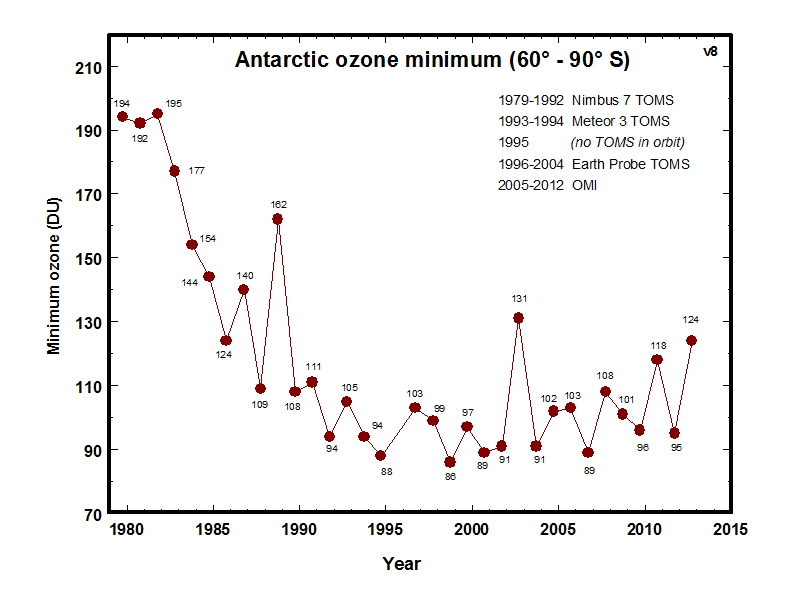
False-color view of total ozone over the Antarctic pole, as of May 27, 2013. The purple and blue colors are where there is the least ozone, and the yellows and reds are where there is more ozone. (Credit: NASA)
Science Daily  May 30, 2013 — Chlorofluorocarbons (CFCs) are to blame for global warming since the 1970s and not carbon dioxide, according to a researcher from the University of Waterloo in a controversial new study published in the International Journal of Modern Physics B this week.

CFCs are already known to deplete ozone, but in-depth statistical analysis now suggests that CFCs are also the key driver in global climate change, rather than carbon dioxide (CO2) emissions, the researcher argues.

"Conventional thinking says that the emission of human-made non-CFC gases such as carbon dioxide has mainly contributed to global warming. But we have observed data going back to the Industrial Revolution that convincingly shows that conventional understanding is wrong," said Qing-Bin Lu, a professor of physics and astronomy, biology and chemistry in Waterloo's Faculty of Science. "In fact, the data shows that CFCs conspiring with cosmic rays caused both the polar ozone hole and global warming."

"Most conventional theories expect that global temperatures will continue to increase as CO2 levels continue to rise, as they have done since 1850. What's striking is that since 2002, global temperatures have actually declined -- matching a decline in CFCs in the atmosphere," Professor Lu said. "My calculations of CFC greenhouse effect show that there was global warming by about 0.6 °C from 1950 to 2002, but the earth has actually cooled since 2002. The cooling trend is set to continue for the next 50-70 years as the amount of CFCs in the atmosphere continues to decline."

The findings are based on in-depth statistical analyses of observed data from 1850 up to the present time, Professor Lu's cosmic-ray-driven electron-reaction (CRE) theory of ozone depletion and his previous research into Antarctic ozone depletion and global surface temperatures.

"It was generally accepted for more than two decades that the Earth's ozone layer was depleted by the sun's ultraviolet light-induced destruction of CFCs in the atmosphere," he said. "But in contrast, CRE theory says cosmic rays -- energy particles originating in space -- play the dominant role in breaking down ozone-depleting molecules and then ozone."

Lu's theory has been confirmed by ongoing observations of cosmic ray, CFC, ozone and stratospheric temperature data over several 11-year solar cycles. "CRE is the only theory that provides us with an excellent reproduction of 11-year cyclic variations of both polar ozone loss and stratospheric cooling," said Professor Lu. "After removing the natural cosmic-ray effect, my new paper shows a pronounced recovery by ~20% of the Antarctic ozone hole, consistent with the decline of CFCs in the polar stratosphere."

By demonstrating the link between CFCs, ozone depletion and temperature changes in the Antarctic, Professor Lu was able to draw almost perfect correlation between rising global surface temperatures and CFCs in the atmosphere.

"The climate in the Antarctic stratosphere has been completely controlled by CFCs and cosmic rays, with no CO2 impact. The change in global surface temperature after the removal of the solar effect has shown zero correlation with CO2 but a nearly perfect linear correlation with CFCs -- a correlation coefficient as high as 0.97."

Data recorded from 1850 to 1970, before any significant CFC emissions, show that CO2 levels increased significantly as a result of the Industrial Revolution, but the global temperature, excluding the solar effect, kept nearly constant. The conventional warming model of CO2, suggests the temperatures should have risen by 0.6°C over the same period, similar to the period of 1970-2002.

The analyses support Lu's CRE theory and point to the success of the Montreal Protocol on Substances that Deplete the Ozone Layer.

"We've known for some time that CFCs have a really damaging effect on our atmosphere and we've taken measures to reduce their emissions," Professor Lu said. "We now know that international efforts such as the Montreal Protocol have also had a profound effect on global warming but they must be placed on firmer scientific ground."

"This study underlines the importance of understanding the basic science underlying ozone depletion and global climate change," said Terry McMahon, dean of the faculty of science. "This research is of particular importance not only to the research community, but to policy makers and the public alike as we look to the future of our climate."

Professor Lu's paper, "Cosmic-Ray-Driven Reaction and Greenhouse Effect of Halogenated Molecules: Culprits for Atmospheric Ozone Depletion and Global Climate Change," also predicts that the global sea level will continue to rise for some years as the hole in the ozone recovers increasing ice melting in the polar regions.

"Only when the effect of the global temperature recovery dominates over that of the polar ozone hole recovery, will both temperature and polar ice melting drop concurrently," says Lu.

The peer-reviewed paper published this week not only provides new fundamental understanding of the ozone hole and global climate change but has superior predictive capabilities, compared with the conventional sunlight-driven ozone-depleting and CO2-warming models, Lu argues.


Preprint of paper H/T WUWThttp://arxiv.org/ftp/arxiv/papers/1210/1210.6844.pdf
See also: http://arxiv.org/ftp/arxiv/papers/1210/1210.1498.pdf

Global warming caused by CFCs, not carbon dioxide, study says

 IMAGE: Chlorofluorocarbons are to blame for global warming since the 1970s and not carbon dioxide, according to new research from the University of Waterloo published in the International Journal of Modern...
Click here for more information.

WATERLOO, Ont. (Thursday, May 30, 2013) - Chlorofluorocarbons (CFCs) are to blame for global warming since the 1970s and not carbon dioxide, according to new research from the University of Waterloo published in the International Journal of Modern Physics B this week.

CFCs are already known to deplete ozone, but in-depth statistical analysis now shows that CFCs are also the key driver in global climate change, rather than carbon dioxide (CO2) emissions.
"Conventional thinking says that the emission of human-made non-CFC gases such as carbon dioxide has mainly contributed to global warming. But we have observed data going back to the Industrial Revolution that convincingly shows that conventional understanding is wrong," said Qing-Bin Lu, a professor of physics and astronomy, biology and chemistry in Waterloo's Faculty of Science. "In fact, the data shows that CFCs conspiring with cosmic rays caused both the polar ozone hole and global warming."

"Most conventional theories expect that global temperatures will continue to increase as CO2 levels continue to rise, as they have done since 1850. What's striking is that since 2002, global temperatures have actually declined – matching a decline in CFCs in the atmosphere," Professor Lu said. "My calculations of CFC greenhouse effect show that there was global warming by about 0.6 °C from 1950 to 2002, but the earth has actually cooled since 2002. The cooling trend is set to continue for the next 50-70 years as the amount of CFCs in the atmosphere continues to decline."

The findings are based on in-depth statistical analyses of observed data from 1850 up to the present time, Professor Lu's cosmic-ray-driven electron-reaction (CRE) theory of ozone depletion and his previous research into Antarctic ozone depletion and global surface temperatures.

 IMAGE: Chlorofluorocarbons are to blame for global warming since the 1970s and not carbon dioxide, according to new research from the University of Waterloo published in the International Journal of Modern...
Click here for more information.

"It was generally accepted for more than two decades that the Earth's ozone layer was depleted by the sun's ultraviolet light-induced destruction of CFCs in the atmosphere," he said. "But in contrast, CRE theory says cosmic rays – energy particles originating in space – play the dominant role in breaking down ozone-depleting molecules and then ozone."

Lu's theory has been confirmed by ongoing observations of cosmic ray, CFC, ozone and stratospheric temperature data over several 11-year solar cycles. "CRE is the only theory that provides us with an excellent reproduction of 11-year cyclic variations of both polar ozone loss and stratospheric cooling," said Professor Lu. "After removing the natural cosmic-ray effect, my new paper shows a pronounced recovery by ~20% of the Antarctic ozone hole, consistent with the decline of CFCs in the polar stratosphere."

By proving the link between CFCs, ozone depletion and temperature changes in the Antarctic, Professor Lu was able to draw almost perfect correlation between rising global surface temperatures and CFCs in the atmosphere.

"The climate in the Antarctic stratosphere has been completely controlled by CFCs and cosmic rays, with no CO2 impact. The change in global surface temperature after the removal of the solar effect has shown zero correlation with CO2 but a nearly perfect linear correlation with CFCs - a correlation coefficient as high as 0.97."

Data recorded from 1850 to 1970, before any significant CFC emissions, show that CO2 levels increased significantly as a result of the Industrial Revolution, but the global temperature, excluding the solar effect, kept nearly constant. The conventional warming model of CO2, suggests the temperatures should have risen by 0.6°C over the same period, similar to the period of 1970-2002.
The analyses indicate the dominance of Lu's CRE theory and the success of the Montreal Protocol on Substances that Deplete the Ozone Layer.

 IMAGE: Chlorofluorocarbons are to blame for global warming since the 1970s and not carbon dioxide, according to new research from the University of Waterloo published in the International Journal of Modern...
Click here for more information.

"We've known for some time that CFCs have a really damaging effect on our atmosphere and we've taken measures to reduce their emissions," Professor Lu said. "We now know that international efforts such as the Montreal Protocol have also had a profound effect on global warming but they must be placed on firmer scientific ground."

"This study underlines the importance of understanding the basic science underlying ozone depletion and global climate change," said Terry McMahon, dean of the faculty of science. "This research is of particular importance not only to the research community, but to policy makers and the public alike as we look to the future of our climate."

Professor Lu's paper, Cosmic-Ray-Driven Reaction and Greenhouse Effect of Halogenated Molecules: Culprits for Atmospheric Ozone Depletion and Global Climate Change, also predicts that the global sea level will continue to rise for some years as the hole in the ozone recovers increasing ice melting in the polar regions.

"Only when the effect of the global temperature recovery dominates over that of the polar ozone hole recovery, will both temperature and polar ice melting drop concurrently," says Lu.
The peer-reviewed paper published this week not only provides new fundamental understanding of the ozone hole and global climate change but has superior predictive capabilities, compared with the conventional sunlight-driven ozone-depleting and CO2-warming models.
###
Journal reference
Cosmic-Ray-Driven Reaction and Greenhouse Effect of Halogenated Molecules: Culprits for Atmospheric Ozone Depletion and
Global Climate Change
Qing-Bin Lu, University of Waterloo
Published on May 30 in International Journal of Modern Physics B Vol. 27 (2013) 1350073 (38 pages).