Monday, May 21, 2012

42% of sea level rise due to groundwater extraction

Climate scientists say they have solved riddle of rising sea

by Staff WritersParis (AFP) May 20, 2012


Massive extraction of groundwater can resolve a puzzle over a rise in sea levels in past decades, scientists in Japan said on Sunday.

Global sea levels rose by an average of 1.8 millimetres (0.07 inches) per year from 1961-2003, according to data from tide gauges.

But the big question is how much of this can be pinned to global warming.

In its landmark 2007 report, the UN's Nobel-winningIntergovernmental Panel onClimate Change (IPCC) ascribed 1.1mm (0.04 inches) per year to thermal expansion of the oceans -- water expands when it is heated -- and to meltwater from glaciers, icecaps and the Greenland and Antarctica icecaps.

That left 0.7mm (0.03 inches) per year unaccounted for, a mystery that left many scientists wondering if the data were correct or if there were some source that had eluded everyone.

In a study published in the journal Nature Geoscience, a team led by Yadu Pokhrel of the University of Tokyo say the answer lies in water that is extracted from underground aquifers, rivers and lakes for human development but is never replenished.

The water eventually makes it to the ocean through rivers and evaporation in the soil, they note.

Groundwater extraction is the main component of additions that account for the mystery gap, according to their paper, which is based on computer modelling.

"Together, unsustainable groundwater use, artificial reservoir water impoundment, climate-driven change in terrestrial water storage and the loss of water from closed basins have contributed a sea-level rise of 0.77mm (0.031 inches) per year between 1961 and 2003, about 42 percent of the observed sea-level rise," it says.

The probe seeks to fill one of the knowledge gaps in the complex science of climate change.
Researchers admit to many unknowns about how the oceans respond to warming, and one of them is sea-level rise, an important question for hundreds of millions of coastal dwellers.

Just a tiny rise, if repeated year on year, can eventually have a dramatic impact in locations that are vulnerable to storm surges or the influx of saltwater into aquifers or coastal fields.

In its 2007 Fourth Assessment Report, the IPCC said the oceans would rise by between 18 and 59 centimetres (seven to 23 inches) by the century's end. [Note: the rate of 1.8mm/yr from 1961-2003 above only results in 6 inches of sea level rise by the end of the century. Sea level rise is decelerating]

But this estimate did not factor in meltwater from the mighty Greenland and Antarctic ice sheets.

A study published last year by the Oslo-based Arctic Monitoring and Assessment Project (AMAP) said sea levels would rise, on current melting trends, by 90 cms to 1.6 metres (3.0 to 5.3 feet) by 2100. [Note: the rate of 1.8mm/yr from 1961-2003 above only results in 6 inches of sea level rise by the end of the century. Sea level rise is decelerating]

Thursday, May 17, 2012

Study finds Southwest fires driven by year-to-year weather cycles rather than climate change


Posted on  by Bob Berwyn

A low-intensity ground fire burns through ponderosa pine during a prescribed fire in Grand Canyon National Park. PHOTO COURTESY NATIONAL PARK SERVICE.
New study offers more evidence that historical fire suppression is the main contributing factor in today’s big southwestern fires
By Summit Voice
SUMMIT COUNTY — A detailed analysis of historic fire-scar records and tree-ring data going back centuries offers more evidence that recent mega-fires in the Southwest are unprecedented and likely a result of widespread fire suppression.
While many of today’s southwestern forests haven’t seen a fire in more than 100 years, historical records show that, in the pre-suppression era, they rarely went as long as 40 or 50 years without a low-intensity ground fire.
To reach their conclusions, researchers at Southern Methodist University used a statistical model that encompassed 1,500 years of climate and fire patterns. They wanted to test if today’s dry, hot climate alone is causing the megafires that routinely destroy millions of acres of forest.
The results were striking. Year-to-year weather patterns that drive fire activity seemed to stay the same against the backdrop of larger climate cycles, according to SMU fire anthropologist Christopher I. Roos.
“The U.S. would not be experiencing massive large-canopy-killing crown fires today if human activities had not begun to suppress the low-severity surface fires that were so common more than a century ago,” said Roos, an assistant professor in the SMU Department of Anthropology.

US Presidential candidates far apart on CO2 regulations


US candidates far apart on carbon, less on green energy New Energy 5/17/12

With six months to go until US elections, it’s clear that prospects for a national carbon price in the US — and Washington’s position at global climate talks — will hinge on whether President Barack Obama earns a second four-year term or is replaced by presumed Republican opponent Mitt Romney. The outcome of the contest is also set to affect a raft of environmental policies, but here, the differences may not be as sharp as portrayed by the campaigns and mainstream media. A second Obama administration could use the Environmental Protection Agency (EPA) to impose additional carbon controls or could even have another run at climate legislation, if more Democrats are elected to Congress. Romney, by contrast, proclaims that alternative energy is expensive, and promises to undo the Obama  EPA’s carbon regulations if elected. But a Romney administration may come around to support some green energy strategies, particularly as a bargaining chip with Congress — after all, he took Massachusetts into a regional carbon
trading scheme while governor of that state.

Even with Obama emboldened by a second, and final, term, he may hold back from comprehensive climate legislation. Analysts note that public support has waned for both cap-and-trade and climate policy more generally over the past three years: “I think we need to wait for the pendulum to swing back, and that’s going to take a while,” says Emilie Mazzacurati, head of carbon analysis at Point Carbon. The EPA would offer Obama a more convenient tool, after the agency ruled in 2009 that greenhouse gases are a health concern that can be regulated under the existing Clean Air Act. The agency initially rolled out technology rules for power plants, refineries and energy-intensive manufacturers, and has now unveiled plans to limit the carbon footprint of new power plants under the act’s “new source performance standards,” effectively shutting out new coal-fired capacity. The latter move suggests the agency “may be moving toward a tradable carbon standard,” says policy analyst Kevin Book of Clearview Energy Partners in Washington. “That’s a big deal.” Although the EPA would prefer legislation, the agency does not rule out setting up a carbon market on its own. The EPA last year tried and failed to get $7.5 million from Congress to explore market mechanisms, and more recently rolled out an online carbon market simulator. The EPA successfully ran a cap-and-trade program for acid rain, but failed with a similar plan for mercury emissions.

Romney, for his part, could find it legally and procedurally difficult to override the EPA’s past conclusions, which would require a strong burden of proof, but could choose to enforce existing carbon controls less strictly through new technical guidance. Certainly, Romney’s campaign statements so far suggest a commitment to dismantle the Obama administration’s carbon controls, and opposition in principle to national carbon legislation.

Romney may be more willing to support renewable energy alongside conventional forms — an “all-of-the-above” approach, rather than a strategy of picking winners and losers. The need to negotiate with Congress on energy, tax and budget legislation would likely force a Romney administration to swallow some items that typically garner  bipartisan support. Such items could include tax credits for renewable electricity generation and cellulosic ethanol  production, both due to expire this year, along with steps to open federal lands and waters to wind and solar development (p7).

Analysis: Electricity from solar costs 4 to 5 times more than from natural gas

According to an analysis published today in New Energy, the cost of generating electricity in the US over the plant lifetime is approximately 4 to 5 times higher for solar sources vs. conventional natural gas. Onshore wind sources are about 1.7 times more expensive and nuclear twice as expensive as a conventional natural gas plant.
 

Wednesday, May 16, 2012

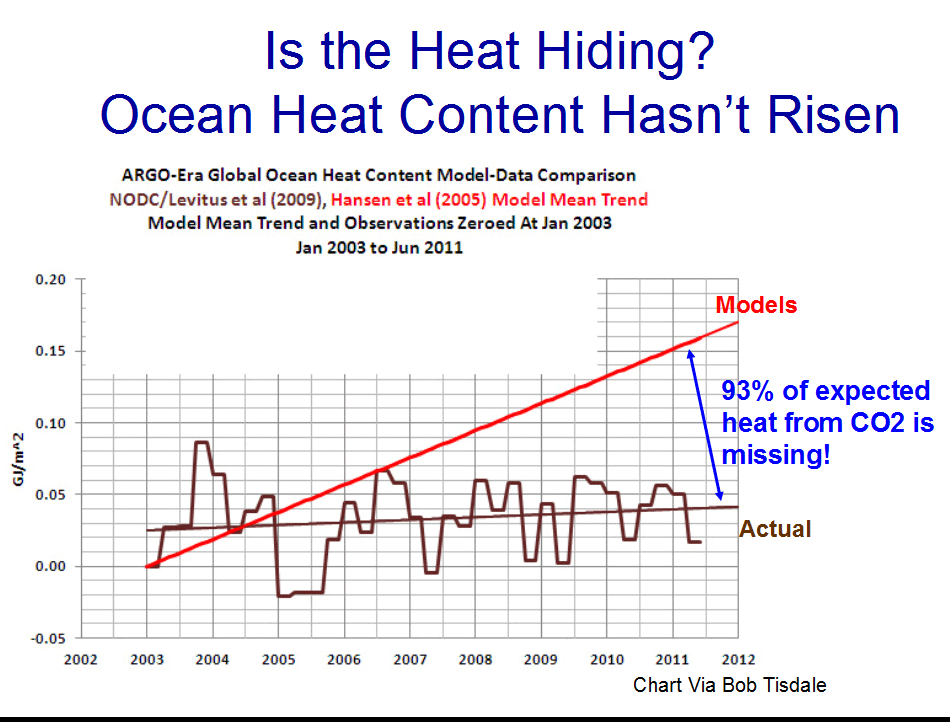
New paper finds world's oceans have warmed only 0.09°C over past 55 years

A paper published today in Geophysical Research Letters finds the oceans have warmed only 0.09°C over the 55 year period from 1955-2010. According to the authors, this resulted in a sea level rise of 0.54 mm per year [only 2.12 inches per century] and corresponds to  0.39 Watts per square meter of the ocean surface. However,  the IPCC claims the increase in CO2 from 1955-2010 'should' have warmed the oceans by 1.12 Watts per square meter [5.35*ln(389.78/312) = 1.12 W/m2]. Thus, even if one assumes all ocean warming is due to increased greenhouse gases, the IPCC has exaggerated climate sensitivity to CO2 by a factor of almost 3 times [1.12/0.39]. [This is why Trenberth can't find his "missing heat"-it never existed in the first place]. In reality, greenhouse gases cannot warm the oceans at all because they radiate infrared which only penetrates the surface of water a few microns to cause evaporative cooling. 


GEOPHYSICAL RESEARCH LETTERS, VOL. 39, L10603, 5 PP., 2012
doi:10.1029/2012GL051106
Key Points
  • A strong positive linear trend in exists in world ocean heat content since 1955
  • One third of the observed warming occurs in the 700-2000 m layer of the ocean
  • The warming can only be explained by the increase in atmospheric GHGs
S. Levitus
National Oceanographic Data Center, NOAA, Silver Spring, Maryland, USA
J. I. Antonov
UCAR Project Scientist, National Oceanographic Data Center, Silver Spring, Maryland, USA
T. P. Boyer
National Oceanographic Data Center, NOAA, Silver Spring, Maryland, USA
O. K. Baranova
National Oceanographic Data Center, NOAA, Silver Spring, Maryland, USA
H. E. Garcia
National Oceanographic Data Center, NOAA, Silver Spring, Maryland, USA
R. A. Locarnini
National Oceanographic Data Center, NOAA, Silver Spring, Maryland, USA
A. V. Mishonov
National Oceanographic Data Center, NOAA, Silver Spring, Maryland, USA
J. R. Reagan
National Oceanographic Data Center, NOAA, Silver Spring, Maryland, USA
D. Seidov
National Oceanographic Data Center, NOAA, Silver Spring, Maryland, USA
E. S. Yarosh
National Oceanographic Data Center, NOAA, Silver Spring, Maryland, USA
M. M. Zweng
National Oceanographic Data Center, NOAA, Silver Spring, Maryland, USA
We provide updated estimates of the change of ocean heat content and the thermosteric component of sea level change of the 0–700 and 0–2000 m layers of the World Ocean for 1955–2010. Our estimates are based on historical data not previously available, additional modern data, and bathythermograph data corrected for instrumental biases. We have also used Argo data corrected by the Argo DAC if available and used uncorrected Argo data if no corrections were available at the time we downloaded the Argo data. The heat content of the World Ocean for the 0–2000 m layer increased by 24.0 ± 1.9 × 10²² J (±2S.E.) corresponding to a rate of 0.39 W m−2 (per unit area of the World Ocean) and a volume mean warming of 0.09°C. This warming corresponds to a rate of 0.27 W m−2 per unit area of earth's surface. The heat content of the World Ocean for the 0–700 m layer increased by 16.7 ± 1.6 × 10²² J corresponding to a rate of 0.27 W m−2 (per unit area of the World Ocean) and a volume mean warming of 0.18°C. The World Ocean accounts for approximately 93% of the warming of the earth system that has occurred since 1955. The 700–2000 m ocean layer accounted for approximately one-third of the warming of the 0–2000 m layer of the World Ocean. The thermosteric component of sea level trend was 0.54 ± .05 mm yr−1 for the 0–2000 m layer and 0.41 ± .04 mm yr−1 for the 0–700 m layer of the World Ocean for 1955–2010.

Joe Bast’s Response to Scholars Feeling Pressure After Attacks on Heartland

Joe Bast’s Response to Scholars Feeling Pressure After Attacks on Heartland:
Several friends of Heartland have expressed trepidation about continuing their long-time associations with us. This is my reply to one of those scholars, which shines a little more light about what’s going on around here since Peter Gleick confessed to creating the “Fakegate” scandal:
Dear John,

Sorry you feel this way.

For 28 years, The Heartland Institute has tried to stay “above the fray,” producing high-quality research and commentary and staying focused on the issues, even as the political dialogue became more and more polarized and corrosive. Almost alone among think tanks, we focus on communicating with people who do not already agree with us. We rely on research and reason, not rhetoric and emotion, and still do.

In February of this year, when a climate scientist named Peter Gleick stole Heartland documents and circulated a fake memo purporting to reveal our “secret strategy” on climate change, the tone of debate took a terrible turn for the worse, and environmental extremists started to use tactics that had never been used before in the public policy arena. Virtually all of the mainstream media reported the event as a major expose of a “climate denier” organization, deliberately overlooking nuances of our position on climate change, and deliberately lying about our funding sources. The stolen documents didn’t expose us, they exonerated us from charges that we are a “front” for the fossil fuel industry.

Regarding tactics, since the “Fakegate” scandal, Greenpeace has contacted the employers of every scientist who works for us, demanding that they be fired for having the temerity to question the official dogma of global warming. Can you imagine a more egregious attack on free speech and open academic debate? Donors to Heartland in the past two years have been the subject of hate mail, letter-writing and telephone campaigns, and online petitions demanding that they stop funding us. All of this happened BEFORE we ran a controversial billboard for a single day a few weeks ago.

Finally, regarding the billboard, after 15 years of being the target of vicious ad hominem attacks, we decided to punch back instead of stand back. Our billboard was factual: The Unabomber was motivated by concern over man-made global warming to do the terrible crimes he committed. He still believes in global warming. We simply put his picture on a billboard, pointed out the “inconvenient truth,” and asked, “do you?”

The mainstream media, which has tolerated and even promoted people who call global warming skeptics “Nazis” and “traitors’ and called for the death penalty for skeptics, now pretends to be “outraged” by this billboard. We took it down immediately and admitted that it was in poor taste and a mistake, but they continue to promote madmen on the other side of the issue including Michael Mann and Bill McKibben, and hypocritically pound on us for our “ethical lapse.” This is fake indignation, being staged by ideological extremists as part of the ongoing attack on us and our donors. It is not sincere, it is not accurate, and it is not ethical.

So John, I’m disappointed that you would side with folks who would use such tactics. if you want to stand up for truth seeking and honesty, for taking an unpopular stand against prevailing wisdom, then you should be speaking up for me and The Heartland Institute, not abandoning us in this moment of need. I hope you will reflect on what is really going on, reconsider your position, and let me know if you’ve changed your mind.

Joe

The worldwide crash of green energy companies

The RENIXX® (Renewable Energy Industrial Index) World is the first global stock index, which comprises the performance of the world´s 30 largest companies of the renewable energy industry
The RENIXX Index of the 30 largest renewable energy companies in the world is trading at an all-time low today and has lost over 90% of its value since 2008. A partial listing of green energy companies that have already filed bankruptcy or are teetering on the brink is below. Many of these companies were financed by taxpayers.

Filed Bankruptcy:

Solyndra
Beacon Power
Ener1
Range Fuels
Solar Trust of America
Spectrawatt
Evergreen Solar
Eastern Energy
Unisolar
Bright Automotive
Olson's Crop Service
Energy Conversion Devices
Sovello
Siag
Solon
Q-Cells
Mountain Plaza 

Teetering on the Brink:

Abound Solar
A123 Systems
Brightsource Energy
Fisker Automotive
First Solar
Nevada Geothermal
SunPower
Nordex
The Bard Group
Amonix
NRG Energy
Alterra Power
Enel Green Power
Sunpower Corp


Only global poverty can save the planet, insists WWF


Analysis Extremist green campaigning group WWF - endorsed by no less a body than the European Space Agency - has stated that economic growth should be abandoned, that citizens of the world's wealthy nations should prepare for poverty and that all the human race's energy should be produced as renewable electricity within 38 years from now.

Most astonishingly of all, the green hardliners demand that the enormous numbers of wind farms, tidal barriers and solar powerplants required under their plans should somehow be built while at the same time severely rationing supplies of concrete, steel, copper and glass.

The WWF presents these demands in its just-issued [1] Living Planet Report for 2012. It's a remarkable document, not least for the fact that it is formally endorsed for the first time by the European Space Agency (ESA) - an organisation which would cease to exist in any meaningful form if the document's recommendations were to be carried out.

The report is also unusual in that it seeks to set policy on economics and energy, but doesn't anywhere give any figures expressed in units of energy (watt-hours, joules etc) or currency (dollars, euros or what have you). Instead the WWF activists prefer to base their argument on various indices invented either by themselves or by other international non- or quasi-governmental organisations.

For instance one key figure used in the report is the Living Planet Index, invented by the WWF, which apparently shows "trends in the overall state of global biodiversity".

It does this by examining the number of individuals (or sometimes pairs) in various local populations of 2,688 selected species - of vertebrates only. Every two years WWF changes what species and populations are included, in large numbers: and anyone would acknowledge that a limited, localised picture of a couple of thousand vertebrate-only species is an utterly minuscule, extremely selective pinpoint on the picture of all the Earth's life.

Nonetheless WWF think that their LPI number offers conclusive proof that "biodiversity has decreased globally".

This is bad, because:
Biodiversity is vital for human health and livelihoods ...
All human activities make use of ecosystem services – but can also put pressure on the biodiversity that supports these systems.
If that's not enough for you, the document is liberally spattered with case studies showing how various animal populations have plunged. For instance there are now many fewer wild tigers than there were in 1970, which is plainly a bad thing for human health and livelihoods.

The report then assumes that global resources in general are limited, which is easily achieved by measuring them in terms of "biocapacity" expressed in hectares of Earth surface, and further stipulating that no resources can come from beyond Earth (which seems an odd idea for a major space agency to endorse, but there). WWF goes on to assign numbers showing how much of these hectare-resources everyone is using, their "ecological footprint".

In these terms, the only people on Earth who are living within their means are those in the poorest nations - their "footprint" exactly matches the "biocapacity" in their countries (doubtless a coincidence) offering a picture of the sort of life all human beings could aspire to in a WWF-run world. Middle-income nations use more "biocapacity" than they actually have, and high-income ones - all the ones where you as a Register reader are most likely to live - use nearly twice as many eco-resources as they produce.
What does this mean?
The Earth’s natural capital – biodiversity, ecosystems and ecosystem services – is limited ...
Human demands on the planet exceed supply.
The WWF eco-nomists also argue that human beings actually don't - or anyway, shouldn't - want to get richer, as people getting rich means economic growth and that (regardless of what all world governments and almost all economists think, especially right now) is a Bad Thing as it leads to consumer demand which leads to resources and energy being used.

"We need to measure success beyond GDP," says WWF, an argument they've made before [2]. In particular the organisation argues that "human development" or the still-flakier metric "inequality adjusted human development" is a far better one than GDP per capita. (One may note that under the normal HDI (Human Development Index) [3] it is better to live in Ireland, Hong Kong, Israel, Korea, Slovenia, Spain, Italy or the Czech Republic than in the UK.)

As the green hardliners note:
In countries with a low level of development, [HDI] development level is independent of per capita [ecological] Footprint.
As development increases beyond a certain level, so does per person Footprint — eventually to the point where small gains in development come at the cost of very large Footprint increases.
Or, paraphrased, provided that development and consumption are both miserably low, you can achieve some development without noticeably increasing consumption. Of course only a cynic would suggest that the very design of the "human development" index - whether adjusted for inequality or not - ensures that there will come a point where only tiny increases in development can be achieved no matter the resources used. This is because the Human Development is on a scale from zero to 1, with 1 being unachievable.

It's not just resources that are limited, in the WWF's view: human potential itself is up against a hard limit beyond which the race cannot ever advance. Even progress thus far, as seen in the wealthy nations, has been achieved only by an unfair and wasteful over-use of precious resources: we rich Westerners are already beyond the practical limits that humans should ever aspire to achieve in terms of health, wealth - and even of education.

That's not economics - that's religion. And not very nice religion either.

All this is followed up with some standard rehashing of the standard carbon-driven apocalypse arguments, so setting the stage for WWF's policy agenda. Some of it is relatively uncontroversial: creation of nature reserves, efforts to control overfishing, efforts to ease deforestation.

But then we get onto the big stuff. First up, there must be an "immediate focus" on "drastically shrinking the ecological footprint of high income populations".

That means you, Reg reader: you are to accept a massively lower standard of living, in order to reduce your "footprint" to match your nation's "biocapacity". Then you'll have to take another cut, because your nation - being rich - has more "biocapacity" than a poor country does (despite their claim that planetary resources are finite, WWF acknowledges that new "biocapacity" can be created in the form of cropland, forests etc), but this should be shared with the poorer lands under "equitable resource governance".
That means less heating when it's cold - no cooling at all, probably, when it's hot. It means sharply limited hot water: so dirtier clothes, dirtier bedding and a dirtier you - which will be nice as you will also have to live in a smaller home and travel almost exclusively on crowded buses or trains along with similar smelly fellow eco-citizens. Food will be scarcer and realistically much less nutritious (milk for kids will be a luxury, let alone meat, fruit, coffee, that sort of stuff. Get ready to eat a lot of turnips, if you're a Brit.)

Windfarms, tide barriers, solar panels to power EVERYTHING. But you can't have any concrete or steel or iron or copper. Or glass. Or shipping either. Get on with it!

All this means more disease, and there will also be less health care (only rich nations can afford proper health care for all or most).

Everything - everything - will be a lot more expensive: materials, tools, books, booze, gadgets, clothes. Holidays will be bus trips to the seaside if you're lucky, not trips overseas by plane or car. So it goes on.
Even this grim poverty-stricken dystopia, though, is not the biggest of the WWF demands. The real biggy is that by the year 2050 all energy is to be supplied in the form of renewables-generated electricity, that is by means of windfarms, solar plants, tidal barriers and so forth. Foralmost all of human history and prehistory [4] we have burned things to generate energy - it is one of the things that makes us human - but now, within a single generation, that is to almost completely stop. After a million years, the fires will go out.

That won't be simple. At the moment, the great bulk of energy used by humanity is not electrical at all - it is generated directly by burning fossil fuels (a little, by burning biofuel such as wood). What electrical energy there is (only a tenth of the total even in countries like the UK) is also mostly fossil-generated right now, and the small proportion of this small proportion which isn't fossil is mainly nuclear, not renewable - presumably to disappear for some reason under the WWF plan.

Then, regardless of the impression one gets from the media, it is not perhaps-dispensable things like aviation or gadgets which use most of our energy. Overwhelmingly, energy is used either in the home, by industries - including for example the health [5] and construction industries - and for ordinary everyday forms of transportation.

And as even WWF acknowledges, billions of people worldwide have no access to any electricity grid at all.

Yet nonetheless - without giving any specifics as to how - WWF considers that just about everyone on Earth can be hooked up to an electrical grid and that these grids can be entirely powered by renewables; and the transport sector can be pretty much entirely electrified; and all of industry, all the mines and smelters and refineries and factories, all of it, can go electric. All this, within 38 years.
There will need to be quite a lot of industry remaining. Even quite limited renewable power goals - for instance (pdf) [6] getting the US onto 20 per cent wind electricity by say 2030 (in other words achieving roughly 2 per cent renewables power for the US) would require every year:
About 6.8 million metric tons of concrete, 1.5 million metric tons of steel, 310,000 metric tons of cast iron, 40,000 metric tons of copper, and 380 metric tons of the rare-earth element neodymium.
Even this equates to 3 per cent of current US domestic consumption of steel, iron and copper - much more in the case of neodymium. To achieve full renewable power you would be talking about doubling or tripling production of concrete, steel and copper. At the moment these materials are produced by burning vast amounts of fossil fuels, so even if you managed to slash use of energy in all other sectors then huge increases in energy demand for materials to build the windmills would cause a massive further demand for more windmills and more materials for them and so on. And all this stuff would have to be hauled all over the place, as renewable plants normally have to be built in inaccessible locations - hauled by electric transport!

But in the WWF cloud-cuckoo-land all this steel and concrete and copper is probably, somehow, unnecessary. The 2012 report says that there must be:
Ambitious energy demand management, especially in sectors with limited renewable options that are likely to be dependent on bioenergy. (Aviation, shipping and high heat industrial applications are likely to be among these.)
"Demand management" is eco-nomics code for "rationing, or making mostly illegal". Rationed aviation is not a big deal except socially (no flying means a return to the days when only the rich and powerful ever got to travel other than for war and migration).

But rationed shipping, in a world which needs to shift gigatonnes of iron and concrete and steel and copper about, is fantasy - the more so as much of the new infrastructure would have to be situated offshore.

And far worse still, "ambitiously" rationing "high heat industrial applications" means that you basically can't have much concrete. Or steel, or copper. Or carbon fibre for your wind-turbine blades. Or glass for your possible solar plants either.

No: the whole plan is plain and simple barking lunacy, based on comedy made-up numbers that signify nothing.

And yet WWF is big stuff. Reports of this type get picked up not just by the mass media but by the Intergovernmental Panel on Climate Change and used in official UN doom warnings (often much to the UN's subsequent embarrassment, as in the cases of the non-melting glaciers [7] and the non-burning rainforests [8]). WWF turns over half a billion dollars a year: not much money in some contexts, but a very big budget in marketing or PR terms. WWF can sign up the ESA, for goodness' sake. ESA astronaut André Kuipers - now in space aboard the ISS - is an official WWF ambassador, and his signature is in the front of Living Planet 2012. He writes:
Looking out of my window and watching Earth from space comes with my job as an astronaut. Nevertheless, I feel I am privileged ... I will live on the International Space Station for five months ...
Seeing Earth from space provides a unique perspective. Our planet is a beautiful and fragile place, protected only by a very thin layer of atmosphere essential for life on our planet. And seemingly large forests turned out to be small and passed by very quickly. It was this perspective, and realization, that lie behind my motivation to become a WWF ambassador.
And yet the hundreds of billions it took to build the ISS, the lesser but still enormous sums that sent Kuipers up to live aboard it - there isn't the slightest prospect that these resources would have been available in a world of the sort that WWF advocates. In a world where governments cared nothing for GDP and economic growth and surpluses, where rich nations or populations able to afford proper space programmes had been outlawed (and poor nations with small space programmes, like India, no longer got aid payments from rich ones) ... in that world, Kuipers would never have got the chance to look down on Earth. With WWF-mandated rationing on aircraft, most of his previous career as an aviation-medicine expert and airforce officer would also not have happened.

But people have a strange blind spot about WWF. They think it's still the cuddly old World Wildlife Fund (CNN does [9], anyway - and so indeed does the ESA [10]). But it's not the WWF any more, nobly trying to save the whale and the dolphin and the tiger. It has transformed into simply WWF - the initials, like those of global arms multinational BAE Systems, no longer stand for anything [11].

Today's WWF is not really about tigers and dolphins any more, though they make excellent figureheads for fundraising. Just to show how much they aren't, in fact, in step with everyone else, the organisation's activists would be very happy if the present desperate efforts to end global recession were to fail; and this just as a prelude to making you (perhaps still more) miserably poor and launching a frankly insane effort to stop the human race using fire in just 38 years - by building windmills without steel or carbon, tide barrages without concrete and solar panels without glass [12].

Think about it, next time one of your kids asks if you can sponsor a dolphin [13], or the next time you hear "WWF says ..." on the news. ®

Tuesday, May 15, 2012

Canadian professor praises Prime Minister for not talking about climate change: 'In the years to come, as the international climate change file gradually fades into obscurity, similar to many other such utopian initiatives, he can look back with satisfaction at a job well done'

How we stopped talking about climate change

Michael Hart - a Carlton University professor ... praised the prime minister. “Harper has successfully ridden the climate change juggernaut to its inevitable end,” Hart wrote. “By not directly confronting an inherited policy that he found distasteful, he has been able to manage it to a conclusion that has alienated fewer and satisfied more Canadians. In the years to come, as the international climate change file gradually fades into obscurity, similar to many other such utopian initiatives, he can look back with satisfaction at a job well done.”

Read more: http://www.ottawacitizen.com/technology/stopped+talking+about+climate+change/6625856/story.html#ixzz1uzJuNiQ2

Bravo: New South Wales Premier calls climate change report 'alarmist'

Climate report alarmist, Stoner says

Most people would consider a report warning about the devastating effects of climate change as alarmist, acting NSW Premier Andrew Stoner says.
The NSW government has dismissed as alarmist a report warning the state faces worsening heatwaves, mental health problems and even deaths due to climate change.
The report from the federal government's Climate Commission found heatwaves are longer and more intense while the number of hot days in western Sydney has risen 60 per cent since the 1970s.
This would make the state more susceptible to bushfires and put coastal areas at risk from rising sea levels, it warns, as well as contributing to physical and mental ill-health.
Acting NSW Premier Andrew Stoner said most people would view the commission's findings as "alarmist".
Mr Stoner also accused Professor Flannery of having been "pretty wide of the mark" previously.
"So unless he has got some new evidence, I think the average person would be a little sceptical," Mr Stoner told reporters.
Climate Commissioner Professor Tim Flannery said the picture was not totally bleak.
"This report isn't all bad news," he told reporters at the launch of the report in Sydney on Monday.
"The world is changing, renewable, clean energy is the future."
Report author and fellow climate commissioner Professor Lesley Hughes said it cited peer-reviews.
"(It) shows a link between extreme hot weather and all sorts of health problems, both mental illness problems - and death," said Prof Hughes.
She said the report's aim wasn't to scare people but to prepare the public for the health risks associated with climate change.
"What we're saying is that we're expecting an increased number of heat waves, and that will increase the number of death and illness," she said.
University of Newcastle Associate Professor of Engineering Stewart Franks said the report failed to take into account cyclical weather patterns.
"The whole thrust of the report is what the climate's going to be doing into the future," he told ABC Radio on Monday.
"Now unfortunately, we know that the climate models that are used to actually do that job actually don't represent key modes of climate which are very important."

Puffington Host says repairing appliances helps reduce climate change

From the Annals of Irresponsible Journalism comes this gem from the Huffington Post claiming that repairing broken appliances will help to reduce "- yup, you guessed it- climate change."
Hot Date Idea: In Amsterdam, a new social activity, the Repair Café, offers to repair things for free, reports Sally McGrane at The New York Times. It's helping to reduce waste, consumption, and -- yup, you guessed it -- climate change.
Note to the Puffington Host: The NYT article says absolutely nothing about climate change

Consensus Not: New paper finds 'no model consensus' on precipitation projections

A paper published today in the Journal of Geophysical Research illustrates the 'travesty' of relying on climate computer model projections, finding 19 different models had 'no model consensus' and a 'large spread' 'with both large positive and negative anomalies' in projections of future Australian tropical climate. Furthermore, the authors conclude that since model projections are all over the map, that indicates there is "large internal or natural variability in tropical Australian precipitation relative to the climate change signal" [of alleged AGW].


JOURNAL OF GEOPHYSICAL RESEARCH, VOL. 117, D10103, 16 PP., 2012
doi:10.1029/2011JD017365
Key Points
  • There is a large spread in model CMIP3 simulations of precipitation change
  • Zonal winds changes indicate intensification of austral summer low level winds
  • Regime-sorting techniques provide insight into uncertainty of precip projections
A. F. Moise
Centre for Australian Weather and Climate Research, Bureau of Meteorology, Melbourne, Victoria, Australia
R. A. Colman
Centre for Australian Weather and Climate Research, Bureau of Meteorology, Melbourne, Victoria, Australia
J. R. Brown
Centre for Australian Weather and Climate Research, Bureau of Meteorology, Melbourne, Victoria, Australia
A systematic study is undertaken for projected changes in tropical Australian climate in 19 CMIP3 Coupled Models for the A2 scenario over the 21st century. While equatorial regions to the north of Australia are projected to have increased precipitation during austral summer (December to February) by the end of the 21st century, there is no significant change over northern Australia based on the model ensemble mean. There is a large spread in model simulations of precipitation change, with both large positive and negative anomalies. The ensemble mean change in the seasonal cycle of precipitation over tropical Australia is small, with precipitation increase during March and April, suggesting a prolonged Australian wet season. There is no model consensus on how interannual variability of tropical Australian precipitation will change in future climate, although more models simulate increased variability than decreased. Correlations between full wet season (October to April) precipitation and austral spring (September to November) NINO3.4 sea surface temperature anomalies show a slight weakening. The spread in projected precipitation seasonal cycle changes between simulations from the same model is larger than the inter-model range, indicating that there is large internal or natural variability in tropical Australian precipitation relative to the climate change signal. Zonal wind changes indicate an intensification of austral summer low level westerlies although combined with a weakening of upper easterlies. Low level westerlies also persist for longer, consistent with a delay in the monsoon retreat. All models simulate an increase in the land-ocean temperature contrast in austral summer, with a significant correlation between changes in land-ocean temperature contrast in the pre-monsoon (austral spring) and summer precipitation changes. Analysis of precipitation changes using regime-sorting techniques shows offsetting tendencies from thermodynamic changes associated with enhanced atmospheric moisture and dynamic changes associated with a weakened atmospheric circulation.