Showing posts sorted by relevance for query missing heat atmosphere. Sort by date Show all posts

Monday, September 1, 2014

The Economist claims heat sinks & bottom of ocean will become hotter than surface

An article published last week in The Economist proclaims, "the mystery of the pause in global warming may have been solved. The answer seems to lie at the bottom of the sea."

No, sadly, the mystery of the "pause" and Trenberth's "missing heat" have not been solved, nor the question whether the "missing heat" ever existed in the first place. The article claims "
People with a grasp of the law of conservation of energy are, however, sceptical in their turn of these positions and doubt that the pause is such good news," which is a false assumption because the only 'evidence' that there is any "missing heat" is the falsified output of climate models, which cannot provide 'data' or evidence.

Further, the article goes on to make astonishingly erroneous statements that violate physics/thermodynamics, including claims that man-made CO2 heat sinks to the bottom of the ocean and once the ocean depths become "hotter than the surface...global warming will resume." Thus, The Economist has become a denier of convection.

Other embarrassing basic physics/thermodynamics errors that fail grade school science include 

1) the assumption that the tail can wag the dog & the atmosphere, with 1/1000 of the heat capacity and thermal inertia of the oceans, can significantly heat the oceans

2) that an atmosphere which has not warmed in 18 years can warm the oceans, and undetected in the upper layers of the ocean


I had a subscription to the Economist for many years, but dropped it because they jumped on the fake-science CAGW bandwagon. 

Related tweets/comments:


In the article
Economist – Oceans and the climate: Davy Jones’ heat locker [http://www.economist.com/news/science-and-technology/21613161-mystery-pause-global-warming-may-have-been-solved-answer-seems?fsrc=scn/tw_ec/davy_jones_s_heat_locker]
the reporter made a factual scientific error. They wrote at the end of the article
“The process of sequestration [of heat] must reverse itself at some point, since otherwise the ocean depths would end up hotter than the surface—an unsustainable outcome. And when it does, global warming will resume.”
The deeper ocean is very cold and involves an enormous amount of mass. There is no way that the ocean depths could become hotter due to the sequestration of heat from added CO2 in the atmosphere!
“No matter how warm the surface of the ocean gets, the ocean’s huge volume and deep basins keep temperatures at the bottom of the ocean at only slightly above freezing.”.
P Gosselin (@NoTricksZone)

9/1/14, 11:27 AM
@newscientist Rubbish...atmos warms 1°...heat absorbed by oceans leads to 0.01° rise in ocean temp...heat exits ocean only if atmos cools


Davy Jones’s heat locker


The mystery of the pause in global warming may have been solved. The answer seems to lie at the bottom of the sea


Aug 23rd 2014 The Economist [with added comments and links by HS]



OVER the past few years one of the biggest questions in climate science has been why, since the turn of the century, average surface-air temperatures on Earth have not risen, even though the concentration in the atmosphere of heat-trapping carbon dioxide has continued to go up. This “pause” in global warming has been seized on by those sceptical that humanity needs to act to curb greenhouse-gas emissions or even (in the case of some extreme sceptics) who think that man-made global warming itself is a fantasy. People with a grasp of the law of conservation of energy are, however, sceptical in their turn of these positions and doubt that the pause is such good news. They would rather understand where the missing heat has gone, and why—and thus whether the pause can be expected to continue.

The most likely explanation is that it is hiding in the oceans, which store nine times as much of the sun’s heat as do the atmosphere and land combined. [Actually, the ocean stores 1000 times as much heat as the atmosphere, and the tail does not wag the dog] But until this week, descriptions of how the sea might do this have largely come from computer models. Now, thanks to a study published in Science by Chen Xianyao of the Ocean University of China, Qingdao, and Ka-Kit Tung of the University of Washington, Seattle, there are data [not according to Josh Willis of JPL who says there are no such "robust" data in the "real ocean" as opposed to the modeled ocean].

Dr Chen and Dr Tung have shown where exactly in the sea the missing heat is lurking. As the left-hand chart below shows, over the past decade and a bit the ocean depths have been warming faster than the surface. This period corresponds perfectly with the pause, and contrasts with the last two decades of the 20th century, when the surface was warming faster than the deep. The authors calculate that, between 1999 and 2012, 69 zettajoules of heat (that is, 69 x 10^21 joules—a huge amount of energy) have been sequestered in the oceans between 300 metres and 1,500 metres down. If it had not been so sequestered, they think, there would have been no pause in warming at the surface [why can't climate scientists ever admit that the other obvious possibility is that there never was any "missing heat" to sequester?]

Hidden depths

The two researchers draw this conclusion from observations collected by 3,000 floats launched by Argo, an international scientific collaboration. These measure the temperature and salinity of the top 2,000 metres of the world’s oceans. In general, their readings match the models’ predictions. But one of the specifics is weird.

Most workers in the field have assumed the Pacific Ocean would be the biggest heat sink, since it is the largest body of water. A study published in Nature in 2013 by Yu Kosaka and Shang-Ping Xie of the Scripps Institution of Oceanography, in San Diego, argued that cooling in the eastern Pacific explained most of the difference between actual temperatures and models of the climate that predict continuous warming. Dr Chen’s and Dr Tung’s research, though, suggests it is the Atlantic (see middle chart) and the Southern Ocean that are doing the sequestering. The Pacific (right-hand chart), and also the Indian Ocean, contribute nothing this way—for surface and deepwater temperatures in both have risen in parallel since 1999.
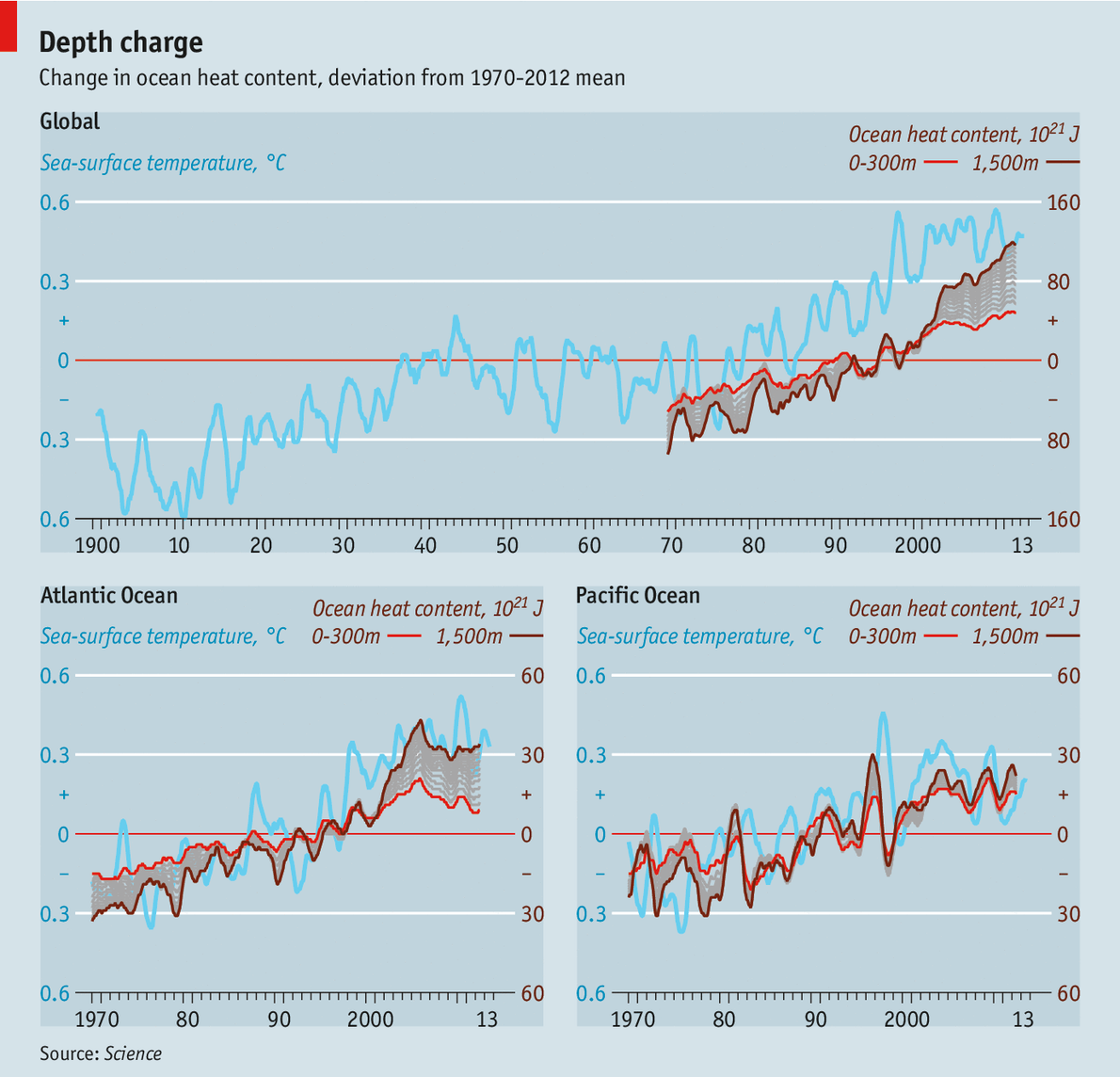


This has an intriguing implication. Because the Pacific has previously been thought of as the world’s main heat sink, fluctuations affecting it are considered among the most important influences upon the climate. During episodes called El Niño, for example, warm water from its west sloshes eastward over the cooler surface layer there, warming the atmosphere. Kevin Trenberth of America’s National Centre for Atmospheric Research has suggested that a strong Niño could produce a jump in surface-air temperatures and herald the end of the pause. Earlier this summer, a strong Niño was indeed forecast, though the chances of this happening seem to have receded recently.

But if Dr Chen and Dr Tung are right, then the fluctuations in the Atlantic may be more important. In this ocean, saltier tropical water tends to move towards the poles (surface water at the tropics is especially saline because of greater evaporation). As it travels it cools and sinks, carrying its heat into the depths—but not before melting polar ice, which makes the surface water less dense, fresh water being lighter than brine. This fresher water has the effect of slowing the poleward movement of tropical water, moderating heat sequestration. It is not clear precisely how this mechanism is changing so as to send heat farther into the depths. But changing it presumably is.

Understanding that variation is the next task. The process of sequestration must reverse itself at some point, since otherwise the ocean depths would end up hotter than the surface—an unsustainable outcome. And when it does, global warming will resume.

Correction: This article originally stated that 69 zettajoules of heat was 69 x 10^11 joules. In fact it is 69 x 10^21 joules. Sorry.

Monday, October 6, 2014

New paper is a huge blow to CAGW: 'Missing heat' NOT found in the deep oceans

A paper published yesterday in Nature Climate Change finds the deep oceans [below 2000 meters] cooled from 2005-2013, debunking the convenient excuse that Trenberth's AGW 'missing heat' has been hiding in the deep oceans. According to the authors, this deep ocean cooling caused a global sea level decrease of -0.13 mm/yr from 2005-2013. 

As the paper notes, this is a reversal from the deep ocean warming from the 1990's to 2005, which led to a sea level rise of +0.11 mm/yr during that period, but has reversed since 2005 to deep ocean cooling and a negative contribution to sea levels. Thus, there is no evidence of the AGW "missing heat" hiding in the deep oceans as many warmists have claimed. 

Even though the heat content of the upper oceans has slightly warmed 0.09C over the past 55 years [Levitus et al 2012], this is also not nearly enough to explain the alleged AGW "missing heat." Therefore, the "missing heat" is missing from both the upper and lower oceans. 

Thirdly, since there has been no statistically-significant warming of the atmosphere [troposphere] over the past 18-26 years during the so-called "pause" or "hiatus", the AGW "missing heat" is missing from the atmosphere as well. 

There is one inescapable conclusion: The "missing heat" is nowhere to be found in Earth's atmosphere or oceans, and has escaped to space, or never existed in the first place [except in computer models]. Indeed, measurements of outgoing longwave radiation to space [infrared from greenhouse gases] have increased over the past 62 years, not decreased as predicted by models from the rise in greenhouse gases.

"It's a travesty!" 


Accompanying editorial in Nature Climate Change [excerpt]


Deep-ocean contribution to sea level and energy budget not detectable over the past decade


Nature Climate Change
 
 
doi:10.1038/nclimate2387
Received
 
Accepted
 
Published online
 

Abstract


As the dominant reservoir of heat uptake in the climate system, the world’s oceans provide a critical measure of global climate change. Here, we infer deep-ocean warming in the context of global sea-level rise and Earth’s energy budget between January 2005 and December 2013. Direct measurements of ocean warming above 2,000 m depth explain about 32% of the observed annual rate of global mean sea-level rise. Over the entire water column, independent estimates of ocean warming yield a contribution of 0.77 ± 0.28 mm yr−1 in sea-level rise and agree with the upper-ocean estimate to within the estimated uncertainties. Accounting for additional possible systematic uncertainties, the deep ocean (below 2,000 m) contributes −0.13 ± 0.72 mm yr−1 to global sea-level rise and −0.08 ± 0.43 W m−2 to Earth’s energy balance. The net warming of the ocean implies an energy imbalance for the Earth of 0.64 ± 0.44 W m−2 from 2005 to 2013.

Deep ocean contribution to sea levels shown in bottom graph has declined -0.13 mm/yr since 2005

Sunday, April 25, 2010

Adiabatic Theory predicts slight cooling from Doubled CO2

Adding to the list (1 2 3 4 5 6 7 8 9 10 11 12 13 14 15 16 17 18 19 20 21 22 23 24 25...and others) of scientists and mathematicians who have disproven conventional greenhouse gas theory, Russian physicists OG Sorokhtin, GV Chilingar, and LF Khilyuk noted in their book Global warming and global cooling. Evolution of climate on earth. Developments in Earth & Environmental Sciences (Elsevier 2007) that conventional greenhouse theory is not based on sound physical derivation, with most calculations and predictions based on intuitive models using numerous poorly defined parameters and unproven positive feedback forcing from CO2. Most conventional interpretations and models, such as those of the IPCC, consider only one component of heat transfer- radiation- to create a flat earth radiation budget of the atmosphere, ocean, and land masses, and do not adequately address the impact of e.g. convection and circulation on a rotating sphere. In contrast, the Sorokhtin et al adiabatic theory considers earth as an open, dissipative system that can be described by non-linear equations of mathematical physics, taking into account the formation of stable thermodynamic structures in each compartment, between compartments, and ruled by strong negative feedbacks (e.g. convection, water cycles, clouds). They devised a model based on well-established relationships among physical fields describing the mass and heat transfer in the atmosphere and subsequently published the paper Cooling of Atmosphere Due to CO2 in Energy Sources, Part A: Recovery, Utilization, and Environmental Effects (2008), excerpted below.
 
This paper and all of the other derivations of atmospheric physics noted in the list above come to essentially the same conclusion: Doubling of CO2 levels will cause insignificant changes in global temperature (<1°C). This prediction is in much better agreement with the five peer-reviewed empirical satellite studies than any of the IPCC models or predictions from conventional greenhouse gas theory.

Saturday, April 28, 2012

Yes, the ocean has warmed; no, it’s not ‘global warming’ And warm water does not sink

From the New Zealand Climate Conversation Group, a noted oceanographer debunks the myth of man-made global warming, explaining why greenhouse gases cannot heat the oceans, and that recent ocean warming is simply the result of natural ocean cycles [oscillations].

Levitus rewarmed

Richard Treadgold | April 28, 2012
lovely iceberg in boundary conditions
Oceanographer Dr Willem de Lange has referred us to a really clear treatment of ocean warming and ocean-atmosphere interaction in an article by a noted oceanographer (now deceased). It appeared in 21st Century Science & Technology magazine in 2000 and carried the “Yes, the ocean has warmed” headline you see above. Though written 12 years ago, it makes a solid rebuttal to the substance of the modern warming scare, emphasizing, as though marine scientists needed to be told, that warm water cannot sink.

The author was Dr. Robert E. Stevenson, an oceanography consultant, who trained NASA astronauts in oceanography and marine meteorology, was Secretary General of the International Association for the Physical Science of the Oceans from 1987 to 1995 and was an oceanographer for the U.S. Office of Naval Research for 20 years.
Having completed the post, I’ve discovered the new Levitus paper. How does Levitus et al. 2012 compare with the old Levitus et al. 2000? The new paper is in press, so we only have the abstracts to compare. In 2000, the heat content of the world ocean increased by ∼2 × 10²³ joules between the mid-1950s and mid-1990s, representing a volume mean warming of 0.06°C. In 2012, the heat content of the world ocean increased by 24.0 × 10²² J for 1955-2010, corresponding to a volume mean warming of 0.09ºC.
With 24.0 × 10²² being 20% greater than 2 × 10²³, and the temperature going from 0.06 to 0.09°C giving an increase of 50%, we have a familiar picture. It’s deja vu, only warmer.
Here’s the article’s original introduction:
Contrary to recent press reports that the oceans hold the still-undetected global atmospheric warming predicted by climate models, ocean warming occurs in 100-year cycles, independent of both radiative and human influences.
Which echoes today’s headlines about ocean heat content trying to explain why climate models don’t predict the climate. For example:
Stevenson’s article in 2000 was prompted by a paper published in Science magazine that year which found warming to a depth of nearly 10,000 feet in the Atlantic, Pacific and Indian Oceans since the late 1940s. In each ocean basin, substantial temperature changes were occurring and much deeper than previously thought.
In an eery forecast of an identical period since his article, Robert Stevenson said that for 15 years, modellers had tried to explain their lack of success in predicting global warming. The climate models had predicted a global temperature increase of 1.5°C by the year 2000, six times more than occurred. Undiscouraged, the modellers argued that the heat generated by their claimed “greenhouse warming effect” was being stored in the deep oceans, and that it would emerge at some time. They had no observational evidence to support that contention until the Levitus article.
Stevenson quotes two people drumming up support for the new paper. Science news writer Richard A. Kerr claimed “The ocean-induced delay in global warming also suggests to some climatologists that future temperature increases will be toward the top end of the models’ range of prediction.”
Then the ever-faithful Dr. James Hansen, of the Goddard Institute for Space Studies, enthused: “Now the ocean-warming data imply that climate sensitivity [to the greenhouse effect] is not at the low end of the spectrum.”
One can imagine those worthy spokesmen thinking, “Ok, so 15 years of no warming is a hard sell, but not impossible; we’ll brazen it through.” Neither of them guessed yet another 15 years lay ahead.

Calculating the heat in the world’s oceans

In their paper, Syd Levitus and colleagues from NOAA’s Ocean Climate Laboratory attempt to quantify the heat content in the top 3000 metres of the world ocean from 1948 to 1998. They calculated an increase of about 2 x 10²³ joules from 1955 to 1995, computing a mean warming of 0.06°C. The increased heat content indicates a warming rate of 0.3 watts/m2 over the Earth’s surface.
They concluded that substantial changes in heat content took place in the 300-metre to 1,000-metre layers of each ocean, and at depths even greater than 1,000 metres in the North Atlantic. From these changes, they determined that in the upper layer (0-300 metres), the mean temperature of the global ocean had increased by 0.31°C during the last half century…
The authors reported: “We compared the range of upper-ocean heat content with the range of the climatological annual cycle of heat content for the Northern Hemisphere” (Levitus and Antonov 1997). They determined that “there is relatively little contribution to the climatological range of heat content from depths below 300 metres.”
Deep water doesn’t contribute to weather? Hardly surprising. However:
The Levitus group looked particularly at the data for the deep waters of the North Atlantic, choosing to address a depth of 1,750 metres. They learned that that ocean had warmed in the period between 1955 and 1974, and again between 1974 and 1988. The warming was not uniform, horizontally or vertically, but they determined that the changes were not small, and could have made appreciable contributions to the Earth’s heat balance on decadal time scales. Maximum heat storage was at depths greater than 300 metres.
This confirms that heat does indeed penetrate downwards, but not far. This is less than 10% of the average ocean depth of 4000 metres — and it’s caused by moving currents; it’s not a result of warm water just sinking, which is impossible.
So, we have the added knowledge that the heat content of the North Atlantic is substantial at depths below 300 metres… Regarding the World Ocean, they reported: “The Pacific and Atlantic have been warming since the 1950s, and the Indian since the 1960s. The delay in the Indian Ocean may be caused by the sparsity of data before 1960.”

Findings

  1. The world ocean has exhibited coherent changes of heat content during the past 50 years, resulting in a net warming.
  2. There is no determination whether the observed warming is caused by natural variability or anthropogenic (man-induced) forcing.
  3. The warming supports the contentions of global-climate modellers that the planetary radiative disequilibrium, for the period of 1979 to 1996, may be the result of “excess heat accumulating in the ocean.”
  4. Sea-surface temperatures have had two distinct warming periods over the past century; from 1920 to 1940, then a cooling period until the second warming began in the 1970s.
  5. In each period of warming, an increase in the ocean’s heat content preceded the observed warming of the sea-surface temperatures. The NOAA scientists concluded that it could be the result of natural variability, or anthropogenic effects, or more likely both.
  6. It was speculated that the extreme warmth of the world ocean during the mid-1990s was caused by (a) the multi-decadal warming of the Atlantic and Indian oceans, and (b) a positive polarity in a possible bidecadal oscillation of the Pacific Ocean heat content.
  7. And a final point, regarding the large change in Atlantic heat storage at depths exceeding 300 metres: The convection in the Labrador Sea, by mixing the ocean through a 2,000-metre-deep water column, may keep sea-surface temperature changes relatively small, despite a large heat flux from ocean to atmosphere. Such convection must be addressed, especially when anthropogenic forcing is being considered.
Stevenson observes:
It sometimes seems as if I’m living in a “time-warp” in which some people, and scientists, are unaware that rational life existed before their birth—or before they got out of the sixth grade. Yet, we marine scientists did not enter the second half of the 20th century without a fair bit of understanding of the thermal ocean.
For example, Prof. Hubert H. Lamb, the premier European climatologist of the 20th century, wrote in 1977 that “there has been a general warming of sea temperatures, by 0.5–1.0°C, from 1880 to 1965, defined from widely scattered points around the oceans of the world.”
Stevenson describes how he took sea water temperature readings during the 1950s,
“learning to deploy Nansen water bottles and reversing thermometers for deep-sea sampling.” He concludes: “Those of us who obtained the data are not going to be snowed by the claims of the great precision of “historical data found stored in some musty archives.”

Basic marine climatology

The basics of these interactions start where oceans and atmosphere meet. The atmosphere cannot warm until the underlying surface warms first. The lower atmosphere is transparent to direct solar radiation, preventing it from being significantly warmed by sunlight alone. The surface atmosphere thus gets its warmth in three ways: from direct contact with the oceans; from infrared radiation off the ocean surface; and from the removal of latent heat from the ocean by evaporation. Consequently, the temperature of the lower atmosphere is largely determined by the temperature of the ocean.
We would do well to remember the simple fact that heat rises, and that the warmer gas or fluid rises above the colder. For all the talk of the radiative effects of greenhouse gases interrupting the escape of long-wave thermal energy from oceans, land and clouds, the re-heating of ocean and land caused by that radiation is minuscule. As we see shortly, long-wave infra-red penetrates only a few microns into the ocean. Coupled with the fact that as soon as water warms up a little at the surface, it evaporates, thus immediately cooling, it’s impossible for this process to cause significant warming of the water.

How the oceans get warm

Warming the ocean is not a simple matter, not like heating a small glass of water. The first thing to remember is that the ocean is not warmed by the overlying air.
Let’s begin with radiant energy from two sources: sunlight and infrared radiation — the latter emitted from the “greenhouse” gases (water vapor, carbon dioxide, methane and various others) in the lower atmosphere. Sunlight penetrates the water surface readily, and directly heats the ocean up to a certain depth. Around 3 percent of the radiation from the Sun reaches a depth of about 100 metres.
The top layer of the ocean to that depth warms up easily under sunlight. Below 100 metres, however, little radiant energy remains. The ocean becomes progressively darker and colder as the depth increases. (It is typical for the ocean temperature in Hawaii to be 26°C (78°F) at the surface, and 15°C (59°F) at a depth of 150 metres.
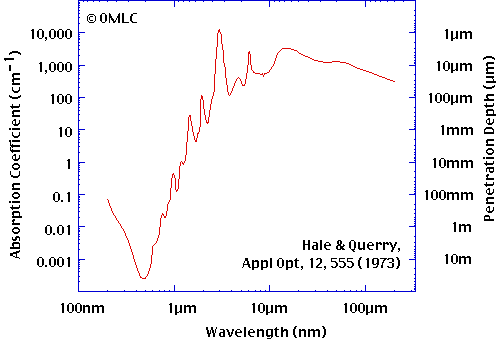
The infrared radiation penetrates but a few millimetres into the ocean [Dr de Lange maintains this distance is actually in the tens of micrometres (microns). Confirmed at Real Climate, strangely -- though the discussion there of why the tiny thermal effect of that OLR (outgoing longwave radiation) on the "skin layer" warms the whole ocean is oddly complex and unconvincing. – RT]. This means that the greenhouse radiation from the atmosphere affects only the top few [microns] of the ocean. Water just a few [millimetres] deep receives none of the direct effect of the infrared thermal energy from the atmosphere. Further, it is in those top few millimetres in which evaporation takes place. So whatever infrared energy may reach the ocean as a result of the greenhouse effect is soon dissipated.
The warmists hope that heat could get into the deep water, since it might hide there for a long time. Stevenson says there have been a number of studies of this process (Nakamura 1997; Tanimoto 1993; Trenberth 1994; Watanabi 1994; and White 1998), and says it is clear that solar-related variations in mixed-layer temperatures penetrate to between 80 and 160 metres, the average depth of the main pycnocline (density discontinuity) in the global ocean. “Below these depths, temperature fluctuations become uncorrelated with solar signals, deeper penetration being restrained by the stratified barrier of the pycnocline.”
Consequently, he says, anomalous heat associated with changing solar irradiance is stored in the upper 100 metres. The heat balance is maintained by heat loss to the atmosphere, not to the deep ocean as the warmists keep hoping.
Sargasso Sea temps last 3000 years

What about Thermohaline Circulation?

The fact that the surface ocean can become denser than the underlying waters, thereby sinking to depths of “density equilibrium,” has been discussed since surveys of the physical ocean began in the second half of the 19th century… Thermohaline circulation is responsible for the formation of the bottom-water masses in all the world’s oceans.
Stevenson explains that modellers who “need” to get warm surface waters into the deep ocean and remain there for long periods hope (or claim) that there can be occasions when salinity, rather than temperature, is the prime determining factor in the density of the surface waters. Then, warm water made dense by a higher salt content would sink.

It does not happen!

The primary physical factor in determining the density of sea water is the temperature (Sverdrup, Johnson, and Fleming, 1943). In the open ocean, top or bottom, salinity differences are measured in a few parts per thousand. Thermohaline circulation takes place where the surface waters become colder than the waters beneath. The large vertical movements occur in polar seas, where accelerated radiation makes the surface waters greatly colder than the deeper waters.
Note that the radiation he mentions is from the frigid atmosphere sucking heat from the water, entirely dwarfing any trivial infra-red radiation from airborne greenhouse gases to the water.
In [polar] waters, surface water temperatures are about -1.9°C, the normal salinity of the water keeping it from freezing into ice. The deep waters, being warmer than such surface waters, rise to the surface, as the upper layers sink slowly into the dark ocean depths. Because only very cold surface water is able to sink, it is simple to understand that the deep ocean can never warm up, regardless of how warm the surface ocean around the world may become. No deep lying “thermal lag” is going to take place. It is clear that there’ll be no Phoenix rising as a haunting spectre.
There we have it. If the surface water warms by any means, it doesn’t sink. If it gets into a current, it may move about in the top 100 metres or so, but no further because of the density boundary at the pycnocline. Claims of thermal energy “hiding” much deeper in the oceans are speculation and no mechanism is known to cause it. Further, when surface water warms it frequently evaporates, taking energy from the surface water and the lower atmosphere, thus cooling them, then rises rapidly by convection, taking its heat far above the ocean, since water vapour is only about 63% of the density of air.
The only way the ocean water warms is by the sun. The only way the lower atmosphere warms is by the water (and a little from the land).

The Big, Deep, Blue Sea

Stevenson says the oceans are the dominant influence on our climate because of their enormous density and heat-storage capacity. The energy that flows in and out of the oceans determines the mean temperature of the global atmosphere. These interactions, plus evaporation, are quite capable of cancelling the slight effect of man-produced CO2.
Robert Stevenson, in 1987, became Secretary General of the International Association for the Physical Science of the Oceans (IAPSO), part of the International Union of Geodesy and Geophysics (IUGG). In 1991, the IUGG met in Vienna to discuss a programme to forward to the International Commission of Scientific Unions (ICSU) for consideration at the 1992 Rio de Janeiro Conference. But Stevenson and his colleagues decided not to prepare any programmes for the Rio conference.
In their joint statement, they said: “To single out one variable, namely radiation through the atmosphere and the associated ‘greenhouse effect,’ as being the primary driving force of atmospheric and oceanic climate, is a simplistic and absurd way to view the complex interaction of forces between the land, ocean, atmosphere and outer space.”
Furthermore, they stated: “climate modelling has been concentrated on the atmosphere with only a primitive representation of the ocean.” Actually, Stevenson says some of the early models depicted the oceans as nearly stagnant. The logical approach would have been to model the oceans first (there were some reasonable ocean models at the time), then add the atmospheric factors.
ICSU and the United Nations Environment Program (UNEP) and the World Meteorological Organization (WMO) simply proceeded to evolve climate models from early weather models. Stevenson gives a fascinating insight into climate science by commenting: “That has imposed an entirely atmospheric perspective on processes which are actually heavily dominated by the ocean.”

This changes nothing — why write the paper?

Mentioning he was at first somewhat put off by the headlines about “missing warming,” after reading the Levitus paper Stevenson is left aghast by its general folly, contradicting as it did so much evident knowledge, saying: “here I sit in the middle of the Pacific Ocean [he lived in Hawaii], surrounded by papers (peer-reviewed, I guess I should add) which conclude:”
  1. For the past two decades at least, and possibly for the past seven decades, the Earth’s true surface air temperature has likely experienced no net change; [while]
  2. there should have been a sizable CO2-induced increase in atmospheric radiative forcing during that time, but there wasn’t. That must mean that a suite of compensatory feedbacks overwhelmed the “greenhouse” impetus for warming; implying, therefore,
  3. that the planet will not warm from any man-produced increases in CO2; indicating
  4. that any increases in temperature will likely fit the global trend of +0.048°C/decade, that is, about 0.5°C this century — the rate of warming that has existed since the Little Ice Age, centered around 1750 in Europe, South America and China; suggesting
  5. that the heat storage in the upper ocean takes place in the upper 100 metres, and the magnitude provides a rise in temperature at those depths of 0.5°C in the past 50 years (in those parts of the ocean for which we have data); [and]
  6. this global warming (and cooling) of the ocean occurs on biennial, ENSO, decadal and interdecadal period scales; thence,
  7. the ocean thermal changes on centennial-period scales, which appear as the warming trend through the past 50 to 100 years, can be explained by means of intrinsic internal modes of the Earth going through their normal cycle of warming and cooling, independent of both radiative and anthropogenic influences.
I guess what I’m really wondering is “Why did Syd Levitus and his associates write their paper in the first place?”
I encourage readers to sample Stevenson’s entire article, for I have omitted much of interest.

Regrettably, Robert Stevenson passed away in August, 2001, aged 80.

Wednesday, August 19, 2015

Why greenhouse gases do not "remove" any alleged "missing heat" from the atmosphere

Excerpts from the comments on WUWT post The Trouble With Global Climate Models in which Quaternary geologist Kristian, TimTheToolMan, and myself explain to "Phil" why greenhouse gases do not "remove" any alleged "missing heat" from the atmosphere:


  • Planck’s Law and the theory of blackbody radiation does in fact prove my statement “A low frequency/energy photon (eg 15um CO2 photons) cannot transfer any quantum energy to a higher frequency/energy/temperature blackbody because all of those lower frequency/energy microstates & orbitals are already completely filled/saturated in the hotter body. This fact alone from quantum mechanics falsifies CAGW.”
    As shown on these calculated Planck curves, CO2 (+H2O overlap) absorbs and emits in the LWIR the same as a true blackbody would at an emitting temperature of ~217K over the LWIR band from ~12 or 13um to ~17um
    Even though CO2 has emissivity less than a true black body and line emissions centered around 15um, and observations also show CO2 emissivity decreases with temperature unlike a true BB, for purposes of this simple question, we’ll assume (like climate scientists incorrectly do) that CO2 emits and absorbs as a true BB.
    gammacrux: Can a BB at 217K cause a BB at 255K to warm by 33K to 288K as the Arrhenius theory claims?
    The lower energy/temperature/frequency microstates of a BB at a given temperature are by definition “saturated” in a perfect blackbody absorber/emitter and that explains why classical physics shown by the dashed lines in fig 4.8 does not happen in nature and instead a Planck curve of emission and absorption is found in nature. If those lower energy/temperature/frequency microstates of a BB were not saturated, then any energy level photons could be thermalized by a blackbody and the frequency vs BB energy intensity curve would go to infinity as shown by the (false) dashed lines in fig 4.8:
  • Phil: Yes or No: Can a blackbody at 193K warm a warmer blackbody at 255K by 33K to 288K?
    Phil says: “Since the ‘blackbody at 193K’ is a figment of your imagination there’s no reason to answer it, I would point out that in your pure nitrogen atmosphere the blackbody at 193K would be replacing a background at 4K, that would make quite a difference.”
    NO not even wrong.
    Phil claims the blackbody at 193K is a figment of the OLR spectra that both he and I have posted!
    Phil look very closely: do you see the blackbody Planck curves calculated for blackbodies with emitting temperatures of 220K-320K?
    Do you see that the CO2+H2O overlap corresponding Planck curve is ~217K (it is higher than 193K for pure CO2 due to presence of water vapor overlap) in the LWIR spectra of any relevance to the AGW debate 12-17um?
    THAT is the 217K “partial blackbody” I’m asking about. YOU are effectively claiming that radiation from a “partial blackbody” at a peak emitting temperature of ~217K in the 12-17um band can make a true black body e.g. the Earth warm from the 255K equilb temp with Sun by 33K to 288K!
    Secondly, I’ve already shown you (and so does Feynman’s chapter 40, vol 1, and the US Std Atmosphere, Maxwell, etc) that a pure N2 or pure N2/O2 Boltzmann distribution atmosphere would have almost the same temperature gradient as our current atmosphere:
    The “ERL” on a planet with pure N2 atmosphere is located at the surface h=0 and is exactly equivalent to the equilibrium temperature with the Sun for that planet, NOT “a blackbody at 193K” as you falsely claim above!

Wednesday, August 18, 2010

Why Greenhouse Gases Won't Heat the Oceans

        Climate scientist Roger Pielke, Sr has noted that land surface temperature records (which comprise the vast majority of temperature records prior to the satellite era (1979-)) are unreliable due to land use changes and urban heat island effects, and that we should therefore look to ocean heat content changes as the most reliable metric for assessing global heating and cooling. The oceans cover 71% of the global surface area and hold at least 1000 times more heat than the atmosphere. Many have claimed that the 'missing heat' from 'anthropogenic global warming' has gone into the oceans, even though the heat seems to be 'missing' from the oceans as well. Recent data from the ARGO network of ~3200 floating robot sensors has shown that since full deployment of the system in ~2003, the ocean heat content has declined despite steadily rising 'greenhouse' CO2 levels:
From Loehle 2009: Cooling of the global ocean since 2003
How could this be? Here are the physical reasons why increasing concentrations of 'greenhouse gases' would not be expected to increase ocean heat content:

1. Infrared radiation from 'greenhouse gases' causes evaporative cooling of the oceans rather than heating
LWIR wavelength is ~8-14 microns
        CO2 and other 'greenhouse gases' re-emit radiation to the Earth and space in the long-wave infrared (LWIR) portion of the electromagnetic spectrum. While ultraviolet and visible radiation from the Sun does penetrate the surface of the oceans to cause heating, the energy output of the Sun is relatively stable and obviously not linked to man. However, since the LWIR re-radiation from increasing 'greenhouse gases' is only capable of penetrating a minuscule few microns (millionths of a meter) past the surface and no further, it could therefore only cause evaporation (and thus cooling) of the surface 'skin' of the oceans. Stephen Wilde, LLB (Hons.), Fellow of the Royal Meteorological Society explains this in detail, excerpted below:
"However the effect of downwelling infrared is always to use up all the infrared in increasing the temperature of the ocean surface molecules whilst leaving nothing in reserve to provide the extra energy required (the latent heat of evaporation) when the change of state occurs from water to vapour. That extra energy requirement is taken from the medium (water or air) in which it is most readily available. If the water is warmer then most will come from the water. If the air is warmer then most will come from the air. However over the Earth as a whole the water is nearly always warmer than the air (due to solar input) so inevitably the average global energy flow is from oceans to air via that latent heat of evaporation in the air and the energy needed is taken from the water. This leads to a thin (1mm deep) layer of cooler water over the oceans worldwide and below the evaporative region that is some 0.3C cooler than the ocean bulk below."
The recent paper by Roy Clark, PhD also discusses the physics and concludes, "Application of Beer’s law to the propagation of solar and LWIR [long-wave infrared] flux through the ocean clearly shows that only the solar radiation can penetrate below the ocean surface and heat subsurface ocean layers. It is impossible for a 1.7 W.m−2 increase [predicted by the IPCC due to man-made greenhouse gases] in downward ‘clear sky’ atmospheric LWIR flux to heat the oceans." (p. 196). Increasing levels of IR-active 'greenhouse gases' would instead be expected to cause increased evaporative surface cooling of the oceans. N.B. there is also a negative feedback phenomenon on CO2 levels discussed in a paper published in Nature which shows that the evaporative cooling of the ocean 'skin' from increased downwelling IR allows increased uptake of CO2 due to increased solubility of CO2 at lower temperatures.

2. Even if 'greenhouse gases' were capable of heating the oceans, the ocean heat capacity is so immense that there would be no significant change in ocean temperature
        The huge mass and heat capacity of the oceans regulates and stabilizes global temperatures to a far greater degree than any possible influence from mankind.
        The immense heat capacity of the oceans can be illustrated by assuming the oceans could be heated one-way by all solar energy absorbed by the Earth, and assuming no cooling due to convection, evaporation, or radiation. The oceans hold 1.3 billion cubic km of water. Assuming the density is 1 kg per liter, the mass of the oceans is 1.3 billion billion kg or 1.3 yotta grams. The total solar power absorbed by the Earth in one year is 89 peta Watts (PW):
        For a thought experiment, assume all 89 PW are taken up by the oceans and that the oceans don't release any of that heat. That would add 0.67 yotta calories to the 1.3 yotta grams, resulting in an increase in the ocean temperature of only 0.5C after an entire year.
        Now, let's also assume that the IPCC is correct that 'greenhouse gases' are causing 1.7 W/m2 'radiative forcing,' and that it is possible for this IR 'back-radiation' to penetrate and heat the ocean (even though we've already shown that is impossible above). The 1.7 W/m2 works out to 850 Tera watts (TW) [or .85 PW] when multiplied by the total Earth surface area of 500 tera square meters. Thus, the IPCC claims that 'greenhouse gases' are preventing .85 PW of energy from leaving the atmosphere to space. This .85 PW is less than the 89 PW from the Sun by a factor of 105 times. Plugging this into our thought experiment above shows that the change in ocean temperature from 'greenhouse forcing' would be 0.5C/105 or .005C in one year or only 0.5C after 105 years, assuming the oceans release none of this added heat!  In reality, of course, the oceans would release all or most of this added heat by convection, evaporation, or radiation, leaving at most only a few hundredths of a degree temperature change after 105 years. Thus, it is impossible for 'greenhouse forcing' to raise ocean heat content to any measurable degree, or cause melting of the icecaps from below, or increase sea levels from thermal expansion.

3. The Second Law of Thermodynamics requires heat to flow one-way from hot to cold.
        Since the atmosphere is colder (average radiating temperature of ~ -10 C) than the ocean surface (~ 17 C), the 2nd Law of Thermodynamics states that heat can only be transferred one-way from the ocean surface to the atmosphere, not the other way around.


Related: 
1. The latest Chilingar et al paper also discusses heat capacity of the atmosphere, which should decrease due to added CO2: "saturation of the atmosphere with carbon dioxide, with all other conditions being equal, results not in an increase but in a decrease of the greenhouse effect and average temperature within the entire layer of planet’s troposphere. This happens despite intense absorption of the heat of radiation by CO2. The physical explanation of this phenomenon is clear: molecular weight of carbon dioxide is 1.5 times higher and its heat-absorbing capacity is 1.2 times lower than those of the Earth’s air. As a result, the adiabatic exponent for a carbon dioxide atmosphere, at the same all other conditions, is about 1.34 times lower than that for a nitrogen–oxygen humid air"
2. Another empirical analysis which finds increased CO2 leads to increased cooling  
3. Sea surface temperatures have been on a long-term decline since the Medieval Warming Period (~1000 years ago),  Roman Warming Period (~2100 years ago), and Egyptian Warming Period (~3100 years ago):
4. NOAA says the oceans are the drivers of global temperature, not the land surface.
5. Dr. Pielke asks whether James Hansen's GISS model should be rejected as unskillful.