The fact is modern sea life cope perfectly well with pH levels that vary by .4 pH units over a period of less than one year, as shown in this graph from the Monterey Bay Aquarium of incoming seawater:
Showing posts sorted by relevance for query monterey ph. Sort by date Show all posts
Wednesday, June 22, 2011
Study shows modern oceans are more alkaline than past 250 million years
While eco-alarmists would have you believe the oceans have "acidified" to dangerous pH levels, a paper published in Nature finds that the modern ocean pH of about 8.1-8.2 is actually the most alkaline the oceans have been over the past 250 million years. During this time corals, phytoplankton, and indeed most of the ocean biomass have evolved. The paper shows a mean pH of about 7.7 over the past 250 million years, whereas the alarmist and frequently incorrect IPCC predicts ocean pH will drop to 7.88 (~0.2 pH units) under a "business as usual" scenario by 2100.
Thursday, May 9, 2013
New paper finds prior claims about effects of ocean "acidification" may be overblown
A paper published today in Global Change Biology finds that prior papers about the alleged effect of ocean "acidification" on marine organisms are overblown because prior research has failed to consider that organisms can adapt over time to pH changes. According to the authors, "nearly all of this work [on the alleged effects of "acidification"] has focused on the effects of future conditions on modern populations, neglecting the role of adaptation."
Natural variation, and the capacity to adapt to ocean acidification in the keystone sea urchin Strongylocentrotus purpuratus
Morgan W. Kelly et al
Abstract: A rapidly growing body of literature documents the potential negative effects of CO2-driven ocean acidification (OA) on marine organisms. However, nearly all of this work has focused on the effects of future conditions on modern populations, neglecting the role of adaptation. Rapid evolution can alter demographic responses to environmental change, ultimately affecting the likelihood of population persistence, but the capacity for adaptation will differ among populations and species. Here, we measure the capacity of the ecologically important purple sea urchin Strongylocentrotus purpuratus to adapt to OA, using a breeding experiment to estimate additive genetic variance for larval size (an important component of fitness) under future high pCO2/low pH conditions. Although larvae reared under future conditions were smaller than those reared under present-day conditions, we show that there is also abundant genetic variation for body size under elevated pCO2, indicating that this trait can evolve. The observed heritability of size was 0.40±0.32 (95% CI) under low pCO2, and 0.50±0.30 under high pCO2 conditions. Accounting for the observed genetic variation in models of future larval size and demographic rates substantially alters projections of performance for this species in the future ocean. Importantly, our model shows that after incorporating the effects of adaptation, the OA-driven decrease in population growth rate is up to 50% smaller, than that predicted by the “no-adaptation” scenario. Adults used in the experiment were collected from two sites on the coast of the Northeast Pacific that are characterized by different pH regimes, as measured by autonomous sensors. Comparing results between sites, we also found subtle differences in larval size under high pCO2 rearing conditions, consistent with local adaptation to carbonate chemistry in the field. These results suggest that spatially varying selection may help to maintain genetic variation necessary for adaptation to future ocean acidification.
Key points from prior posts on ocean "acidification":
http://nipccreport.org/articles/2013/may/8may2013a1.html
Global Warming Science
Ocean Acidification: How bad can it get?
Acid Test
SeaFriends
Ocean Acidification: Another Failing Scare Story
Acid in the oceans fraud
Ocean acidification: a non-problem
Dying Shellfish Larvae: Story of a Scam
Corals & the Great Barrier Reef
Monterey Bay pH 1995-2004
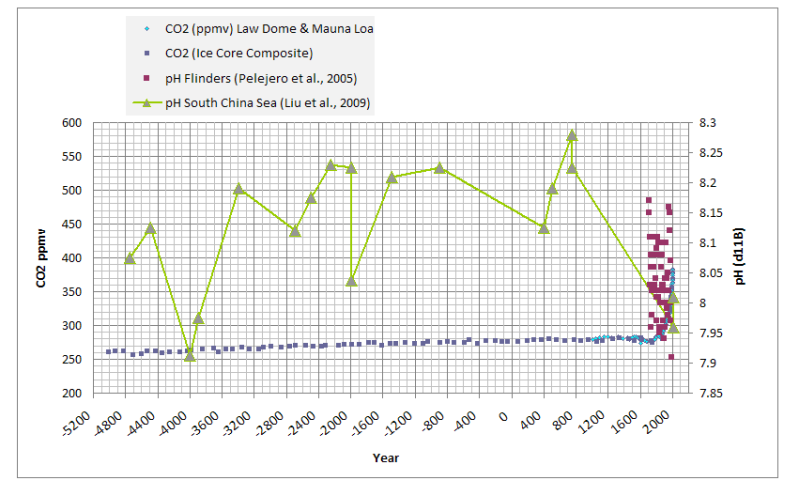
South China Sea pH
Ocean Acidification: the evil twin of global warming?
'Ocean Acidification' is the new climate scare
Testimony of Dr. John Everett
Speculations beyond the pale of reality
CO2 & pH
- Doubling of atmospheric levels would only increase dissolved CO2 in the oceans by .48%
- There is no reliable evidence that ocean pH is falling
- Increased CO2 dissolution in the oceans increases calcification of shellfish and coral
- Corals evolved at a time when CO2 levels were 15 times higher than the present
- Laboratory experiments on sealife in which hydrochloric acid is added to the water (not CO2) and without the natural buffers present in the ocean is meaningless to determine effects of increased CO2 levels on sealife.
http://nipccreport.org/articles/2013/may/8may2013a1.html
Global Warming Science
Ocean Acidification: How bad can it get?
Acid Test
SeaFriends
Ocean Acidification: Another Failing Scare Story
Acid in the oceans fraud
Ocean acidification: a non-problem
Dying Shellfish Larvae: Story of a Scam
Corals & the Great Barrier Reef
Monterey Bay pH 1995-2004
South China Sea pH
Ocean Acidification: the evil twin of global warming?
'Ocean Acidification' is the new climate scare
Testimony of Dr. John Everett
Speculations beyond the pale of reality
CO2 & pH
| Effects of Ocean Acidification on Marine Ecosystems |
Tuesday, September 9, 2014
Debunking the latest UN climate propaganda
A report released today from the UN World Meteorological Organization makes multiple false propaganda statements about radiative forcing from greenhouse gases, ocean 'acidification', extreme weather, CO2 lifetime in the atmosphere, that climate science is the "laws of physics which are non-negotiable", that CO2 levels are "surging," and others, debunked below:
1. Claim: "The Greenhouse Gas Bulletin showed that between 1990 and 2013 there was a 34% increase in radiative forcing -- the warming effect on our climate -- because of long-lived greenhouse gases such as carbon dioxide (CO2), methane and nitrous oxide."
According to the [falsified] IPCC formula, the increased radiative forcing from increased CO2 from 1990-2013 is
5.35*ln(396.48/354.35) = 0.6 W/m2
whereas, Trenberth's energy budget claims the total radiative forcing "backradiation" is 342 W/m2, thus the percentage increase in radiative forcing 1990-2013 from CO2 was
0.6/342 = 0.17%, not 34% as claimed by the UN above in an apparent attempt to make it sound scary.
2. Claim: "The current rate of ocean acidification appears unprecedented at least over the last 300 million years"
There is no good long-term observational data showing a trend of decreased pH at any location on earth, much less the entire ocean. The best continuous long-term record of observed pH is from the Monterey Bay Aquarium from 1996-present, which shows no trend:

The claim of "unprecedented" pH is from dicey proxy studies that are not accurate enough to detect a tiny 0.1 pH change allegedly since the start of the industrial revolution. Even direct measurements with the best pH meters available today are generally uncertain to ± 0.2 pH units. All claims about anthropogenic 'acidification' are from models, not observations, which are debunked here by Professor of geochemistry Dr. Tom Segalstad.
7. They did get one thing right however, admitting "It is high time the ocean, as the primary driver of the planet's climate and attenuator of climate change, becomes a central part of climate change discussions"
That's right, the Sun heats the ocean, the Sun and possibly lunar tidal forcing drive ocean oscillations, ocean oscillations then drive global surface temperatures, not greenhouse gases. Longwave IR from greenhouse gases cannot penetrate or heat the oceans, and warming of the atmosphere cannot heat the oceans because heat rises and the oceans have 1000 times greater heat capacity than the atmosphere. Game over.
Carbon dioxide concentration surges: Record greenhouse gas levels impact atmosphere and oceans, WMO report finds
Date: September 9, 2014
Source: World Meteorological Organization
Summary: The amount of greenhouse gases in the atmosphere reached a new record high in 2013, propelled by a surge in levels of carbon dioxide. This is according to the World Meteorological Organization's annual Greenhouse Gas Bulletin, which injected even greater urgency into the need for concerted international action against accelerating and potentially devastating climate change.
The amount of greenhouse gases in the atmosphere reached a new record high in 2013, propelled by a surge in levels of carbon dioxide. This is according to the World Meteorological Organization's annual Greenhouse Gas Bulletin, which injected even greater urgency into the need for concerted international action against accelerating and potentially devastating climate change.
The Greenhouse Gas Bulletin showed that between 1990 and 2013 there was a 34% increase in radiative forcing -- the warming effect on our climate -- because of long-lived greenhouse gases such as carbon dioxide (CO2), methane and nitrous oxide.
In 2013, concentration of CO2 in the atmosphere was 142% of the pre-industrial era (1750), and of methane and nitrous oxide 253% and 121% respectively.
The observations from WMO's Global Atmosphere Watch (GAW) network showed that CO2 levels increased more between 2012 and 2013 than during any other year since 1984. Preliminary data indicated that this was possibly related to reduced CO2 uptake by Earth's biosphere in addition to the steadily increasing CO2 emissions.
The WMO Greenhouse Gas Bulletin reports on atmospheric concentrations -- and not emissions -- of greenhouse gases. Emissions represent what goes into the atmosphere. Concentrations represent what remains in the atmosphere after the complex system of interactions between the atmosphere, biosphere and the oceans. About a quarter of the total emissions are taken up by the oceans and another quarter by the biosphere, reducing in this way the amount of CO2 in the atmosphere.
The ocean cushions the increase in CO2 that would otherwise occur in the atmosphere, but with far-reaching impacts. The current rate of ocean acidification appears unprecedented at least over the last 300 million years, according to an analysis in the report.
"We know without any doubt that our climate is changing and our weather is becoming more extreme due to human activities such as the burning of fossil fuels," said WMO Secretary-General Michel Jarraud.
"The Greenhouse Gas Bulletin shows that, far from falling, the concentration of carbon dioxide in the atmosphere actually increased last year at the fastest rate for nearly 30 years. We must reverse this trend by cutting emissions of CO2 and other greenhouse gases across the board," he said. "We are running out of time."
"Carbon dioxide remains in the atmosphere for many hundreds of years and in the ocean for even longer. Past, present and future CO2 emissions will have a cumulative impact on both global warming and ocean acidification. The laws of physics are non-negotiable," said Mr Jarraud.
"The Greenhouse Gas Bulletin provides a scientific base for decision-making. We have the knowledge and we have the tools for action to try keep temperature increases within 2°C to give our planet a chance and to give our children and grandchildren a future. Pleading ignorance can no longer be an excuse for not acting," said Mr Jarraud.
"The inclusion of a section on ocean acidification in this issue of WMO's Greenhouse Gas Bulletin is appropriate and needed. It is high time the ocean, as the primary driver of the planet's climate and attenuator of climate change, becomes a central part of climate change discussions," said Wendy Watson-Wright, Executive Secretary of the Intergovernmental Oceanographic Commission of UNESCO.
"If global warming is not a strong enough reason to cut CO2 emissions, ocean acidification should be, since its effects are already being felt and will increase for many decades to come. I echo WMO Secretary General Jarraud's concern -- we ARE running out of time," she said.
Atmospheric Concentrations
Carbon dioxide accounted for 80% of the 34% increase in radiative forcing by long-lived greenhouse gases from 1990 to 2013, according to the U.S. National Oceanic and Atmospheric Administration (NOAA) Annual Greenhouse Gas Index.
On the global scale, the amount of CO2 in the atmosphere reached 396.0 parts per million in 2013. The atmospheric increase of CO2 from 2012 to 2013 was 2.9 parts per million, which is the largest annual increase for the period 1984-2013. Concentrations of CO2 are subject to seasonal and regional fluctuations. At the current rate of increase, the global annual average CO2 concentration is set to cross the symbolic 400 parts per million threshold in 2015 or 2016.
Methane is the second most important long-lived greenhouse gas. Approximately 40% of methane is emitted into the atmosphere by natural sources (e.g., wetlands and termites), and about 60 % comes from human activities like cattle breeding, rice agriculture, fossil fuel exploitation, landfills and biomass burning. Atmospheric methane reached a new high of about 1824 parts per billion (ppb) in 2013, due to increased emissions from anthropogenic sources. Since 2007, atmospheric methane has been increasing again after a temporary period of leveling-off.
Nitrous oxide (N2O)
Nitrous oxide is emitted into the atmosphere from both natural (about 60%) and anthropogenic sources (approximately 40%), including oceans, soil, biomass burning, fertilizer use, and various industrial processes. Its atmospheric concentration in 2013 was about 325.9 parts per billion. Its impact on climate, over a 100-year period, is 298 times greater than equal emissions of carbon dioxide. It also plays an important role in the destruction of the stratospheric ozone layer which protects us from the harmful ultraviolet rays of the sun.
Ocean Acidification
For the first time, this Bulletin contains a section on ocean acidification prepared in collaboration with the International Ocean Carbon Coordination Project (IOCCP) of the Intergovernmental Oceanographic Commission of UNESCO (IOC-UNESCO), the Scientific Committee on Oceanic Research (SCOR), and the Ocean Acidification International Coordination Centre (OA-ICC) of the International Atomic Energy Agency (IAEA).
The ocean currently absorbs one-fourth of anthropogenic CO2 emissions, reducing the increase in atmospheric CO2 that would otherwise occur because of fossil fuel combustion. Enhanced ocean CO2 uptake alters the marine carbonate system and lead to increasing acidity. The ocean's acidity increase is already measurable as oceans take up about 4 kilogrammes of CO2 per day per person.
The current rate of ocean acidification appears unprecedented at least over the last 300 million years, based on proxy-data from paleo archives. In the future, acidification will continue to accelerate at least until mid-century, based on projections from Earth system models.
The potential consequences of ocean acidification on marine organisms are complex. A major concern is the response of calcifying organisms, such as corals, algae, mollusks and some plankton, because their ability to build shell or skeletal material (via calcification) depends on the abundance of carbonate ion. For many organisms, calcification declines with increased acidification. Other impacts of acidification include reduced survival, development, and growth rates as well as changes in physiological functions and reduced biodiversity.
The WMO Global Atmosphere Watch Programme (www.wmo.int/gaw) coordinates systematic observations and analysis of greenhouse gases and other trace species. Fifty countries contributed data for the Greenhouse Gas Bulletin. Measurement data are reported by participating countries and archived and distributed by the World Data Centre for Greenhouse Gases (WDCGG) at the Japan Meteorological Agency. (http://ds.data.jma.go.jp/gmd/wdcgg)
The summary on ocean acidification was jointly produced by the International Ocean Carbon Coordination Project (IOCCP) of the Intergovernmental Oceanographic Commission of UNESCO (IOC-UNESCO), the Scientific Committee on Oceanic Research (SCOR), and the Ocean Acidification International Coordination Centre (OA-ICC) of the International Atomic Energy Agency (IAEA).
Story Source:
The above story is based on materials provided by World Meteorological Organization. Note: Materials may be edited for content and length.
World Meteorological Organization. "Carbon dioxide concentration surges: Record greenhouse gas levels impact atmosphere and oceans, WMO report finds." ScienceDaily. ScienceDaily, 9 September 2014..
1. Claim: "The Greenhouse Gas Bulletin showed that between 1990 and 2013 there was a 34% increase in radiative forcing -- the warming effect on our climate -- because of long-lived greenhouse gases such as carbon dioxide (CO2), methane and nitrous oxide."
According to the [falsified] IPCC formula, the increased radiative forcing from increased CO2 from 1990-2013 is
5.35*ln(396.48/354.35) = 0.6 W/m2
whereas, Trenberth's energy budget claims the total radiative forcing "backradiation" is 342 W/m2, thus the percentage increase in radiative forcing 1990-2013 from CO2 was
0.6/342 = 0.17%, not 34% as claimed by the UN above in an apparent attempt to make it sound scary.
2. Claim: "The current rate of ocean acidification appears unprecedented at least over the last 300 million years"
There is no good long-term observational data showing a trend of decreased pH at any location on earth, much less the entire ocean. The best continuous long-term record of observed pH is from the Monterey Bay Aquarium from 1996-present, which shows no trend:

The claim of "unprecedented" pH is from dicey proxy studies that are not accurate enough to detect a tiny 0.1 pH change allegedly since the start of the industrial revolution. Even direct measurements with the best pH meters available today are generally uncertain to ± 0.2 pH units. All claims about anthropogenic 'acidification' are from models, not observations, which are debunked here by Professor of geochemistry Dr. Tom Segalstad.
3. Claim: "We know without any doubt that our climate is changing and our weather is becoming more extreme due to human activities such as the burning of fossil fuels"
4. Claim: "Carbon dioxide remains in the atmosphere for many hundreds of years and in the ocean for even longer"
5. We should believe falsified climate model GIGO because "The laws of physics are non-negotiable"
6. Claim: CO2 levels are "surging" or accelerating
Further, even if CO2 levels were surging, the globe doesn't seem to care as there has been no statistically significant warming for 18-26 years, indicating climate sensitivity to CO2 is much lower than previously believed and overwhelmed by natural variability. Climate models are incapable of determining climate sensitivity to CO2, and observational estimates of climate sensitivity are very low, thus CO2 becomes a non-problem, with the added benefit of greening the planet.
7. They did get one thing right however, admitting "It is high time the ocean, as the primary driver of the planet's climate and attenuator of climate change, becomes a central part of climate change discussions"
That's right, the Sun heats the ocean, the Sun and possibly lunar tidal forcing drive ocean oscillations, ocean oscillations then drive global surface temperatures, not greenhouse gases. Longwave IR from greenhouse gases cannot penetrate or heat the oceans, and warming of the atmosphere cannot heat the oceans because heat rises and the oceans have 1000 times greater heat capacity than the atmosphere. Game over.
Carbon dioxide concentration surges: Record greenhouse gas levels impact atmosphere and oceans, WMO report finds
Date: September 9, 2014
Source: World Meteorological Organization
Summary: The amount of greenhouse gases in the atmosphere reached a new record high in 2013, propelled by a surge in levels of carbon dioxide. This is according to the World Meteorological Organization's annual Greenhouse Gas Bulletin, which injected even greater urgency into the need for concerted international action against accelerating and potentially devastating climate change.
The amount of greenhouse gases in the atmosphere reached a new record high in 2013, propelled by a surge in levels of carbon dioxide. This is according to the World Meteorological Organization's annual Greenhouse Gas Bulletin, which injected even greater urgency into the need for concerted international action against accelerating and potentially devastating climate change.
The Greenhouse Gas Bulletin showed that between 1990 and 2013 there was a 34% increase in radiative forcing -- the warming effect on our climate -- because of long-lived greenhouse gases such as carbon dioxide (CO2), methane and nitrous oxide.
In 2013, concentration of CO2 in the atmosphere was 142% of the pre-industrial era (1750), and of methane and nitrous oxide 253% and 121% respectively.
The observations from WMO's Global Atmosphere Watch (GAW) network showed that CO2 levels increased more between 2012 and 2013 than during any other year since 1984. Preliminary data indicated that this was possibly related to reduced CO2 uptake by Earth's biosphere in addition to the steadily increasing CO2 emissions.
The WMO Greenhouse Gas Bulletin reports on atmospheric concentrations -- and not emissions -- of greenhouse gases. Emissions represent what goes into the atmosphere. Concentrations represent what remains in the atmosphere after the complex system of interactions between the atmosphere, biosphere and the oceans. About a quarter of the total emissions are taken up by the oceans and another quarter by the biosphere, reducing in this way the amount of CO2 in the atmosphere.
The ocean cushions the increase in CO2 that would otherwise occur in the atmosphere, but with far-reaching impacts. The current rate of ocean acidification appears unprecedented at least over the last 300 million years, according to an analysis in the report.
"We know without any doubt that our climate is changing and our weather is becoming more extreme due to human activities such as the burning of fossil fuels," said WMO Secretary-General Michel Jarraud.
"The Greenhouse Gas Bulletin shows that, far from falling, the concentration of carbon dioxide in the atmosphere actually increased last year at the fastest rate for nearly 30 years. We must reverse this trend by cutting emissions of CO2 and other greenhouse gases across the board," he said. "We are running out of time."
"Carbon dioxide remains in the atmosphere for many hundreds of years and in the ocean for even longer. Past, present and future CO2 emissions will have a cumulative impact on both global warming and ocean acidification. The laws of physics are non-negotiable," said Mr Jarraud.
"The Greenhouse Gas Bulletin provides a scientific base for decision-making. We have the knowledge and we have the tools for action to try keep temperature increases within 2°C to give our planet a chance and to give our children and grandchildren a future. Pleading ignorance can no longer be an excuse for not acting," said Mr Jarraud.
"The inclusion of a section on ocean acidification in this issue of WMO's Greenhouse Gas Bulletin is appropriate and needed. It is high time the ocean, as the primary driver of the planet's climate and attenuator of climate change, becomes a central part of climate change discussions," said Wendy Watson-Wright, Executive Secretary of the Intergovernmental Oceanographic Commission of UNESCO.
"If global warming is not a strong enough reason to cut CO2 emissions, ocean acidification should be, since its effects are already being felt and will increase for many decades to come. I echo WMO Secretary General Jarraud's concern -- we ARE running out of time," she said.
Atmospheric Concentrations
Carbon dioxide accounted for 80% of the 34% increase in radiative forcing by long-lived greenhouse gases from 1990 to 2013, according to the U.S. National Oceanic and Atmospheric Administration (NOAA) Annual Greenhouse Gas Index.
On the global scale, the amount of CO2 in the atmosphere reached 396.0 parts per million in 2013. The atmospheric increase of CO2 from 2012 to 2013 was 2.9 parts per million, which is the largest annual increase for the period 1984-2013. Concentrations of CO2 are subject to seasonal and regional fluctuations. At the current rate of increase, the global annual average CO2 concentration is set to cross the symbolic 400 parts per million threshold in 2015 or 2016.
Methane is the second most important long-lived greenhouse gas. Approximately 40% of methane is emitted into the atmosphere by natural sources (e.g., wetlands and termites), and about 60 % comes from human activities like cattle breeding, rice agriculture, fossil fuel exploitation, landfills and biomass burning. Atmospheric methane reached a new high of about 1824 parts per billion (ppb) in 2013, due to increased emissions from anthropogenic sources. Since 2007, atmospheric methane has been increasing again after a temporary period of leveling-off.
Nitrous oxide (N2O)
Nitrous oxide is emitted into the atmosphere from both natural (about 60%) and anthropogenic sources (approximately 40%), including oceans, soil, biomass burning, fertilizer use, and various industrial processes. Its atmospheric concentration in 2013 was about 325.9 parts per billion. Its impact on climate, over a 100-year period, is 298 times greater than equal emissions of carbon dioxide. It also plays an important role in the destruction of the stratospheric ozone layer which protects us from the harmful ultraviolet rays of the sun.
Ocean Acidification
For the first time, this Bulletin contains a section on ocean acidification prepared in collaboration with the International Ocean Carbon Coordination Project (IOCCP) of the Intergovernmental Oceanographic Commission of UNESCO (IOC-UNESCO), the Scientific Committee on Oceanic Research (SCOR), and the Ocean Acidification International Coordination Centre (OA-ICC) of the International Atomic Energy Agency (IAEA).
The ocean currently absorbs one-fourth of anthropogenic CO2 emissions, reducing the increase in atmospheric CO2 that would otherwise occur because of fossil fuel combustion. Enhanced ocean CO2 uptake alters the marine carbonate system and lead to increasing acidity. The ocean's acidity increase is already measurable as oceans take up about 4 kilogrammes of CO2 per day per person.
The current rate of ocean acidification appears unprecedented at least over the last 300 million years, based on proxy-data from paleo archives. In the future, acidification will continue to accelerate at least until mid-century, based on projections from Earth system models.
The potential consequences of ocean acidification on marine organisms are complex. A major concern is the response of calcifying organisms, such as corals, algae, mollusks and some plankton, because their ability to build shell or skeletal material (via calcification) depends on the abundance of carbonate ion. For many organisms, calcification declines with increased acidification. Other impacts of acidification include reduced survival, development, and growth rates as well as changes in physiological functions and reduced biodiversity.
The WMO Global Atmosphere Watch Programme (www.wmo.int/gaw) coordinates systematic observations and analysis of greenhouse gases and other trace species. Fifty countries contributed data for the Greenhouse Gas Bulletin. Measurement data are reported by participating countries and archived and distributed by the World Data Centre for Greenhouse Gases (WDCGG) at the Japan Meteorological Agency. (http://ds.data.jma.go.jp/gmd/wdcgg)
The summary on ocean acidification was jointly produced by the International Ocean Carbon Coordination Project (IOCCP) of the Intergovernmental Oceanographic Commission of UNESCO (IOC-UNESCO), the Scientific Committee on Oceanic Research (SCOR), and the Ocean Acidification International Coordination Centre (OA-ICC) of the International Atomic Energy Agency (IAEA).
Story Source:
The above story is based on materials provided by World Meteorological Organization. Note: Materials may be edited for content and length.
World Meteorological Organization. "Carbon dioxide concentration surges: Record greenhouse gas levels impact atmosphere and oceans, WMO report finds." ScienceDaily. ScienceDaily, 9 September 2014.
Sunday, May 9, 2010
New SPPI paper on Ocean Acidification
Since the CO2 causes catastrophic global warming schtick hasn't worked out, many alarmists have now turned their focus onto another imaginary problem: CO2 causing "acidification" of the oceans. A new SPPI paper by Lord Monckton exposes the fallacy.
Key points:
Key points:
- Doubling of atmospheric levels would only increase dissolved CO2 in the oceans by .48%
- There is no reliable evidence that ocean pH is falling
- Increased CO2 dissolution in the oceans increases calcification of shellfish and coral
- Corals evolved at a time when CO2 levels were 15 times higher than the present
- Laboratory experiments on sealife in which hydrochloric acid is added to the water (not CO2) and without the natural buffers present in the ocean is meaningless to determine effects of increased CO2 levels on sealife.
Subscribe to:
Posts (Atom)