Showing posts sorted by relevance for query srex. Sort by date Show all posts

Monday, October 28, 2013

New paper finds no evidence that climate has become more variable or extreme, says many models predict decreased variability

A paper published today in Environmental Research Letters finds that there is "no firm evidence" that the global climate has or will become more variable or extreme. According to the authors, 
"debate rages in the literature about whether the climate has or will become more variable. There is currently no firm evidence that temperature variability has or will increase because questions have been raised about the methods used to reach this conclusion."  
"The IPCC has so far been unable to draw firm conclusions about whether temperature variability is increasing. Indeed SREX even contained the question 'is the climate becoming more extreme?'. To paraphrase the answer, 'we don't know'." 
"Once issues such as these [data analysis problems] have been accounted for, there appears to be little overall change in global temperature variability. In addition, Huntingford et al indicate that many climate models predict decreases in variability in the future, while [another model] essentially points to no change."

Debate heating up over changes in climate variability

Lisa Alexander and Sarah Perkins

2013 Environ. Res. Lett. 8 041001 doi:10.1088/1748-9326/8/4/041001 Published 28 October 2013

Abstract

Heatwaves have profound socio-economic impacts. Increases in temperature variability would exacerbate these impacts but debate rages in the literature about whether the climate has or will become more variable. There is currently no firm evidence that temperature variability has or will increase because questions have been raised about the methods used to reach this conclusion. However, irrespective of changing temperature variability, the impact from increases in the frequency and intensity of heatwaves will be a major problem for the future.[non-sequitur]

Heatwaves kill people and cause enormous economic and environmental damage [1, 2]. In 2012, the Intergovernmental Panel on Climate Change (IPCC) Special Report on Managing the Risks of Extreme Events and Disasters to Advance Climate Change Adaptation (SREX) concluded that there was medium confidence that the length and/or number of heatwaves had increased since the middle of the 20th century and that it was very likely that the length, frequency, and/or intensity of these events would increase over most land areas by the end of the 21st century [3]. These conclusions were reiterated and strengthened by the IPCC Fifth Assessment Report (AR5) [4], released last month. However the IPCC has so far been unable to draw firm conclusions about whether temperature variability is increasing. Indeed SREX even contained the question 'is the climate becoming more extreme?'. To paraphrase the answer, 'we don't know'. If it is, then the impacts from changes in extreme heat could be far greater than if only mean temperatures were increasing.

In recent years several studies have tried to address this question directly. Some have analysed daily observational data [5, 6] but these data are not available across the whole globe. Methodological differences between these studies mean that the results are hard to compare. Most studies, including Coumou and Robinson [7], who investigated both past and future temperature variability, have used monthly or seasonal temperature data as a proxy for severe heatwaves [810]. This allows a more global assessment. However, although a relationship exists between extreme monthly mean temperatures and the presence of heatwaves [8, 9], monthly temperatures do not reflect the intensity and duration of heatwaves—the aspects that are likely to have the most severe impact on people and the environment. In contrast to the studies based on daily observations, the studies using monthly or seasonal data [811] can be compared but disagree on temperature variability.

There are two camps: one that says that temperature variability is increasing globally [9] and one that says that it isn't [10, 11] (or at least that the jury is still out [6]). The validity of the method used by the first camp [9] and also incorporated into the Coumou and Robinson study, has been questioned by studies in the second camp [1012]. The main issue relates to the normalization of temperature anomalies, creating the impression that overall variability has increased [10]. Other problems relate to the existence of trends in time series and the changing number of observing stations over time [11]. Once issues such as these have been accounted for, there appears to be little overall change in global temperature variability. In addition, Huntingford et al [10] indicate that many climate models predict decreases in variability in the future, while [7] essentially points to no change. However there does seem to be some consistency between the studies in both camps that variability has increased in some regions e.g. western Europe.

Tuesday, May 15, 2012

Hansen gets slammed on his 'extreme weather' alarmism

More on Extreme Weather and the Greenhouse Effect   NYT.com

Martin P. Hoerling, a federal research meteorologist specializing in climate dynamics, has written the following expansion and defense of his criticism of some assertions made in an Op-Ed article on climate change by James E. Hansen of NASA. His initial criticism was posted on the Dot Earth blog.   

Several scientific conclusions and claims were expressed in the NYT Op-Ed piece by J. Hansenwith which I raised concerns and objections on a scientific basis.   While allowing for imprecision in how nuanced climate change science is sometimes communicated in such venues, there were nonetheless statements in the Hansen NYT piece that drew my attention because they stood contrary to peer-reviewed literature.  Some of these claims could also be tested and/or falsified by simple tests using data available in the public domain, with examples given below.

The Hansen NYT piece asserts:  

"Over the next several decades, the Western United States and the semi-arid region from North Dakota to Texas will develop semi-permanent drought, with rain, when it does come, occurring in extreme events with heavy flooding. Economic losses would be incalculable. More and more of the Midwest would be a dust bowl. California’s Central Valley could no longer be irrigated. Food prices would rise to unprecedented levels."

To which I replied:  

“I am unaware of any projection for "semi-permanent" drought in this time frame over the expansive region of the Central Great Plains.  He implies the drought is to be a phenomena due to lack of rain (except for the brief, and ineffective downpours).  I am unaware of indications, from model projections, for a material decline in mean rainfall. “

Supporting Material for My Statement  

The peer-reviewed study by Milly et al. titled “Global Pattern of Trends in Streamflow and Water Availability in a Changing Climate”(Nature, 2005) used the IPCC CMIP3simulations to diagnose the relative change in surface runoff for the period 2040-2060 compared to 1900-1970.  A version of their published Fig. 4 is shown below.  Runoff is a holistic indicator of surface water balance that integrates the effects of changes in mean precipitation and its characteristics, and also changes in temperature via evapotranspiration.  These published results indicate no appreciable change in surface water availability over the semi-arid region from North Dakota to Texas, or for the Midwest as a whole, within this ensemble of  CMIP3 simulations.    The authors point out the various uncertainties in such regional scale projections, not the least of which one must also include the uncertainty in the consequences of changes in land cover and land use.

The recently published report by the U.S. Global Change Research Program titled “Global Climate Change Impacts in the United States”provided a synthesis of the current understanding of probable regional climate change impacts. This synthesis document states, in the section on Water Resources on pg. 45, “Precipitation and runoff are likely to increase in the Northeast and Midwest in winter and spring.” Drawn from such works as the Milly et al. study, this synthesis is clearly quite contrary to the assertion made in the Hansen NYT piece.Regarding flooding that is mentioned in the Hansen piece, it is important not to confuse heavy downpours with hydrologic flooding on a river basin scale, for instance.  The IPCC Special Report on Managing the Risks of Extreme Events and Disasters to Advance Climate Change Adaptation (SREX, 2012http://www.ipcc-wg2.gov/SREX/) states a low confidence for both observed and projected changes in the magnitude and frequency of floods.

Summary  

The claim in the Hansen NYT piece that the Midwest would be a dustbowl in coming decades thus runs contrary to peer reviewed literature and recent assessments by the U.S. Global Research Program that emerged from the synthesis of current understanding by an expert team of scientists.

Regarding observed changes in climate of the Great Plains, I stated: 

“Indeed, that region (Great Plains) has seen a general increase in rainfall over the long term, during most seasons (certainly no material decline).  Also, for the warm season when evaporative loss is especially effective, the climate of the central Great Plains has not become materially warmer (perhaps even cooled) since 1900.  In other words, climate conditions in the growing season of the Central Great Plains are today not materially different from those existing 100 years ago.  This observational fact belies the expectations, from climate simulations, and in truth, our science lacks a good explanation for this discrepancy. “

Supporting Material for My Statement

The lack of a warming trend over the central United States during the past century, sometimes called the U.S. “warming hole”, has been especially noted in the peer-reviewed literature (e.g., Kunkel et al. Journal of Climate, 2006, Knutson et al. Journal of Climate2006).  Particularly striking has been a cooling trend in summertime temperatures at many meteorological observing stations located between the Rocky and Appalachian Mountains over the period 1901-2010 (Fig. 2, top).   This region of summertime cooling has generally coincided with a region of summertime mean precipitation increase (Fig. 2, bottom).  The data is the monthly Global Historical Climate Network data available at http://www.ncdc.noaa.gov/ghcnm/v3.php

To date, these regional patterns are not well understood on physical grounds. This, and other regional examples of climate trends, illustrate the need for a more comprehensive assessment on the causes of regional and seasonal differences in climate trends that considers multiple possible contributing factors, including atmospheric dynamics and coupled ocean-atmosphere processes, land surface and biological processes, atmospheric chemistry and aerosol and human-induced climate change.

Summary  

The certainty language expressed in the Hansen NYT piece about the coming dustbowl fate for the Great Plains region and Midwest is contrary to the low confidence of regional climate change projections for coming decades as documented in USGCRP and IPCC reports.  Not only are various regional patterns of trends that have been observed over the last century poorly understood, but the projections of regional changes in coming decades are highly uncertain.

The Hansen NYT piece asserts:

"The global warming signal is now louder than the noise of random weather..."  

To which I replied:  

“This is patently false.  Take temperature over the U.S. as an example. The variability of daily temperature over the U.S. is much larger than the anthropogenic warming signal at the local, weather time scales. Depending on season and location, the disparity is at least a factor of 5 to 10. I think that a more scientifically justifiable statement, at least for the U.S. and extratropical land areas is that --- Daily weather noise continues to drum out the siren call of climate change on local, weather scales.”

Supporting Material for My Statement  

Weather---as experienced on a daily basis and at any particular location--- is highly variable, but the challenge offered in the Hansen NYT piece is that the noise of such variations are now being drowned out by the global warming signal.   Debating this latter point should not, of course, be confused with opening a debate about the rise in global mean temperatures.  The IPCC (2007) has stated that warming of the climate system is unequivocal.  The unequivocal rise in global average temperature and the attribution that most of this rise is due to the rise in anthropogenic greenhouse gas concentrations, owes to the small natural variability of global mean temperatures compared to the large magnitude of the human-induced warming signal in global averaged temperatures.    In other words, for global mean conditions, the signal is much louder than natural variability of globally averaged temperatures.   The science is clear, we know that the planet has warming over the past century, and we are very confident as to why such warming has (and continues) to occur.

But that appears not to be the point of the NYT piece, as impliedby the subsequent context of Hansen’s statement regarding extreme local weather events. The “random weather” called out in the NYT piece is unlikely meant to refer to the variability in global mean temperature, but rather to the local conditions we regularly encounter in our own backyards and that swing back and forth across a range of conditions.  Thisrange (the random noise, as per Hansen) is in fact not smaller than the global warming signal, as shown from several lines of evidence below.

The recent published peer-reviewed study by Hawkins and Sutton (2012, Geophysical Research Letters) diagnoses the so-called “time of emergence” of climate signals from the noise of random variability at a local level.   Their analysis compares an estimate of a human-induced change in surface air temperature against an estimate of its natural variability for seasonally averaged data.   For a signal-to-noise ratio of two (signal being double the magnitude of the noise), they find that the time of emergence is after 2050 for most mid-latitude regions during cold and warm seasons.  The tropics, where noise of temperature variability is less than in mid-latitudes, the time of emergence is appreciably earlier.

But even that analysis is not quite germane to the Hansen assertion regarding the noise of random weather.   Figure 3 presents an analysis of the intensity of the variability of daily averaged surface temperature across the United States.

The data is daily temperature at Cooperative observing stations, which is available at http://www.ncdc.noaa.gov/oa/climate/research/gdcn/gdcn.html.  The top panel is the intensity of daily temperature variability during 1901-2010, averaged across the 12 calendar months January-December.   On average, daily temperature variability is about 5°C over North Dakota, to as small as 2°C over Florida.  The recent update, by NCDC, of the annual mean global mean warming signal is +0.51°C (for 2011 relative to a 20th Century reference).  It is thus evident that daily surface temperature variability is on order 5 to 10 times greater than the global warming signal (see Fig. 3, bottom).   Consistent with the published work of Hawkins and Sutton, it is obvious that the time of emergence of the global warming signal from this weather noise is far in the future under the assumption of continuing global warming.

Summary

The global warming signal is much smaller than the typical daily variability of surface air temperature over the United States.  Most of the magnitude of daily weather extremes owes its causes to natural internal fluctuations and not to global warming.  A possible exception could be imagined if global warming were also to increase the variability of daily temperatures (and not just increase the mean temperatures), but no compelling evidence to such effects has been shown.   While globally averaged temperatures have risen during the past century, the cause for which is very likely human-induce climate change, the signal of this change is still barely audible among the loud noise of daily, backyard weather fluctuations.

Weather, of course, is more than temperature variability.  While this discussion has involved temperature, weather involves rain, storms, winds, severe convection, clouds among others.   In this regard, it is important to reiterate the statement in IPCC SREX (2012) in their Executive Summary which states that “many weather and climate extremes are the result of natural climate variability”, and that “even if there were no anthropogenic changes in climate, a wide variety of natural and weather extremes would still occur”.

The Hansen NYT piece asserts:

" We can say with high confidence that the recent heat waves in Texas and Russia, and the one in Europe in 2003, which killed tens of thousands, were not natural events — they were caused by human-induced climate change."

To which I replied:

“Published scientific studies on the Russian heat wave indicate this claim to be false.  Our own study on the Texas heat wave and drought, submitted today to Journal of Climate, likewise shows that that event was not caused by human-induced climate change. These are not de novo events, but upon scientific scrutiny,one finds both the Russian and Texas extreme events to be part of the physics of what has driven variability in those regions over the past century.  Not to say that climate change didn’t contribute to the those cases, but their intensity owes to natural, not human, causes.”

Supporting Material for My Statement

The principal conclusion by Dole et al. (2011, Geophysical Research Letters) is that the extreme magnitude of the 2010 Russian heat wave was mainly due to internal dynamical processes (associated with atmospheric blocking), and that it was very unlikely that warming attributable to GHG forcing contributed substantially to the heat wave's magnitude. Rahmstorf and Coumou (2011, PNAS) concluded that a strong warming over western Russia (which they attribute primarily to GHG forcing) multiplied the likelihood of a record heat wave. They estimated an 80% probability that the 2010 July heat records in Moscow would not have occurred without climate warming. Barriopedro et al. (2011, Science), on the other hand, conclude that the magnitude of the 2010 event was so extreme that despite GHG warming, the likelihood of an analog over the same region remains fairly low at this time. This is consistent with estimates in Dole et al., which showed a very low probability of an event of this magnitude in 2010, but a rapidly increasing likelihood of crossing given thresholds in future climate, based on results from CMIP3 model runs.

Toward attempting to reconcile these conclusions, Otto et al (2012, Geophysical Research Letters) conclude that there is no substantial contradiction between studies by Dole et al. and Rahmstorf and Coumou, in that the heat wave “can be both mostly internally generated due to magnitude, and mostly externally-driven in terms of occurrence-probability”. Further discussion on this matter including an extensive list of recent published work on the Russian heat wave is available at http://www.esrl.noaa.gov/psd/csi/events/2010/russianheatwave/index.html

Summary

Analysis of various forced model simulations indicates that human influences did not contribute substantially to the magnitude of the Russian heat wave. Even accounting for a possible stronger warming signal, as suggested by Rahmsdorf and Coumou, these were still appreciably smaller than the peak magnitude of the event (which reached 10°C over Moscow during July).   Barriapedro et al. (2011) conclude that the magnitude of the 2010 event was so extreme that despite an increase in temperatures due to human climate change, the likelihood of an analog over the same region remains fairly low until the second half of the 21st century.   These results are thus consistent also with the Hawkins and Sutton (2012) results regarding the time of emergence of a climate change signal at local scales.

go to Revkins blog for graphics in above piece

Saturday, June 28, 2014

What some climate scientists are really ticked-off about

Warmist Graham Readfearn of The Guardian has a piece today titled, "What really annoys scientists about the state of the climate change debate?," in which he interviews the usual alarmist suspects such as Michael Mann and Stefan Rahmstorf about "what is it that really gets them annoyed?"

Mann is ticked off that 

"model projections have underestimated the rate and magnitude of the climate changes resulting from our burning of fossil fuels" 
such as the zero global warming over the past 18 years. He's also most pissed off that "Rather than being cause for inaction, uncertainty is a reason to act all the sooner."

Rahmstorf says 

"One of the phrases that makes me cringe is when I read in the media that a particular extreme weather event "is no evidence for climate change". This is so bad it's not even wrong, but it is quite misleading."
Notes for Rahmstorf: Even the IPCC SREX says a particular extreme weather event is not evidence for climate change, and there is no evidence that climate has become more variable or extreme.

Andrew Pitman says
"I want some of our decision-makers and commentators to either shut up, or familiarise themselves with climate science well enough to talk sense."
apparently unfamiliar with the concepts of free speech, scientific or political debate. 

Michael Raupach says
"humankind is encountering the finitude of our planet"
i.e. the end of the planet is near and we're not doing enough.


Roger Jones is pissed off about a lot of things including 
I can buy disaffected scientists to deny sound science with a plane fare to a bogus conference and a little publicity.
Andrew Glickson is most upset about "irreversible tipping points," which have never occurred in Earth's 3.5 billion year history with CO2 levels 17-25 times higher than the present. 

Sophie Lewis thinks 
"Dismissing the link between climate change and extremes as hogwash leaves us vulnerable to a warmer climate."
while ignoring that there is no evidence that climate has become more variable or extreme, paleoclimate evidence shows extreme weather is more common during cold periods, and many climate models predict less extreme weather in a warmer climate. 

Illuminating that these scientists are most upset about politics and one-sided scientific arguments with scant scientific evidence to back them up, and for which ample conflicting evidence exists. 

Readfearn's article, with [added comments, highlights, graphs, and links]:


What really annoys scientists about the state of the climate change debate?

From misinformed politicians who should 'shut up', to a failure of large parts of society to grasp reality, climate scientists reveal their bugbears


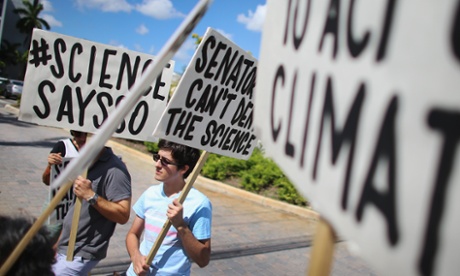
Protesters at the office of a US senator who doubts the evidence of human-caused climate change.

“Don’t shoot the messenger,” so the saying goes.

But what if that message warns we might want to rethink that whole fossil fuel burning thing pretty quick because it could seriously alter civilization and the natural world for centuries to come, and not in a good way?

Time to get the bullets out and start firing, obviously.

Climate scientists have been trying to dodge, catch or deflect those bullets for decades.

They are now all too used to being shot at, kicked and maligned as their findings are misunderstood, misrepresented, trivialised or booted around like footballs between politicians and other warring ideological factions and self-interested industry groups.

But if they had to pick one thing, what is it that really gets them annoyed?

When the public tries to understand the implications of their scientific findings – or just understand the findings themselves – what’s the most common mistake they see?

When the media gets hold of their findings, what makes climate scientists chuck a shoe, ice core or physics textbook at the screen in frustration?

I decided to ask a few leading climate scientists from around the globe to articulate that one thing that leaves them totally tacked off.

Some struggled to pick only a single bugbear (one even called to apologise for taking too long, so spoilt for choice were they), others took the chance to uncompromisingly unload their frustrations.

Here’s what they had to say.

Professor Andrew Pitman, director of the Australian Research Council’s Centre of Excellence for Climate System Science, University of New South Wales, Sydney


Many people who would not dream to claim they understand how antibiotics, microprocessors or immunisations work seem happy to wax lyrical on their views on climate change.

A politician or media identity who would be laughed out of office if they said “vaccines don't work" or “I am certain the moon is made of cheese" happily speak equivalent rubbish on climate science, believing their views deserve credit.

I want engineers to build bridges; I want a trained surgeon to operate on hearts and I want some of our decision-makers and commentators to either shut up, or familiarise themselves with climate science well enough to talk sense.

Professor Michael Mann, director of Penn State Earth System Science Center, United States


If there’s one concept that is typically misrepresented in the public discourse on climate change, it is the concept of uncertainty.

There are uncertainties in model projections of future climate change. However, these uncertainties cut both ways, and in many cases it appears that model projections have underestimated the rate and magnitude of the climate changes resulting from our burning of fossil fuels and emission of greenhouse gases into the atmosphere. The rapid lost of Arctic sea ice is one such example.

Rather than being cause for inaction, uncertainty is a reason to act all the sooner.

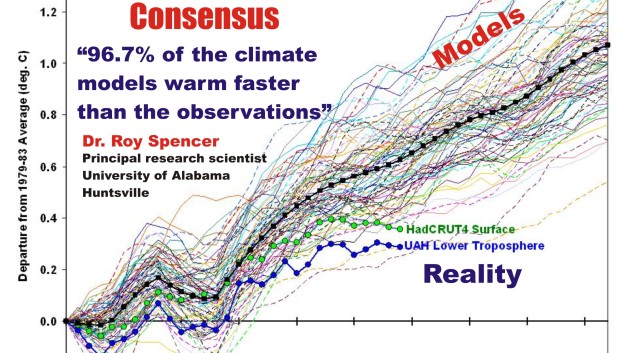
Notes for Michael Mann: 97% of the climate models have exaggerated, not "underestimated the rate and magnitude of the climate changes resulting from our burning of fossil fuels and emission of greenhouse gases into the atmosphere." Arctic sea ice has essentially stabilized since 2007 while Antarctic sea ice is at record highs. Global sea ice is significantly above the satellite era average. 


Global sea ice is significantly above the long-term average

Professor Michael Raupach, director of the Climate Change Institute, Australian National University, Canberra


The greatest cause for sorrow is the widespread inability of the public discussion to recognise the whole picture.

Much of the political discourse reduces the complexities of climate change to political football (“axe the tax”); much media reporting sees only the hook to today’s passing story; many interest groups want to use climate change to proselytise for their particular get-out-of-jail free card (nuclear power, carbon farming).

All of this misses or trivialises the real, systemic significance of climate change: that humankind is encountering the finitude of our planet, [the end is near] confronting the need to share and protect our endowment from nature, and realising that much will have to change to make this possible.
Professor Richard Betts, chair in Climate Impacts at the College of Life and Environmental Sciences, University of Exeter, UK


The thing that bugs me most about the way climate change is talked about in the media is journalists citing scientific papers without providing a link to the original paper.

Readers often want to get more details or simply check sources, but this is very difficult (or sometimes impossible) if the source is not given. I've raised this a few times, and get lame excuses like 'readers get frustrated when the journals are paywalled' but that's not good enough. Media should provide sources – end of.
Professor Steven Sherwood, director of the Climate Change Research Centre at the University of New South Wales, Sydney


Where to start?

These are things I don’t see (or don’t see enough).

First is still that, even though it is clear greenhouse gas emissions raise the temperature of the Earth, we’ve known this for 50+ years and no reputable atmospheric scientist in the world disputes this, most people think scientists disagree. They’ve been misled by the media, and I’ve been told repeatedly by reporters in the US and Australia that this is due to pressure from management.

Second is the fact that carbon dioxide emissions are effectively irreversible and will stay in the climate system for hundreds of generations is seldom noted. [false] If we decide later that this was a huge mistake there is no going back (practically speaking).

On the political side, I wish the media would note the obvious parallels of the carbon debate with past ones over restricting pollutants (mercury, lead, asbestos, CFCs), where claims that restrictions would be economically catastrophic never came true.

These are things I do see that bug me.

One would be phrases like “action on climate change”. We should be talking about “action on carbon dioxide” — and climate is only one reason (albeit the biggest) that too much of it is dangerous. Nothing we do with respect to any other influence on climate will prevent global warming if CO2 keeps climbing.
Professor Stefan Rahmstorf, head of Earth System Analysis, Potsdam Institute for Climate Impact Research, Germany


One of the phrases that makes me cringe is when I read in the media that a particular extreme weather event "is no evidence for climate change". This is so bad it's not even wrong, but it is quite misleading.

Notes for Stefan Rahmstorf: Even the IPCC SREX says a particular extreme weather event is no evidence for climate change, and there is no evidence that climate has become more variable or extreme. 

Climate change is a measured fact seen in rising temperatures, vanishing ice, rising sea levels etc. - it needs no further evidence. [Yes it does, namely the cause of climate change, natural or AGW] And a single extreme event cannot possibly provide such evidence, because climate change increases the number of certain extremes. Some, like heat waves, have already increased massively thanks to global warming.

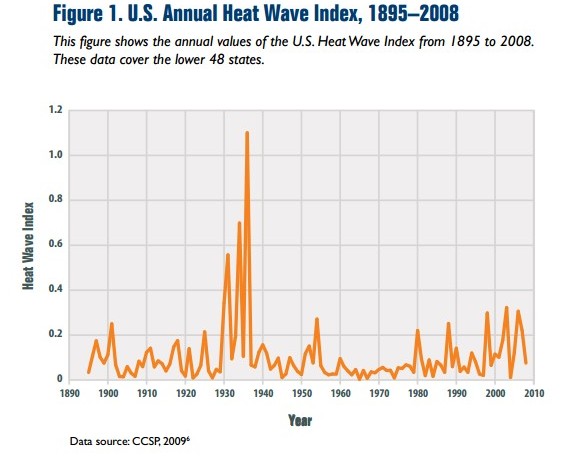
US Heat waves were much more common in the 1930's:


Professor Roger Jones, research fellow at the Centre for Strategic and Economic Studies at Victoria University, Melbourne

Who am I?

I can be sued for calling a public individual fraudulent but not a whole scientific community or organisation – because climate scientists and the IPCC are fraudulent.

I can publish proven lies in my newspaper day after day with no penalty.

I can buy disaffected scientists to deny sound science with a plane fare to a bogus conference and a little publicity.

I can anonymously threaten researchers online, especially the female ones.

If anyone threatens me with facts, I can call them an antidemocratic, anti-jobs, McCarthyist, communist, anti-freedom, pagan environmentalist.

Everyone says there is no consensus.

I deny everything
.

Dr Sophie Lewis, research fellow in the School of Earth Sciences at the University of Melbourne


I get annoyed when I hear yet another politician arguing that we can’t link extreme events to climate change. You know the spurious reasoning? Australia’s always had heatwaves/floods/fires, so this recent extreme is nothing to worry about. When I hear this, it’s time to turn off the TV.

Climate scientists don’t just guess at what contributed to recent extremes. We methodically calculate changes in the risk of extremes due to human factors, like greenhouse gases. I don’t just get irate out of principle.

Dismissing the link between climate change and extremes as hogwash leaves us vulnerable to a warmer climate. [see above comments on extremes]
Dr Andrew Glikson, visiting fellow at the School of Archaeology and Anthropology, Australian National University

I think the scale of the changes being seen now when compared to the Earth's history is something the media and the public do not appreciate. Earth's history is marked by a number of major mass extinctions of species, triggered by volcanic eruptions, asteroid impacts and release of methane from sediments.

Major shifts in the state of the climate were caused either by pulsations in solar radiation or by release of carbon from the Earth. In each of these events a marked rise occurred in the concentration of greenhouse gases in the atmosphere.

As the level of energy and temperature of the atmosphere increased, irreversible tipping points were reached where the synergy of feedback processes – ice melt, warming water, released methane, droughts and fires - combined to shift the climate from one state to the next.

The current rise in energy of the atmosphere above that of pre-industrial times, by about 3 Watt per square meter, is about half that of the atmospheric energy rise during the last transition from glacial to interglacial state.

The current shift is threatening to bring about irreversible tipping points in the climate, with the most serious consequences, likely indicated by the increase over the last 20 years or so in the intensity of extreme weather events around the globe.

The current rise of atmospheric CO2 at a rate of near-three parts per million per year exceeds rates recorded in the history of the atmosphere for the last 55 million years, which retards the ability of species to adapt to environmental change in time.

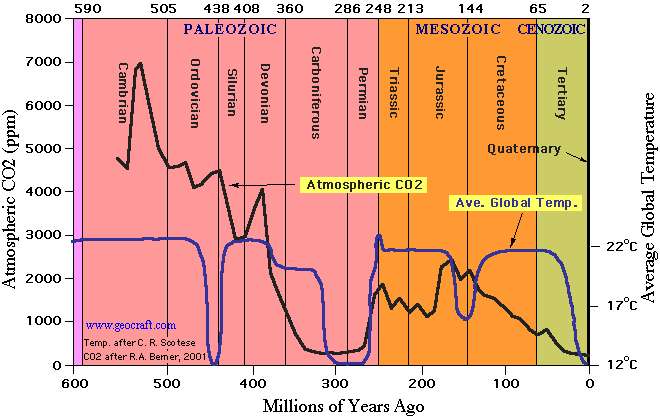
Note the discontinuity of CO2 and temperature over geologic time scales, as well as no "irreversible tipping points" with CO2 levels more than 17 times higher than the present


A consequent shift from conditions, which have allowed agriculture to take place from about 8,000 years ago, would render large parts of the continents unsuitable for cultivation.

Wednesday, May 1, 2013

Geoscientist explains why alarmist claims of continued global warming are unscientific political propaganda

Warmism's bellowing dinosaurs

by Dr. John Happs
May 2, 2013  Quadrant Online

In its publication, “The Angry Summer” the Australian Climate Commission (ACC) provides the dramatic headline:
“Earth continues to warm strongly despite sceptics claims.” (1)

In a forlorn attempt to assure the public that the information it provides can be trusted, the government-appointed ACC states on its website:
The Climate Commission was established to provide all Australians with an independent and reliable source of information about the science of climate change…”  (2)
Independent and reliable?  Then why the following disclaimer:
“This website is not a substitute for independent professional advice and users should obtain any appropriate professional advice relevant to their particular circumstances.” (3)
There are those who dismiss the ACC as little more than a mouthpiece for government propaganda to justify its carbon (dioxide) tax, but its website does provide one excellent piece of advice:
“The Commission recommends that users ….. carefully evaluate the accuracy, currency, completeness and relevance of the material on the website for their purposes.”
So let’s do just that.
The ACC has trumpeted its message about catastrophic anthropogenic global warming (CAGW):
“The Earth continues to warm strongly despite sceptics claims.”
It appears that Chief Climate Commissioner and paleontologist Professor Tim Flannery doesn’t seem to know if he should support the ACC’s strong warming message or actually heed real-world evidence. In 2009 he said:
“We’re dealing with an incomplete understanding of the way the earth system works… When we come to the last few years when we haven’t seen a continuation of that (warming) trend we don’t understand all of the factors that create earth’s climate…We just don’t understand the way the whole system works… See, these people work with models, computer modelling. So when the computer modelling and the real world data disagree you’ve got a very interesting problem… Sure for the last 10 years we’ve gone through a slight cooling trend.” (4) (author's emphasis)
Cooling over the last 10 years?  Following that public admission, someone at the ACC must have had a quiet word with Flannery since he later did a U-turn, telling Leigh Sales (March 4, 2013):
“If you look at the temperature of the Earth, we have to measure the oceans, the air and the land. And there, we see a continually strong rise in temperature.” (5)
A strong rise in temperature?  I’m sure the scientific community would certainly like to learn more from the ACC about this strong global temperature rise that few seem to be aware of.
It appears that Flannery is no stranger to contradictions. He has even contradicted the ACC about the reliability of findings from the now discredited Intergovernmental Panel on Climate Change (IPCC). On the one hand, the ACC declares that the IPCC is an authority on climate science:
“The IPCC is the leading international body for the assessment of climate change and is acknowledged by governments around the world, including the Australian Government, as the authoritative source of advice on climate change.” (6)
Yet, in Flannery’s 2005 book, The Weather Makers, he emphatically disagreed:
“The pronouncements of the IPCC do not represent mainstream science, nor even good science, but lowest-common-denominator-science – and of course even that is delivered at glacial speed.” (7)
What is it about the ACC and contradictions? Flannery’s fellow climate commissioner, chemical engineer Professor Will Steffen, is also no stranger to contradictions.  In 2011 he told Andrew Bolt:
“We’ve had very severe droughts before so again we cannot attribute this drought statistically to climate change….”
Someone at the ACC must have also had a quiet word with Steffen. In 2013 we saw another U-turn:
“Australia has long had a highly variable climate of droughts and heavy rains, and this pattern is likely to continue into the future. However, climate change is likely to increase the severity of these extreme weather events…”
Such contradictions tend to generate doubt about the reliability of ACC pronouncements on climate. Let’s return to Flannery’s statement about global temperature:
“If you look at the temperature of the Earth, we have to measure the oceans, the air and the land. And there, we see a continually strong rise in temperature.”
Not only has there been no recent warming of the atmosphere but the oceans, which store most of the heat within the climate system, also show a lack of warming. More than 3,000 Argo buoys (8) descend to depths of 2,000 metres, continually recording ocean temperatures. Contrary to IPCC climate model predictions and Flannery’s statement, Argo data have shown no overall ocean temperature rise since deployment in 2003 (9)
Kuhnert and Mulitza (2011) reported cooling of the Atlantic Ocean surface temperature over the past millennium (10) and passive microwave data from the Windsat, TMI and AMSR-E satellites have shown no warming of sea surface temperatures (SST) since 2003.  Dr Roy Spencer comments:
“I consider this dataset to be the most accurate depiction of SST variability over the last 10+ years due to these instruments’ relative insensitivity to contamination by clouds and aerosols..” (11)
What about continental temperatures? When the ACC tells us that 2012–13 was the hottest summer on record, we are referred to the Australian Bureau of Meteorology (ABOM) as its source of authority. (12)
The ABOM says: 
“Of the 112 locations used in long-term climate monitoring, 14 had their hottest day on record during the summer of 2012/13 – the largest number in any single summer. Record temperatures were also set in two capital cities; Sydney with 45.8°C and Hobart with 41.8°C.”
In contrast, “uncontaminated” satellite records show that the 2012-13 summer was little more than ordinary, ranking 14th warmest out of the last 35. (13). Professor Murray Salby agrees, pointing out that the 2012-13 summer was not exceptional by any means. (14)
The ACC tells us that:
“Hotter temperatures were also recorded in large parts of Argentina, Chile and Brazil, while temperatures in parts of Patagonia were more than 4°C above normal in January.”
Argentina, Chile, Brazil, Patagonia?
No mention of course that the Northern Hemisphere has been experiencing unusually cold weather with the UK having had its coldest December in 120 years in 2011 and the coldest March in 50 years; recent snowfall in the Isle of Man has been the heaviest recorded since 1963; Belfast had its coldest March since 1962 with the Irish Met. Office reporting that temperatures throughout March were the lowest on record nearly everywhere; sheep that were lambing, were buried by deep snow drifts in Wales, the North of England, Scotland and Northern Ireland. (15)
In 2011, Moscow had its coldest winter in 100 years and the heaviest snowfall in a century in 2013 as did the Ukraine; Belaruse had its worst winter in 150 years; in 2013, Germany experienced its coldest spring since 1963; in 2013, China recorded its lowest temperatures in almost 3 decades; the USA wasn’t spared from a severe winter in 2013 with record snowfalls in Illinois and Missouri; temperatures in Colorado, Kansas and Ohio were 10-30 degrees colder than average throughout March 2013 and the USA overall recorded many record low temperatures.
No doubt ACC alarmists are likely to say that the above examples of record, unseasonal low temperatures result from “normal fluctuations in the weather” whilst elevated summer temperatures in Australia, Argentina, Chile, Brazil and Patagonia clearly point to CAGW.
Interestingly, there is no mention from the ACC about evidence of global temperature stasis from various sources (16) such as:
(a)         UAH temperature data show stasis since 2008;
(b)         GISS temperature data show stasis since 2001;
(c)         Hadcrut4 temperature data show stasis since 2000;
(d)         Hadcrut3 temperature data show stasis since 1997;
(e)         Hadsst2 temperature data show stasis since 1997;
(f)          RSS temperature data show stasis since 1997.  
Temperature stasis has occurred whilst atmospheric carbon dioxide levels continue to increase yet the ACC wants us to believe, without any supportive empirical evidence, that carbon dioxide drives global temperature.
Not surprisingly the ACC ignores acceptance of temperature stasis from the following:
(a)         The Chairman of the IPCC, Dr Rajendra Pachauri, has now conceded there has been no global warming for the past 17 years (17);
(b)         Professor Phil Jones from the Climatic Research Unit (CRU) at the University of East Anglia, where global temperature data are collated, admitted that from 1995 to 2009 there was no statistically significant global warming (18);
(c)         Dr Mojab Latif, climate modeller and IPCC author told more than 1,500 climate scientists at the UN’s World Climate Conference in Geneva we could be entering one or even two decades of cooler temperatures (19);
(d)         Dr David Gee, chairman of the science committee of the 2008 International Geological Congress, asks the question:“For how many years must the planet cool before we begin to understand that the planet is not warming? For how many years must cooling go on?" (20)
(e)         Climate scientist Professor Richard Lindzen says: “There has been no warming since 1997 and no statistically significant warming since 1995.” (21)
(f)          Climate scientist Professor Judith Curry said it is clear that the IPCC’s unvalidated computer modeling, which predicted continual warming, is deeply flawed and suggested that all climate scientists should: “Use this as an opportunity to communicate honestly with the public about what we know and what we don’t know about climate change. Take a lesson from other scientists who acknowledge the “pause”. (22)
(g)         Dr Habibullo Abdussamatov, head of space research at Pulkovo Astronomical Observatory in St. Petersburg, Russia, says: “The Earth as a planet will henceforward have negative balance in the energy budget which will result in the temperature drop in approximately 2014.” (23)
(h)         The UK Met. Office has released data from 3,000 stations from 1997 through 2012 showing no overall warming during this time. (24)
(i)           The Central England Temperature record (CET), maintained since the middle of the 17th Century, shows a temperature rise of around +0.45oC per century since 1850, marking the end of the Little Ice Age. CET records from 2000 onwards reveal that recent cooling has already negated about 80% of the temperature rise since 1850. (25)
(j)           Activist climate scientist Dr James Hansen in a recent paper concedes: “The 5-year mean global temperature has been flat for a decade, which we interpret as a combination of natural variability and a slowdown in the growth rate of the net climate forcing.” (26)
In a leaked email (#1939) from Dr Peter Thorne of the UK Met. Office to Professor Phil Jones at the CRU we see a frank admission (and warning) about global temperature stasis: 
“Observations do not show rising temperatures throughout the tropical troposphere unless you accept one single study and approach and discount a wealth of others. This is just downright dangerous. We need to communicate the uncertainty and be honest. Phil, hopefully we can find time to discuss these further if necessary.”
Thorne added a further warning:
“I also think the science is being manipulated to put a political spin on it which for all our sakes might not be too clever in the long run.” (27)
Political spin? Surely not!
The ACC appears reluctant to communicate any uncertainty about its dire warming predictions and it certainly knows all about“political spin” as it unconvincingly keeps promoting the myth that the “Earth continues to warm strongly despite sceptics’ claims.”  
The ACC not only promotes alarmism about strong global warming but adds dire predictions about flooding, drought and bushfires, all increasing due to CAGW. Tim Flannery told Leigh Sales (4th March 2013):
“Sure. Look, the studies suggest it's a 1/500 chance that this sorta stuff is just normal.” (28)
It’s a pity that Sales didn’t ask Flannery to cite the studies which suggest a 1 in 500 chance and to actually point us to the calculations which substantiate such an outrageous claim.
The ACC’s Angry Summer report tells us:
“Over the last few years the east coast of Australia has experienced a number of intense rainfall events, triggering large floods that have cost lives, damaged property, inundated ecosystems and caused significant dislocation to local and regional communities.”
If the ACC has evidence about imaginary global warming and links to increased flooding, the IPCC doesn’t appear to know about it:
“There is limited to medium evidence available to assess climate-driven observed changes in the magnitude and frequency of floods at regional scales because the available instrumental records of floods at gauge stations are limited in space and time, and because of confounding effects of changes in land use and engineering. Furthermore, there is low agreement in this evidence, and thus overall low confidence at the global scale regarding even the sign of these changes.” (29)
The ACC’s recent comments about more intense rainfall and flooding contradict previous alarmist predictions from the Chief Climate Commissioner. In 2004 Flannery predicted that:
“Perth would be the 21st century's first ghost metropolis.” (30)
Western Australia spent $300 million on a desalination plant.
In 2005, he predicted Sydney’s dams could be dry by 2007, because global warming was drying up the rains, leaving the city “facing extreme difficulties with water.”
A $2 billion desalination plant was built in Sydney. Following a two-year proving period it was shut down in 2012.
In 2007, Flannery predicted that global warming would so dry our continent that desalination plants would be needed to save three of our biggest cities from disaster.
He said:
“Brisbane’s water supplies are so low they need desalinated water urgently, possibly in as little as 18 months.”
Queensland spent more than $1 billion on a desalination plant.
In 2008 Flannery said:
“The water problem is so severe for Adelaide that it may run out of water by early 2009.”
South Australia spent almost 2 billion dollars on a desalination plant which was completed in 2011.
Victoria also built a $5.7 billion desalination plant.
Chief Commissioner Flannery told Sally Sara in 2007:
“Although we're getting say a 20 per cent decrease in rainfall in some areas of Australia, that's translating to a 60 per cent decrease in the run-off into the dams and rivers. That's because the soil is warmer because of global warming and the plants are under more stress and therefore using more moisture. So even the rain that falls isn't actually going to fill our dams and our river systems, and that's a real worry for the people in the bush. If that trend continues then I think we're going to have serious problems, particularly for irrigation.” (my emphasis) (31)
In 2007 Flannery reported in New Scientist that:
“Australia’s Coal fired power stations…… emit much of the CO2 that is the ultimate cause of the drying.”
And
 “Australia is likely to lose its northern rainfall.”
He continued, allowing advocacy to replace objective science:
“Australia must ratify the Kyoto protocol and agitate globally for a swift and decisive reduction in greenhouse gas emissions. Our best theories show that Australia is suffering early and disproportionately from climate change. As one of the two renegade developed nations not to have ratified the treaty (the other is the US), and as the world's worst per capita emitter of CO2, some may say that Australia deserves its fate. If it is to save itself from even more severe climate impacts the country needs to change its ways, and fast.” (32)
In contrast to Flannery’s dire predictions, Sheffield et al. (2012) reported in Nature that the world has not seen a general increase in drought over the past 60 years. (33)
It appears that our climate commissioners are trying to outdo the warming hyperbole of other climate “experts” such as Dr David Viner from the CRU, who confidently told British readers in 2000:
"Snowfalls are now just a thing of the past.”
And
"Children just aren't going to know what snow is.” (34)
Vinerism appears to be contageous. Dr Stefan Rahmstorf assured German readers in 2006:
“Due to global warming, the coming winters in the local regions will become milder.” (35)
In 2007 the UK’s Met Office meteorologist Wayne Elliott told the BBC:
"It is consistent with the climate change message … It is exactly what we expect winters to be like - warmer and wetter.” (36)
Some crusading celebrities appear to have caught “vinerism” and have promoted this snow-free message. Robert Kennedy Jr. wrote in the Los Angeles Times:
“Snow is so scarce today that most Virginia children probably don’t own a sled.” (37)
In his 2005 book The Weather Makers our Chief Climate Commissioner said that global warming would bring worse or more tornadoes to America. This is contradicted by data from the National Oceanic and Atmospheric Administration (NOAA) which shows a decline in the number of strong to violent tornadoes since the 1950’s (38)
Dr Roy Spencer is emphatic:
“Anyone who claims more tornadoes are caused by global warming is either misinformed, pandering, or delusional.” (39)
Dr Roger Pielke Jr. Professor of Environmental Studies at the University of Colorado studies climate change and disasters. He concludes:
“Over the past six decades, tornado damage has declined after accounting for development that has put more property into harm's way.” (40)
In 2008, Flannery relayed his alarmism about Arctic ice melt to The Guardian, saying:
“We can only project that if this summer's melt trajectory follows recent decades, by September this year the Arctic ice cap will have lost around half of its remaining ice, and be just 2.2m square kilometres.” (41)
It’s a pity that Flannery hasn’t conceded that, on January 2013, Arctic sea ice extent reached 12,901,875 km2 (42)
On September 23rd, 2005 Flannery told Nance Haxton on ABC radio that tropical cyclones had increased in number and intensity around the world. This contradicted the IPCC which reported:
“Low confidence in any observed long-term (ie 40 years or more) increases in tropical cyclone activities, after accounting for past changes in observing capabilities. Projected: Likely that the global frequency of tropical cyclones will either decrease or remain essentially unchanged.” (43)
Bjorn Lomborg points out:
“Hurricanes in recent years don't indicate that storms are getting worse. Measured by total energy (Accumulated Cyclone Energy), hurricane activity is at a low not encountered since the 1970s. The U.S. is currently experiencing the longest absence of severe landfall hurricanes in over a century.” (44)
Pielke Jr. comments about disasters from various causes:
“Researchers have similar conclusions for other phenomena around the world, ranging from typhoons in China, bushfires in Australia, and windstorms in Europe. After adjusting for patterns of development, over the long-term there is no climate change signal — no "footprint" — of increasing damage from extreme events either globally or in particular regions.” (45)
Ryan Crompton and John McAneney from Macquarie University have investigated damage to property caused by extreme events. They have produced a data-base of normalized insured disaster losses for Australia and conclude that the long-term average annual normalised insured loss from weather-related disasters is around $1.1 billion. To date, insured losses during the 2012-13 financial year from bushfires in Tasmania and Coonabarabran and flooding in Queensland and New South Wales currently total almost $1 billion. (46)
Hardly evidence of increasing weather-related disasters. If more people choose to build on floodplains, eroding or subsiding coastlines or in the bush, inevitably there will be more disaster-related insurance claims.
Whether it’s global temperature, rainfall, drought, tornadoes, cyclones or even polar bear futures, our Climate Commissioners can’t help lapsing into amateur dramatics. Their best act of course has to be Flannery’s breathtaking announcement that the Earth is a living organism. Whereas we might expect to hear logical, scientific arguments from a Chief Climate Commissioner, Flannery told The Guardian newspaper in April, 2011:
“For the first time, this global super-organism, this global intelligence will be able to send a signal, a strong and clear signal to the earth. And what that means in a sense is that we can, we will be a regulating intelligence for the planet, I’m sure, in the future … And lead to a stronger Gaia, if you will, a stronger earth system.”
He had previously stated this belief on the ABC’s Science Show in January 2011:
“This planet, this Gaia, will have acquired a brain and a nervous system. That will make it act as a living animal, as a living organism, at some sort of level.” (47)
Most climate scientists would acknowledge that there are many known factors (some poorly-understood) which influence global and micro-climate, with the likelihood that additional contributing factors have yet to be identified. However, ecologist Professor Leslie Hughes from the ACC appears to know all about such contributing factors and how we can readily control our changing climate. She told Stephanie Smail (25th September, 2012):
“We know what needs to be done because we know what's causing it. If the climate was changing and we didn't know what was causing it, we'd be in a far worse position than we are now. Because it's a human-caused problem, that means that humans can fix it.” (48)
And we are expected to take the Climate Commission seriously. Perhaps Professor Bob Carter best sums up the ACC:
“They do not give good advice on climate. They give incompetent advice on climate.”
And
“They just accept the word of a political organisation, the United Nations Intergovernmental Panel on Climate Change, and pretty it up a little for the Australian context, and then put it into reports that they issue in their own name. (49)
The IPCC and ACC bring to mind the words of Oliver Cromwell when he addressed the English Parliament:
“You have sat too long for any good you have been doing. Depart, I say, and let us have done with you. In the name of God, go!”

Dr John Happs has an academic background in the geosciences. He has been a science educator at several universities in Australia and overseas

REFERENCES:
 2.           http://climatecommission.gov.au
 7.           Flannery, T. (2001). The Weather Makers: How Man Is Changing the Climate and What It Means for Life on Earth. Grove Press.
11.         http://www.drroyspencer.com
17.    http://www.cfact.org/2013/02/23/pachauri-would-not-admit-over-a-decade-without-warming-when-cfact-asked-him-in-mexico-but-admits-it-now/
19.        http://www.newscientist.com/article/mg20327254.000-world-will-cool-for-the-next-decade.html
20. http://www.iceagenow.com/Another_Prominent_Scientist_Dissents_from_Warming_Fears.htm
21.        http://wattsupwiththat.com/2012/10/13/report-global-warming-stopped-16-years-ago/
23. http://iceagenow.info/2012/11/russian-scientist-—-ice-age/
24.        http://www.dailymail.co.uk/sciencetech/article-2217286/Global-warming-stopped-16-years-ago-reveals-Met-Office-report-quietly-released--chart-prove-it.html?openGraphAuthor=%2Fhome%2Fsearch.html%3Fs%3D%26authornamef%3DDavid%2BRose0
26. http://www.nasa.gov/pdf/719139main_2012_GISTEMP_summary.pdf
27. http://drtimball.com/2011/early-signs-of-cruipcc-corruption-and-cover-up/
 28. http://www.abc.net.au/7.30/content/2013/s3703207.htm
30.    http://www.quadrant.org.au/blogs/doomed-planet/2011/08/damp-prophet-of-doom
 32.    http://www.science.org.au/nova/newscientist/105ns_001.htm
 33.    Sheffield, J., Wood, E.F., Roderick, M.L. 2012. Little change in global drought over the past 60 years. Nature, Nov. 15: 435-8
 34.    http://www.independent.co.uk/environment/snowfalls-are-now-just-a-thing-of-the-past-724017.html?oo=102541
35.    http://climatelessons.blogspot.com.au/2013/04/climate-teachers-have-you-seen-any-of.html
37.    http://stevengoddard.wordpress.com/2011/02/05/robert-kennedy-jr-snow-is-so-scarce-today-that-most-virginia-children-probably-dont-own-a-sled/
39.    MORE Tornadoes from Global Warming? That’s a Joke, Right?          http://www.drroyspencer.com/
41.    http://www.guardian.co.uk/books/2008/aug/09/scienceandnat ure.climatechange?oo=102541
44.    http://online.wsj.com/article/SB1000142412788732348          5704578258172660564886.html
46.    http://cstpr.colorado.edu/sparc/research/projects/extreme_ev          ents/munich_workshop/crompton.pdf
 49.    http://resources.news.com.au/files/2013/04/07/1226614/311 106-mtp-ep07-carter.pdf