Showing posts sorted by date for query okulaer. Sort by relevance Show all posts

Tuesday, December 2, 2014

Debunking Myths & Strawmen about the Gravito-Thermal Greenhouse Effect & Radiative Greenhouse Effect

This post will be continuously updated with a list of all posts concerning the gravito-thermal greenhouse effect, the derivation and use of the greenhouse equation of the gravito-thermal greenhouse effect, as well as numbered responses to common objections.

This is in lieu of constantly repeating information in responses to new comments here & elsewhere, to link to the numbered list below referring to a specific post which addresses the argument in question for or against the two competing 33C greenhouse effect theories (because one and only one of these greenhouse theories can be correct, otherwise Earth would be at least 33C warmer than present): 
1) The Arrhenius radiative greenhouse effect theory (the catastrophic man-made CO2 global warming theory)
vs.
2) The Maxwell gravito-thermal greenhouse effect theory


3] Why Greenhouse Gases Don't Affect the Greenhouse Equation or Lapse Rate (debunks claim that greenhouse gases are necessary for convection or a lapse rate to occur or that greenhouse gas radiative forcing can affect the lapse rate)


6] Why the atmosphere is in horizontal thermodynamic equilibrium but not vertical equilibrium (debunks claims that the gravito-thermal greenhouse effect assumes thermodynamic equilibrium in all three x, y, and z planes).


13] Why can't radiation from a cold body make a hot body hotter?

Answers these queries:

  • Can radiation from a cold body increase the temperature of a warmer body?
  • Are the Stefan-Boltzmann and Planck Laws applied correctly in calculating the greenhouse effect?
  • How can radiation from a cold body not be thermalized [cause an increase in temperature] of a warmer body?
  • How does quantum mechanics explain why a cold body can't make a warm body warmer still?
  • How do photons "know" how to do this?
  • Does water vapor warm or cool the planet?
  • Do clouds warm or cool the planet?
  • Why are cloudy nights warmer?
  • Do clouds cause 25% of the radiative greenhouse effect theory as claimed?

  • 17] New paper demonstrates climate models don't even have the 'basic physics' of the greenhouse effect correct


    Short summary of the 33C gravito-thermal greenhouse effect 


    The ~33C gravito-thermal greenhouse effect, first described by the great physicist Maxwell in 1872 by the barometric Poisson Relation, describes the temperature gradient from the 220K tropopause all the way down to the 288K Earth surface. As we have shown, the "average temperature" within the distribution of this quasi-linear [lapse rate] temperature gradient of the troposphere matches the energy input from the Sun, thus conserving energy:

    (288K + 220K)/2 = 254K ~ 255K = Equilibrium temperature with the Sun (located at center of mass of atmosphere)

    288K (at surface) - 255K (at center of mass of the atmosphere) = 33C gravito-thermal greenhouse effect

    Thus fulfilling the 1st law requirement of conservation of energy. (Before someone comments, I know you can't properly average temperatures, and that temperature is not a direct proxy for heat energy because calorimetry requires the mass, specific heats, heats of fusion and vaporization, and all phase changes be accounted, but use of temperature as a proxy of heat is done for illustrative purposes and simplification of the explanation)

    The temperature (a rough proxy for heat energy) distribution on either side of equilibrium temperature with the Sun Te = 255 is approximately an equal distribution around the center of atmospheric mass in the ~middle of the troposphere at ~5100 meters, thus conserving energy and placing Te = 255K at the center of mass (where P=1/2 of surface pressure) of the gravito-thermal greenhouse effect.


    Common myths & strawmen arguments & rebuttals:

    18] Myth: The Arrhenius radiative greenhouse theory is incontrovertible "basic physics"

    Rebuttal
    : Twenty-six years before Arrhenius devised his radiative greenhouse theory, the greatest physicist in history on the topics of heat and radiation, James Clerk Maxwell, said that the gravito-thermal greenhouse effect is what creates the atmospheric temperature gradient, not radiation from greenhouse gases. The Arrhenius radiative greenhouse theory makes at least three huge incorrect physical assumptions:

    1) cold bodies can make much hotter bodies much hotter (in violation of the 2nd law of thermodynamics which says transfer of any heat from cold to hot would cause an impossible decrease of entropy, since the second law requires total entropy to always increase),

    2) that radiation dominates over convection in the troposphere (disproven by countless papers and observations),

    3) gravitational forcing upon atmospheric mass (as described by the barometric formulae) does not create the temperature gradient in the troposphere (disproven by Maxwell, the barometric formulae, and millions of observations).

    Thus, all of the major physical assumptions of the Arrhenius radiative greenhouse effect are false. One and only one 33C greenhouse theory, either gravitational or radiative, can explain the entire 33C greenhouse effect; you cannot have it both ways and both cannot have merit, otherwise the Earth would be 33C warmer than at present. In addition the "Maxwell theory" is the only one compatible with the 18-26 year "pause" or "hiatus" of global warming along with a 20% increase in CO2 levels.


    19] Myth: “Every pressurised container would be hot if pressure increases temperature”

    Rebuttal:
    Let's use a bicycle tire analogy. When you use a pump to pressurize the tire it gets hotter for awhile, but then cools to ambient room temp by the tire convecting that heat to the atmosphere.

    Second situation is we have a leaky tire that we have to keep pumping to maintain the same pressure, so that tire remains hotter as long as compression of the air is a continuous process.

    The atmosphere is only analogous to the second situation, since air packets are continuously warming at the surface then rise/expand/cool until equilibrium with surrounding air in upper atmosphere, then due to gravitational potential energy these air packets have accumulated then fall/compress/warm down to the surface.

    This is how the troposphere temperature gradient from 220K-288K is entirely controlled by these barometric processes and perfectly predicted by the barometric formula.

    Sunday, November 16, 2014

    Why can't radiation from a cold body make a hot body hotter?

    Three new posts by Quaternary geologist "okulaer" and astrophysicist Joe Postma further explain the misconceptions behind conventional greenhouse effect theory including
    • Can radiation from a cold body increase the temperature of a warmer body?
    • Are the Stefan-Boltzmann and Planck Laws applied correctly in calculating the greenhouse effect?
    • How can radiation from a cold body not be thermalized [cause an increase in temperature] of a warmer body?
    • How does quantum mechanics explain why a cold body can't make a warm body warmer still?
    • How do photons "know" how to do this?
    • Does water vapor warm or cool the planet?
    • Do clouds warm or cool the planet?
    • Why are cloudy nights warmer?
    • Do clouds cause 25% of the greenhouse effect as claimed?
    • In addition to the "back-radiation" misconceptions listed above and below, a prior HS post explains why global warming also cannot be explained by an increase of the "effective radiating level"
    The real atmospheric greenhouse effect is instead entirely explainable on the basis of atmospheric mass/gravity/pressure/heat capacity/adiabatic lapse rate, and the "ocean greenhouse effect" explainable on the basis of the  ~0.76 - 0.89 far-IR emissivity of the oceans, which "traps" heat from solar radiation in the oceans.

    While water vapor and other greenhouse gases DO have a profound effect upon climate, the effect is a slowing of cooling at night and slowing of warming during the day [from evaporation, clouds, and enhancement of convection], resulting in a much more benign climate with decreased diurnal temperature range and decreased temperature extremes. 

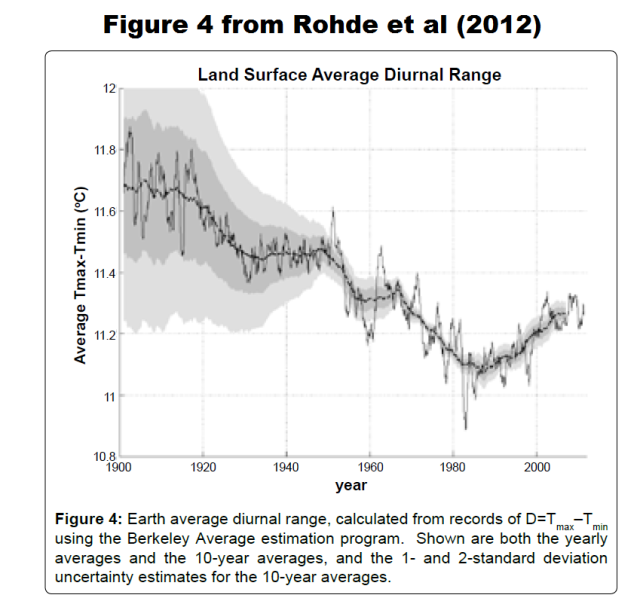
    Compared to the moon, which has a mean daytime temperature of 123C and mean nighttime temperature of -233C [a diurnal range of 356C!], the presence of Earth's atmosphere serves to greatly cool during the day and retain warmth during the night to reduce the diurnal temperature range to only ~11C. The global land diurnal temperature range has decreased over the past 110 years with the increase of greenhouse gases, as expected from a slowing of cooling at night and/or slowing of warming during the day.


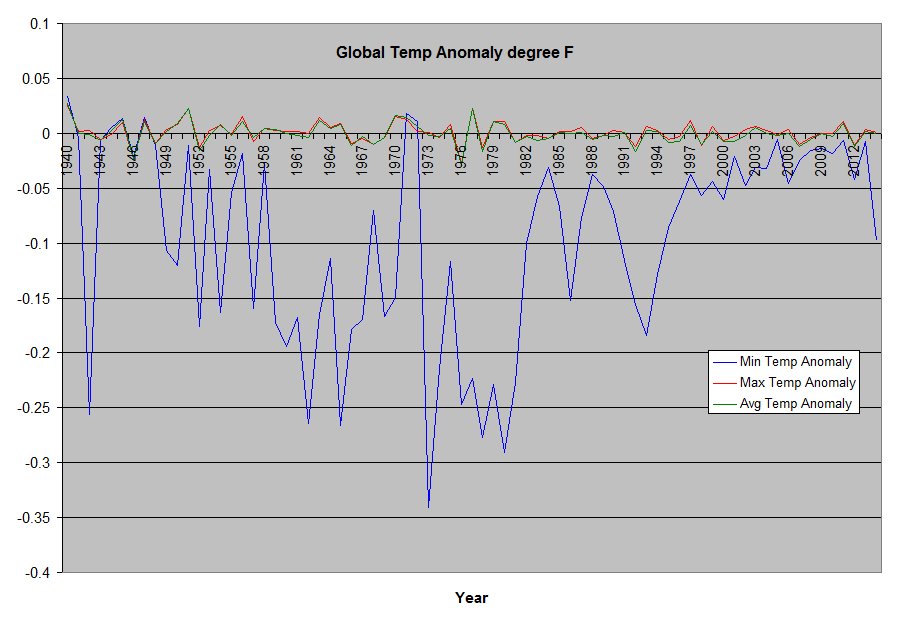
    In addition, a paper published in the Journal of Geophysical Research Atmospheres finds that daily [diurnal] temperature range in China decreased from 1962 to 2011, and that this decrease was due to a decrease in maximum temperatures related to a decrease of sunshine durations over this period. Similar to the findings of this paper, examination of the raw global temperature data [prior to tampering] shows a significant increase in minimum temperatures over the period 1962-1989, and then leveling off 1989-present. However, over the entire period 1940-present, there is no trend in minimum, maximum, or average global temperature anomalies. 


    See two posts from Quaternary geologist okulaer "The greenhouse effect that wasn't" Part 1 and Part 2

    Excerpts from Climate of Sophistry by Joe Postma, emphasis/bolding added:

    Why not Backradiation? The Amazing Nature of Light


    The Basics

    It seems that a major source of confusion stems around this equation for radiative transfer of heat energy:
    Q = σT24 – σT14
    The term ‘Q’ is not the incoming solar energy nor does it represent a source of energy at all. From that incorrect interpretation of the equation arises all sorts of further misinterpretations and bad physics.  It’s where the whole incorrect idea of backradiation heating arises and all of the various arguments about cold helping to make something warmer hotter still.  I address that misinterpretation of the equation many times on this blog, but here I do it up front:
    ‘Q’ is the heat flow between the Sun and Earth and so is not the solar energy.  The solar energy flux would be a term on the right hand side, σT24 say, but factored for distance. How this is done is demonstrated in the link above.  ‘Q’ is actually zero if we consider the Earth to be in energy equilibrium with the solar input, which it should be within a small margin.
    It is also discussed here:
    So to repeat, ‘Q’ can not be the solar heat input, when T1 and T2 are supposed to be the temperatures of the atmosphere and surface. That’s not what that equation is about at all.
    I’ll let Rosco explain, and I was going to blockquote his comment from a previous thread but with my own editing now finished, I’ll just acknowledge that this next section comes largely from him:

    The Physics

    ‘Q’ is not an actual radiant emission corresponding to any temperature and hence is not subject to any valid algebraic manipulation as if it supposed to be a conserved quantity from some source.  It is not a conserved quantity and it does not represent a source.
    ‘Q’  is actually Q(net) – the difference between two emission powers from 2 objects.
    This is easily observed on a Planck curve diagram.
    σT14 is the area between the Planck curve and the x axis for T1.
    σT24 is the area between the Planck curve and the x axis for T2. If T2 > T1 then the area of the Planck curve for T2 completely includes all of σT14.
    But ‘Q’ = Q(net) = σT24 – σT14 is not a radiative flux at all. It is the area between the T2 Planck curve and the T1 Planck curve!
    two planck curves
    Only the T1 and T2 terms have any relationship to the Stefan-Boltzmann equation because they are explicitly derived from Planck’s equation as the integral from 0 to infinity of Planck’s equation in either df (frequency) or dlambda (wavelength) terms.
    If T1 = T2 then Q(net) = 0 this simply says that two objects at the same temperature have zero net energy exchange and therefore no thermal effect on each other.
    If T1 is less than T2 then object 2 is heating object 1 and raising its temperature. This demonstrates the ridiculous nature of all “greenhouse effect” “physics” – they simply play algebraic tricks without any recognition of what the terms actually mean.
    F1 = σT14 is a valid flux for T1; F1 = σT14 is a valid flux for T2.
    Q = σT24 – σT14 is just a number, just the difference of the fluxes – nothing more! It is not a source in itself.  It is not conserved.  You can’t hold it constant and say that an increase in the cooler T1 will cause an increase in the warmer T2, i.e., that cold can heat hot.
    To manipulate this expression by algebra and claiming that ‘Q’ has to remain fixed because it is the energy from the Sun is entirely nonsensical by the terms and logic of the equation itself.

    The Question

    So this is the question that confuses just about everybody, and it is also where the error of backradiation heating and the misinterpretation of the heat flow equation originates:
    What happens to the energy from the cooler portion if it travels to the hotter side but does nothing?  How can it do nothing?  Does it even travel to the hotter side at all?  How can it not?  How could it know not to?  How could the photons from the cooler side either A) not cause any heating when they get to the hotter side, or B) not travel to the other side at all?  These are all related questions.
    To be sure, the equation we’ve been discussing for ‘Q’ absolutely, most definitely, 100% says that radiative heat energy only goes from hot to cold and thus that temperature can only be increased by something hot warming up something cooler.  It specifically does not result in something like the supposed “steel greenhouse effect”, as debunked previously.  And this equation is the correct equation from radiative transfer theory and thermodynamics, when used and interpreted properly.  It says what happens, and so it appears that the problem is that it doesn’t say why that happens.

    The Answer

    The radiation from the cooler source doesn’t have the high frequency light-wave energy components which would be required to fill up the higher-energy microstates that the warmer source already has filled up, let alone the higher frequency states beyond to result in an increase in temperature.  You can see it a little bit in the Planck curve plot above, that the higher-temperature object has a microstate population that is “activated” at higher frequencies, i.e. shorter/smaller wavelengths, than the lower-temperature object has.  (The warmer one also has a larger population in each frequency microstate as compared to the cooler one.)
    The integration over all the active microstates of a system determines its macrostate, and the macrostate is the thing you actually measure to take a temperature.  If you activate higher-frequency microstates, then you shift the macrostate to a higher temperature.  But you can only activate the higher-frequency microstates with the frequencies required to activate them, which are obviously their frequencies.
    And so because the radiation from a cooler source lacks the higher-frequency microstates that the warmer source of radiation already has, then the cooler source can not have the effect of raising the temperature of the warmer source.  And obviously the same would be true of two systems with identical temperatures – they could have no effect on each other’s microstate population, hence can not heat each other.
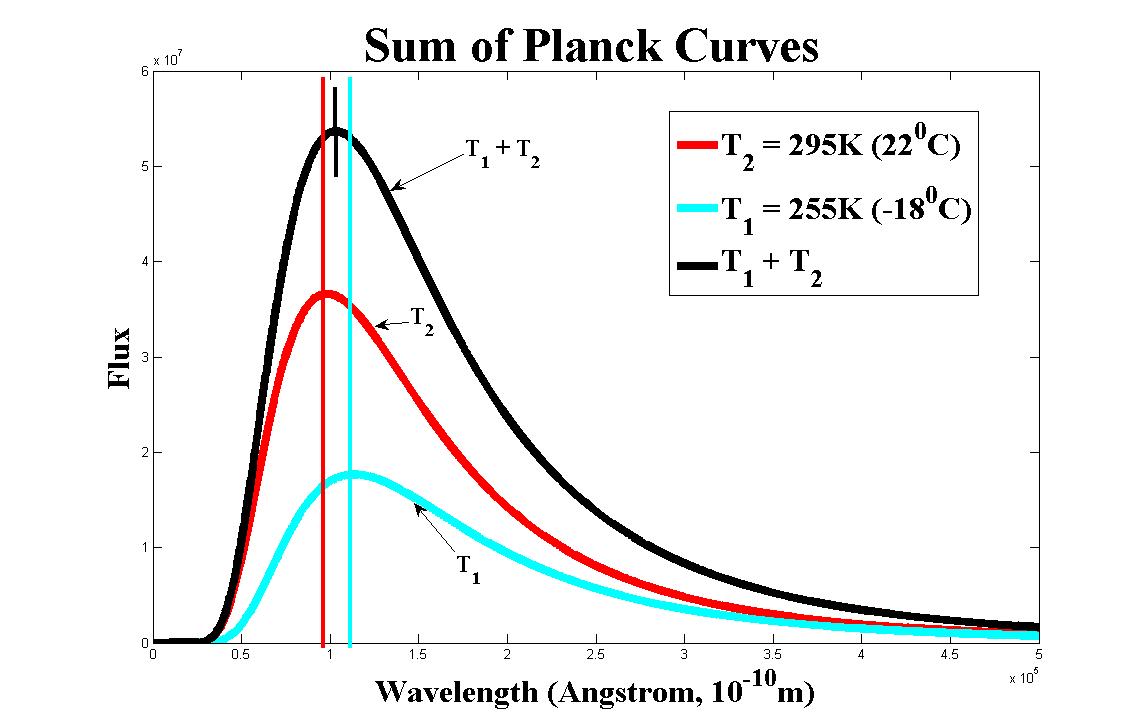
    For example, if we add the two Planck thermal radiation curves from the above plot together, then the existing microstate populations are increased, but it doesn’t activate any new higher-frequency microstates than the warmer curve already had activated, and thus the temperature doesn’t get increased:
    sum of planck curves
    Now you can’t see it because the lines all overlap each other at high energy (i.e. short/small wavelength), but the cooler curve has zero contribution, zero activated microstates, at the high energy, high frequency, short wavelength end of the plot (left side) where the warmer curve does have populated microstates.  Thus, adding the cooler radiation with the warmer radiation doesn’t result in a macrostate that has microstates activated at higher frequencies as compared to the original warmer radiation (T2), and thus, the result doesn’t have a higher temperature than the original warmer source of radiation .
    Also note, and this you can see, that the peak of the population of microstates for the sum of the warm and cool source radiation is at longer wavelength and thus lower energy than the original warm source radiation.  Adding cool to hot doesn’t result in something hotter…but adding hot to cool certainly does result in something hotter.
    But still the question can be asked:  Why doesn’t the addition of energy from the cooler source to the warmer source result in an increase in temperature for the warmer source?  If you add any energy to anything, doesn’t that have to result in an increase in internal energy, and thus temperature?
    The answer to that, is “No”, because that is not how thermodynamics works.  It’s not what the radiative heat transfer equation says or how it works.
    It is not that simple.

    More Answer

    We actually shouldn’t have add those fluxes together at all because that is not how heat radiatively transfers.  If we add those fluxes, then is that now the flux that the hotter object emits, or is it the cooler objects?  Or is that the radiation field between the two objects?  None of those are correct.  It was wrong to add those fluxes together.  It is easy to make that mistake, but on the other hand, we’ve always had the equation for radiative heat transfer at hand and so we should simply refer to it and obey it.  The energy field flowing as heat between the hot and cool objects is only ‘Q’, only the difference between the hot and cool fluxes.
    difference of two planck curves
    You can see a little more clearly now that ‘Q’, the heat flow, merges to the hotter curve at high frequency/small wavelength, which again is all about how only the hotter source has active microstates at high frequency, and the cooler curve doesn’t.  If you add the ‘Q’ curve, the heat flow, to the T1 object’s curve, then you get the T2 curve, which would indicate that object 1 has come to the temperature of object 2 in thermal equilibrium, and then the heat flow ‘Q’ would be zero, meaning that no more temperature changes can occur.  Object 1 & 2 become a unified thermal system on the side facing each other, and object 1 then simply emits the energy supplied by object 2 out from the side facing way from object 2.
    When you have say, two planes of material, touching each other, then the heat flow would be purely diffusive, meaning purely by conduction.  The addition of another layer physically touching the existing warmer layer doesn’t make the warmer layer warmer still – the new layer simply gets heated to the temperature of the original layer, and then it becomes the new surface of the original warmer plane.  Nothing about this changes when there is a gap between the layers so that the heat transfer between them become radiative.  It’s not like you would remove the added layer from touching the original one to create a vacuum gap in between, and suddenly this would cause the warmer layer to become warmer still, when this is not what happened when the layers were touching.  The modes of heat transfer obey the same limitations and the same general rules of heat flow.
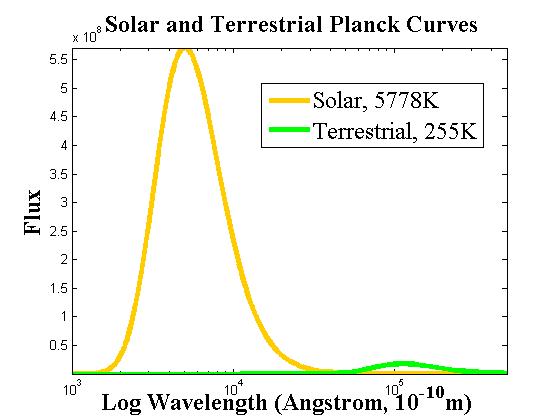
    The situation for the Sun and Earth is a little different.  Scaled for local intensity at the distance of the Earth from the Sun, the solar spectrum has much less intensity at terrestrial frequencies and thus the Earth can locally shed heat energy in the direction of the Sun.  You can see this in idealized Planck curves given the solar and terrestrial effective temperatures:
    solar and terrestrial
    The Solar and Terrestrial fluxes are scaled for distance of the Sun from Earth, and for 4-times the emission from a sphere for the Earth as compared to the disk cross-section of absorption.
    However, as we calculated in the steel greenhouse debunking thread, the radius of heat potential for the Earth only extends to 56.8 million kilometers before the terrestrial heat becomes indistinguishable from the cosmic background thermal radiation.  Therefore, the Earth can not heat the Sun with terrestrial backradiation (because the Sun is 150 million kilometers distant), and that will always be a general result in any scenario.
    Of course, as you go back towards the Sun, the solar flux spectrum increases in intensity and so well before reaching the Sun, the flux from the Earth will become dominated by the outward flux from the Sun at those wavelengths.  The flux intensities from the Earth vs. the Sun, at the wavelength of the peak of the terrestrial spectrum, become equal at 27.1 million kilometers distance from the Earth towards the Sun, which is well inside the heat envelope of Earth.

     Final Consideration

    All of the GHE advocates make this same mistake of misinterpreting the meaning of the terms of radiative heat transfer equation.  They all have this idea that ‘Q’ is a conserved quantity as if is the energy flux from the Sun.  This is wrong.  How surprised would they be if they realized that ‘Q’ was actually zero, given that we generally assume a state of thermal equilibrium between the solar input and terrestrial output, thus requiring that Q equals zero?
    Furthermore, if they make such a basic mistake with such a simple and basic equation, then how can you really trust the rest of what they’re doing?  This is first-year undergraduate level stuff, and not only does it seem entirely beyond them, they actually get extremely angry and hostile when you ask them to read up on it and correct such a simple mistake.
    But we have one last amazing thing to think about with regard to radiation.  Sure the stuff about energy microstates and thermodynamic macrostates is all very interesting, and describes what happens to some degree, but still people may wonder:  Why do those fluxes not add together if their energy is in the same region of space?  What happens to the radiative energy if only the difference, not the sum, has an effect on inducing temperature changes?  How do the photons “know” how to do this?
    Well firstly, that is exactly how vectors behave.  This Wiki article on heat transfer physics is a little mathematically advanced, but the term we’ve been denoting as ‘Q’ here is a “heat flux vector”.  Opposing vectors subtract, not add.
    And finally, think of the way that the universe is experienced by a photon.  A photon travels at the speed of light and so time is infinitely dilated and space is infinitely shrunk.  A photon quite literally exists outside of space and time as we know it.  It doesn’t experience time, and it doesn’t experience space!
    Just apply the Lorentz relativity equations with the subject in question being a photon, traveling at the speed of light ‘c‘.  The equations directly say that neither time nor space is experienced by a photon.  A photon has no distance to travel as far as it is concerned, since there is no space because all spatial length is infinitely contracted, and it has no time to experience because time has come to a complete stand-still with infinite time dilation.
    So a photon has no distance to travel, in no time – from its perspective, and we have to grant it its own perspective as per relativity theory.  And so, under these conditions, a photon essentially does know what its destination is like and so radiative transfer of heat energy can be limited to the same rules as physical-contact flows such as with conduction.
    How does a photon from a cool spectrum source “know” not to travel to and warm up a warmer source?  It is because a photon is effectively outside of space and time.
    Start thinking of what life as a photon must be like, if you were a photon, travelling at the speed of light, and wrap your head around that.

    Thursday, November 6, 2014

    Okulaer on "Why atmospheric radiative greenhouse warming is a chimaera"

    Quaternary geologist "okulaer" takes on warmist "Science of Doom"/"SoD" in this essay reposted from his blog. In my opinion, Okulaer meets the SoD "challenge," demonstrating "why atmospheric radiative GH warming is a chimaera," due to inappropriate assumptions regarding the Stefan-Boltzmann [SB] law. 

    In a nutshell, while physics textbooks always state the radiative heat transfer equation [based on the SB law] between a hot and cold body as: 

    P/A = εσ(Th^4 – Tc^4)

    where Th = hot body temperature, Tc = cold body temperature, ε= emissivity, σ=SB constant

    climatologists assume 

    P/A = εσTh^4 - εσTc^4 is also physically correct

    While equivalent algebraically, thermodynamics textbooks never state the heat transfer equation in the form εσTh^4 - εσTc^4 used by climatologists, because to do so assumes bidirectional heat transfer independent of the difference in the simultaneously changing temperatures of the two bodies, which is not true in a physical sense, since Th is simultaneously decreasing due to heat transfer to the cold body, which in-turn increases the temperature Tc of the cold body only. 

    These are not independent processes as assumed by the incorrect form of the SB heat transfer equation, but rather dependent on the continuously changing difference in temperatures of the hot and cold bodies (Th^4 – Tc^4). As first demonstrated by Clausius, heat flows in one direction only from hot to cold, dependent upon the continuously changing difference in temperatures of the hot and cold bodies [i.e. radiation transfer IS bidirectional, but heat transfer is unidirectional only] i.e. radiative heat transfer = εσ(Thot^4 – Tcold^4) as stated in thermodynamics textbooks, but is not necessarily equal to εσThot^4 - εσTcold^4 in physics. 

    This is how the misconcept arises that Thot [e.g. the Earth surface] increases in temperature due to alleged heat transfer from the cold body at temperature Tcold [e.g. GHGs in the atmosphere] to create the greenhouse effect, whereas in reality the temperature of the Thot body decreases due to heat transfer to the Tcold body, causing an increase in temperature of the Tcold body only. 


    For those who challenge okulaer's arguments below, please refer to specific quotes being challenged:

    Why ‘atmospheric radiative GH warming’ is a chimaera 

    by okulaer

    Science of Doom (SoD) has apparently issued a challenge of some sort to a commenter going by the name of ‘Bryan’. This is how SoD describes Bryan:
    “Bryan needs no introduction on this blog, but if we were to introduce him it would be as the fearless champion of Gerlich and Tscheuschner.”
    And the challenge appears to be a return to the ‘Steel Greenhouse’, a setup that is meant to convey in the simplest possible way the basic mechanism behind ‘atmospheric radiative greenhouse warming’ of the surface of the Earth.

    The challenge is as follows:
    “Case A
    Spherical body, A, of radius ra, with an emissivity, εa =1. The sphere is in the vacuum of space.
    It is internally heated by a mystery power source (let’s say nuclear, but it doesn’t matter), with power input = P.
    The sphere radiates into deep space, let’s say the temperature of deep space = 0K to make the maths simpler.
    1. What is the equation for the equilibrium surface temperature of the sphere, Ta?
    Case B
    The condition of case A, but now body A is surrounded by a slightly larger spherical shell, B, which of course is itself now surrounded by deep space at 0K.
    B has a radius rb, with an emissivity, εb =1. This shell is highly conductive and very thin.
    2a. What is the equation for the new equilibrium surface temperature, Ta’?
    2b. What is the equation for the equilibrium temperature, Tb, of shell B?”
    What SoD is of course getting at here, the realisation he is seeking to provoke, is that in the end the shell will be the layer radiating to space rather than the surface of the sphere, andsince the shell at radiative equilibrium needs to give off an equal amount of energy to space per unit of time as the sphere/shell system receives from the mystery internal power source of the sphere, then its temperature would have to be pretty much equal to the surface of the sphere before the shell was emplaced – same temp, same radiation flux. In turn forcing the surface of the sphere, with the shell in place, to become warmer so that it can send a larger radiative flux towards the shell (twice as large, as a matter of fact, seeing that the shell seemingly ‘splits’ the absorbed flux from the sphere and emits only half out to space, with the other half going back in towards the sphere):
    SphereShell
    Figure 1. Black column (l): inner sphere; Gray column (c): 1 cm vacuum between sphere and shell; Light gray column (r): outer vacuum (space).
    Ta = 4√(P/4πra2σ) = 4√(P/Aaσ) = 193.6K*
    Tb ≈ Ta = Ta’/4√2 = 193.6K (192.6K)*
    Ta’ = (4√2)Ta = 230.2K*
    At radiative equilibrium,
    P/Aa’ – P/Ab ≈ P/Ab or
    P/Ab ≈ (P/Aa’)/2.
    Therefore Tb4 ≈ Ta’4/2 or
    Tb ≈ 4√(Ta’4/2) →
    Tb ≈ Ta’/4√2.
    *Temps based on one of SoD’s Notes to the challenge: “For anyone who wants to visualize some numbers: ra=1m, P=1000W, rb=1.01m” Other relevant notes are as follows: “The reason for the ‘slightly larger shell’ is to avoid ‘complex’ view factor issues. (…) The reason for the ‘highly conductive’ and ‘thin’ outer shell, B, is to avoid any temperature difference between the inside and the outside surfaces of the shell. That is, we can assume the outside surface is at the same temperature as the inside surface – both at temperature, Tb.”
    Through this exercise, SoD is trying, then, to imply that this is also how the surface/atmosphere system on Earth works.

    And he would be both right … and very wrong.

    There is no question that replacing the vacuum of space with a massive atmosphere will force the mean surface temperature of Earth to rise significantly, because the energy – after the replacement – escaping the surface as heat would be reduced. This is however NOT because there is an extra energy transfer to the surface from the atmosphere. This is a grave misunderstanding. The misinterpretation of reality lying at the very heart of the whole rGHE/AGW hypothesis. No, it is simply because a massive atmosphere – unlike the ‘non-massive’ vacuum of space – is able to warm and thus attain a temperature much higher than 0 K.

    Compare the pure Stefan-Boltzmann equation (1) with the general radiative heat transfer equation (2):
    (1) P/A = εσT4 
    (2) P/A = εσ(Th4 – Tc4)
    The pure version portrays an ideal situation where the radiating object ejects its energy into a perfect (0 K) heat sink. There is a maximum/ideal/largest possible temperature difference between object and surroundings. Hence, there is only the temperature of the object radiating to consider.

    The composite version (the general radiative heat transfer equation) reflects a situation where there is no longer just an empty void surrounding the radiating object*, but rather surroundings/other objects with an ability to absorb and store energy, and therefore possessing a temperature. In other words, it’s no longer enough to simply consider the temperature of the radiating object itself. One also needs to take into account the temperature of its surroundings. The temperature difference is no longer the largest possible and so the radiative heat escaping the radiating object (P/A, equal to the more familiar Q) is less than the maximum/ideal value.

    *Or, more relevant on Earth, surroundings/objects much, much colder than the radiating object.

    Note, in both (1) and (2) above, the left-hand side of the equation is the solution, the value we’re looking for, of the actual physical phenomenon being studied. The right-hand side merely shows us how this value is mathematically derived, based on the temperature (and emissivity/absorptivity) of the objects involved in the thermal exchange (heat transfer). The only radiation ever detected within a thermal exchange is always the ‘heat’ (P/A). In (1), the single mathematical term on the right-hand side simply happens to equal the heat on the left-hand side. In (2) there are two opposing terms on the right-hand side and the heat is therefore only the net (the sum) of the two. In this case, each single term on the right-hand side only signifies a potential flow of energy. They would only bereal (detectable, thermodynamically working) flows of energy if they were facing a perfect (0 K) heat sink like in (1), that is, if they were completely thermally isolated from one another.

    This is an extremely important point, because people like SoD (and the entire ‘climate establishment’) base their rGHE/AGW argumentation on the idea that these two opposing terms (in (2)) in fact do represent physically real fluxes of energy, each operating separately and distinctly from the other, inside one single radiation field.

    It’s an appallingly naive, simplistic and, quite frankly, absurd view on how things work in the real world. But it has still effectively managed to infect the minds of practically every person alive today. The hypothetical construct claiming the reality of an ‘atmospheric radiative greenhouse effect’ (the rGHE) warming the surface of the Earth is simply taken at face value. It is taken for granted as ‘fact’. By all. It is never questioned in the least, there is no critical thinking whatsoever directed at its fundamental premises and tenets.
    The idea is that the atmosphere needs the so-called ‘GHGs’ to radiate a (real, working) flux back down to the surface for it to become warmer. Without these radiatively active gases in the atmosphere, there would be no such flux and the surface could not become as warm as it is. (Read the final part of this post to see what they ignore, promoting this idea.)

    In the end, it bases itself wholly on a profound misrepresentation of reality.

    Look, the observable warming effect of putting a shell around a heated sphere is real. It does not violate the laws of thermodynamics. Of course it doesn’t. It comes specifically as aconsequence of the definitive physical constraints that they define.

    What does violate the laws of thermodynamics, however, is the description given by people like SoD of what happens; their proposed explanation of how the effect comes about.
    They propose that the effect is a result of more energy coming IN to the central sphere. 

    From a cooler place.

    Conceptually, schematically, one can get away with describing the situation like this if we only include two cooling objects at different temperatures, that is, the warmer object is not supplied with energy from a third object. We can get away with it only because the warmer object in this situation will not at any point have its internal energy increase, that is, become warmer in absolute terms as time passes. Such a description, where energy moves along separate ‘highways’ (depicted in diagrams by opposing arrows), is but a highly simplified (and hence instructive on a basic level) way of explaining an integrated process that in reality is very hard to grasp and to visualise, almost mysterious to us macroscopic creatures. It is what we normally see in textbooks on radiative heat transfer. You will, however, never find an example in any of these textbooks where it is even hinted or suggested that energy transferred from a cold to a hot body in a spontaneous thermal exchange (a heat transfer) will be able to directly cause an increase in the hot body’s internal energy and thus make it warmer in absolute terms.

    So even in the ‘two bodies cooling’ situation, it cannot be correct to say that it is the energy coming IN from the cooler to the warmer body that makes the warmer body cool more slowly than if it were facing a heat sink at 0 K. The slower cooling rate of the warmer body is rather the result of less energy going OUT from the warmer body to the cooler one. 

    Because it’s facing a higher temperature than 0 K.

    So why is this an important distinction? More INPUT vs. less OUTPUT. Because, if you were to connect the warmer body to an external heat source, a third body supplying it with a constant input of energy, and then still, like SoD does, insisted that it is the extra energy from the cooler body facing the warmer one that’s making it ‘not as cold as it could be’, then you would end up breaking the Second Law of Thermodynamics.

    How?

    Because now this same ‘extra’ energy input (from cold to hot) would be the sole cause of the internal energy, and hence the temperature, of the warmer body rising in absolute terms. No longer ‘making it cool more slowly’, but directly ‘heating’ it.

    Why?

    Very simple. Remember the 1st Law of Thermodynamics for a solid surface: ΔU = Q = Qin – Qout.
    Scenario 1: Warm body facing space.
    External heat input (Qin from hot reservoir): 2. Heat output (Qout to space): 2. Net heat (Q): 2 – 2 = 0. No change in internal energy: ΔU = 0. Steady-state temperature. Notice here that the heat output from the warm body equals its Stefan-Boltzmann-derived radiant emittance, because the cold reservoir (space) has no temperature: Q = εσT4. 
    Scenario 2: Warm body facing cooler body.
    External heat input: 2. Potential heat output (radiant emittance) from the warm body up: 2. Potential heat output (radiant emittance) from the cooler body down: 1. Net heat: 2 – 2 + 1 = 1. Imbalance. The internal energy increases: ΔU = 1. As a consequence, the old steady-state temperature can no longer be maintained. It will rise. Until the radiant emittance (the potentialradiative heat) from the warm body has doubled: 2 – 4 + 2 = 0. A new and higher steady-state temperature. The general radiative heat transfer equation: Q = εσ(Thot4 – Tcold4). The heat moving from hot to cold (Q) is now not the same as either of the radiant emittances (potential heats), σT4, of the two opposing bodies.
    So what changes from the first to the second scenario above?
    • The external heat input does not change. It is 2 in both scenarios.
    • The initial heat output/radiant emittance from the warm body also doesn’t change. It is 2 in both scenarios.
    • And still the temperature of the warm body rises in absolute terms. Its internal energy increases. Making the energy output from the warm body rise as well, from 2 to 4.
    How, in the world of SoD, is this accomplished?

    By ADDING extra energy to the warm body, increasing the energy INPUT. The initial 1 coming in from the cooler body. That’s the only difference.

    This and ONLY this is what makes the warm body even warmer, raising its temperature from one steady state to a higher one. So the energy ‘flux’ from the cooler to the warm body directly increases the internal energy, and thereby the temperature, of the warm body. As you can see above, there is no help whatsoever from any of the other two fluxes involved.

    This is a transfer of HEAT, folks. There is no other word for it. A transfer of energy directly adding to the internal energy and thus raising the temperature of the receiving system, is thermodynamically defined as HEAT (or work). And heat does not move spontaneously from cold to hot. NEVER.

    You just cannot describe the process in this way. If the insulated object warms, it’s because the energy from the heat source (like the Sun) can no longer be released as fast from the insulated object as it comes in, so it accumulates. The INPUT remains the same. The OUTPUT, however, is reduced. So the input energy from the heat source (the Sun) piles up. In SoD’s world, it is not the energy coming in from the heat source that piles up and does the warming. It’s rather his extra energy input (actually energy already rejected, coming back a second round to do thermodynamic work a second time) from the cooler atmosphere. Increasing the INPUT which in turn increases the OUTPUT. Reality totally turned on its head.

    The energy exchange in a radiative heat transfer is continuous, simultaneous and instantaneous, the radiation field through which the heat is transferred completely integrated and indivisible. Which means there is no way you could ever detect any surface effect of separate emittances, separate waves of radiation (or ‘photons’ if you will) moving around the field. ONLY THE HEAT, the spontaneously occurring vector (net) sum of them all, moving through the field in one direction – from hot to cold – is a real transfer of energy, directly detectable and sensible. It is equivalent to a waterfall, wind or to an electric current, all moving spontaneously from high to low potential.

    SoD and the climate establishment need to stop pretending that there are two separate fluxes of energy operating distinct from the other one within one and the same radiation field, one and the same thermal exchange. As if they were both ‘heats’ in their own right.


    Everyone seems to agree in the end that it’s all about impeding the outward heat flow from the solar-heated surface. But it’s the atmosphere’s TEMPERATURE that does this. Not the presence of the ‘GHGs’. The temperature gradient away from the surface and up through the troposphere + the weight of the atmosphere, suppressing buoyant uplift and evaporation from the surface, are what determines the degree of impedance. Not ‘back radiation’.


    What the proponents of the rGHE/AGW hypothesis (like SoD) consistently fail to take in are two exceedingly basic points that reveal their hypothesized ‘radiative warming effect’ to be a mere figment of their imaginations – a chimaera:
    1. The very presence of a fluid (like water or air) on top of or surrounding a heated surface will make it impossible for that surface to ever achieve a purely radiative equilibrium with its heat source. As long as the fluid is still in place. Because the heated surface and the fluid would be directly and tightly conductively > convectively coupled. Meaning the fluid would naturally and automatically have energy transferred to it from the heated surface via conduction > convection and would hence warm. Concerning our Earth’s surface/atmosphere system, the atmosphere would warm no matter what, as long as the surface is still heated by the Sun. It doesn’t matter if the atmosphere contains radiatively active (IR absorbing/emitting) gases or not. Because the atmosphere does not depend on IR absorption for warming. It contributes, yes, but it is not the sole player. Not even the most important one.*
    2. When the energy is already in the atmosphere, though, brought there by various heat transfers from the surface, it can only escape the total system by being radiated away to space. There is no use bringing it back down to the surface. Meaning,without radiatively active gases present in the atmosphere, it would still warm convectively from the surface, but could not adequately cool radiatively to space. In other words, the radiatively active gases, by people like SoD hilariously called ‘greenhouse gases’ or ‘GHGs’, do not enable the atmosphere towarm. They enable it to cool. The corollary of this? Without them, the Earth would be a much hotter place. Not a colder one. And what compound is the prime (almost exclusive) tropospheric radiative coolant? H2O. Water. In all its glory.**
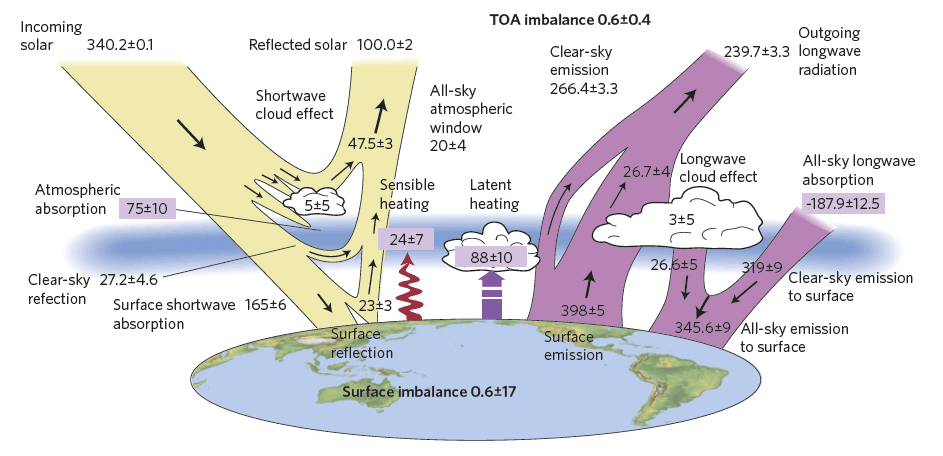
    *According to the Earth energy budget of Stephens et al. 2012, the atmosphere gains its energy by way of heat transfer from three different sources: (a) absorption of incoming (solar) radiation: 75 W/m2, (b) absorption of outgoing (terrestrial) radiation: [398-345.6-20=] 32.4 W/m2, and (c) conduction and water vapour condensation: [24+88=] 112 W/m2; all in all [75+32.4+112=] 219.4 W/m2. (Note how the atmospheric absorption of incoming radiative heat (from the Sun) is about 2.3 times as large as the absorption ofoutgoing radiative heat (from the surface). Likewise, how the conductive/latent heat transfer is nearly 3.5 times as large as the radiative heat transfer from the surface to the atmosphere. On a global average.)
    **
    stratosphere-radiation-by-species-1460
    Figure 2. The dotted line approximates the tropopause. H2O effectively does all the tropospheric cooling, from the entire column, but primarily from the upper levels. 

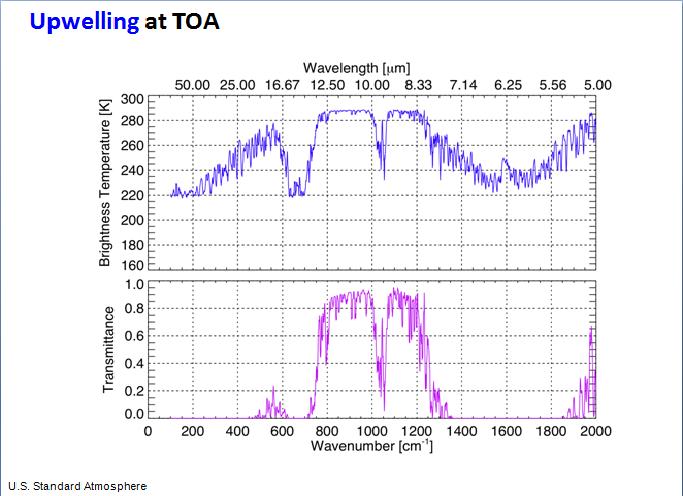
    upwelling_brightness1
    Figure 3. Fig. 2 confirmed. Lower diagram shows the surface radiation allowed through the atmospheric window, meaning 288K radiation directly from surface to space. Upper diagram shows Earth’s final/total radiative flux to space: surface (atm window) + troposphere. We see that what’s added to the surface radiation is derived from the water bands, from all temperature levels between surface and tropopause.