Showing posts sorted by relevance for query "known climate of the past" models. Sort by date Show all posts

Monday, August 12, 2013

New paper finds climate models cannot explain the global warming stagnation over past 15 years

A new paper by prominent German climatologists Dr. Hans von Storch and Dr. Eduardo Zorita, et al, finds "that the continued [global] warming stagnation over fifteen years, from 1998 -2012, is no longer consistent with model projections even at the 2% confidence level." In other words, there is a greater than 98% probability that climate models are unable to explain the stagnation in warming over the past 15+ years. The authors suggest 3 possible explanations for this:

1. the models underestimate natural climate variability

2. the climate models fail to include important forcings such as ocean oscillations and solar amplification

3. the models assume exaggerated climate sensitivity to man-made CO2

The authors point out that even if climate sensitivity to CO2 was greatly reduced future models, it is still "hardly feasible" that the models would reproduce the 15 year stagnation of temperature, stating, "a recalibration [with lower CO2 sensitivity] reproducing the reduced warming of the last 15 years appears hardly feasible." All of which suggests that CO2 is not the control knob of climate and natural variability is. 

Can climate models explain the recent stagnation in global warming?

Hans von Storch (1) , Armineh Barkhordarian (1) , Klaus Hasselmann (2) and Eduardo Zorita (1)

(1) Institute for Coastal Research, Helmholtz-Zentrum Geesthacht, Geesthacht, Germany
(2) Max-Planck-Institute for Meteorology, Hamburg, Germany

In recent years, the increase in near-surface global annual mean temperatures has emerged as considerably smaller than many had expected. We investigate whether this can be explained by contemporary climate change scenarios. In contrast to earlier analyses for a ten-year period that indicated consistency between models and observations at the 5% confidence level, we find that the continued warming stagnation over fifteen years, from 1998 -2012, is no longer consistent with model projections even at the 2% confidence level. Of the possible causes of the inconsistency, the underestimation of internal natural climate variability on decadal time scales is a plausible candidate, but the influence of unaccounted external forcing factors or an overestimation of the model sensitivity to elevated greenhouse gas concentrations cannot be ruled out. The first cause would have little impact of the expectations of longer term anthropogenic climate change, but the second and particularly the third would.

Estimates of the observed global warming for the recent 15-year period 1998-2012 vary between 0.00370C/year NCDC)(1), 0.00410C/year (HadCRUT4)(2) and 0.0080C/year (GISS)(3). These values are significantly lower than the average warming of 0.020C/year observed in the previous thirty years 1970-2000(4). Can models explain the global warming stagnation?
...
What do these inconsistencies imply for the utility of climate projections of anthropogenic climate
change? Three possible explanations of the inconsistencies can be suggested: 1) the models underestimate the internal natural climate variability; 2) the climate models fail to include important external forcing processes in addition to anthropogenic forcing, or 3) the climate model sensitivities to external anthropogenic forcing is too high,.

The first explanation is simple and plausible. Natural climate variability is an inevitable consequence of a slow system (climate) interacting with a fast system (weather) (10) . The forcing of the slow system by the (white noise) low-frequency components of the fast system produces a “Brownian motion” of the slow system, represented by a red variance spectrum - in qualitative agreement with observations.However, the details of the response depend strongly on the internal dynamics of the slow system in the time scale range of interest - in the present case, on decadal time scales. It is long known, from successive reports of the Intergovernmental Panel on Climate Change (4), that contemporary global climate models have only limited success in simulating many such processes, ranging from the variability of the ocean circulation, ENSO events, various coupled ocean-atmosphere oscillation regimes, to changes in sea ice, land surface, atmospheric chemistry and the biosphere. The inability to simulate the statistical internal climate variability may have been artificially compensated in the past by tuning the models to prescribed external forcings, such as volcanic eruptions and tropospheric aerosols.This would explain why simulations with historical forcing by different GCMs tend to be very similar and follow closely the observed record. This artificial "inflation”  (11) of forced variability at the expense of unpredictable natural variability works, however, only in the period of tuning, and no longer in the post-tuning phase since about 2000. The net effect of such a procedure is an underestimation of natural 3 variability and an overestimation of the response to forced variability. .  

Nevertheless, the second explanation cannot be ruled out: in the spirit of traditional model tuning, the recent stagnation in global warming could be assigned to an external forcing that is not included, or not included satisfactorily, in contemporary models. Volcanic eruptions and variations in solar insolation are frequently proposed candidates. However, while both explanations have supporters, a significant increase in recent volcanic activity has not been recorded, while variations in solar insolation or activity still require rather speculative amplification mechanisms that could contribute to the observed recent decrease in global warming (12,13)

Finally, the model overestimation of the global warming in the period 1998-2012 could be partially corrected by a reduction in the assumed model sensitivity to radiative forcing. In principle, climate model sensitivities are calibrated by fitting the climate response to the known seasonal and latitudinal variations in solar forcing, as well as by the observed climate change to increased anthropogenic forcing over a longer period, mostly during the 20th century. It would be difficult to modify the model calibration significantly to reproduce the recent global warming slow down while still satisfying these other major constraints. While adjusting the effect of aerosols may help to reconcile differences between observed and simulated long term trends 14 , and a recent study (15) argues that the true sensitivity may indeed lie at the lower range of the of the contemporary climate models, a recalibration reproducing the reduced warming of the last 15 years appears hardly feasible. Whether or not a later calibration of the CMIP5-models was undertaken is not known, but the CMIP3 models were run before the recent stagnation emerged.

We do not wish to suggest which of the three possible explanations is the most probable, leaving this for others to decide. Quite possibly, all three factors contribute to some extent. But we hope that the need to understand the origin of the recent stagnation in global warming will accelerate efforts to achieve a more reliable simulation of climate variability on decadal time scales, and the ability to disentangle the relative contributions of forced (deterministic) and internal [natural] (stochastic) variability. 

Thursday, June 21, 2012

Paper cross-examines global warming advocacy science and finds rhetorical tricks used to oversell and to hide uncertainty

A highly-recommended paper from the University of Virginia School of Law, Property and Environment Research Center cross-examines in detail the peer-reviewed literature of 'global warming advocacy science' and finds 
"a systematic tendency of the climate establishment to engage in a variety of stylized rhetorical techniques that seem to oversell what is actually known about climate change while concealing fundamental uncertainties and open questions regarding many of the key processes involved in climate change." 
The paper notes, 
"Fundamental open questions include not only the size but the direction of feedback effects that are responsible for the bulk of the temperature increase predicted to result from atmospheric greenhouse gas increases: while climate models all presume that such feedback effects are on balance strongly positive, more and more peer-edited scientific papers seem to suggest that feedback effects may be small or even negative. The cross-examination conducted in this paper reveals many additional areas where the peer-edited literature seems to conflict with the picture painted by establishment climate science, ranging from the magnitude of 20th century surface temperature increases and their relation to past temperatures; the possibility that inherent variability in the earth’s non-linear climate system, and not increases in CO2, may explain observed late 20th century warming; the ability of climate models to actually explain past temperatures; and, finally, substantial doubt about the methodological validity of models used to make highly publicized predictions of global warming impacts such as species loss. 

Insofar as establishment climate science has glossed over and minimized such fundamental questions and uncertainties in climate science, it has created widespread misimpressions that have serious consequences for optimal policy design."
Full paper available here

Global Warming Advocacy Science: A Cross Examination


Jason Scott Johnston 


University of Virginia - School of Law ; PERC - Property and Environment Research Center 

May 1, 2010

U of Penn, Inst for Law & Econ Research Paper No. 10-08 


Abstract:      
Legal scholarship has come to accept as true the various pronouncements of the Intergovernmental Panel on Climate Change (IPCC) and other scientists who have been active in the movement for greenhouse gas (ghg) emission reductions to combat global warming. The only criticism that legal scholars have had of the story told by this group of activist scientists - what may be called the climate establishment - is that it is too conservative in not paying enough attention to possible catastrophic harm from potentially very high temperature increases.

This paper departs from such faith in the climate establishment by comparing the picture of climate science presented by the Intergovernmental Panel on Climate Change (IPCC) and other global warming scientist advocates with the peer-edited scientific literature on climate change. A review of the peer-edited literature reveals a systematic tendency of the climate establishment to engage in a variety of stylized rhetorical techniques that seem to oversell what is actually known about climate change while concealing fundamental uncertainties and open questions regarding many of the key processes involved in climate change. Fundamental open questions include not only the size but the direction of feedback effects that are responsible for the bulk of the temperature increase predicted to result from atmospheric greenhouse gas increases: while climate models all presume that such feedback effects are on balance strongly positive, more and more peer-edited scientific papers seem to suggest that feedback effects may be small or even negative. The cross-examination conducted in this paper reveals many additional areas where the peer-edited literature seems to conflict with the picture painted by establishment climate science, ranging from the magnitude of 20th century surface temperature increases and their relation to past temperatures; the possibility that inherent variability in the earth’s non-linear climate system, and not increases in CO2, may explain observed late 20th century warming; the ability of climate models to actually explain past temperatures; and, finally, substantial doubt about the methodological validity of models used to make highly publicized predictions of global warming impacts such as species loss.

Insofar as establishment climate science has glossed over and minimized such fundamental questions and uncertainties in climate science, it has created widespread misimpressions that have serious consequences for optimal policy design. Such misimpressions uniformly tend to support the case for rapid and costly decarbonization of the American economy, yet they characterize the work of even the most rigorous legal scholars. A more balanced and nuanced view of the existing state of climate science supports much more gradual and easily reversible policies regarding greenhouse gas emission reduction, and also urges a redirection in public funding of climate science away from the continued subsidization of refinements of computer models and toward increased spending on the development of standardized observational datasets against which existing climate models can be tested.


From the conclusion:


III. Conclusion: Questioning the Established Science, and Developing a Suitably
Skeptical Rather than Faith-based Climate Policy


Even if the reader is at this point persuaded to believe that there remain very important open questions about ghg emissions and global warming, and important areas of disagreement among climate scientists, she may well ask: So what? After all, such a reader might argue, CO2 is a ghg, and if we continue to increase CO2, then it seems clear that despite whatever uncertainty there may be about how much temperatures will increase as a consequence of increasing CO2 in the atmosphere,  and about the impacts of such rising temperatures, there is no doubt that temperatures will increase with increasing CO2, and that at some point, such rising temperatures will cause harm, so that one way or another, at one time or another, we simply have to reduce our emissions of CO2.


However beguiling, such an argument not only oversimplifies the policy questions raised by human ghg emissions, it is also misunderstands the significance of the scientific questions revealed by my cross examination for the predictability of anthroprogenically-forced climate change.  Consider first the scientific questions. If climate were a simple linear system – with increases in atmospheric CO2 directly and simply determining future warming – then while a detailed understanding of the earth’s climate system might still of scientific interest, there would be little policy justification for expending large amounts of public money to gain such an understanding.   But if one thing is clear in climate science it is that the earth’s climate system is not linear, but is instead a highly complex, non-linear system made up of sub-systems – such as the ENSO, and the North Atlantic Oscillation, and the various circulating systems of the oceans – that are themselves highly non-linear.  Among other things, such non-linearity means that it may be extremely difficult to separately identify the impact of an external shock to the system – such as what climate scientists call anthropogenic CO2 forcing – from changes that are simply due to natural cycles, or due to other external natural and anthropogenic forces, such as solar variation and human land use changes.   Perhaps even more importantly, any given forcing may have impacts that are much larger – in the case of positive feedbacks – or much smaller – in the case of negative feedbacks – than a simple, linear vision of the climate system would suggest.  Because of the system’s complexity and non-linearity, without a quite detailed understanding of the system, scientists cannot provide useful guidance regarding the impact on climate of increases in atmospheric ghg concentration.


As a large number of climate scientists have stressed, such an understanding will come about only if theoretical and model-driven predictions are tested against actual observational evidence.  This is just to say that to really provide policymakers with the kind of information they need, climate scientists ought to follow the scientific method of developing theories and then testing those theories against the best available evidence.  It is here that the cross examination conducted above yields its most valuable lesson, for it reveals what seem to be systematic patterns and practices that diverge from, and problems that impede, the application of basic scientific methods in establishment climate science.  Among the most surprising and yet standard practices is a tendency in establishment climate science to simply ignore published studies that develop and/or present evidence tending to disconfirm various predictions or assumptions of the establishment view that increases in CO2 explain virtually all recent climate change. Perhaps even more troubling, when establishment climate scientists do respond to studies supporting alternative hypotheses to the CO2 primacy view, they more often than not rely upon completely different observational datasets which they say confirm (or at least don’t disconfirm) climate model predictions. The point is important and worth further elucidation: while there are quite a large number of published papers reporting evidence that seems to disconfirm one or another climate model prediction, there is virtually no instance in which establishment climate scientists have taken such disconfirming evidence as an indication that the climate models may simply be wrong.  Rather, in every important case, the establishment response is to question the reliability of the disconfirming evidence and then to find other evidence that is consistent with model predictions.  Of course, the same point may be made of climate scientists who present the disconfirming studies: they tend to rely upon different datasets than do establishment climate scientists.  From either point of view, there seems to be a real problem for climate science: With many crucial, testable predications – as for example the model prediction of differential tropical tropospheric versus surface warming – there is no indication that climate scientists are converging toward the use of standard observational datasets that they agree to be valid and reliable.


Without such convergence, the predictions of climate models (and climate change theories more generally) cannot be subject to empirical testing, for it will always be possible for one side in any dispute to use one observational dataset and the other side to use some other observational dataset.  Hence perhaps the central policy implication of the cross-examination conducted above is a very concrete and yet perhaps surprising one: public funding for climate science should be concentrated on the development of better, standardized observational datasets that achieve close to universal acceptance as valid and reliable.  We should not be using public money to pay for faster and faster computers so that increasingly fine-grained climate models can be subjected to ever larger numbers of simulations until we have got the data to test whether the predictions of existing models are confirmed (or not disconfirmed) by the evidence.


This might seem like a more or less obvious policy recommendation, but if it were taken, it would represent not only a change in climate science funding practices, but also a reaffirmation of the role of basic scientific methodology in guiding publicly funded climate science.  As things now stand, the advocates representing the establishment climate science story broadcast (usually with color diagrams) the predictions of climate models as if they were the results of experiments – actual evidence.   Alongside these multi-colored multi-century model-simulated time series come stories, anecdotes, and photos – such as the iconic stranded polar bear -- dramatically illustrating climate change today.   On this rhetorical strategy, the models are to be taken on faith, and the stories and photos as evidence of the models’ truth.  Policy carrying potential costs in the trillions of dollars ought not to be based on stories and photos confirming faith in models, but rather on precise and replicable testing of the models’ predictions against solid observational data.

Friday, September 19, 2014

WSJ Op-Ed: Climate Science Is Not Settled. We are very far from the knowledge needed to make good climate policy

Physicist Dr. Steven Koonin, who is the Chairman of the American Physical Society [APS] subcommittee in charge of revising the APS 2007 Climate Change Statement, reveals in this Wall Street Journal op-ed his skepticism of the so-called "settled" climate "consensus," and notes the fundamental unanswered problems of climate sensitivity to CO2, feedbacks, the many problems inherent in climate models, the lack of understanding and "several dozen" excuses for the 18+ year "pause" of global warming, the missing AGW 'hot spot', lack of acceleration of sea level rise [which means there is no evidence of a man-made influence on sea levels], the IPCC's willful omission of these problems in the Summary for Policymakers, and other fundamental issues regarding the fictitious so-called "settled" "consensus."

Dr. Koonin also served as Undersecretary for Science in the US Department of Energy during President Barack Obama’s first term.

The forthcoming revision of the APS Climate Change Statement will likely reflect Chairman Koonin's skeptical views, which has some rabid warmists very worried that "the APS has been arrogantly negligent in its handling of the coming Climate Change position statement," that Chairman Dr. Koonin has "hit the fan," and "this sucks."


Physicist Dr. Steven Koonin

Climate Science Is Not Settled

We are very far from the knowledge needed to make good climate policy, writes leading scientist Steven E. Koonin

By STEVEN E. KOONIN
Sept. 19, 2014 12:19 p.m. ET       THE WALL STREET JOURNAL


The crucial scientific question for policy isn't whether the climate is changing. That is a settled matter: The climate has always changed and always will. Mitch Dobrowner

The idea that "Climate science is settled" runs through today's popular and policy discussions. Unfortunately, that claim is misguided. It has not only distorted our public and policy debates on issues related to energy, greenhouse-gas emissions and the environment. But it also has inhibited the scientific and policy discussions that we need to have about our climate future.

My training as a computational physicist—together with a 40-year career of scientific research, advising and management in academia, government and the private sector—has afforded me an extended, up-close perspective on climate science. Detailed technical discussions during the past year with leading climate scientists have given me an even better sense of what we know, and don't know, about climate. I have come to appreciate the daunting scientific challenge of answering the questions that policy makers and the public are asking.

The crucial scientific question for policy isn't whether the climate is changing. That is a settled matter: The climate has always changed and always will. Geological and historical records show the occurrence of major climate shifts, sometimes over only a few decades. We know, for instance, that during the 20th century the Earth's global average surface temperature rose 1.4 degrees Fahrenheit.

Nor is the crucial question whether humans are influencing the climate. That is no hoax: There is little doubt in the scientific community that continually growing amounts of greenhouse gases in the atmosphere, due largely to carbon-dioxide emissions from the conventional use of fossil fuels, are influencing the climate. There is also little doubt that the carbon dioxide will persist in the atmosphere for several centuries. The impact today of human activity appears to be comparable to the intrinsic, natural variability of the climate system itself.

Rather, the crucial, unsettled scientific question for policy is, "How will the climate change over the next century under both natural and human influences?" Answers to that question at the global and regional levels, as well as to equally complex questions of how ecosystems and human activities will be affected, should inform our choices about energy and infrastructure.

But—here's the catch—those questions are the hardest ones to answer. They challenge, in a fundamental way, what science can tell us about future climates.

Even though human influences could have serious consequences for the climate, they are physically small in relation to the climate system as a whole. For example, human additions to carbon dioxide in the atmosphere by the middle of the 21st century are expected to directly shift the atmosphere's natural greenhouse effect by only 1% to 2%. Since the climate system is highly variable on its own, that smallness sets a very high bar for confidently projecting the consequences of human influences.

A second challenge to "knowing" future climate is today's poor understanding of the oceans. The oceans, which change over decades and centuries, hold most of the climate's heat and strongly influence the atmosphere. Unfortunately, precise, comprehensive observations of the oceans are available only for the past few decades; the reliable record is still far too short to adequately understand how the oceans will change and how that will affect climate.

A third fundamental challenge arises from feedbacks that can dramatically amplify or mute the climate's response to human and natural influences. One important feedback, which is thought to approximately double the direct heating effect of carbon dioxide, involves water vapor, clouds and temperature.


Scientists measure the sea level of the Ross Sea in Antarctica. National Geographic/Getty Images

But feedbacks are uncertain. They depend on the details of processes such as evaporation and the flow of radiation through clouds. They cannot be determined confidently from the basic laws of physics and chemistry, so they must be verified by precise, detailed observations that are, in many cases, not yet available.

Beyond these observational challenges are those posed by the complex computer models used to project future climate. These massive programs attempt to describe the dynamics and interactions of the various components of the Earth system—the atmosphere, the oceans, the land, the ice and the biosphere of living things. While some parts of the models rely on well-tested physical laws, other parts involve technically informed estimation. Computer modeling of complex systems is as much an art as a science.

For instance, global climate models describe the Earth on a grid that is currently limited by computer capabilities to a resolution of no finer than 60 miles. (The distance from New York City to Washington, D.C., is thus covered by only four grid cells.) But processes such as cloud formation, turbulence and rain all happen on much smaller scales. These critical processes then appear in the model only through adjustable assumptions that specify, for example, how the average cloud cover depends on a grid box's average temperature and humidity. In a given model, dozens of such assumptions must be adjusted ("tuned," in the jargon of modelers) to reproduce both current observations and imperfectly known historical records.

We often hear that there is a "scientific consensus" about climate change. But as far as the computer models go, there isn't a useful consensus at the level of detail relevant to assessing human influences. Since 1990, the United Nations Intergovernmental Panel on Climate Change, or IPCC, has periodically surveyed the state of climate science. Each successive report from that endeavor, with contributions from thousands of scientists around the world, has come to be seen as the definitive assessment of climate science at the time of its issue.


There is little doubt in the scientific community that continually growing amounts of greenhouse gases in the atmosphere, due largely to carbon-dioxide emissions from the conventional use of fossil fuels, are influencing the climate. Pictured, an estuary in Patgonia.


For the latest IPCC report (September 2013), its Working Group I, which focuses on physical science, uses an ensemble of some 55 different models. Although most of these models are tuned to reproduce the gross features of the Earth's climate, the marked differences in their details and projections reflect all of the limitations that I have described. For example:

• The models differ in their descriptions of the past century's global average surface temperature by more than three times the entire warming recorded during that time. Such mismatches are also present in many other basic climate factors, including rainfall, which is fundamental to the atmosphere's energy balance. As a result, the models give widely varying descriptions of the climate's inner workings. Since they disagree so markedly, no more than one of them can be right.

• Although the Earth's average surface temperature rose sharply by 0.9 degree Fahrenheit during the last quarter of the 20th century, it has increased much more slowly for the past 16 years, even as the human contribution to atmospheric carbon dioxide has risen by some 25%. This surprising fact demonstrates directly that natural influences and variability are powerful enough to counteract the present warming influence exerted by human activity.

Yet the models famously fail to capture this slowing in the temperature rise. Several dozen different explanations for this failure have been offered, with ocean variability most likely playing a major role. But the whole episode continues to highlight the limits of our modeling.

• The models roughly describe the shrinking extent of Arctic sea ice observed over the past two decades, but they fail to describe the comparable growth of Antarctic sea ice, which is now at a record high.

• The models predict that the lower atmosphere in the tropics will absorb much of the heat of the warming atmosphere. But that "hot spot" has not been confidently observed, casting doubt on our understanding of the crucial feedback of water vapor on temperature.

• Even though the human influence on climate was much smaller in the past, the models do not account for the fact that the rate of global sea-level rise 70 years ago was as large as what we observe today—about one foot per century.

• A crucial measure of our knowledge of feedbacks is climate sensitivity—that is, the warming induced by a hypothetical doubling of carbon-dioxide concentration. Today's best estimate of the sensitivity (between 2.7 degrees Fahrenheit and 8.1 degrees Fahrenheit) is no different, and no more certain, than it was 30 years ago. And this is despite an heroic research effort costing billions of dollars.

These and many other open questions are in fact described in the IPCC research reports, although a detailed and knowledgeable reading is sometimes required to discern them. They are not "minor" issues to be "cleaned up" by further research. Rather, they are deficiencies that erode confidence in the computer projections. Work to resolve these shortcomings in climate models should be among the top priorities for climate research.

Yet a public official reading only the IPCC's "Summary for Policy Makers" would gain little sense of the extent or implications of these deficiencies. These are fundamental challenges to our understanding of human impacts on the climate, and they should not be dismissed with the mantra that "climate science is settled."

While the past two decades have seen progress in climate science, the field is not yet mature enough to usefully answer the difficult and important questions being asked of it. This decidedly unsettled state highlights what should be obvious: Understanding climate, at the level of detail relevant to human influences, is a very, very difficult problem.

We can and should take steps to make climate projections more useful over time. An international commitment to a sustained global climate observation system would generate an ever-lengthening record of more precise observations. And increasingly powerful computers can allow a better understanding of the uncertainties in our models, finer model grids and more sophisticated descriptions of the processes that occur within them. The science is urgent, since we could be caught flat-footed if our understanding does not improve more rapidly than the climate itself changes.

A transparent rigor would also be a welcome development, especially given the momentous political and policy decisions at stake. That could be supported by regular, independent, "red team" reviews to stress-test and challenge the projections by focusing on their deficiencies and uncertainties; that would certainly be the best practice of the scientific method. But because the natural climate changes over decades, it will take many years to get the data needed to confidently isolate and quantify the effects of human influences.

Policy makers and the public may wish for the comfort of certainty in their climate science. But I fear that rigidly promulgating the idea that climate science is "settled" (or is a "hoax") demeans and chills the scientific enterprise, retarding its progress in these important matters. Uncertainty is a prime mover and motivator of science and must be faced head-on. It should not be confined to hushed sidebar conversations at academic conferences.

Society's choices in the years ahead will necessarily be based on uncertain knowledge of future climates. That uncertainty need not be an excuse for inaction. There is well-justified prudence in accelerating the development of low-emissions technologies and in cost-effective energy-efficiency measures.

But climate strategies beyond such "no regrets" efforts carry costs, risks and questions of effectiveness, so nonscientific factors inevitably enter the decision. These include our tolerance for risk and the priorities that we assign to economic development, poverty reduction, environmental quality, and intergenerational and geographical equity.

Individuals and countries can legitimately disagree about these matters, so the discussion should not be about "believing" or "denying" the science. Despite the statements of numerous scientific societies, the scientific community cannot claim any special expertise in addressing issues related to humanity's deepest goals and values. The political and diplomatic spheres are best suited to debating and resolving such questions, and misrepresenting the current state of climate science does nothing to advance that effort.

Any serious discussion of the changing climate must begin by acknowledging not only the scientific certainties but also the uncertainties, especially in projecting the future. Recognizing those limits, rather than ignoring them, will lead to a more sober and ultimately more productive discussion of climate change and climate policies. To do otherwise is a great disservice to climate science itself.

Dr. Koonin was undersecretary for science in the Energy Department during President Barack Obama's first term and is currently director of the Center for Urban Science and Progress at New York University. His previous positions include professor of theoretical physics and provost at Caltech, as well as chief scientist of BP, where his work focused on renewable and low-carbon energy technologies.

Tuesday, May 18, 2010

American Physical Society begins to Backpedal on Climate Policy

The Council of the American Physical Society (APS) has adopted on April 18, 2010 a "Climate Change Commentary" to append to their definitive and "incontrovertible" 2007 policy statement on climate change. The commentary allows considerable backpedaling from the prior policy while appearing to save face. The commentary removes the word incontrovertible because such words are "rarely used in science because by its very nature science questions prevailing ideas." The statement "While there are factors driving the natural variability of climate (e.g., volcanoes, solar variability, oceanic oscillations), no known natural mechanisms have been proposed that explain all of the observed warming in the past century." is added, and while not true since there are a number of papers which show that ocean oscillations and solar variability can explain all of the 0.7 degree warming of the past century, it is a step in the right direction from the 2007 policy which makes no mention of natural forcing and blames climate change on man-made emissions of CO2.

For the first time there is acknowledgement of the uncertainties associated with models, including the statement "These models have uncertainties associated with radiative response functions, especially clouds and water vapor. However, the models show that water vapor has a net positive feedback effect (in addition to CO2 and other gases) on global temperatures. The impact of clouds is less certain because of their dual role as scatterers of incoming solar radiation and as greenhouse contributors." While it is true the models show net positive feedback, that is only because that is how they were programmed, and no mention is made of the empirical satellite and weather balloon data which show the net feedback is actually negative. At least, the commentary begins to indicate large uncertainties with climate modeling.

The commentary adds "The uncertainty in the estimates from various climate models for doubling CO2-equivalent concentration is in the range of 1°C to 3°C with the probability distributions having long tails out to much larger temperature changes.", without mentioning that 1°C global warming is what is expected from the no feedback model and even less from the negative feedback model as supported by data, which is likely to be beneficial and is hardly cause for alarm or cap & tax schemes. As Richard Lindzen and Roy Spencer have repeatedly pointed out, the real issue to be determined is the sensitivity of the climate to changes in CO2, for which all the empirical data show the models have greatly overestimated sensitivity. If there is low sensitivity, there is no cause for alarm.

Here is the original 2007 policy, followed by the new Commentary:

Tuesday, August 6, 2013

New paper finds climate models are unable to reproduce the known climate of the past 6,000 years

A new paper published in Climate of the Past finds climate models are unable to reproduce the climate change of the past 6,000 years found by temperature proxies. According to the authors, "Independently of the choice of the climate model, we observe significant mismatches between modelled and estimated SST [Sea Surface Temperature] amplitudes in the trends for the last 6,000 years," and climate model "SST trends underestimate the [proxy] SST trends by a factor of two to five. For [a different proxy], no significant relationship between model simulations and proxy reconstructions can be detected." The paper adds to many other peer-reviewed papers finding climate models are unable to reproduce the known climate of the past, much less the future. 

Clim. Past, 9, 1807-1839, 2013
www.clim-past.net/9/1807/2013/
doi:10.5194/cp-9-1807-2013


A model–data comparison of the Holocene global sea surface temperature evolution

G. Lohmann1, M. Pfeiffer1, T. Laepple1, G. Leduc2, and J.-H. Kim3
1Alfred Wegener Institute, Helmholtz Centre for Polar and Marine Research, Bussestrasse 24, 27570 Bremerhaven, Germany
2Kiel University, Institute of Earth Sciences, Ludewig-Meyn-Str. 10, 24118 Kiel, Germany
3Royal Netherlands Institute for Sea Research, P.O. Box 59, 1790 AB Den Burg, Texel, the Netherlands

Abstract. We compare the ocean temperature evolution of the Holocene as simulated by climate models and reconstructed from marine temperature proxies. We use transient simulations from a coupled atmosphere–ocean general circulation model, as well as an ensemble of time slice simulations from the Paleoclimate Modelling Intercomparison Project. The general pattern of sea surface temperature (SST) in the models shows a high-latitude cooling and a low-latitude warming. The proxy dataset comprises a global compilation of marine alkenone- and Mg/Ca-derived SST estimates. Independently of the choice of the climate model, we observe significant mismatches between modelled and estimated SST amplitudes in the trends for the last 6000 yr. Alkenone-based SST records show a similar pattern as the simulated annual mean SSTs, but the simulated SST trends underestimate the alkenone-based SST trends by a factor of two to five. For Mg/Ca, no significant relationship between model simulations and proxy reconstructions can be detected. We test if such discrepancies can be caused by too simplistic interpretations of the proxy data. We explore whether consideration of different growing seasons and depth habitats of the planktonic organisms used for temperature reconstruction could lead to a better agreement of model results with proxy data on a regional scale. The extent to which temporal shifts in growing season or vertical shifts in depth habitat can reduce model–data misfits is determined. We find that invoking shifts in the living season and habitat depth can remove some of the model–data discrepancies in SST trends. Regardless whether such adjustments in the environmental parameters during the Holocene are realistic, they indicate that when modelled temperature trends are set up to allow drastic shifts in the ecological behaviour of planktonic organisms, they do not capture the full range of reconstructed SST trends. Results indicate that modelled and reconstructed temperature trends are to a large degree only qualitatively comparable, thus providing a challenge for the interpretation of proxy data as well as the model sensitivity to orbital forcing.

Tuesday, September 17, 2013

Executive Summary of the NIPCC Climate Change Reconsidered II Report

Executive Summary from the NIPCC Climate Change Reconsidered II Report, released 9/16/13:


Executive Summary 

This report is produced by the Nongovernmental International Panel on Climate Change (NIPCC), a joint project of three organizations: Center for the Study of Carbon Dioxide and Global Change, Science & Environmental Policy Project, and The Heartland Institute. 

Three lead authors -- Craig D. Idso, Robert M. Carter, and S. Fred Singer – assembled and worked closely with nearly 50 chapter lead authors, contributors, and reviewers from 15 countries. This volume was subjected to the common standards of peer-review.  This work provides the scientific balance that is missing from the overly alarmists reports of the United Nations’ Intergovernmental Panel on Climate Change (IPCC), which are highly selective in their review of climate science and controversial with regard to their projections of future climate change. Although the IPCC claims to be unbiased and to have based its assessment on the best available science, we have found this to not be the case. In many instances conclusions have been seriously exaggerated, relevant facts have been distorted, and key scientific studies have been ignored.  

In keeping with its “Red Team” mission, NIPCC authors paid special attention to contributions that were either overlooked by the IPCC or that contain data, discussion, or implications arguing against the IPCC’s claim that dangerous global warming is resulting, or will result, from human-related greenhouse gas emissions. Most notably, its authors say the IPCC has exaggerated the amount of warming they predict to occur in response to future increases in atmospheric CO2. Any warming that may occur is likely to be modest and cause no net harm to the global environment or to human well-being. 

Key Findings by Chapter 

Chapter 1. Global Climate Models and Their Limitations 

• Properties inherent in models make dynamic predictability impossible. Without dynamic predictability, other techniques must be used to simulate climate. Such techniques introduce biases of varying magnitude into model projections. 

• To have any validity in terms of future projections, GCMs must incorporate not only the many physical processes involved in determining climate, but also all important chemical and biological processes that influence climate over long time periods. Several of these important processes are either missing or inadequately represented in today’s state-of-the-art climate models. 

• Limitations in computing power frequently result in the inability of models to resolve important climate processes. Low-resolution models fail to capture many important phenomena of regional and lesser scales, such as clouds; downscaling to higher-resolution models introduces boundary interactions that can contaminate the modelling area and propagate error. 

• The magnitude of the range of projected responses to a doubling of atmospheric CO2 by itself establishes that large errors and limitations in the models remain to be corrected. 

• Many GCMs fail to account properly for certain “multiplier effects” that may significantly amplify the initial impacts of various biospheric processes. For example, although the absolute variations associated with some solar-related phenomena are rather small, Several multiplier effects may significantly amplify the initial perturbation. 

• Major imperfections in the models prevent proper simulation of important elements of the climate system, including pressure, wind, clouds, temperature, precipitation, ocean currents, sea ice, permafrost, etc. Large differences between model predictions and observations frequently exist when comparing these elements or features. In some cases computer models fail to simulate even the correct sign of the observed parameters. 

• Although some improvements have been noted in performance between the CMIP3 set of models used in AR4 and the newer CMIP5 models utilized in AR5, many researchers report finding little or no improvement in the CMIP5 model output for several important parameters and features of Earth’s climate. 

Chapter 2. Forcings and Feedbacks 

• Research published in peer-reviewed science journals indicates the model-derived temperature sensitivity of Earth accepted by the IPCC is too large. Negative feedbacks in the climate system reduce that sensitivity to values an order of magnitude smaller. 

• Establishing the historic phase relationship between atmospheric carbon dioxide and temperature is a necessary step toward understanding the physical relationship between CO2 forcing and climate change. When such analyses are conducted, changes in CO2 are frequently seen to lag changes in temperature by several hundred years. 

• Many studies reveal a large uncoupling of temperature and CO2 throughout portions of the historical record. Such findings contradict the IPCC’s theory that changes in atmospheric CO2 drive changes in temperature. 

• Atmospheric methane observations over the past two decades reside far below the values projected by the IPCC in each of the four Assessment Reports it has released to date. The IPCC’s temperature projections, which incorporate this inflated influence, should be revised downward to account for this discrepancy. 

• Because agriculture accounts for almost half of nitrous oxide (N2O) emissions in some countries, there is concern that enhanced plant growth due to CO2 enrichment might increase the amount and warming effect of this greenhouse gas. But field research shows N2O emissions will likely fall as CO2 concentrations and temperatures rise, indicating this is actually another negative climate feedback. 

• The IPCC has concluded “the net radiative feedback due to all cloud types is likely positive” (p. 9 of the Summary for Policy Makers, Second Order Draft of AR5, dated October 5, 2012). Contrary to that assessment, several studies indicate the net global effect of cloud feedbacks is a cooling, the magnitude of which may equal or exceed the warming projected from increasing greenhouse gases. 

• The IPCC likely underestimates the total cooling effect of aerosols. Studies have found their radiative effect is comparable to or larger than the temperature forcing caused by all the increase in greenhouse gas concentrations recorded since preindustrial times. 

• Higher temperatures are known to increase emissions of dimethyl sulfide (DMS) from the world’s oceans, which increases the albedo of marine stratus clouds, which has a cooling effect. The IPCC characterizes this chain of events as “a rather weak aerosol-climate feedback at the global scale” (p. 21 of the Technical Summary, Second Order Draft of AR5, dated October 5, 2012), but many studies suggest otherwise. 

• Several other important negative forcings and feedbacks exist in nature, about which little is known or acknowledged by the IPCC. Such forcings and feedbacks have been shown by multiple scientific studies to significantly influence Earth’s climate to a degree comparable to that of projected anthropogenic-induced global warming. 

• The IPCC claims a positive feedback exists between climate and the carbon cycle on century to millennial time scales such that a warming climate will result in a loss of carbon storage. There is no empirical evidence to support such an assertion. Just the opposite appears to be the case, as global carbon uptake doubled over the past half century. 

Chapter 3. Solar Forcing of Climate 

• Evidence is accruing that changes in Earth’s surface temperature are largely driven by variations in solar activity. Examples of solar controlled climate change epochs include the Medieval Warm Period, Little Ice Age and Early Twentieth Century (1910–1940) Warm Period. 

• The Sun may have contributed as much as 66% of the observed twentieth century warming, and perhaps more. 

• Strong empirical correlations have been reported from all around the world between solar variability and climate indices including temperature, precipitation, droughts, floods, streamflow, and monsoons. 

• IPCC models do not incorporate important solar factors such as fluctuations in magnetic intensity and overestimate the role of human-related CO2 forcing. 

• The IPCC fails to consider the importance of the demonstrated empirical relationship between solar activity, the ingress of galactic cosmic rays, and the formation of low clouds. 

• The respective importance of the Sun and CO2 in forcing Earth climate remains unresolved; current climate models fail to account for a plethora of known Sun-climate connections. 

• The recently quiet Sun and extrapolation of solar cycle patterns into the future suggest a planetary cooling may occur over the next few decades. 

Chapter 4. Observations: Temperature Records 

• The warming of the late-twentieth-century as well as the cessation of warming that occurred since 1998 fall well within the range of natural climate variability. 

• Surface-based temperature histories of the globe contain a significant warming bias introduced by insufficient corrections for the non-greenhouse gas-induced urban heat island effect. Filtering out urbanization and related land-use effects in the temperature record is a complicated task, and there is solid evidence the methods currently used are inadequate. 

• Although all greenhouse models show an increasing warming trend with altitude, peaking around 10 km at roughly two times the surface value, the temperature data from balloons give the opposite result: no increasing warming, but rather a slight cooling with altitude in the tropical zone. 

• The IPCC claim of robust evidence of amplified CO2-induced warming in Earth’s polar regions is false, having been invalidated time and again by real-world data. 

• Earth’s climate has both cooled and warmed independent of its atmospheric CO2 concentration, revealing the true inability of carbon dioxide to drive climate change throughout the Holocene. Conditions as warm as, or warmer than, the present have persisted across the Holocene for decades and centuries even though the atmosphere’s CO2 concentration remained at values approximately 30% lower than those of today. 

• An enormous body of literature clearly demonstrates the IPCC’s assessment of the Medieval Climate Anomaly (MCA) is incorrect. The degree of warming and climatic influence during the MCA indeed varied from region to region, and hence its consequences were manifested in a variety of different ways. But that it occurred and was a global phenomenon is certain. 

• Computer model simulations have given rise to three claims regarding the influence of global warming on ENSO events: (1) global warming will increase the frequency of ENSO events, (2) global warming will increase the intensity of ENSO events, and (3) weather-related disasters will be exacerbated under El Niño conditions. However, this is generally not what observational data reveal to be the case. In fact, in nearly all historical records it is seen that frequent and strong El Niño activity increases during periods of colder temperatures (e.g., the Little Ice Age) and decreases during warm ones (e.g., Medieval Warm Period, Current Warm Period). 

Chapter 5. Observations: The Cryosphere 

• Satellite and airborne geophysical datasets used to quantify the global ice budget are short and the methods involved in their infancy, but results to date suggest both the Greenland and Antarctic Ice Caps are close to balance. 

• Deep ice cores from Antarctica and Greenland show climate change occurs as both major glacial-interglacial cycles and as shorter decadal and centennial events with high rates of warming and cooling, including abrupt temperature steps. 

• Observed changes in temperature, snowfall, ice flow speed, glacial extent, and iceberg calving in both Greenland and Antarctica appear to lie within the limits of natural climate variation. 

• Global sea-ice cover remains similar in area to that at the start of satellite observations in 1979, with ice shrinkage in the Arctic Ocean since then being offset by growth around Antarctica. 

• During the past 25,000 years (late Pleistocene and Holocene) glaciers around the world have fluctuated broadly in concert with changing climate, at times shrinking to positions and volumes smaller than today. 

• This fact notwithstanding, mountain glaciers around the world show a wide variety of responses to local climate variation, and do not respond to global temperature change in a simple, uniform way. 

• Tropical mountain glaciers in both South America and Africa have retreated in the past 100 years because of reduced precipitation and increased solar radiation; some glaciers elsewhere also have retreated since the end of the Little Ice Age. 

• The data on global glacial history and ice mass balance do not support the claims made by the IPCC that CO2 emissions are causing most glaciers today to retreat and melt.

• No evidence exists that current changes in Arctic permafrost are other than natural or that methane released by thawing would significantly affect Earth’s climate.

• Most of Earth’s gas hydrates occur at low saturations and in sediments at such great depths below the seafloor or onshore permafrost that they will barely be affected by warming over even one thousand years. 

Chapter 6. Observations: The Hydrosphere and Oceans The Hydrosphere 

• Little evidence exists for an overall increase in global precipitation during the twentieth century independent of natural multidecadal climate rhythmicity. 

• Monsoon precipitation did not become more variable or intense during late twentieth century warming; instead, precipitation responded mostly to variations in solar activity. 

• South American and Asian monsoons were more active during the cold Little Ice Age and less active during the Medieval Warm Period. Neither global nor local changes in streamflow have been linked to CO2 emissions. 

• The relationship between drought and global warming is weak, since severe droughts occurred during both the Medieval Warm Period and the Little Ice Age.Oceans 

• Knowledge of local sea-level change is vital for coastal management; such change occurs at widely variable rates around the world, typically between about +5 and -5 mm/year. 

• Global (eustatic) sea level, knowledge of which has only limited use for coastal management, rose at an average rate of between 1 and 2 mm/year over the past century. 

• Satellite altimeter studies of sea-level change indicate rates of global rise since 1993 of over 3 mm/year, but complexities of processing and the infancy of the method precludes viewing this result as secure. 

• Rates of global sea-level change vary in decadal and multidecadal ways and show neither recent acceleration nor any simple relationship with increasing CO2 emissions. 

• Pacific coral atolls are not being drowned by extra sea-level rise; rather, atoll shorelines are affected by direct weather and infrequent high tide events, ENSO sea level variations, and impacts of increasing human populations. 

• Extra sea-level rise due to heat expansion (thermosteric rise) is also unlikely given that the Argo buoy network shows no significant ocean warming over the past 9 years. 

• Though the range of natural variation has yet to be fully described, evidence is lacking for any recent changes in global ocean circulation that lie outside natural variation or were forced by human CO2emissions. 

Chapter 7. Observations: Extreme Weather 

• Air temperature variability decreases as mean air temperature rises, on all time scales. 

• Therefore the claim that global warming will lead to more extremes of climate and weather, including of temperature itself, seems theoretically unsound; the claim is also unsupported by empirical evidence. 

• Although specific regions have experienced significant changes in the intensity or number of extreme events over the twentieth century, for the globe as a whole no relationship exists between such events and global warming over the past 100 years. 

• Observations from across the planet demonstrate droughts have not become more extreme or erratic in response to global warming. In most cases, the worst droughts in recorded meteorological history were much milder than droughts that occurred periodically during much colder times. 

• There is little or no evidence that precipitation will become more variable and intense in a warming world; indeed, some observations show just the opposite. 

• There has been no significant increase in either the frequency or intensity of stormy weather in the modern era. 

• Despite the supposedly “unprecedented” warming of the twentieth century, there has been no increase in the intensity or frequency of tropical cyclones globally or in any of the specific ocean basins. 

Wednesday, February 19, 2014

McNider and Christy: Why John Kerry Is Flat Wrong on Climate Change

McNider and Christy: Why Kerry Is Flat Wrong on Climate Change
It was the scientific skeptics who bucked the 'consensus' and said the Earth was round.

By RICHARD MCNIDER and JOHN CHRISTY
Updated Feb. 19, 2014 7:31 p.m. ET The Wall Street Journal

In a Feb. 16 speech in Indonesia, Secretary of State John Kerry assailed climate-change skeptics as members of the "Flat Earth Society" for doubting the reality of catastrophic climate change. He said, "We should not allow a tiny minority of shoddy scientists" and "extreme ideologues to compete with scientific facts."

But who are the Flat Earthers, and who is ignoring the scientific facts? In ancient times, the notion of a flat Earth was the scientific consensus, and it was only a minority who dared question this belief. We are among today's scientists who are skeptical about the so-called consensus on climate change. Does that make us modern-day Flat Earthers, as Mr. Kerry suggests, or are we among those who defy the prevailing wisdom to declare that the world is round?


Most of us who are skeptical about the dangers of climate change actually embrace many of the facts that people like Bill Nye, the ubiquitous TV "science guy," say we ignore. The two fundamental facts are that carbon-dioxide levels in the atmosphere have increased due to the burning of fossil fuels, and carbon dioxide in the atmosphere is a greenhouse gas, trapping heat before it can escape into space.

What is not a known fact is by how much the Earth's atmosphere will warm in response to this added carbon dioxide. The warming numbers most commonly advanced are created by climate computer models built almost entirely by scientists who believe in catastrophic global warming. The rate of warming forecast by these models depends on many assumptions and engineering to replicate a complex world in tractable terms, such as how water vapor and clouds will react to the direct heat added by carbon dioxide or the rate of heat uptake, or absorption, by the oceans.

We might forgive these modelers if their forecasts had not been so consistently and spectacularly wrong. From the beginning of climate modeling in the 1980s, these forecasts have, on average, always overstated the degree to which the Earth is warming compared with what we see in the real climate.

For instance, in 1994 we published an article in the journal Nature showing that the actual global temperature trend was "one-quarter of the magnitude of climate model results." As the nearby graph shows, the disparity between the predicted temperature increases and real-world evidence has only grown in the past 20 years.

When the failure of its predictions become clear, the modeling industry always comes back with new models that soften their previous warming forecasts, claiming, for instance, that an unexpected increase in the human use of aerosols had skewed the results. After these changes, the models tended to agree better with the actual numbers that came in—but the forecasts for future temperatures have continued to be too warm.
U.S. Secretary of State John Kerry during a speech on climate change in Jakarta on Sunday

The modelers insist that they are unlucky because natural temperature variability is masking the real warming. They might be right, but when a batter goes 0 for 10, he's better off questioning his swing than blaming the umpire.

The models mostly miss warming in the deep atmosphere—from the Earth's surface to 75,000 feet—which is supposed to be one of the real signals of warming caused by carbon dioxide. Here, the consensus ignores the reality of temperature observations of the deep atmosphere collected by satellites and balloons, which have continually shown less than half of the warming shown in the average model forecasts.

The climate-change-consensus community points to such indirect evidence of warming as glaciers melting, coral being bleached, more droughts and stronger storms. Yet observations show that the warming of the deep atmosphere (the fundamental sign of carbon-dioxide-caused climate change, which is supposedly behind these natural phenomena) is not occurring at an alarming rate: Instruments aboard NASA and National Oceanic and Atmospheric Association satellites put the Mid-Tropospheric warming rate since late 1978 at about 0.7 degrees Celsius, or 1.3 degrees Fahrenheit, per 100 years. For the same period, the models on average give 2.1 degrees Celsius, or 3.8 degrees Fahrenheit, per 100 years (see graph).

The models also fail to get details of the past climate right. For example, most of the observed warming over land in the past century occurred at night. The same models used to predict future warming models showed day and night warming over the last century at nearly the same rates.

Past models also missed the dramatic recent warming found in observations in the Arctic. With this information as hindsight, the latest, adjusted set of climate models did manage to show more warming in the Arctic. But the tweaking resulted in too-warm predictions—disproved by real-world evidence—for the rest of the planet compared with earlier models.

Shouldn't modelers be more humble and open to saying that perhaps the Arctic warming is due to something we don't understand?

While none of these inconsistencies refutes the fundamental concern about greenhouse-gas-enhanced climate change, it is disturbing that "consensus science" will not acknowledge that such discrepancies are major problems. From the Intergovernmental Panel on Climate Change's beginning, that largely self-selected panel of scientists has embraced the notion that consensus on climate change is the necessary path to taking action and reducing man-made carbon emissions around the world. The consensus community uses this to push the view that "the science is settled" and hold up skeptics to ridicule, as John Kerry did on Sunday.

We are reminded of the dangers of consensus science in the past. For example, in the 18th century, more British sailors died of scurvy than died in battle. In this disease, brought on by a lack of vitamin C, the body loses its ability to manufacture collagen, and gums and other tissues bleed and disintegrate. These deaths were especially tragic because many sea captains and some ships' doctors knew, based on observations early in the century, that fresh vegetables and citrus cured scurvy.

Nonetheless, the British Admiralty's onshore Sick and Health Board of scientists and physicians (somewhat akin to the current Intergovernmental Panel on Climate Change) dismissed this evidence for more than 50 years because it did not fit their consensus theory that putrefaction (or internal decay) caused scurvy, which they felt could be cured by fresh air, exercise and laxatives.

"Consensus" science that ignores reality can have tragic consequences if cures are ignored or promising research is abandoned. The climate-change consensus is not endangering lives, but the way it imperils economic growth and warps government policy making has made the future considerably bleaker. The recent Obama administration announcement that it would not provide aid for fossil-fuel energy in developing countries, thereby consigning millions of people to energy poverty, is all too reminiscent of the Sick and Health Board denying fresh fruit to dying British sailors.

We should not have a climate-science research program that searches only for ways to confirm prevailing theories, and we should not honor government leaders, such as Secretary Kerry, who attack others for their inconvenient, fact-based views.

Messrs. McNider and Christy are professors of atmospheric science at the University of Alabama in Huntsville and fellows of the American Meteorological Society. Mr. Christy was a member of the Intergovernmental Panel on Climate Change that shared the 2007 Nobel Peace Prize with former Vice President Al Gore.

Wednesday, September 3, 2014

New paper claims 99.999% certainty global warming over past 25 years is man-made

"There are three kinds of lies: lies, damned lies, and statistics."- Mark Twain


A new paper published in a journal called "Climate Risk Management" claims a ridiculous degree of "certainty" of  99.999% that global warming over the past 25 years is man-made. The claim is made based upon climate models already falsified at confidence levels of 98%+.

According to the authors,
"there is less than a one in one hundred thousand chance of observing an unbroken sequence of 304 months [25.3 years] (our analysis extends to June 2010) with mean surface temperature exceeding the 20th century average."
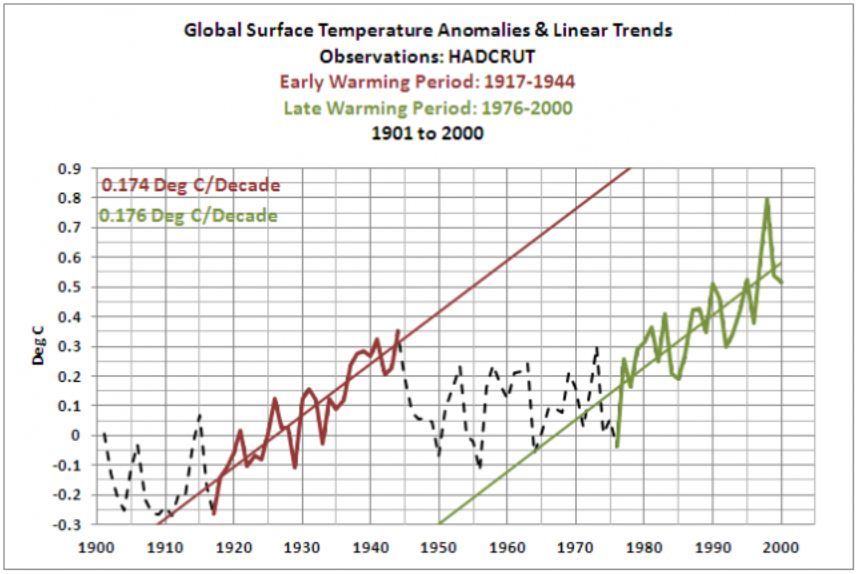
Fundamental problems with this claim [which is basically the falsified IPCC attribution claim of 95% certainty on steroids] include:


  • There is no statistical difference between the rate of warming over the 27 years from 1917-1944 and the 25 years from 1975/1976 to 2000:


Thus, this new paper is not even wrong with 99.999% certainty


Assumed climate model forcings for CO2, solar TSI, Southern Oscillation Index [SOI] and volcanic.
Upper right graph uses the same falsified technique of IPCC of comparing climate models assuming no change in CO2 [black] with increased CO2 [blue]. 


Abstract

December 2013 was the 346th consecutive month where global land and ocean average surface temperature exceeded the 20th century monthly average, with February 1985 the last time mean temperature fell below this value. Even given these and other extraordinary statistics, public acceptance of human induced climate change and confidence in the supporting science has declined since 2007. The degree of uncertainty as to whether observed climate changes are due to human activity or are part of natural systems fluctuations remains a major stumbling block to effective adaptation action and risk management. Previous approaches to attribute change include qualitative expert-assessment approaches such as used in IPCC reports and use of ‘fingerprinting’ methods based on global climate models. Here we develop an alternative approach which provides a rigorous probabilistic statistical assessment of the link between observed climate changes and human activities in a way that can inform formal climate risk assessment. We construct and validate a time series model of anomalous global temperatures to June 2010, using rates of greenhouse gas (GHG) emissions, as well as other causal factors including solar radiation, volcanic forcing and the El Niño Southern Oscillation. When the effect of GHGs is removed, bootstrap simulation of the model reveals that there is less than a one in one hundred thousand chance of observing an unbroken sequence of 304 months (our analysis extends to June 2010) with mean surface temperature exceeding the 20th century average. We also show that one would expect a far greater number of short periods of falling global temperatures (as observed since 1998) if climate change was not occurring. This approach to assessing probabilities of human influence on global temperature could be transferred to other climate variables and extremes allowing enhanced formal risk assessment of climate change.