Showing posts sorted by relevance for query svensmark's. Sort by date Show all posts

Wednesday, August 24, 2011

Svensmark's theory of cosmoclimatology confirmed

from Nigel Calder's blog [former editor in chief of New Scientist]:

CERN experiment confirms cosmic ray action

Climate Change – News and Comments
The global warmists’ dam breaks
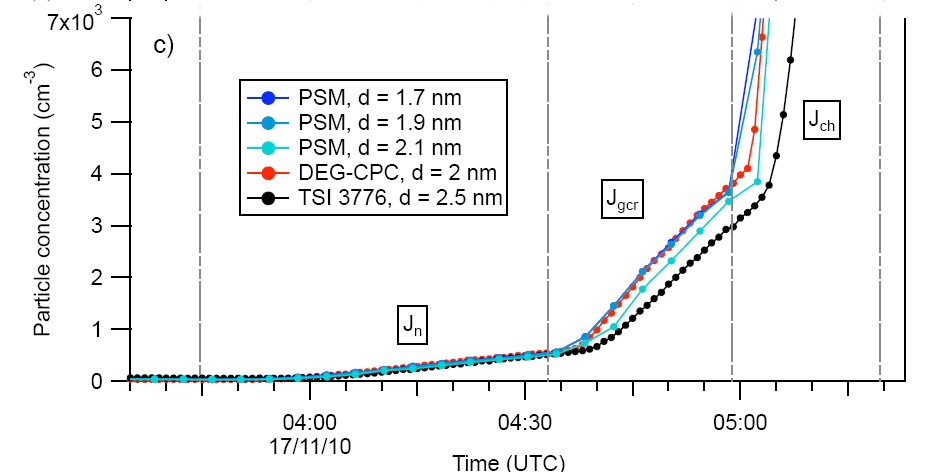
A graph they'd prefer you not to notice. Tucked away near the end of online supplementary material, and omitted from the printed CLOUD paper in Nature, it clearly shows how cosmic rays promote the formation of clusters of molecules (“particles”) that in the real atmosphere can grow and seed clouds. In an early-morning experimental run at CERN, starting at 03.45, ultraviolet light began making sulphuric acid molecules in the chamber, while a strong electric field cleansed the air of ions. It also tended to remove molecular clusters made in the neutral environment (n) but some of these accumulated at a low rate. As soon as the electric field was switched off at 04.33, natural cosmic rays (gcr) raining down through the roof of the experimental hall in Geneva helped to build clusters at a higher rate. How do we know they were contributing? Because when, at 04.58, CLOUD simulated stronger cosmic rays with a beam of charged pion particles (ch) from the accelerator, the rate of cluster production became faster still. The various colours are for clusters of different diameters (in nanometres) as recorded by various instruments. The largest (black) took longer to grow than the smallest (blue). This is Fig. S2c from supplementary online material for J. Kirkby et al., Nature, 476, 429-433, © Nature 2011
Long-anticipated results of the CLOUD experiment at CERN in Geneva appear in tomorrow’s issue of the journal Nature (25 August). The Director General of CERN stirred controversy last month, by saying that the CLOUD team’s report should be politically correct about climate change (see my 17 July post below). The implication was that they should on no account endorse the Danish heresy – Henrik Svensmark’s hypothesis that most of the global warming of the 20th Century can be explained by the reduction in cosmic rays due to livelier solar activity, resulting in less low cloud cover and warmer surface temperatures.
Willy-nilly the results speak for themselves, and it’s no wonder the Director General was fretful.


Jasper Kirkby
Jasper Kirkby of CERN and his 62 co-authors, from 17 institutes in Europe and the USA, announce big effects of pions from an accelerator, which simulate the cosmic rays and ionize the air in the experimental chamber. The pions strongly promote the formation of clusters of sulphuric acid and water molecules – aerosols of the kind that may grow into cloud condensation nuclei on which cloud droplets form. What’s more, there’s a very important clarification of the chemistry involved.


A breach of etiquette
My interest in CLOUD goes back nearly 14 years, to a lecture I gave at CERN about Svensmark’s discovery of the link between cosmic rays and cloudiness. It piqued Kirkby’s curiosity, and both Svensmark and I were among those who helped him to prepare his proposal for CLOUD.


By an unpleasant irony, the only Svensmark contribution acknowledged in the Nature report is the 1997 paper (Svensmark and Friis-Christensen) on which I based my CERN lecture. There’s no mention of the successful experiments in ion chemistry and molecular cluster formation by the Danish team in Copenhagen, Boulby and latterly in Aarhus where they beat CLOUD to the first results obtained using a particle beam (instead of gamma rays and natural cosmic rays) to ionize the air in the experimental chamber – see http://calderup.wordpress.com/2011/05/17/accelerator-results-on-cloud-nucleation-2/


What will historians of science make of this breach of scientific etiquette? That Kirkby was cross because Svensmark, losing patience with the long delay in getting approval and funding for CLOUD, took matters into his own hands? Or because Svensmark’s candour about cosmic rays casting doubt on catastrophic man-made global warming frightened the national funding agencies? Or was Kirkby simply doing his best (despite the results) to obey his Director General by slighting all things Danish?


Personal rivalries aside, the important question is what the new CLOUD paper means for the Svensmark hypothesis. Pick your way through the cautious prose and you’ll find this:


Ion-induced nucleation [cosmic ray action] will manifest itself as a steady production of new particles [molecular clusters] that is difficult to isolate in atmospheric observations because of other sources of variability but is nevertheless taking place and could be quite large when averaged globally over the troposphere [the lower atmosphere].”


It’s so transparently favourable to what the Danes have said all along that I’m surprised the warmists’ house magazine Nature is able to publish it, even omitting the telltale graph shown at the start of this post. Added to the already favourable Danish experimental findings, the more detailed CERN result is excellent. Thanks a million, Jasper.
Read remainder at Nigel Calder's blog

Monday, December 9, 2013

20th century data supports Svensmark's cosmic ray theory of climate

A post today from the website for the book The Neglected Sun: How the Sun Precludes Climate Catastrophe by German scientists Fritz Vahrenholt and Sebastian Luning shows long term data of cosmic ray proxies for the past 200 years strongly support the Svensmark cosmic ray theory of climate. 

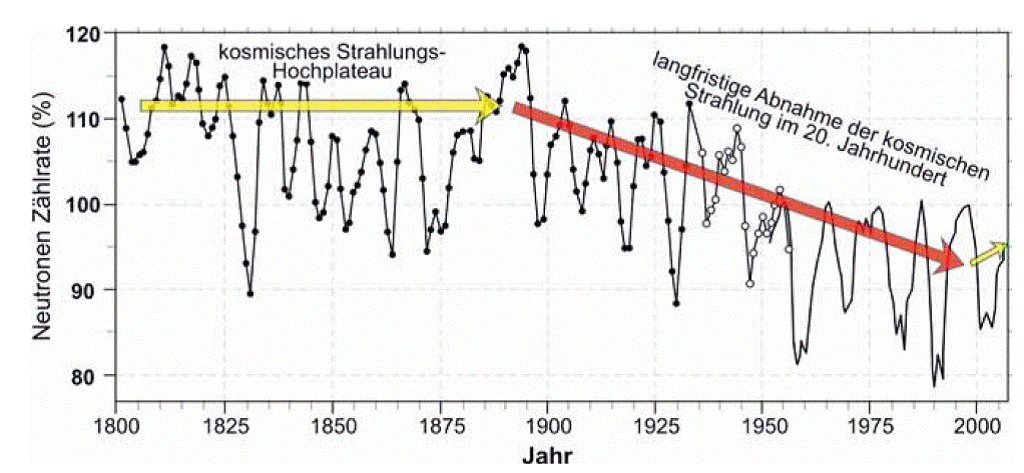
As shown by Figure 2 below, there was essentially no trend in cosmic rays during the 19th century, but a significant decrease during the 20th century, and a slight uptick at the end of the 20th century. Per Svensmark's theory, solar activity controls cosmic rays which in turn affect cloud formation, with cosmic rays inversely related to global temperature. Thus, figure 2 is highly supportive of the Svensmark theory and cause of 20th century warming.

Climate alarmists such as Stefan Rahmstorf of Michael Mann's site RealClimate claim Svensmark's theory is debunked by only cherry-picking the tiny uptick at the end of the 20th century in cosmic ray counts, absurd in comparison to the long-term view.

The post also reviews recent additional papers demonstrating the Sun controls climate, not man-made CO2.

Google Translation:

Michael Odenwald made ​​on 22 November 2013 in the focus thoughts on the climate effects of the sun:
The man or the sun: Who is responsible for climate change?
politicians seem to find any compromises in order to further reduce greenhouse gas emissions. Climate skeptics doubt that measures are necessary at all. In your opinion, should not the man cause global warming, but the sun. Recent studies contradict this.
This is strange. Because most recent studies strengthen the role of the sun rather than to weaken it. Here are some examples:

What are supposed to be for "current studies" the words to which Odenwald refers here? This initially remains in the dark, because the opening act of the focus man has Germany's top climate alaramist Stefan Rahmstorf perform with his questionable age-old trick:
Stefan Rahmstorf of the Potsdam Institute for Climate Impact Research (PIL) rejects the idea completely. "The cosmic radiation is measured since 1953. It shows similar to the sun brightness no trend to increase or decrease. Without such a trend can be explained also no change in the cloud cover. "
No trend? The professor liked to joke well. Using geological isotopic methods can be the development of cosmic rays several centuries and even millennia reconstruct back periods, the climate very much more meaningful than the 60 years used by Rahmstorf. And the data speak a very clear language: There is a significant decrease in the cosmic rays in the 20th century, which occurs in parallel with the increase in global temperature ( Figure 2 ). Why deny the obvious trend Rahmstorf and consciously chooses a misleading reference period? What is really behind this wanton feint of research-based environmental activist?
Figure 2: Cosmic rays over the long term during the last 200 years. At the same time the global temperature increased. Figure from "The cold sun", Chapter 6, based on McCracken, KG (2007): Helio Magnetic field near Earth, 1428-2005. Journal of Geophysical Research 112, 1-9.
And one more magician may occur in the opening act, Sami Solanki:
The experts at the Max Planck Institute for Solar System Research (MPS) in Katlenburg-Lindau see no connection. Although would have longer-term variations in solar activity to hot and cold phases, such as the medieval climate optimum, the subsequent Little Ice Age, as well as for heating in the first half of the 20th Contributed century. "But in the 30s, the curves of the solar brightness temperature of the earth and ran for the first time apart," said MPS Director Sami Solanki. "As well the man had a hand in it." Definitively the curves according to Solanki decoupled nearly 30 years ago. The earth's temperature rose sharply, but the sun brightness shows no trend.
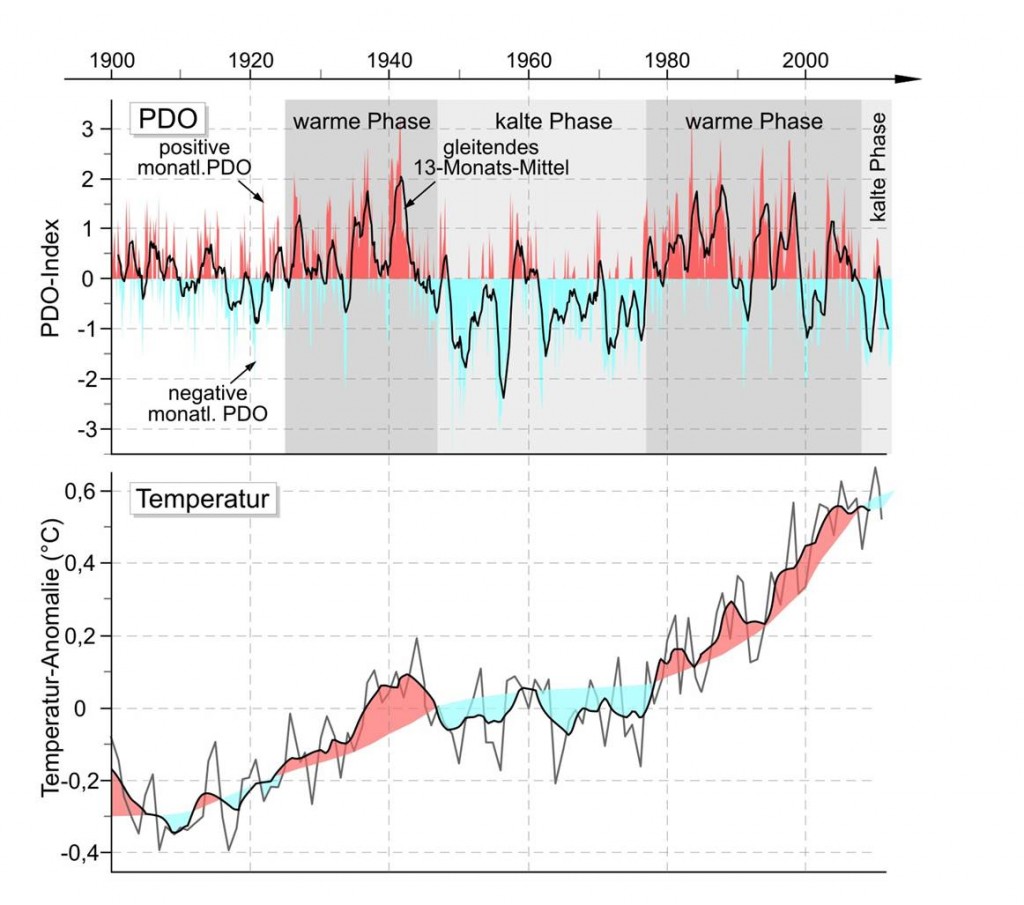
Deviations in the 1930s and 1980s? This must surely have made the man! Who else? But wait. Was not there still something? Just the ocean cycles! In the 1930s and 1980s, the Pacific Decadal Oscillation (PDO) increased to their respective maximum value, which drove strong global temperatures upward. Solanki fall into the trap and forgets to take into account this important natural climate cycle. Setback performance. Put six.
Figure 3: synchronicity between temperature cycles and the PDO ocean cycle (PDU = Pacific Decadal Oscillation). From: The cold sun.

Below Odenwald brings new insights into the climate effect of cosmic rays. Some studies negate this context, others hold him still possible. This Odenwald makes the mistake to let an important recent work unmentioned, which we at this point have already reported (see our blog post "Unexpected twist: study in Environmental Research Letters finds regional coupling of cloud cover with solar activity "), namely, a study by Mirela Voiculescu and Ilya Usoskin, in October 2012 in the Environmental Research Letters has been published. We wrote:
Voiculescu works at the Institute of Chemistry, Physics and the Environment 'Dunărea de Jos "University of Galati in Romania, during Usoskin is head of the Arctic research station to cosmic radiation in Oulu, Finland. The two researchers went a bit more differentiated on the matter as many colleagues and distinguished different regions and different clouds Floor. The corresponding combinations then they checked to see if a correlation is noted with solar activity for the period 1984-2009. The investigation period covered thereby two full solar 11-year cycles. As a proxy for the solar activity, the researchers used the cosmic rays and UV radiation. To their surprise, found Voiculescu and Usoskin for certain key regions of a continuous correlation of cloud cover with solar activity over the entire study period. In some areas there is a direct correlation was observed, in others, an opposing. The authors point out that there is no uniform global trend, but it is primarily geographically limited systematic influences. It therefore makes no sense to limit themselves in the search for a solar fingerprint on the global level. Also differed trends and the sun-clouds-coupling for the various clouds Stock Works. In a corresponding expected spatial heterogeneity of the process we had already pointed out in our book "The cold sun" in Chapter 6.
Regardless how or if the cosmic radiation is effective as climatic Solar amplifier, Odenwald would definitely have to point to a second mechanism, namely the UV in the stratosphere. A terrible omission. See for example our blog article " New study describes the missing link in the climate Chain: Polar Stratospheric eddy-rich solar climate signal in the lower atmosphere continue "," International research team: UV solar variation in the climate models so far 4 - underestimated to 6-fold "and" Solar amplifier in the stratosphere: West winds move in cycles of solar activity . "Odenwald do not like the sun, that's for sure. For some reason he picked from the vast literature only works out to support his own subjective perspective. However, this can not be the basis for solid, balanced journalism. He should therefore make thought dear hinüberzuwechseln for Greenpeace Magazine, where you will probably see such personal inclinations rather. The focus slogan "facts, facts, facts" Odenwald is in any case not cope with this biased attitude. Perhaps the Lord Chief Editor should look into this matter again?

Tuesday, November 19, 2013

New paper finds evidence of Svensmark's cosmic ray theory of climate on a regional scale

A new paper published in Annales Geophysicae finds "an indirect indication of possible relationships between the variability of galactic cosmic rays and climate change on a regional scale," supportive of Svensmark's cosmic ray theory of climate. The authors find climate patterns in southern Brazil correlated to 11-22 year solar cycles and El Nino Southern Oscillation [ENSO] cycles. ENSO, in turn, has been linked to solar activity and lunisolar cycles.

Svenmark's cosmic ray theory of climate is only one of many solar amplification mechanisms described in the peer-reviewed literature. 

Ann. Geophys., 31, 1833-1841, 2013
www.ann-geophys.net/31/1833/2013/
doi:10.5194/angeo-31-1833-2013


E. Frigo1,2, I. G. Pacca1, A. J. Pereira-Filho3, P. H. Rampelloto4, and N. R. Rigozo5
1Departamento de Geofísica, Instituto de Astronomia, Geofísica e Ciências Atmosféricas, Universidade de São Paulo, São Paulo, Brazil
2Universidade Federal do Pampa, Campus Caçapava do Sul, Caçapava do Sul, Brazil
3Departamento de Ciências Atmosféricas, Instituto de Astronomia, Geofísica e Ciências Atmosféricas, Universidade de São Paulo, São Paulo, Brazil
4Universidade Federal do Pampa, Campus São Gabriel, São Gabriel, Brazil
5Divisão de Geofísica Espacial, Instituto Nacional de Pesquisas Espaciais, São José dos Campos, Brazil

Abstract. Possible direct or indirect climatic effects related to solar variability and El Niño–Southern Oscillation (ENSO) were investigated in the southern Brazil region by means of the annual mean temperatures from four weather stations 2 degrees of latitude apart over the South Atlantic Magnetic Anomaly (SAMA) region. Four maximum temperature peaks are evident at all stations in 1940, 1958, 1977 and 2002. A spectral analysis indicates the occurrence of periodicities between 2 and 7 yr, most likely associated with ENSO, and periodicities of approximately 11 and 22 yr, normally associated with solar variability. Cross-wavelet analysis indicated that the signal associated with the 22 yr solar magnetic cycle was more persistent in the last decades, while the 11 yr sunspot cycle and ENSO periodicities were intermittent. Phase-angle analysis revealed that temperature variations and the 22 yr solar cycle were in anti-phase near the SAMA center. Results show an indirect indication of possible relationships between the variability of galactic cosmic rays and climate change on a regional scale.

Thursday, March 21, 2013

New paper corroborates Svensmark's theory of cosmoclimatology

A paper published today in the Journal of Atmospheric and Solar-Terrestrial Physics finds "strong evidence" of a link between thunderstorm and solar activity in Brazil from 1951-2009. According to the authors, thunderstorm "behavior with respect to the 11-year solar cycle suggest a global mechanism probably related to a solar magnetic shielding effect acting on galactic cosmic rays as an explanation for the relationship of thunderstorm and solar activity," which would corroborate Svensmark's theory of cosmoclimatology

The relationship between thunderstorm and solar activity for Brazil from 1951 to 2009


  • a Camilo Castelo Branco University (Unicastelo), São Jose dos Campos, Sao Paulo, 12247-004, Brazil
  • b ELAT/CCST, National Institute of Space Research (INPE), São Jose dos Campos, Sao Paulo, 12227-010, Brazil

Highlights

First results on the relationship between solar and thunderstorm activity in Brazil.
Strong evidence of anti-phase correlation between solar and thunderstorm activity in Brazil.
New statistical method for evaluating correlation between solar and thunderstorm activity.

Abstract

The goal of this article is to investigate the influence of solar activity on thunderstorm activity in Brazil. For this purpose, thunder day data from seven cities in Brazil from 1951 to 2009 are analyzed with the wavelet method for the first time. To identify the 11-year solar cycle in thunder day data, a new quantity is defined. It is named TD1 and represents the power in 1-year in a wavelet spectrum of monthly thunder day data. The wavelet analysis of TD1 values shows more clear the 11-year periodicity than when it is applied directly to annual thunder day data, as it has been normally investigated in the literature. The use of this new quantity is shown to enhance the capability to identify the 11-year periodicity in thunderstorm data. Wavelet analysis of TD1 indicates that six out seven cities investigated exhibit periodicities near 11 years, three of them significant at a 1% significance level (p < 0.01). Furthermore, wavelet coherence analysis demonstrated that the 11-year periodicity of TD1 and solar activity are correlated with an anti-phase behavior, three of them (the same cities with periodicities with 1% significance level) significant at a 5% significance level (p < 0.05). The results are compared with those obtained from the same data set but using annual thunder day data. Finally, the results are compared with previous results obtained for other regions and a discussion about possible mechanisms to explain them is done.   The existence of periodicities around 11 years in six out of seven cities and their anti-phase behavior with respect to 11-year solar cycle suggest a global mechanism probably related to a solar magnetic shielding effect acting on galactic cosmic rays as an explanation for the relationship of thunderstorm and solar activity, although more studies are necessary to clarify its physical origin.

Saturday, August 27, 2011

More confirmation of Svensmark's theory?

A paper published this week finds that cloudiness over Russia has increased during the period of 2001-2010 compared to 1991-2000. Interesting in light of the corresponding global cooling since 2001, Svensmark's cosmic ray theory of cloud formation, the rise of cosmic rays since 2001 to record levels, and the concomitant decrease in solar activity.
Recent variations of cloudiness over Russia from surface daytime observations

A V Chernokulsky et al

Changes of total and low cloud fraction and the occurrence of different cloud types over Russia were assessed. The analysis was based on visual observations from more than 1600 meteorological stations. Differences between the 2001–10 and 1991–2000 year ranges were evaluated. In general, cloud fraction has tended to increase during recent years. A major increase of total cloud fraction and a decrease of the number of days without clouds are revealed in spring and autumn mostly due to an increase of the occurrence of convective and non-precipitating stratiform clouds. In contrast, the occurrence of nimbostratus clouds has tended to decrease. In general, the ratio between the occurrence of cumulonimbus and nimbostratus clouds has increased for the period 2001–10 relative to 1991–2000. Over particular regions, a decrease of total cloud fraction and an increase of the number of days without clouds are noted.

Sunday, September 14, 2014

Paper could explain why Mann had to "hide the decline" & relationship of solar activity to tree growth

A paper published in New Phytologist finds "the growth of British spruce trees appears to follow a cosmic pattern, with trees growing faster when high levels of cosmic rays arrive from space." The level of cosmic rays is in turn controlled by solar activity and the strength of the solar wind, which blocks cosmic rays from the Earth.

The authors find

"during a number of years, the trees' growth also particularly slowed. These years correlated with periods when a relatively low level of cosmic rays reached the Earth's surface. When the intensity of cosmic rays reaching the Earth's surface was higher, the rate of tree growth was faster. The effect is not large, but it is statistically significant. 
The intensity of cosmic rays also correlates better with the changes in tree growth than any other climatological factor, such as varying levels of temperature or precipitation over the years. 
"The correlation between growth and cosmic rays was moderately high, but the correlation with the climatological variables was barely visible," Ms Dengel told the BBC.
The paper, which was published the month before Climategate in 2009, may ironically explain the mystery behind the so-called "divergence problem" that led Michael Mann et al to use his "trick to hide the decline" in tree-ring proxy temperatures, one of the largest scientific scandals of the whole Climategate affair. 

Solar activity reconstructions have demonstrated that solar activity in the latter half of the 20th century was at the highest levels of the past 3,000 - 9,400 years. Since increased solar activity increases the solar wind which blocks cosmic rays from space, cosmic rays were at relatively low levels during the latter 20th century. According to this paper, this decrease in cosmic rays may have accounted for a decrease in tree growth in the latter 20th century, which corresponds to the "decline" in tree-ring sizes that Mann et al tried to "hide" after 1960. Further, the authors did not find any statistically-significant correlation between tree-ring size and temperature or precipitation, which is what Mann et al falsely assumed and thus, had to conveniently hide.

Thus, given the findings of this paper, it could well be that the high solar activity of the latter 20th century explains both the global warming and the decline in tree growth ["the divergence problem"] that Mann used his "trick to hide" because it didn't support "the cause" of Mann-made global warming. 

The authors attribute the correlation between cosmic rays and tree growth to the Svensmark et al cosmic ray theory of climate, one of many solar amplification mechanisms described in the literature.

"We tried to correlate the width of the rings, i.e. the growth rate, to climatological factors like temperature. We also thought it would be interesting to look for patterns related to solar activity, as a few people previously have suggested such a link," explains Ms Dengel. 
"We found them. And the relation of the rings to the solar cycle was much stronger than it was to any of the climatological factors we had looked at. We were quite hesitant at first, as solar cycles have been a controversial topic in climatology."

"As for the mechanism, we are puzzled." 
Ms Dengel's team proposes two main hypotheses as to how cosmic ray particles could influence the growth of trees. 
The first idea is that cosmic rays ionise gases in the atmosphere, creating molecules around which clouds condense, therefore increasing cloud over.[Svensmark's cosmic ray theory of climate]
One study published in 2006 suggested it may account for as little as 2% of the variation in cloud cover across the UK.[Note a mere 1-2% change in cloud cover is sufficient to cause global warming or cooling] 
But if it does occur, then an increase in cloud cover and haze would diffuse the amount of solar radiation reaching the trees. 
As diffuse radiation penetrates forest canopies better than direct light, it would increase the amount of radiation that plants capture, and increase photosynthesis by trees, boosting growth.

Mann's Climategate "trick to hide the decline" in tree-ring growth affair is explained and lambasted by warmist Dr. Richard Mueller in this highly recommended short lecture excerpt:


and hilariously parodied by Minnesotans for Global Warming:


From the full paper here


By Matt Walker BBC News 10/19/09
Editor, Earth News
Tree rings
Cosmic record

The growth of British trees appears to follow a cosmic pattern, with trees growing faster when high levels of cosmic radiation arrive from space.
Researchers made the discovery studying how growth rings of spruce trees have varied over the past half a century.
As yet, they cannot explain the pattern, but variation in cosmic rays impacted tree growth more than changes in temperature or precipitation.
The study is published in the scientific journal New Phytologist.
"We were originally interested in a different topic, the climatological factors influencing forest growth," says Ms Sigrid Dengel a postgraduate researcher at the Institute of Atmospheric and Environmental Science at the University of Edinburgh.
 The relation of the rings to the solar cycle was much stronger than to any climatological factors 
Sigrid Dengel
University of Edinburgh
To do this, Ms Dengel and University of Edinburgh colleagues Mr Dominik Aeby and Professor John Grace obtained slices of spruce tree trunks.
These had been freshly-felled from the Forest of Ae in Dumfriesshire, Scotland, by Forest Research, the research branch of the UK's Forestry Commission.
The trees had been planted in 1953 and felled in 2006.
The researchers froze the trunk slices, to prevent the wood shrinking, then scanned them on to a computer and used software to count the number and width of the growth rings.
As the trees aged, they showed a usual decline in growth.
However, during a number of years, the trees' growth also particularly slowed. These years correlated with periods when a relatively low level of cosmic rays reached the Earth's surface.
Sitka spruce (Picea sitchensis)
Reaching for the stars
When the intensity of cosmic rays reaching the Earth's surface was higher, the rate of tree growth was faster.
The effect is not large, but it is statistically significant.
The intensity of cosmic rays also correlates better with the changes in tree growth than any other climatological factor, such as varying levels of temperature or precipitation over the years.
"The correlation between growth and cosmic rays was moderately high, but the correlation with the climatological variables was barely visible," Ms Dengel told the BBC.
Here comes the Sun
Cosmic rays are actually energetic particles, mainly protons, as well as electrons and the nuclei of helium atoms, that stream through space before hitting the Earth's atmosphere.
The levels of cosmic rays reaching the Earth go up and down according to the activity of the Sun, which follows an 11-year cycle.
 As for the mechanism, we are puzzled 
Sigrid Dengel
University of Edinburgh
Every 11 years or so, the Sun becomes more active, producing a peak of sunspots. These sunspots carry a magnetic field that blocks and slows the path of energetic particles.
When the researchers looked at their data, they found that tree growth was highest during periods of low sunspot activity, when most cosmic rays reached Earth.
But growth slowed during the four periods of cosmic ray-blocking high sunspot activity, which have occurred between 1965 and 2005.
"We tried to correlate the width of the rings, i.e. the growth rate, to climatological factors like temperature. We also thought it would be interesting to look for patterns related to solar activity, as a few people previously have suggested such a link," explains Ms Dengel.
"We found them. And the relation of the rings to the solar cycle was much stronger than it was to any of the climatological factors we had looked at. We were quite hesitant at first, as solar cycles have been a controversial topic in climatology."
Tree trunk slices
Sliced for examination
"As for the mechanism, we are puzzled."
Ms Dengel's team proposes two main hypotheses as to how cosmic ray particles could influence the growth of trees.
The first idea is that cosmic rays ionise gases in the atmosphere, creating molecules around which clouds condense, therefore increasing cloud over.[Svensmark's cosmic ray theory of climate]
This mechanism is hotly debated among scientists, and evidence for it is weak.
One study published in 2006 suggested it may account for as little as 2% of the variation in cloud cover across the UK.[note a mere 1-2% change in cloud cover is sufficient to cause global warming or cooling]
But if it does occur, then an increase in cloud cover and haze would diffuse the amount of solar radiation reaching the trees.
As diffuse radiation penetrates forest canopies better than direct light, it would increase the amount of radiation that plants capture, and increase photosynthesis by trees, boosting growth.
Explaining the unexplained
"Or there is some direct effect," says Ms Dengel.
What that might be is unknown, but experiments in space have shown that cosmic rays can have some positive impacts on biological materials.
Ms Dengel says that much more work needs to be done to investigate the effect further, and their results have received a mixed reaction from other scientists.
"We sent the paper to 161 international colleagues. We are still harvesting the emails. We've identified four groups who would like to work with us on this.
"Locally, one of our colleagues is a cloud physicist. He was encouraging but sceptical at the same time."
If further research backs up the team's findings, the implications could be significant.
"We want to repeat this work for larger data sets, and understand the mechanism better, before we speculate," says Ms Dengel.
But the influence of cosmic rays could resolve other as yet unexplained cycles in tree growth found in studies in North America.
It also suggests the amount of aerosols that humans emit into the atmosphere could impact tree growth, as high levels of aerosols cause "global dimming", an effect that occurs when the levels of light reaching the Earth's surface fall.
"If it is true that the mechanism is all about rays enhancing diffuse radiation, it would mean that 'global dimming' and 'global brightening' would have a big effect on tree growth and therefore on the absorption of carbon dioxide," warns Ms Dengel.

Sunday, April 11, 2010

Richard Alley's Failed Rebuttal of Cosmoclimatology

AGW salesmen, such as geologist Dr. Richard Alley of Penn State, maintain that the variations in solar output have little to do with climate change on earth. In a 2009 lecture, Dr. Alley makes the following statements and shows the slide below as his rebuttal to the Svensmark et al theory of Cosmoclimatology. This theory suggests that small changes in the solar magnetic field throughout solar cycles are amplified due to the effect on cosmic rays, which may seed cloud formation and thereby cool the earth. Dr. Alley tries to refute this theory by stating that a period of high cosmic ray activity 40,000 years ago didn't change the climate. However, the added vertical line below shows a correlation between the increased cosmic rays 40,000 years ago and the end of an interglacial with transition to an ice age and drop in temperature of about 6 degrees. While this does not prove Svensmark's et als theory, it certainly does not support Dr. Alley's rebuttal. Why does Dr. Alley not consider the possibility that the increased cosmic rays played a role in transition to an ice age, and that there might be a "saturation point" beyond which additional cosmic rays do not make a significant difference? That's not discussed, since it doesn't agree with his party-line theory that CO2 controls all.


(red vertical line and "X" added)


link for article above and below


Thursday, August 25, 2016

Bombshell: New study confirms 'solar activity has a direct impact on Earth's cloud cover' important to climate change

A new study confirms "solar variations affect the abundance of clouds in our atmosphere," a solar amplification mechanism which is the basis of Svensmark's theory of cosmo-climatology. 
The solar eruptions are known to shield Earth's atmosphere from cosmic rays. However the new study, published in Journal of Geophysical Research: Space Physics, shows that the global cloud cover is simultaneously reduced, supporting the idea that cosmic rays are important for cloud formation. The eruptions cause a reduction in cloud fraction of about 2 percent corresponding to roughly a billion tonnes of liquid water disappearing from the atmosphere.

As Dr. Roy Spencer notes,

"The most obvious way for warming to be caused naturally is for small, natural fluctuations in the circulation patterns of the atmosphere and ocean to result in a 1% or 2% decrease in global cloud cover. Clouds are the Earth’s sunshade, and if cloud cover changes for any reason, you have global warming — or global cooling."
The IPCC models fail to consider multiple solar amplification mechanisms, including cosmic rays and numerous other amplification mechanisms, thereby ignoring that solar activity can explain the 0.7C global warming since the end of the Little Ice Age in 1850. Solar activity reached a grand maximum in the latter half of the 20th century, and accumulated solar energy (the 'sunspot integral') explains global temperature change since 1900 with greater than 97% statistical significance.  This new paper confirms that solar activity variation can account for a 2% variation in global cloud cover, sufficient to explain the warming of the 20th century and without any consideration of CO2 "radiative forcing."


Solar activity has a direct impact on Earth's cloud cover


Date:
August 25, 2016
Source:
Technical University of Denmark
Summary:
Solar variations affect the abundance of clouds in our atmosphere, a new study suggests. Large eruptions on the surface of the Sun can temporarily shield Earth from so-called cosmic rays which now appear to affect cloud formation.
A team of scientists from the National Space Institute at the Technical University of Denmark (DTU Space) and the Racah Institute of Physics at the Hebrew University of Jerusalem has linked large solar eruptions to changes in Earth's cloud cover in a study based on over 25 years of satellite observations.
The solar eruptions are known to shield Earth's atmosphere from cosmic rays. However the new study, published in Journal of Geophysical Research: Space Physics, shows that the global cloud cover is simultaneously reduced, supporting the idea that cosmic rays are important for cloud formation. The eruptions cause a reduction in cloud fraction of about 2 percent corresponding to roughly a billion tonnes of liquid water disappearing from the atmosphere.
Since clouds are known to affect global temperatures on longer timescales, the present investigation represents an important step in the understanding of clouds and climate variability.
"Earth is under constant bombardment by particles from space called galactic cosmic rays. Violent eruptions at the Sun's surface can blow these cosmic rays away from Earth for about a week. Our study has shown that when the cosmic rays are reduced in this way there is a corresponding reduction in Earth's cloud cover. Since clouds are an important factor in controlling the temperature on Earth our results may have implications for climate change," explains lead author on the study Jacob Svensmark of DTU.
Very energetic particles
These particles generate electrically charged molecules -- ions -- in Earth's atmosphere. Ions have been shown in the laboratory to enhance the formation of aerosols, which can serve as seeds for the formation of the cloud drops that make up a cloud. Whether this actually happens in the atmosphere, or only in the laboratory is a topic that has been investigated and debated for years.
When the large solar eruptions blow away the galactic cosmic rays before they reach Earth they cause a reduction in atmospheric ions of up to about 20 to -30 percent over the course of a week. So if ions affect cloud formation it should be possible to observe a decrease in cloud cover during events when the Sun blows away cosmic rays, and this is precisely what is done in this study.
The so-called 'Forbush decreases' of the cosmic rays have previously been linked to week-long changes in Earth's cloud cover but the effect has been debated at length in the scientific literature. The new study concludes that "there is a real impact of Forbush decreases on cloud microphysics" and that the results support the suggestion that "ions play a significant role in the life-cycle of clouds."
Arriving at that conclusion was, however, a hard endeavor; Very few strong Forbush decreases occur and their effect on cloud formation is expected to be close to the limit of detection using global atmospheric observations measured by satellites and land based stations. Therefore it was of the greatest importance to select the strongest events for study since they had to have the most easily detected effect. Determining this strength required combining data from about 130 stations in combination with atmospheric modeling.
This new method resulted in a list of 26 events in the period of 1987-2007 ranked according to ionization. This ranked list was important for the detection of a signal, and may also shed some light on why previous studies have arrived at varied conclusions, since they have relied on events that were not necessarily ranked high on the list.
Possible long term effect
The effect from Forbush decreases on clouds is too brief to have any impact on long-term temperature changes.
However since clouds are affected by short term changes in galactic cosmic radiation, they may well also be affected by the slower change in Solar activity that happens on scales from tens to hundreds of years, and thus play a role in the radiation budget that determines the global temperature.
The Suns contribution to past and future climate change may thus be larger than merely the direct changes in radiation, concludes the scientists behind the new study.

Story Source:
The above post is reprinted from materials provided by Technical University of Denmark. The original item was written by Morten Garly Andersen. Note: Content may be edited for style and length.

Journal Reference:
  1. J. Svensmark, M. B. Enghoff, N. J. Shaviv, H. Svensmark. The response of clouds and aerosols to cosmic ray decreasesJournal of Geophysical Research: Space Physics, 2016; DOI:10.1002/2016JA022689