Showing posts sorted by date for query "hot spot". Sort by relevance Show all posts

Friday, July 29, 2016

Jupiter's Giant Red Spot is red hot & explained by the gravito-thermal greenhouse effect

A new paper published in Nature finds Jupiter's Great Red Spot is red hot at about 2,420°F or 1,330°C (i.e. almost hot enough to melt steel at 1425°C) and that this observation, 
"could solve the mystery of the unusually high temperatures observed throughout Jupiter's upper atmosphere, which can't be explained by solar heating alone. [nor by a radiative greenhouse effect]"
"Previous heat-distribution models suggested that Jupiter's atmosphere should be much cooler, largely because the planet is about fives times further from the sun than Earth is. So, having ruled out solar heating from above, the authors of the new research found evidence suggesting this atmospheric heating is largely driven by a combination of gravity waves and acoustic waves generated by turbulences in the atmosphere below the Great Red Spot.
"Giant planets like Jupiter are measured to be hundreds of degrees warmer than current temperature models predict. Before now, the extremely warm temperatures observed in Jupiter's atmosphere have been difficult to explain, due to the lack of a known heat source."
In other words, the very hot atmospheric temperatures on Jupiter cannot be due to an Arrhenius radiative greenhouse effect. The atmosphere of Jupiter is mostly comprised of the non-greenhouse gases hydrogen and helium, but does contain small amounts of the IR-active 'greenhouse' gas water vapor. However, the Maxwell/Clausius/Carnot gravito-thermal greenhouse effect perfectly explains the observed atmospheric temperature profile of Jupiter, making Jupiter the ninth planet in our solar system to follow the simple Poisson relationship of atmospheric mass/gravity/pressure to temperature. The Poisson relationship was demonstrated in another recent paper:

Referring to fig. 1 of the paper, we find at 0.1 bar pressure on Jupiter, the corresponding temperature is~112°K, and at 11 bars pressure corresponds to 400°K or 260°F:

Fig 1 from the paper. The dotted line is the atmospheric temperature vs. pressure curve on Jupiter. At 11 bars pressure, the temperature is 400°K or 127°C or 260°F.  
This satisfies the Poisson Relation (which in turn is derived from the Ideal Gas Law) previously demonstrated on 6 8 other celestial bodies in our solar system:


T/To = (P/Po)^0.286 ~= 400°K/112°K = (11 bar/0.1 bar)^.286

where
T = temperature at 11 bars pressure =  400°K
To= temperature at top of atmosphere = 112°K
P = 11 bars
Po= pressure at top of atmosphere = 0.1 bar

and once again demonstrates that the catastrophic anthropogenic global warming (CAGW) theory is a myth, that atmospheric temperatures are controlled by mass/gravity/pressure and are independent of greenhouse gas concentrations on any of these 9 planets with atmospheres, including Earth. Adding additional CO2 plant food to the atmosphere will undoubtedly green the Earth, but Earth's climate sensitivity to CO2 is effectively zero. 

Related: How can Uranus have storms hot enough to melt steel? A runaway greenhouse effect?


Jupiter's Great Red Spot is Also Red Hot, Study Shows

 | 

Jupiter's Great Red Spot is apparently also red hot: The highest temperatures ever observed on the planet were recently detected in the region above the ginormous storm.  
The Great Red Spot (GRS) is a massive storm about twice the diameter of Earth that lies in lowest layer of Jupiter's atmosphere. About 497 miles (800 kilometers) above this humongous storm, astronomers measured temperatures reaching about 700 degrees Fahrenheit (about 370 degrees Celsius) higher than normal, James O'Donoghue, lead author of the new study and a research scientist with Boston University's (BU) Center for Space Physics, told Space.com. 
The new finding could solve the mystery of the unusually high temperatures observed throughout Jupiter's upper atmosphere, which can't be explained by solar heating alone.[Jupiter's Great Red Spot: Photos of the Solar System's Biggest Storm] 
Generally, atmospheric temperatures on Jupiter are around 1,700 degrees F (around 930 degrees C), with the exception of areas above the planet's poles, which are heated by auroras. Above the Great Red Spot, however, the atmosphere is about 2,420 degrees F (about 1,330 degrees C), O'Donoghue said. 
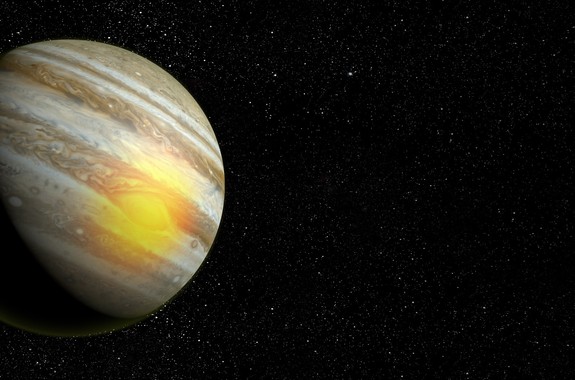


Observations show that Jupiter's upper atmosphere — above the Great Red Spot — is hundreds of degrees hotter than anywhere else on the planet.

Previous heat-distribution models suggested that Jupiter's atmosphere should be much cooler, largely because the planet is about fives times further from the sun than Earth is. So, having ruled out solar heating from above, the authors of the new research found evidence suggesting this atmospheric heating is largely driven by a combination of gravity waves and acoustic waves generated by turbulences in the atmosphere below the Great Red Spot. The new study was published today (July 27) in the journal Nature. 
Atmospheric gravity waves — not to be mistaken for gravitational waves — occur when pockets of air collide with things like mountains. The resulting effect is similar to when a pebble is dropped into a lake, and ripples then form on the surface of the water.  
Acoustic waves, on the other hand, are sound waves, which means they develop from compressions and refractions in the air and travel upward into the atmosphere. There, they encounter regions of lower density and break, much like ocean waves breaking on the shore. When this happens, the acoustic waves release stored kinetic energy and cause molecules and atoms in the air to move around more, which then raises the temperature, O'Donoghue said.  
"Changes in density around the Great Red Spot will shoot waves in all directions," O'Donoghue added. "We believe that acoustic waves are the majority of the heating cause, because gravity waves tend to ship their energy across the planet, rather than vertically up like acoustic waves." 
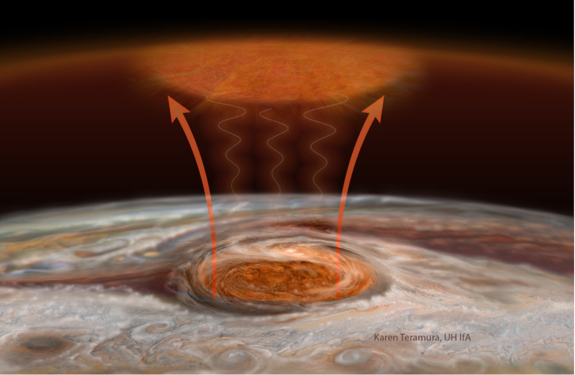


This illustration shows how a combination of gravity and acoustic waves transfers heat above the Great Red Spot to Jupiter's upper atmosphere.
Credit: Art by Karen Teramura, UH IfA, James O'Donoghue

The GRS is a massive storm that rotates counterclockwise, colliding with the natural flow of molecules in the atmosphere, which are moving opposite the storm. These types of collisions create turbulence that creates acoustic and gravity waves, O'Donoghue said. 
Using data from the SpeX instrument on the NASA Infrared Telescope Facility (IRTF) on Mauna Kea mountain in Hawaii, the researchers were able to measure the temperature of Jupiter's atmosphere, specifically around the GRS.  
"The Great Red Spot is the largest storm in the solar system — it is bigger than Earth itself — so it generates a lot of turbulence that impedes the flow of air in the atmosphere," O'Donoghue said. "It is kind of like when you stir a cup of coffee and you turn the spoon around and go the opposite way. Suddenly, there is a lot of sloshing [turbulence] going on that generates sound waves, or compressions of air, upwards for you to hear."  
The heat generated from the acoustic and gravity waves has a localized effect, which suggests there is a coupling between low and high altitudes, as energy is transferred from the lower atmosphere to the upper atmosphere. Previously, the connection between low and high altitudes was thought to be pretty much impossible because the distance is so vast, O'Donoghue explained.
"This new result from Jupiter provides the first evidence of upward coupling of energy that finds its way from the lower atmosphere to the upper atmosphere," Michael Mendillo, a professor of astronomy at BU, who was not involved with the study, told Space.com. "It's a very interesting observation — even on Earth, this mechanism is not well-studied or understood. If this happens on Jupiter, it is possible that it happens on all planets." 
Giant planets like Jupiter are measured to be hundreds of degrees warmer than current temperature models predict. Before now, the extremely warm temperatures observed in Jupiter's atmosphere have been difficult to explain, due to the lack of a known heat source, Tom Stallard, co-author of the new study and an associate professor of astronomy at the University of Leicester in the United Kingdom, told Space.com. 
"Sometimes, ironically, it is easier to see these features on a planet far away [from Earth]," said Stallar, who advised O'Donoghue throughout his research. In other words, "It's much more difficult to step back and see these broadscale effects … on Earth, so it's interesting to use Jupiter as a 'proxy' for what might be happening on other planets, and that includes Earth."
With the Juno spacecraft orbiting Jupiter, the researchers hope to get an up-close view of the Great Red Spot and isolate where the heat observed in the planet's upper atmosphere comes from. They also plan to study the fine details of smaller storms like Red Spot Jr., to see if there is heating above them as well. 

Tuesday, September 1, 2015

Why the effective radiating level (ERL) is always located at the center of mass of the atmosphere & not controlled by greenhouse gas concentrations

The Arrhenius radiative greenhouse effect proponents, having abandoned "back-radiation" from greenhouse gases as the explanation of the greenhouse effect, now claim global warming is instead due to an increase of the "effective radiating height" or "effective radiating level" [ERL] of greenhouse gases in the atmosphere. So the theory goes, an increase of CO2 levels will cause longwave (~15 micron) infrared emissions from CO2 to occur from colder heights in the atmosphere, and since colder blackbodies emit less radiation, more radiation will allegedly be "trapped" by the colder CO2 "blackbody" in the fabled tropospheric "hot spot" & unable to escape to space. 

In contrast, the competing 33C gravito-thermal greenhouse effect of Maxwell, Clausius, Carnot, Boltzmann, Feynman, Poisson, Helmholtz, et al, shows that the "effective radiating level" or ERL is fixed at the center of mass (COM) of the atmosphere.

As we can see in Fig 1a, the observed ERL or "emission level for OLR (Outgoing Longwave Radiation)" global average is right around 500 millibars or 0.49 atmospheres ~ 0.5 atmospheres, exactly at the center of mass of the entire atmosphere as predicted in the HS greenhouse equation below. 

The HS greenhouse equation "triangulates" the geopotential height of the 255K ERL at the center of mass using:

1. The center of mass (COM) of the atmosphere where P=0.5 atmospheres (after density correction), i.e. exactly one-half of the surface pressure
2. The adiabatic lapse rate = -(gravitational acceleration constant g)/(heat capacity at constant pressure Cp)
3. The equilibrium temperature of Earth with the Sun = 255K

all of which are essentially constants in the atmosphere, and without any knowledge of the surface temperature, greenhouse gas concentrations, or Arrhenius "radiative forcing" from greenhouse gases.  

Why use the center of mass of the atmosphere in calculation of the gravito-thermal greenhouse effect? Because the force of gravity by Newton's Second Law is F = ma = mg, and for a system of particles like our atmosphere, one must determine the center of mass in applying Newton's 2nd Law F = mg to the force of gravity. 

Thus, since the height of the ERL is fixed at the COM, and the COM is essentially a constant, the height of the ERL will not change, regardless of greenhouse gas concentrations.

In addition, in the longwave infrared band of Earth’s thermal radiation, the only band in which CO2 absorbs and emits is centered at ~15 microns. The kinetic temperature of the surrounding atmosphere and the CO2 molecules has nothing to do with the fact that CO2 emits at a fixed ~15 microns in the longwave IR due to its fixed molecular structure bending transitions. The entire atmosphere surface to space is warmer than the CO2 “equivalent partial blackbody” fixed band-emitting temperature of 193K at ~15 microns.

Also, absorption followed by emission of a photon by CO2 only takes microseconds, and all the bouncing around at the speed of light between greenhouse gases in the atmosphere only delays the average photon a few milliseconds on its way from the surface to space. Thus, the only "slowing of cooling" or "heat trapping" by CO2 absorption/emission is a few milliseconds and easily reversed and erased over a 12 hour night. 


Addition of more CO2 increases the few milliseconds delay by adding a few more milliseconds, but once again is easily reversed and erased over a 12 hour night.

More importantly, increased CO2 increases radiative surface area, which increases radiative loss to space. That’s why increased CO2 cools the stratosphere through thermosphere, and troposphere as well as I’ve shown.

And even more importantly, the probability of CO2 transferring heat by collisions with N2/O2 in the troposphere is about 2 orders of magnitude higher than emitting a photon, which increases convective cooling.

An earlier post also provides nine additional reasons why the effective radiating level (ERL) is always located at the center of mass of the atmosphere & not controlled by greenhouse gas concentrations.

Thus, the false notion that global warming is instead due to an increase of the "effective radiating height" or "effective radiating level" [ERL] of greenhouse gases in the atmosphere is effectively disproven.

The HS greenhouse equation and quick & dirty explanation below, followed by the derivation from first principles:
The "Greenhouse Equation" calculates temperature (T) at any location from the surface to the top of the troposphere as a function of atmospheric mass/gravity/pressure and radiative forcing from the Sun only, and without any radiative forcing from greenhouse gases. Note the pressure (P) divided by 2 in the greenhouse equation is the pressure at the center of mass of the atmosphere (after density correction), where the temperature and height are equal to the equilibrium temperature with the Sun and ERL respectively.

http://hockeyschtick.blogspot.com/2014/11/quick-and-dirty-explanation-of.html

We will use the ideal gas law, 1st law of thermodynamics, Newton's second law of motion (F = ma), and well-known barometric formulae in this derivation to very accurately determine Earth's surface temperature, the height in the atmosphere at which the effective equilibrium temperature of Earth with the Sun is located, and show that this height is located as expected at the center of mass of the atmosphere on Earth and Titan.

We will show that the mass/pressure greenhouse effect theory can also be used to accurately determine the temperatures at any height in the troposphere from the surface to the tropopause, and compute the mass/gravity/pressure greenhouse effect to be 33.15C, the same as determined from radiative climate models and the conventional radiative greenhouse effect theory. 

1. Conservation of energy and the ideal gas law

We will start once again with the ideal gas law 

PV = nRT (1)

an equation of state that relates the pressure P, volume V, temperature T, number of moles n of gas and the gas law constant R = 8.3144621 J/(mol K). 

The properties of gases fall into two categories: 

1. Extensive variables are proportional to the size of the system: volume, mass, energy
2. Intensive variables do not depend on the size of the system: pressure, temperature, density

To conserve energy (and to ensure that no radiative imbalances from greenhouse gases are affecting this derivation) of the mass/gravity/pressure greenhouse effect, we assume

Energy incoming from the Sun (Ein) = Energy out (Eout) from Earth to space

Observations indeed show Ein = Eout = 240 W/m2 (2)

which by the Stefan-Boltzmann law equates to a blackbody radiating at 255 K or -18C, which we will call the effective or equilibrium temperature (Te) between the Sun and Earth. As seen by satellites, the Earth radiates at the equilibrium temperature 255K from an average height referred to as the "effective radiating level" or ERL or "effective radiating height."

2. Determine the "gravity forcing" upon the atmosphere

Returning to the ideal gas law above, pressure is expressed using a variety of measurement units including atmospheres, bars, and Pascals, and for this derivation we will use units in atmospheres, which is defined as the pressure at mean sea level at the latitude of Paris, France in terms of Newtons per square meter [N/m2]

Newtons per square meter corresponds to the force per unit area [or "gravity forcing" upon the atmospheric mass per unit area of the Earth surface]. 

Now let's determine the mass of the atmosphere above one square meter at the Earth surface:

By Newton's 2nd law of motion equation, force (F) is 

F = ma  (3)   where m = mass and a = acceleration

As we noted above, the atmospheric pressure is a force or forcing per unit area. The force in this case is the weight (note weight is not the same as mass and is in physical definitions of mass, length, time-2) or mass of the atmosphere times the gravitational acceleration, therefore

F = mg  (4) where g is the gravitational constant 9.8 m/s2, i.e. the acceleration due to gravity in meters per second squared.

If we assume that g is a constant for the entire column of the atmosphere above the 1 meter2 area (A) we obtain

m = PA/g = (1.0325 x 10^5 N/m2 )(1 m2 )/(9.8 m/s2 ) = 1.05 x 10^4 kg

thus, the weight of the atmosphere over 1 square meter of the surface is 10,500 kilograms, quite a remarkable gravitational forcing upon the atmosphere.

If m is the mass of the atmosphere and g is the gravitational acceleration, the gravitational force is thus

F = mg (4)

The density (p) is the mass (m) per unit Volume (V), thus,

p = m/V

SI units of pressure refer to N/m2 as the Pascal (Pa). There are 1.0325 x 10^5 Pa per atmosphere (unit). 

Starting again with equation (3) above

F = ma  (3)

F = mg  (4)

F = (PA/g)g = PA  (5)

P = F/A = mg/A = phAg/A = phg (6) 

where 

h=height along either a gas or liquid column under pressure or gravity field
g = gravitational constant
p = density = mass/volume

3. Determine the atmospheric pressures from gravitational forcing, and the height of the effective equilibrium temperature (ERL)

Now we will determine the atmospheric pressures in a gravitational field using (6) above

First let's determine the pressure at the ERL since the temperature must equal the equilibrium temperature of 255K at the ERL.

The pressure is a function of height 

P(h) = ρgh (7)

and the change in pressure dP is related to the change in height dh by 

dP = -ρg dh (8)

The minus sign arises from the fact that pressure decreases with height, subject to an adjustment for density which changes with height. We will determine this adjustment from the ideal gas law. The density is 

ρ = nM/V  (9)

where n is the number of moles, M is the molar mass, and V is the volume. We can obtain n/V from the ideal gas law: 

n/V = P/RT (10)

thus 

ρ = MP/RT  (11)

We can now substitute the density into the pressure vs. height formula:

dP = -(MPg/RT)dh  (12)

 ∫dP/P = -(Mg/RT) ∫dh  (13) (the first integral is from 1 to P, second from 0 to h)  

ln(P) = -(Mgh/RT)  (14)

P = e^-((Mgh/(RT))  (15)

We will now determine the height (h) at the ERL where the temperature = the effective equilibrium temperature = 255K, and without use of radiative forcing from greenhouse gases.

Plugging in numbers of M = 29 grams/mole (0.029 kg/mole) as average molar mass for atmosphere, g = 9.8 m/s^2, Pressure = 0.50 atmospheres at the approximate center of mass of the atmosphere, R=8.31, and T=Te=255K effective equilibrium temperature we obtain:

0.50 atmosphere P at the ERL= e^-((.029*9.8*5100)/(8.31*255))

So the height of the ERL set by gravity forcing is located at 5100 meters and is where T=Te=255K and pressure = 0.5 atmospheres, right at the center of mass of the atmosphere as we predicted from our gravity forcing hypothesis. 

4. Determine the temperatures at any location in the troposphere, and the magnitude of the mass/pressure greenhouse effect

Now that we have solved for the location of the ERL at 5100 meters, we can use the adiabatic lapse rate equation to determine all troposphere temperatures from the surface up to the ERL at 255K and then up to the top of the troposphere. The derivation of the lapse rate equation from the ideal gas law and 1st law of thermodynamics is described in this post, thus will not be repeated here, except to mention that the derivation of the lapse rate 

dT/dh = -g/Cp where Cp = heat capacity of the atmosphere at constant pressure

is also completely independent of any radiative forcing from greenhouse gases, greenhouse gas concentrations, emission/absorption spectra from greenhouse gases, etc., and is solely a function of gravity and heat capacity of the atmosphere. 

Plugging the average 6.5C/km lapse rate and 5100 meter or 5.1 km height of the ERL we determine above into our derived lapse rate equation (#6 from prior post) gives

T = -18C - (6.5C/km × (h - 5.1km)) 

Using this equation we can perfectly reproduce the temperature at any height in the troposphere as shown in Fig 1. At the surface, h = 0, thus temperature at the surface Ts is calculated as

Ts = -18 - (6.5 × (0 - 5.1)) 

Ts = -18 + 33.15C (gravity forced greenhouse effect)

Ts = 15.15°C or 288.3°K at the surface

which is exactly the same as determined by satellite observations and is 33.15C above the equilibrium temperature -18C or 255K with the Sun as expected.

Thus, we have determined the entire 33.15C greenhouse effect, the surface temperature, and the temperature of the troposphere at any height, and the height at which the equilibrium temperature with the Sun occurs at the ERL entirely on the basis of the Newton's 2nd law of motion, the 1st law of thermodynamics, and the ideal gas law, without use of radiative forcing from greenhouse gases, nor the concentrations of greenhouse gases, nor the emission/absorption spectra of greenhouse gases at any point in this derivation, demonstrating that the entire 33C greenhouse effect is dependent upon atmospheric mass/pressure/gravity, rather than radiative forcing from greenhouse gases. Also note, it is absolutely impossible for the conventional radiative theory of the greenhouse effect to also be correct, since if that was the case, the Earth's greenhouse effect would be at least double (66C+ rather than 33C). 

In essence, the radiative theory of the greenhouse effect confuses cause and effect. As we have shown, temperature is a function of pressure, and absorption/emission of IR from greenhouse gases is a function of temperature. The radiative theory tries to turn that around to claim IR emission from greenhouse gases controls the temperature, the heights of the ERL and tropopause, and thus the lapse rate, pressure, gravity, and heat capacity of the atmosphere, which is absurd and clearly disproven by basic thermodynamics and observations. The radiative greenhouse theory also makes the absurd assumption a cold body can make a hot body hotter,disproven by Pictet's experiment 214 years ago, the 1st and 2nd laws of thermodynamics, the principle of maximum entropy production, Planck's law, the Pauli exclusion principle, and quantum mechanics. There is one and only one greenhouse effect theory compatible with all of these basic physical laws and millions of observations. Can you guess which one it is?


Friday, January 2, 2015

Why Earth is a closed thermodynamic system that must obey the 2nd Law of Thermodynamics

Some have claimed that the Earth is not defined by thermodynamics as a physically "closed system," alleging upon this false assumption that the Second Law of Thermodynamics [which is applicable to closed or isolated systems only] somehow doesn't apply to the atmosphere/greenhouse gases/total Earth climate system including the surface, atmosphere, and oceans. 

We have refuted this claim in several prior posts ranging from Why the AGW 'Hot Spot' Won't Happen (2010) all the way up to the recent series of posts on the greenhouse equation, including the post Maxwell's Demon proves why cold gases cannot make hot bodies hotter. 

This incorrect assumption that Earth is defined as an "open system" and not a physically "closed system" is often utilized by AGW proponents to claim that the atmosphere or Earth can rightfully violate the Second Law of Thermodynamics, such as by decreasing total entropy, transferring heat from cold to hot [which requires an impossible decrease of total entropy], warming of the surface from -18C to +15C by greenhouse gases such as CO2 (radiating at a very, very cold peak radiating temperature of -80C), and various other physical absurdities. 

While individual components of the Earth may be considered by definition an open physical system (where highly-localized decreases of entropy may intermittently occur), the Earth's climate system including land, oceans, and atmosphere in total are considered to be a closed thermodynamic system, for which the 2nd Law of Thermodynamics applies and requires total system entropy to always increase. 


Thus, the claim that greenhouse gases may violate the 2nd law to transfer heat from their very cold radiating temperatures (ranging from -80C to -18C) to warm the much warmer Earth surface by an additional 33C is absurd and physically false. Instead, the tropospheric 33C temperature gradient ["the greenhouse effect"] above and below the center of mass of the atmosphere (at ~5100 meters altitude) is maintained by the Maxwell/Carnot/Clausius gravito-thermal "greenhouse effect," as described in the recent series of posts, and is completely insensitive to changes in man-made CO2 levels. 

The physical boundary conditions of Earth's thermodynamic closed system range from the bottom of the oceans up to the top of the atmosphere at the edge of space. There is effectively no exchange of mass across any of these boundary conditions, therefore by physical definition, the total Earth system including climate system is considered a closed system which must obey the 2nd Law of Thermodynamics. 

Note the only true "isolated system" in the universe is by definition the universe itself, thus Earth is part of the isolated system of the Universe, and the "closed systems" of the Milky Way, solar system, and Earth itself. Any claims that since the universe is technically the only physically "isolated system" in existence, therefore the 2nd law of thermodynamics may be violated in total for the Earth itself, are equally absurd. 

Thermodynamic types of systems as applied to the Earth are described in this excerpt from The Physical Environment: an Introduction to Physical Geography by Michael Ritter, PhD.:


Types of systems

Systems can be classified as open, closed, or isolated. Open systems allow energy and mass to pass across the system boundary.  A closed system allows energy but not mass across its system boundary. An isolated system allows neither mass or energy to pass across the system boundary.

Open Systems


The ocean is an example of an open system. The ocean is a component of the hydrosphere and the ocean surface represents the interface between the hydrosphere and the atmosphere that lies above. Solar radiation passes through the atmosphere and is absorbed by the ocean. The absorbed energy evaporates water from the ocean. As water vapor (mass) enters the atmosphere it carries with it the heat used to evaporate the water (called latent heat) and raises the air's humidity. If the humidity is high enough, condensation occurs, latent heat is released, and clouds are created. Continued condensation creates precipitation (mass) that falls back into the ocean. Hence, energy and heat (solar radiation, latent heat) as well as mass (water vapor and precipitation) passes across the boundary between the atmosphere and hydrosphere. All of the "spheres" of the earth system are considered open systems because energy and mass is exchanged between them.


Closed Systems

Earth as a closed system
The earth system as a whole is a closed system. The boundary of the earth system is the outer edge of the atmosphere. Virtually no mass is exchanged between the Earth system and the rest of the universe (except for an occasional meteorite). However, energy in the form of solar radiation passes from the Sun, through the atmosphere to the surface. Earth in turn emits radiation back out to space across the system boundary. Hence, energy passes across Earth's system boundary, but not mass, making it a closed system.
The interface between systems is not always easy to identify, others more so. The interface between the hydrosphere and lithosphere at a shoreline is easy to recognize as a definite planar boundary between a solid and fluid. The interface between the atmosphere and hydrosphere is less easy to discern as the hydrosphere comprises both liquid water of the surface and water held in the air.

And by this engineering brief:


What is a Thermodynamic System?


written by: Haresh Khemani • edited by: Swagatam • updated: 5/4/2010

The term thermodynamic system is used frequently in the subject of thermodynamics. Let us see what thermodynamic system is and its various types.

Introduction

The word system is very commonly used in thermodynamics; let us know what it is. Certain quantity of matter or the space which is under thermodynamic study or analysis is called as system. Let us say for example we are studying the engine of the vehicle, in this case engine is called as the system. Similarly, the other examples of system can be complete refrigerator, air-conditioner, washing machine, heat exchange, a utensil with hot water etc.

Now, let us suppose that we have to analyze the performance of engine in different conditions. Here, we will feed the engine with fuels of different grades and load it with different loads to find out its efficiency. We will also find its performance during idling, acceleration, varying speed, slow speed and high speed. A thorough analysis of the engine is carried out; hence it is called as system.

The system is covered by the boundary and the area beyond the boundary is called as universe or surroundings. The boundary of the system can be fixed or it can be movable. Between the system and surrounding the exchange of mass or energy or both can occur.

Types of Thermodynamic Systems

There are three mains types of system: open system, closed system and isolated system. All these have been described below:


1) Open system: The system in which the transfer of mass as well as energy can take place across its boundary is called as an open system. Our previous example of engine is an open system. In this case we provide fuel to engine and it produces power which is given out, thus there is exchange of mass as well as energy. The engine also emits heat which is exchanged with the surroundings. The other example of open system is boiling water in an open vessel, where transfer of heat as well as mass in the form of steam takes place between the vessel and surrounding.

2) Closed system: The system in which the transfer of energy takes place across its boundary with the surrounding, but no transfer of mass takes place is called as closed system. The closed system is fixed mass system. The fluid like air or gas being compressed in the piston and cylinder arrangement is an example of the closed system. In this case the mass of the gas remains constant but it can get heated or cooled. Another example is the water being heated in the closed vessel, where water will get heated but its mass will remain same.

3) Isolated system: The system in which neither the transfer of mass nor that of energy takes place across its boundary with the surroundings is called as isolated system. For example if the piston and cylinder arrangement in which the fluid like air or gas is being compressed or expanded is insulated it becomes isolated system. Here there will neither transfer of mass nor that of energy. Similarly hot water, coffee or tea kept in the thermos flask is closed system. However, if we pour this fluid in a cup, it becomes an open system.

Related Reading

What is Thermodynamics

First law of Thermodynamics

Second law of Thermodynamics

Third law of Thermodynamics

Zeroth law of Thermodynamics

Types of Thermodynamic Systems and Important Terms Related to Thermodynamics - Part 1

And by this overview of Thermodynamics Laws and Systems


http://www.uccs.edu/Documents/rtirado/Ch%2015%20The%20Laws%20of%20Thermodynamics.pdf 

Sunday, November 23, 2014

Derivation of the entire 33°C greenhouse effect without radiative forcing from greenhouse gases

We will derive the entire 33°C greenhouse effect using the 1st law of thermodynamics and ideal gas law without use of radiative forcing from greenhouse gases, nor the concentrations of greenhouse gases, nor the emission/absorption spectra of greenhouse gases at any point in this derivation, thus demonstrating that the entire 33C greenhouse effect is dependent upon atmospheric mass/pressure/gravity, rather than radiative forcing from greenhouse gases. Secondly, we will show why multiple observations perfectly confirm the mass/gravity/pressure theory of the greenhouse effect, and disprove the radiative forcing theory of the greenhouse effect.

Note, this physical derivation is absolutely not suggesting the ~33C greenhouse effect doesn't exist. On the contrary, the physical derivation and observations demonstrate the 33C greenhouse effect does exist, but is explained by a different mechanism not dependent on radiative forcing from greenhouse gases. Also note, it is impossible for both explanations of the greenhouse effect to be true, since the global temperature would have to increase by an additional 33C (at least) above the present. You cannot have it both ways. We will show how the 
mass/gravity/pressure theory causes the temperature gradient and that the emission spectra of greenhouse gases seen from space are a consequence rather than the cause of that temperature gradient. 

This derivation uses very well-known physical principles and barometric formulae possibly first described by the great physicist Maxwell in 1872, who demonstrated that the atmospheric temperature gradient and greenhouse effect are due to pressure from Earth's gravitational field, not radiative forcing. Maxwell makes no mention of any influence of radiation as the cause of the temperature gradient of the atmosphere, but rather relates temperature at a given height to pressure. He discusses the convective (dominated) equilibrium of the atmosphere in his book Theory of Heat, pp. 330-331:

"...In the convective equilibrium of temperature, the absolute temperature is proportional to the pressure raised to the power (γ-1)/γ, or 0,29..."
Twenty four years later, Arrhenius devised his radiative forcing theory of the greenhouse effect, which unfortunately makes a huge false assumption that convection doesn't dominate over radiative-convective equilibrium in the lower atmosphere, and thus Arrhenius completely ignored the dominant negative-feedback of convection over radiative forcing in his temperature derivations. Johns Hopkins physicist RW Wood completely demolished Arrhennius' theory in 1909, as did other published papers in 1963, 1966, 1973, (and others below), but it still refuses to die given its convenience to climate alarm.

We now know from Robinson & Catling's paper in Nature 2014 (and others) that radiative-convective equilibrium on all planets with thick atmospheres in our solar system (including Earth of course) is dominated by convection/pressure/lapse rate in the troposphere up to where the tropopause begins at pressure = 0.1bar. When P < 0.1 bar, the atmosphere is too thin to sustain convection and radiation from greenhouse gases takes over to cause cooling of the stratosphere and above. 

Since Maxwell's book was published in 1872, many others have confirmed that the greenhouse effect is due to atmospheric mass/pressure/gravity, rather than radiative forcing from greenhouse gases, including Hans Jelbring, Connolly & Connolly, Nikolov & Zeller, Mario Berberan-Santos et al, Claes Johnson and here, Velasco et al, Giovanni Vladilo et al, Heinz Thieme, Jacques Henry, Stephen Wilde, Alberto Miatello, Gerhard Gerlich and Ralf D. Tscheuschner, Verity Jones, William C. Gilbert & here, Richard C. Tolman, Lorenz & McKay, Peter Morecombe, Robinson and Catling, and many others, so this concept is not new and preceded the Arrhenius theory. 


Step 1: Derivation of the dry adiabatic lapse rate from the 1st Law of Thermodynamics and ideal gas law:

First, the basic assumption can be adopted that the atmosphere, in hydrostatic terms, is a self-gravitating system in constant hydrostatic equilibrium due to the balance of the two opposing forces of gravity and the atmospheric pressure gradient, according to the equation:

 dP/dz = - ρ × g (1)

where ρ is the density (mass per volume) and g the acceleration due to gravity. This equation, from a mathematical point of view, can be derived by considering the hydrostatic equilibrium function as a system of partial derivatives depending on P and ρ and considering all three spatial dimensions:

 ∂P/∂x = ρ × X, ∂P/∂y = ρ × Y, ∂P/∂z = ρ × Z (2)

As, within a fluid mass in equilibrium, pressure and density does not vary along the horizontal axes (X and Y), the related partial derivatives equal zero. But, in the remaining vertical dimension, the partial derivative is non-zero, with density and pressure varying inversely as a function of fluid height (density and pressure decrease with increasing height relative to the bottom) and, considering gravitational force as a constant connected to the measure of density, thus equation (2) can be derived.

For a precise calculation involving the valid parameters, the 1st Law of Thermodynamics can be used:

 Δ U = Q – W (3)

where U is the total internal energy of the system, Q its heat energy, and W the mechanical work the system is undergoing. Applying this relationship to Earth's atmosphere, yields:

 U = C(p)T + gh (4)

where U is the total energy of atmospheric system in hydrostatic equilibrium and equal to the sum of the thermal energy (kinetic plus dissipative and vibro-rotational), the specific heat C(p) multiplied by the temperature T plus the gravitational potential energy, with gravitational force g at height h of the gas. In this case, because the force of gravity has a negative sign as the system is undergoing work, the potential energy ( -g × h) can be equated to the mechanical work (-W) that the system undergoes in the 1st Law of Thermodynamics.

Based on this equation, the atmosphere's "average" temperature change can be found for any point with the system in equilibrium; for now and for simplicity, weather phenomena and disturbances at specific locations are not considered because, with the system in overall hydrostatic and macroscopic equilibrium, any local internal, microclimatic perturbation by definition triggers a rebalancing reaction. In fact, to calculate the energy change of the system in equilibrium (here U is constant) as a function of temperature and height change, differentiation yields: 

dU = 0 = C(p)dT + gdh,

which becomes: 

dT/dh = -g/C(p), or dT = (-g/C(p))dh.  [Dry adiabatic lapse rate equation]

This is a splendid equation, describing precisely the temperatures’ distribution of a gas (as the air of Earth’s atmosphere) in hydrostatic equilibrium between the 2 forces of the lapse-rate (preventing the collapse of the atmosphere at the Earth’s surface) and gravity (preventing the escape of the atmosphere in the void of space). 

In other words, temperature variation (dT) is a function of altitude variation (dh), whose solution at any point of height (h°) and for any temperature (T°), can be found by integrating as follows:

∫dT = -g/C(p) × ∫dh (5)

and whose solution is:

 T - T° = -g/C(p) × (h - h°)   (6)

where:

T – T° = ∆ T (or dT) = Interval of temperatures
g = Gravitational acceleration constant = 9.8 m/s^2
h – h° = ∆ h (or dh) = Space interval (vertical) in the atmosphere
Cp = heat capacity at constant pressure

Step 2: Determine the height at the center of mass of the atmosphere

We are determining the temperature gradient within the mass of the atmosphere using a linear function of atmospheric mass (the lapse rate), therefore the equilibrium temperature is located at the center of mass. The "effective radiating level" or ERL of planetary atmospheres is located at the approximate center of mass of the atmosphere where the temperature is equal to the equilibrium temperature with the Sun. The equilibrium temperature of Earth with the Sun is commonly assumed to be 255K or -18C as calculated here. As a rough approximation, this height is where the pressure is ~50% of the surface pressure. It is also located at the approximate half-point of the troposphere temperature profile set by the linear adiabatic lapse rate, since to conserve energy in the troposphere, the increase in temperature from the ERL to the surface is offset by the temperature decrease from the ERL to the tropopause.


Fig 1. From Robinson & Catling, Nature, 2014 with added notations in red showing at the center of mass of Earth's atmosphere at ~0.5 bar the temperature is ~255K, which is equal to the equilibrium temperature with the Sun. Robinson & Catling also demonstrated that the height of the tropopause is at 0.1 bar for all the planets in our solar system with thick atmospheres, as also shown by this figure, and that convection dominates over radiative-convective equilibrium in the troposphere to produce the troposphere lapse rates of each of these planets as shown above. R&C also show the lapse rates of each of these planets are remarkably similar despite very large differences in greenhouse gas composition and equilibrium temperatures with the Sun, once again proving pressure, not radiative forcing from greenhouse gases, determines tropospheric temperatures. 

Step 3: Determine the surface temperature

For Earth, surface pressure is 1 bar, so the ERL is located where the pressure ~0.5 bar, which is near the middle of the ~10 km high troposphere at ~5km. The average lapse rate on Earth is 6.5C/km, intermediate between the 10C/km dry adiabatic lapse rate and the 5C/km wet adiabatic lapse rate, since the atmosphere on average is intermediate between dry and saturated with water vapor. 

Plugging the average 6.5C/km lapse rate and 5km height of the ERL into our equation (6) above gives

T = -18 - (6.5 × (h - 5)) 

Using this equation we can perfectly reproduce the temperature at any height in the troposphere as shown in Fig 1. At the surface, h = 0, thus temperature at the surface Ts is calculated as

Ts = -18 - (6.5 × (0 - 5)) 

Ts = -18 + 32.5  

Ts = 14.5°C or 288°K

which is the same as determined by satellite observations and is ~33C above the equilibrium temperature with the Sun.

Thus, we have determined the entire 33C greenhouse effect, the surface temperature, and the temperature of the troposphere at any height, entirely on the basis of the 1st law of thermodynamics and ideal gas law, without use of radiative forcing from greenhouse gases, nor the concentrations of greenhouse gases, nor the emission/absorption spectra of greenhouse gases at any point in this derivation, demonstrating that the entire 33C greenhouse effect is dependent upon atmospheric mass/pressure/gravity, rather than radiative forcing from greenhouse gases.

The greenhouse gas water vapor does have a very large negative-feedback cooling effect on the surface and atmospheric temperature by reducing the lapse rate by half from the 10C/km dry rate to the 5C/km wet rate. Increased water vapor increases the heat capacity of the atmosphere Cp, which is inversely related to temperature by the lapse rate equation above:

dT/dh = -g/Cp

Plugging these lapse rates into our formula for Ts above:

Ts = -18 - (10 × (0 - 5)) = 32C using dry adiabatic lapse rate

Ts = -18 - (5 × (0 - 5)) = 7C using wet adiabatic lapse rate [fully saturated]

showing a cooling effect of up to 25C just from changes in the lapse rate from water vapor. Water vapor also cools the planet via evaporation and clouds, and which is confirmed by observations. Water vapor is thus proven by observations and theory to be a strong negative-feedback cooling agent, not a positive-feedback warming agent as assumed by the overheated climate models to amplify warming projections by a factor of 3-5 times. 

What about CO2? At only 0.04% of the atmosphere, CO2 contributes negligibly to atmospheric mass and only slightly increases the heat capacity Cp of the atmosphere, which as we have shown above, is inversely related to temperature. CO2 would thus act as a cooling agent by slightly increasing troposphere heat capacity. Increased CO2 also increases the radiative surface area of the atmosphere to enhance outgoing radiation to space, analogous to putting a larger heat sink on your microprocessor which increases radiative surface area and convection to cause cooling. 

It is well-known that CO2 and ozone are the primary cooling agents of the stratosphere up to the thermosphere, but even the warmist proponents are unable to agree on a coherent explanation why CO2 would assume the opposite role of a warming agent in the troposphere. As the mass/gravity/pressure greenhouse theory shows, and just like water vapor, CO2 also acts to cool the troposphere, and the rest of the atmosphere by increasing radiative surface loss and outgoing radiation to space. 

Millions of weather balloon observations confirm that there is no greenhouse gas-induced "hot spot" in the mid-upper troposphere, which is the alleged "fingerprint of AGW." The 2nd law of thermodynamics principle of maximum entropy production also explains why such a "hot spot" will not form. However, observations do show a cooling of the stratosphere over the satellite era, which would be consistent with increased CO2 increasing outgoing radiation to space. Observations also show an increase of outgoing longwave radiation to space over the past 62 years, which is entirely consistent with increased outgoing radiation from greenhouse gases and a decrease of "heat trapping", the opposite of AGW theory. 

In essence, the radiative theory of the greenhouse effect confuses cause and effect. As we have shown, temperature is a function of pressure, and absorption/emission of IR from greenhouse gases is a function of temperature. The radiative theory tries to turn that around to claim IR emission from greenhouse gases controls the temperature and thus pressure and heat capacity of the atmosphere, which is absurd and clearly disproven by basic thermodynamics and observations. The radiative greenhouse theory also makes the absurd assumption a cold body can make a hot body hotter, disproven by Pictet's experiment 214 years ago, the 1st and 2nd laws of thermodynamics, the principle of maximum entropy production, Planck's law, the Pauli exclusion principle, and quantum mechanics. There is one and only one greenhouse effect theory compatible with all of these basic physical laws and millions of observations. Can you guess which one it is?

Update: The atmospheric center of mass assumption in step 2 above also appears to be applicable to Titan, the closest Earth analog with a thick atmosphere in our solar system. For Titan, the surface temperature is 94K, equilibrium temperature with the Sun is 82K, and surface pressure is 1.47 bar. 

Thus, the center of mass of the atmosphere is located at ~1.47/2 = ~0.74 bar, which observations show is where Titan's atmospheric temperature is ~82K, the same as the equilibrium temperature with the Sun. I have added the notations in red to Robinson and Catling's graph below:


Update 2: Some still claim the ERL is set by radiative forcing, but this is false because:

1) A purely radiative model of the atmosphere without convection sets the ERL too high, at ~7km instead of ~5 km where observations show it is located. At 7km altitude, observations show the temperature to be 242K instead of the equilibrium temperature of 255K.

Solely radiative "greybody" model of the atmosphere without convection shown in blue. I have added in red the actual temperatures from the US Standard Atmosphere calculator. Note how the purely radiative model is up to 20K hotter, e.g. at the top of the troposphere, than the observations show. This is because convection dominates and "short-circuits" radiative forcing in the troposphere to cause cooling.


Open symbols show no relationship between tropopause height and troposphere temperatures
That's because, as Robinson and Catling have shown, the height of the troposphere and the adiabatic lapse rate that extends from the 0.1 bar tropopause all the way to the surface is controlled by pressure, not temperature nor radiative forcing from greenhouse gases:
"At higher pressures [P > 0.1 bar], atmospheres become opaque to thermal radiation, causing temperatures to increase with depth and convection to ensue. A common dependence of infrared opacity on pressure, arising from the shared physics of molecular absorption, sets the 0.1 bar tropopause"

3. We have already shown that temperature is a function of pressure, and radiance and emission spectra from greenhouse gases are in turn a function of temperature, not the other way around.