Showing posts sorted by date for query adiabatic work thermodynamics. Sort by relevance Show all posts

Thursday, December 11, 2014

Why Man-Made Global Warming Theory Confuses the Cause With the Effect

This next post in a series demonstrating physical & mathematical proofs why Maxwell's atmospheric mass/gravity/pressure (33C) greenhouse effect is the only correct explanation of the greenhouse effect will now show why the entire physical basis of the competing anthropogenic global warming theory (now out of necessity called "man-made climate change" since it hasn't warmed for 18-26 years), somehow conveniently ignored the well-established basic and atmospheric physics, physical chemistry, and barometric relations that had been well-established for more than the past two centuries, and effectively hide this in their overheated & untouchable black-box computer models. 

The models then serve the purpose of providing a veritable & impenetrable safety deposit box of ancient Fortran computer code, completely secured from inspection by anyone who doesn't have the key, or understand poorly-documented Fortran.  

The CAGW computer modelers also completely ignored the hundreds of physicists, atmospheric and rocket scientists, physical chemists, and other scientists who just a decade earlier (during the 1970's ice age scare) provided the immense, overwhelming physical, chemical, and observational proof of the gold standard 1976 US Standard Atmosphere calculations and the first computer model of the atmosphere (and the only model which has been verified with (millions) of observations), offering overwhelming evidence that greenhouse gases have no significant "radiative forcing" or "radiative imbalance" effects upon the Earth's atmosphere whatsoever, from the surface to edge of space. 

The Standard Atmosphere model does no radiative calculations from greenhouse gases or other gases, since these hundreds of scientists had previously established any such effects to be negligible. The calculations and std. atmosphere model do not ever utilize the absolutely essential Stefan-Boltzmann equation, nor any absorption/emission spectra from any IR-active gases at all to determine temperatures from "radiative imbalance," or "heat trapping," or "radiative forcing from greenhouse gases."

Bad things can happen when climate modelers conveniently ignore over 200 years of well-established physics, including confusing a cause with an effect, but that is unfortunately what has happened. We will now show additional reasons why man-made or natural CO2 cannot be the Earth's climate control knob, demonstrating how the IR emission spectra from greenhouse gases are simply an effect of and not the cause of the mass densities/gravity/pressure/viscosities of all gases present in each layer of the atmosphere all the way from the surface to the edge of space, which in-turn are entirely responsible for the resulting temperatures (via the Ideal Gas Law and other physical laws) at every altitude, not IR backradiation from passive IR absorbers/emitting gases (so-called "greenhouse gases" for the first time a decade later). 

The cause must always precede the effect, and the cause never follows the effect. As the greatest physicist in history on the topics of radiation and heat, J Clerk Maxwell, wrote in 1872, the atmospheric temperatures and gradients are a function of and caused by atmospheric pressure/density/specific heat capacity of the particular gases in the atmosphere, not the other way around as falsely assumed by CAGW proponents and the falsified & overheated climate models. 

Atmospheric pressure/density/specific heat capacity of the particular gases in the atmosphere produce temperature gradients without violating the 1st and 2nd laws of thermodynamics, increasing the surface temperature by ~33C above the equilibrium temperature with the Sun, and decreasing the top of the troposphere by even more 35C below of the equilibrium temperature with the Sun (an anti-greenhouse effect). By way of illustration (ignoring that temperature cannot be properly "averaged"):
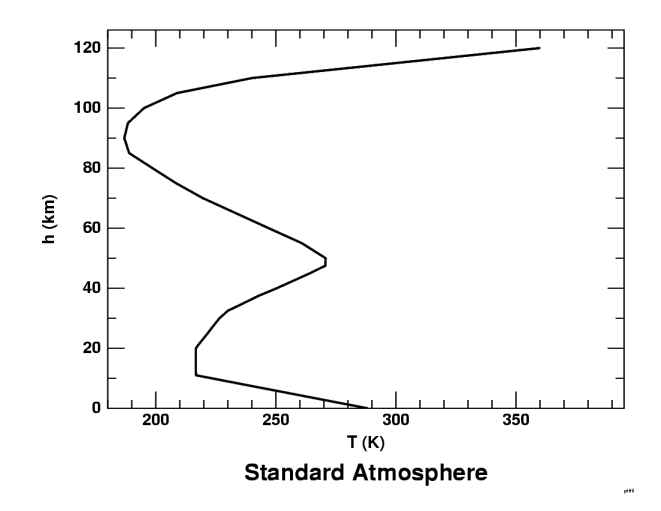


Temperature at top of the troposphere at ~11,000 meters average ~220K (35C colder than the equilibrium temperature with the Sun of 255K

Temperature at the surface average ~288K (33C warmer than the equilibrium temperature with the Sun of 255K

(220 + 288)/2 = 254K ~ 255K

Thus energy is conserved as required by the 1st law of thermodynamics: 

dU = Q + W = 0 change in internal energy

where

dU = change in internal energy which must be zero or infinitesimally small in order to conserve energy
Q = any heating source of the system (i.e. the Sun only)
W = work done 

Thus

Q = -W (note the minus sign in front of the Work done, which must be exactly equal and opposite)

which in the case of the atmosphere, the Q is radiative forcing from the Sun, and Work done is the adiabatic compression and expansion of gases in the troposphere, which must be equal and opposite for energy to be conserved:


The climate modelers claim, however, that passive IR absorbers/radiators greenhouse gases somehow add 33C of heat energy to the planet to the 255K already provided by the Sun, causing the 255+33K = 288K surface temperature. However, they never mention (for very good reasons) that the US Standard Atmosphere above and observations show the troposphere also has an even greater 35C negative greenhouse effect from 255K falling to 220K at the top of the troposphere. 

How can any greenhouse gas allegedly "know" that it is supposed to heat only the troposphere by 33C below ~5100 meters altitude while simultaneously cooling the remainder of the troposphere by 35C from ~5100 - 11,000 meters altitude? They cannot, nor can computer models, without violating the 1st and 2nd laws of thermodynamics, and common sense. 

According to the radiative greenhouse proponents, the emission/absorption spectra shown below somehow prove greenhouse gases are the cause of and not the effect of the tropospheric lapse rate temperature gradient


But the annotations below show that the big notch in the emission spectra due to H2O and CO2 is simply the exact same temperatures all along the linear adiabatic lapse rate corresponding Planck blackbody curves. As we have shown many times, the lapse rate is controlled only by gravity and atmospheric heat capacity and not affected in the least by greenhouse gas concentrations. This proves that the greenhouse gases in the atmosphere are simply radiating at the temperatures set by the lapse rate equation, as expected:

dT/dh = -g/Cp

thus the temperature is a function of and an effect of gravity/molecular mass, not the other way around from greenhouse gas "radiative forcing" or "backradiation." Irradiance or "backradiation" from greenhouse gases is in turn a function of the 4th power of temperature (by the Stefan Boltzmann equation), not the cause of the temperatures to begin with.


The cause absolutely cannot follow the effect. Mass/gravity/pressure cause the Maxwell greenhouse effect and lapse rates, which causes the resulting temperature, which in-turn causes the greenhouse gases at each atmospheric temperature thus established to passively radiate IR at the above blackbody curves and absorption/emission spectra, not the other way around. You cannot have it both ways. One and only one 33C greenhouse effect theory can be correct, not both since otherwise the surface would be at least 33C warmer. 

In the next post of this series we will introduce newly improved and greatly simplified versions of the greenhouse equation proving all atmospheric temperatures can be derived without any knowledge of the surface temperature in advance, only the equilibrium temperature of Earth and the Sun plus the barometric formulae:


Tuesday, December 2, 2014

How Gravity continuously does Work on the atmosphere to control pressure & temperature

Some commenters claim gravity is not continuously performing thermodynamic Work upon the atmosphere to generate the thermal gradient from the continuous compression/expansion of gas parcels or packets continuously moving up and down within the lower atmosphere. This is the source of the 33C gravito-thermal greenhouse effect, so we will now demonstrate why this misconception is incorrect by using the 1st Law of Thermodynamics (law of conservation of energy), ideal gas law, and barometric formulae. 

Beginning with the 1st Law of Thermodynamics: 


\Delta U = Q\, - \, W\,\,\,\,\mathrm{(sign\,convention\,of\,Clausius\,and\,generally\,in\,this\,article)}\, ,

where
 \Delta U is change in internal energy 
 Q and W are quantities of heat supplied to the system by its surroundings and of work done by the system on its surroundings, respectively. 

When a system expands [e.g. the inflation of the atmosphere by solar radiative forcing] in a fictive quasistatic process, the work done by the system on the environment is the product, +P dV,  of pressure, P, and volume change, dV, whereas the work done on the system is  -P dV.  Using either sign convention for work, the change in internal energy of the system is:

\mathrm d U = \delta Q - P \, \mathrm d V\,\,\,\,\text{(quasi-static process)},

The two sides of the 1st law equation must balance with change in internal energy for the atmosphere ~0. Note the Work done on the right side of the equation is the work done by gravitational forcing on the atmosphere = F = ma = mg for the atmosphere by the continuous compression of cold, descending air packets and the gravitational potential energy PE that convecting warm air packets accumulate as they rise, expand, and cool. In the 1st law above, the Work done on the right side is from the expansion/compression of air packets continuously rising and falling in the atmosphere ad infinitum. 
This continuous compression by gravity of cold gas packets descending adiabatically from the upper atmosphere down to the surface is what is continuously doing Work (W = pda = Pressure*change in specific volume (a)) upon the atmosphere. By the ideal gas law, this continuous work or compression of gas packets increases their pressure as they descend toward the surface, thus creating the temperature gradient within the troposphere.
Also note, greenhouse gases are passive IR absorbers/emitters and not a source of any heat energy on the left side of the equation.

Applying the 1st Law to gases or the atmosphere provides these various forms for a gas of mass m:


Note "changes in temperature result from either expansion or contraction" and "adiabatic processes play a large role in deep convective processes"


The Poisson Relation as the entire source of the atmospheric temperature gradient (gravito-thermal greenhouse effect), not radiative forcing from greenhouse gases, was perhaps first described by the great physicist Maxwell. These same barometric relations are the basis of all the barometric formulae and the greenhouse equation. 


Thus, gravity is continuously doing the work upon air packets/parcels ascending (which are accumulating gravitational potential energy) and air packets/parcels descending (which in the process are using up their gravitational potential energy in exchange for the work done by gravity on continuous compression of air packets/parcels). 

This demonstrates how gravity creates the thermal gradient above and below the equilibrium temperature with the Sun, while conserving energy:

Equilibrium temperature with the Sun = 255K
Ts = temperature at Earth's surface = 288K
Tt = temperature at the tropopause = 220K at around 15,000 km height

"Average temperature" of the quasi-linear [lapse rate] temperature gradient of the troposphere:

(288K + 220K)/2 = 254K ~ 255K = Equilibrium temperature with the Sun

288K - 255K = 33C gravito-thermal greenhouse effect

Thus fulfilling the 1st law requirement of conservation of energy. (Before someone comments, I know you can't properly average temperatures, and that temperature is not a direct proxy for heat energy because calorimetry requires the mass, specific heats, heats of fusion and vaporization, and all phase changes be accounted, but use of temperature as a proxy of heat is done for illustrative purposes and simplification of the explanation)

Note the units of pressure used in the greenhouse equation are in unit atmospheres, and by definition 1 atmosphere of pressure at the surface = 1.01325×10⁵ Newtons/meter squared, which is the continuous gravitational forcing F = mg upon the atmosphere by gravity which is producing the gravito-thermal greenhouse effect. Newton's 2nd law of motion F = ma = mg appears in the greenhouse equation as annotated below to calculate this gravitational forcing upon the atmospheric mass:


Also note, we previously calculated the adiabatic lapse rate and temperature distribution in a theoretical Earth atmosphere of 100% Nitrogen, a non-greenhouse gas, and found the adiabatic lapse rate and troposphere temperature distribution almost the same as our Earth, surface temperature warmer on the theoretical 100% Nitrogen atmosphere Earth, thus proving greenhouse gases act as cooling agents rather than warming. 

Thursday, November 27, 2014

Derivation of the effective radiating height & entire 33°C greenhouse effect without radiative forcing from greenhouse gases

The purpose of the recent series of physical proofs is to demonstrate that the greenhouse effect theory is entirely explained by the force of gravity, i.e. "gravity forcing" upon the mass of the atmosphere, rather than "radiative forcing" from greenhouse gases. This alternative "gravity forcing theory" of the greenhouse effect will be demonstrated to be completely independent of greenhouse gas radiative forcing, and compatible with all physical laws and millions of observations, as opposed to the radiative forcing theory.

We will use the ideal gas law, 1st law of thermodynamics, Newton's second law of motion (F = ma), and well-known barometric formulae in this derivation to very accurately determine Earth's surface temperature, the height in the atmosphere at which the effective equilibrium temperature of Earth with the Sun is located, and show that this height is located as expected at the center of mass of the atmosphere on Earth and Titan.

We will show that the mass/pressure greenhouse effect theory can also be used to accurately determine the temperatures at any height in the troposphere from the surface to the tropopause, and compute the mass/gravity/pressure greenhouse effect to be 33.15C, the same as determined from radiative climate models and the conventional radiative greenhouse effect theory. 

1. Conservation of energy and the ideal gas law

We will start once again with the ideal gas law 

PV = nRT (1)

an equation of state that relates the pressure P, volume V, temperature T, number of moles n of gas and the gas law constant R = 8.3144621 J/(mol K). 

The properties of gases fall into two categories: 

1. Extensive variables are proportional to the size of the system: volume, mass, energy
2. Intensive variables do not depend on the size of the system: pressure, temperature, density

To conserve energy (and to ensure that no radiative imbalances from greenhouse gases are affecting this derivation) of the mass/gravity/pressure greenhouse effect, we assume

Energy incoming from the Sun (Ein) = Energy out (Eout) from Earth to space

Observations indeed show Ein = Eout = 240 W/m2 (2)

which by the Stefan-Boltzmann law equates to a blackbody radiating at 255 K or -18C, which we will call the effective or equilibrium temperature (Te) between the Sun and Earth. As seen by satellites, the Earth radiates at the equilibrium temperature 255K from an average height referred to as the "effective radiating level" or ERL or "effective radiating height."

2. Determine the "gravity forcing" upon the atmosphere

Returning to the ideal gas law above, pressure is expressed using a variety of measurement units including atmospheres, bars, and Pascals, and for this derivation we will use units in atmospheres, which is defined as the pressure at mean sea level at the latitude of Paris, France in terms of Newtons per square meter [N/m2]

Newtons per square meter corresponds to the force per unit area [or "gravity forcing" upon the atmospheric mass per unit area of the Earth surface]. 

Now let's determine the mass of the atmosphere above one square meter at the Earth surface:

By Newton's 2nd law of motion equation, force (F) is 

F = ma  (3)   where m = mass and a = acceleration

As we noted above, the atmospheric pressure is a force or forcing per unit area. The force in this case is the weight or mass of the atmosphere times the gravitational acceleration, therefore

F = mg  (4) where g is the gravitational constant 9.8 m/s2, i.e. the acceleration due to gravity in meters per second squared.

If we assume that g is a constant for the entire column of the atmosphere above the 1 meter2 area (A) we obtain

m = PA/g = (1.0325 x 10^5 N/m2 )(1 m2 )/(9.8 m/s2 ) = 1.05 x 10^4 kg

thus, the weight of the atmosphere over 1 square meter of the surface is 10,500 kilograms, quite a remarkable gravitational forcing upon the atmosphere.

If m is the mass of the atmosphere and g is the gravitational acceleration, the gravitational force is thus

F = mg (4)

The density (p) is the mass (m) per unit Volume (V), thus,

p = m/V

SI units of pressure refer to N/m2 as the Pascal (Pa). There are 1.0325 x 10^5 Pa per atmosphere (unit). 

Starting again with equation (3) above

F = ma  (3)

F = mg  (4)

F = (PA/g)g = PA  (5)

P = F/A = mg/A = phAg/A = phg (6) 

where 

h=height along either a gas or liquid column under pressure or gravity field
g = gravitational constant
p = density = mass/volume

3. Determine the atmospheric pressures from gravitational forcing, and the height of the effective equilibrium temperature (ERL)

Now we will determine the atmospheric pressures in a gravitational field using (6) above

First let's determine the pressure at the ERL since the temperature must equal the equilibrium temperature of 255K at the ERL.

The pressure is a function of height 

P(h) = ρgh (7)

and the change in pressure dP is related to the change in height dh by 

dP = -ρg dh (8)

The minus sign arises from the fact that pressure decreases with height, subject to an adjustment for density which changes with height. We will determine this adjustment from the ideal gas law. The density is 

ρ = nM/V  (9)

where n is the number of moles, M is the molar mass, and V is the volume. We can obtain n/V from the ideal gas law: 

n/V = P/RT (10)

thus 

ρ = MP/RT  (11)

We can now substitute the density into the pressure vs. height formula:

dP = -(MPg/RT)dh  (12)

 ∫dP/P = -(Mg/RT) ∫dh  (13) (the first integral is from 1 to P, second from 0 to h)  

ln(P) = -(Mgh/RT)  (14)

P = e^-((Mgh/(RT))  (15)

We will now determine the height (h) at the ERL where the temperature = the effective equilibrium temperature = 255K, and without use of radiative forcing from greenhouse gases.

Plugging in numbers of M = 29 grams/mole (0.029 kg/mole) as average molar mass for atmosphere, g = 9.8 m/s^2, Pressure = 0.50 atmospheres at the approximate center of mass of the atmosphere, R=8.31, and T=Te=255K effective equilibrium temperature we obtain:

0.50 atmosphere P at the ERL= e^-((.029*9.8*5100)/(8.31*255))

So the height of the ERL set by gravity forcing is located at 5100 meters and is where T=Te=255K and pressure = 0.5 atmospheres, right at the center of mass of the atmosphere as we predicted from our gravity forcing hypothesis. 

4. Determine the temperatures at any location in the troposphere, and the magnitude of the mass/pressure greenhouse effect

Now that we have solved for the location of the ERL at 5100 meters, we can use the adiabatic lapse rate equation to determine all troposphere temperatures from the surface up to the ERL at 255K and then up to the top of the troposphere. The derivation of the lapse rate equation from the ideal gas law and 1st law of thermodynamics is described in this post, thus will not be repeated here, except to mention that the derivation of the lapse rate 

dT/dh = -g/Cp where Cp = heat capacity of the atmosphere at constant pressure

is also completely independent of any radiative forcing from greenhouse gases, greenhouse gas concentrations, emission/absorption spectra from greenhouse gases, etc., and is solely a function of gravity and heat capacity of the atmosphere. 

Plugging the average 6.5C/km lapse rate and 5100 meter or 5.1 km height of the ERL we determine above into our derived lapse rate equation (#6 from prior post) gives

T = -18C - (6.5C/km × (h - 5.1km)) 

Using this equation we can perfectly reproduce the temperature at any height in the troposphere as shown in Fig 1. At the surface, h = 0, thus temperature at the surface Ts is calculated as

Ts = -18 - (6.5 × (0 - 5.1)) 

Ts = -18 + 33.15C (gravity forced greenhouse effect)

Ts = 15.15°C or 288.3°K at the surface

which is exactly the same as determined by satellite observations and is 33.15C above the equilibrium temperature -18C or 255K with the Sun as expected.

Thus, we have determined the entire 33.15C greenhouse effect, the surface temperature, and the temperature of the troposphere at any height, and the height at which the equilibrium temperature with the Sun occurs at the ERL entirely on the basis of the Newton's 2nd law of motion, the 1st law of thermodynamics, and the ideal gas law, without use of radiative forcing from greenhouse gases, nor the concentrations of greenhouse gases, nor the emission/absorption spectra of greenhouse gases at any point in this derivation, demonstrating that the entire 33C greenhouse effect is dependent upon atmospheric mass/pressure/gravity, rather than radiative forcing from greenhouse gases. Also note, it is absolutely impossible for the conventional radiative theory of the greenhouse effect to also be correct, since if that was the case, the Earth's greenhouse effect would be at least double (66C+ rather than 33C). 

In essence, the radiative theory of the greenhouse effect confuses cause and effect. As we have shown, temperature is a function of pressure, and absorption/emission of IR from greenhouse gases is a function of temperature. The radiative theory tries to turn that around to claim IR emission from greenhouse gases controls the temperature, the heights of the ERL and tropopause, and thus the lapse rate, pressure, gravity, and heat capacity of the atmosphere, which is absurd and clearly disproven by basic thermodynamics and observations. The radiative greenhouse theory also makes the absurd assumption a cold body can make a hot body hotter,disproven by Pictet's experiment 214 years ago, the 1st and 2nd laws of thermodynamics, the principle of maximum entropy production, Planck's law, the Pauli exclusion principle, and quantum mechanics. There is one and only one greenhouse effect theory compatible with all of these basic physical laws and millions of observations. Can you guess which one it is?

Note the gravity forcing greenhouse theory also perfectly predicts the height of the ERL and surface temperature of Titan, the closest Earth analog in our solar system, and the only planet other than Earth with an atmosphere comprised of mostly non-greenhouse gases. The theory would not apply to any planets with thin atmospheres such as Mars which is unable to sustain significant convection. In the odd case of Venus, which I will pursue next, the atmospheric temperatures will likely be as determined by the mass/pressure theory plus additional warming from conduction downward from the thick opaque cloud top of the atmosphere, but this work is in progress.

Sunday, November 23, 2014

Derivation of the entire 33°C greenhouse effect without radiative forcing from greenhouse gases

We will derive the entire 33°C greenhouse effect using the 1st law of thermodynamics and ideal gas law without use of radiative forcing from greenhouse gases, nor the concentrations of greenhouse gases, nor the emission/absorption spectra of greenhouse gases at any point in this derivation, thus demonstrating that the entire 33C greenhouse effect is dependent upon atmospheric mass/pressure/gravity, rather than radiative forcing from greenhouse gases. Secondly, we will show why multiple observations perfectly confirm the mass/gravity/pressure theory of the greenhouse effect, and disprove the radiative forcing theory of the greenhouse effect.

Note, this physical derivation is absolutely not suggesting the ~33C greenhouse effect doesn't exist. On the contrary, the physical derivation and observations demonstrate the 33C greenhouse effect does exist, but is explained by a different mechanism not dependent on radiative forcing from greenhouse gases. Also note, it is impossible for both explanations of the greenhouse effect to be true, since the global temperature would have to increase by an additional 33C (at least) above the present. You cannot have it both ways. We will show how the 
mass/gravity/pressure theory causes the temperature gradient and that the emission spectra of greenhouse gases seen from space are a consequence rather than the cause of that temperature gradient. 

This derivation uses very well-known physical principles and barometric formulae possibly first described by the great physicist Maxwell in 1872, who demonstrated that the atmospheric temperature gradient and greenhouse effect are due to pressure from Earth's gravitational field, not radiative forcing. Maxwell makes no mention of any influence of radiation as the cause of the temperature gradient of the atmosphere, but rather relates temperature at a given height to pressure. He discusses the convective (dominated) equilibrium of the atmosphere in his book Theory of Heat, pp. 330-331:

"...In the convective equilibrium of temperature, the absolute temperature is proportional to the pressure raised to the power (γ-1)/γ, or 0,29..."
Twenty four years later, Arrhenius devised his radiative forcing theory of the greenhouse effect, which unfortunately makes a huge false assumption that convection doesn't dominate over radiative-convective equilibrium in the lower atmosphere, and thus Arrhenius completely ignored the dominant negative-feedback of convection over radiative forcing in his temperature derivations. Johns Hopkins physicist RW Wood completely demolished Arrhennius' theory in 1909, as did other published papers in 1963, 1966, 1973, (and others below), but it still refuses to die given its convenience to climate alarm.

We now know from Robinson & Catling's paper in Nature 2014 (and others) that radiative-convective equilibrium on all planets with thick atmospheres in our solar system (including Earth of course) is dominated by convection/pressure/lapse rate in the troposphere up to where the tropopause begins at pressure = 0.1bar. When P < 0.1 bar, the atmosphere is too thin to sustain convection and radiation from greenhouse gases takes over to cause cooling of the stratosphere and above. 

Since Maxwell's book was published in 1872, many others have confirmed that the greenhouse effect is due to atmospheric mass/pressure/gravity, rather than radiative forcing from greenhouse gases, including Hans Jelbring, Connolly & Connolly, Nikolov & Zeller, Mario Berberan-Santos et al, Claes Johnson and here, Velasco et al, Giovanni Vladilo et al, Heinz Thieme, Jacques Henry, Stephen Wilde, Alberto Miatello, Gerhard Gerlich and Ralf D. Tscheuschner, Verity Jones, William C. Gilbert & here, Richard C. Tolman, Lorenz & McKay, Peter Morecombe, Robinson and Catling, and many others, so this concept is not new and preceded the Arrhenius theory. 


Step 1: Derivation of the dry adiabatic lapse rate from the 1st Law of Thermodynamics and ideal gas law:

First, the basic assumption can be adopted that the atmosphere, in hydrostatic terms, is a self-gravitating system in constant hydrostatic equilibrium due to the balance of the two opposing forces of gravity and the atmospheric pressure gradient, according to the equation:

 dP/dz = - ρ × g (1)

where ρ is the density (mass per volume) and g the acceleration due to gravity. This equation, from a mathematical point of view, can be derived by considering the hydrostatic equilibrium function as a system of partial derivatives depending on P and ρ and considering all three spatial dimensions:

 ∂P/∂x = ρ × X, ∂P/∂y = ρ × Y, ∂P/∂z = ρ × Z (2)

As, within a fluid mass in equilibrium, pressure and density does not vary along the horizontal axes (X and Y), the related partial derivatives equal zero. But, in the remaining vertical dimension, the partial derivative is non-zero, with density and pressure varying inversely as a function of fluid height (density and pressure decrease with increasing height relative to the bottom) and, considering gravitational force as a constant connected to the measure of density, thus equation (2) can be derived.

For a precise calculation involving the valid parameters, the 1st Law of Thermodynamics can be used:

 Δ U = Q – W (3)

where U is the total internal energy of the system, Q its heat energy, and W the mechanical work the system is undergoing. Applying this relationship to Earth's atmosphere, yields:

 U = C(p)T + gh (4)

where U is the total energy of atmospheric system in hydrostatic equilibrium and equal to the sum of the thermal energy (kinetic plus dissipative and vibro-rotational), the specific heat C(p) multiplied by the temperature T plus the gravitational potential energy, with gravitational force g at height h of the gas. In this case, because the force of gravity has a negative sign as the system is undergoing work, the potential energy ( -g × h) can be equated to the mechanical work (-W) that the system undergoes in the 1st Law of Thermodynamics.

Based on this equation, the atmosphere's "average" temperature change can be found for any point with the system in equilibrium; for now and for simplicity, weather phenomena and disturbances at specific locations are not considered because, with the system in overall hydrostatic and macroscopic equilibrium, any local internal, microclimatic perturbation by definition triggers a rebalancing reaction. In fact, to calculate the energy change of the system in equilibrium (here U is constant) as a function of temperature and height change, differentiation yields: 

dU = 0 = C(p)dT + gdh,

which becomes: 

dT/dh = -g/C(p), or dT = (-g/C(p))dh.  [Dry adiabatic lapse rate equation]

This is a splendid equation, describing precisely the temperatures’ distribution of a gas (as the air of Earth’s atmosphere) in hydrostatic equilibrium between the 2 forces of the lapse-rate (preventing the collapse of the atmosphere at the Earth’s surface) and gravity (preventing the escape of the atmosphere in the void of space). 

In other words, temperature variation (dT) is a function of altitude variation (dh), whose solution at any point of height (h°) and for any temperature (T°), can be found by integrating as follows:

∫dT = -g/C(p) × ∫dh (5)

and whose solution is:

 T - T° = -g/C(p) × (h - h°)   (6)

where:

T – T° = ∆ T (or dT) = Interval of temperatures
g = Gravitational acceleration constant = 9.8 m/s^2
h – h° = ∆ h (or dh) = Space interval (vertical) in the atmosphere
Cp = heat capacity at constant pressure

Step 2: Determine the height at the center of mass of the atmosphere

We are determining the temperature gradient within the mass of the atmosphere using a linear function of atmospheric mass (the lapse rate), therefore the equilibrium temperature is located at the center of mass. The "effective radiating level" or ERL of planetary atmospheres is located at the approximate center of mass of the atmosphere where the temperature is equal to the equilibrium temperature with the Sun. The equilibrium temperature of Earth with the Sun is commonly assumed to be 255K or -18C as calculated here. As a rough approximation, this height is where the pressure is ~50% of the surface pressure. It is also located at the approximate half-point of the troposphere temperature profile set by the linear adiabatic lapse rate, since to conserve energy in the troposphere, the increase in temperature from the ERL to the surface is offset by the temperature decrease from the ERL to the tropopause.


Fig 1. From Robinson & Catling, Nature, 2014 with added notations in red showing at the center of mass of Earth's atmosphere at ~0.5 bar the temperature is ~255K, which is equal to the equilibrium temperature with the Sun. Robinson & Catling also demonstrated that the height of the tropopause is at 0.1 bar for all the planets in our solar system with thick atmospheres, as also shown by this figure, and that convection dominates over radiative-convective equilibrium in the troposphere to produce the troposphere lapse rates of each of these planets as shown above. R&C also show the lapse rates of each of these planets are remarkably similar despite very large differences in greenhouse gas composition and equilibrium temperatures with the Sun, once again proving pressure, not radiative forcing from greenhouse gases, determines tropospheric temperatures. 

Step 3: Determine the surface temperature

For Earth, surface pressure is 1 bar, so the ERL is located where the pressure ~0.5 bar, which is near the middle of the ~10 km high troposphere at ~5km. The average lapse rate on Earth is 6.5C/km, intermediate between the 10C/km dry adiabatic lapse rate and the 5C/km wet adiabatic lapse rate, since the atmosphere on average is intermediate between dry and saturated with water vapor. 

Plugging the average 6.5C/km lapse rate and 5km height of the ERL into our equation (6) above gives

T = -18 - (6.5 × (h - 5)) 

Using this equation we can perfectly reproduce the temperature at any height in the troposphere as shown in Fig 1. At the surface, h = 0, thus temperature at the surface Ts is calculated as

Ts = -18 - (6.5 × (0 - 5)) 

Ts = -18 + 32.5  

Ts = 14.5°C or 288°K

which is the same as determined by satellite observations and is ~33C above the equilibrium temperature with the Sun.

Thus, we have determined the entire 33C greenhouse effect, the surface temperature, and the temperature of the troposphere at any height, entirely on the basis of the 1st law of thermodynamics and ideal gas law, without use of radiative forcing from greenhouse gases, nor the concentrations of greenhouse gases, nor the emission/absorption spectra of greenhouse gases at any point in this derivation, demonstrating that the entire 33C greenhouse effect is dependent upon atmospheric mass/pressure/gravity, rather than radiative forcing from greenhouse gases.

The greenhouse gas water vapor does have a very large negative-feedback cooling effect on the surface and atmospheric temperature by reducing the lapse rate by half from the 10C/km dry rate to the 5C/km wet rate. Increased water vapor increases the heat capacity of the atmosphere Cp, which is inversely related to temperature by the lapse rate equation above:

dT/dh = -g/Cp

Plugging these lapse rates into our formula for Ts above:

Ts = -18 - (10 × (0 - 5)) = 32C using dry adiabatic lapse rate

Ts = -18 - (5 × (0 - 5)) = 7C using wet adiabatic lapse rate [fully saturated]

showing a cooling effect of up to 25C just from changes in the lapse rate from water vapor. Water vapor also cools the planet via evaporation and clouds, and which is confirmed by observations. Water vapor is thus proven by observations and theory to be a strong negative-feedback cooling agent, not a positive-feedback warming agent as assumed by the overheated climate models to amplify warming projections by a factor of 3-5 times. 

What about CO2? At only 0.04% of the atmosphere, CO2 contributes negligibly to atmospheric mass and only slightly increases the heat capacity Cp of the atmosphere, which as we have shown above, is inversely related to temperature. CO2 would thus act as a cooling agent by slightly increasing troposphere heat capacity. Increased CO2 also increases the radiative surface area of the atmosphere to enhance outgoing radiation to space, analogous to putting a larger heat sink on your microprocessor which increases radiative surface area and convection to cause cooling. 

It is well-known that CO2 and ozone are the primary cooling agents of the stratosphere up to the thermosphere, but even the warmist proponents are unable to agree on a coherent explanation why CO2 would assume the opposite role of a warming agent in the troposphere. As the mass/gravity/pressure greenhouse theory shows, and just like water vapor, CO2 also acts to cool the troposphere, and the rest of the atmosphere by increasing radiative surface loss and outgoing radiation to space. 

Millions of weather balloon observations confirm that there is no greenhouse gas-induced "hot spot" in the mid-upper troposphere, which is the alleged "fingerprint of AGW." The 2nd law of thermodynamics principle of maximum entropy production also explains why such a "hot spot" will not form. However, observations do show a cooling of the stratosphere over the satellite era, which would be consistent with increased CO2 increasing outgoing radiation to space. Observations also show an increase of outgoing longwave radiation to space over the past 62 years, which is entirely consistent with increased outgoing radiation from greenhouse gases and a decrease of "heat trapping", the opposite of AGW theory. 

In essence, the radiative theory of the greenhouse effect confuses cause and effect. As we have shown, temperature is a function of pressure, and absorption/emission of IR from greenhouse gases is a function of temperature. The radiative theory tries to turn that around to claim IR emission from greenhouse gases controls the temperature and thus pressure and heat capacity of the atmosphere, which is absurd and clearly disproven by basic thermodynamics and observations. The radiative greenhouse theory also makes the absurd assumption a cold body can make a hot body hotter, disproven by Pictet's experiment 214 years ago, the 1st and 2nd laws of thermodynamics, the principle of maximum entropy production, Planck's law, the Pauli exclusion principle, and quantum mechanics. There is one and only one greenhouse effect theory compatible with all of these basic physical laws and millions of observations. Can you guess which one it is?

Update: The atmospheric center of mass assumption in step 2 above also appears to be applicable to Titan, the closest Earth analog with a thick atmosphere in our solar system. For Titan, the surface temperature is 94K, equilibrium temperature with the Sun is 82K, and surface pressure is 1.47 bar. 

Thus, the center of mass of the atmosphere is located at ~1.47/2 = ~0.74 bar, which observations show is where Titan's atmospheric temperature is ~82K, the same as the equilibrium temperature with the Sun. I have added the notations in red to Robinson and Catling's graph below:


Update 2: Some still claim the ERL is set by radiative forcing, but this is false because:

1) A purely radiative model of the atmosphere without convection sets the ERL too high, at ~7km instead of ~5 km where observations show it is located. At 7km altitude, observations show the temperature to be 242K instead of the equilibrium temperature of 255K.

Solely radiative "greybody" model of the atmosphere without convection shown in blue. I have added in red the actual temperatures from the US Standard Atmosphere calculator. Note how the purely radiative model is up to 20K hotter, e.g. at the top of the troposphere, than the observations show. This is because convection dominates and "short-circuits" radiative forcing in the troposphere to cause cooling.


Open symbols show no relationship between tropopause height and troposphere temperatures
That's because, as Robinson and Catling have shown, the height of the troposphere and the adiabatic lapse rate that extends from the 0.1 bar tropopause all the way to the surface is controlled by pressure, not temperature nor radiative forcing from greenhouse gases:
"At higher pressures [P > 0.1 bar], atmospheres become opaque to thermal radiation, causing temperatures to increase with depth and convection to ensue. A common dependence of infrared opacity on pressure, arising from the shared physics of molecular absorption, sets the 0.1 bar tropopause"

3. We have already shown that temperature is a function of pressure, and radiance and emission spectra from greenhouse gases are in turn a function of temperature, not the other way around.