Showing posts sorted by relevance for query "extreme weather". Sort by date Show all posts

Sunday, February 9, 2014

Evidence demonstrates global warming decreases flooding & extreme precipitation

The UK Meteorological Office chief scientist Julia Slingo proclaimed yesterday "all the evidence suggests that climate change has a role to play" in the current precipitation and floods in SW England, and that "There is no evidence to counter the basic premise that a warmer world will lead to more intense daily and hourly rain events."

These are blatantly false statements countered by over 200 peer-reviewed published studies demonstrating that global warming decreases extreme precipitation and flooding. Slingo's claims are based highly flawed climate models, which even the IPCC admits cannot be used to support such claims. Slingo's MET Office report claims Britian's storms are "consistent with global warming," weasel words to defend a theory which is always said to be "consistent" with any weather event including warming, cooling, snow, droughts, and floods. 

Excerpts below of Slingo's statements from the BBC and Bishop Hill, followed by links to several published papers demonstrating that global cooling leads to more frequent and extreme flooding, rather than global warming which climate alarmists claim is the culprit. Also included below are several papers finding decreased solar activity is linked to increased precipitation and flooding. 
BBC: Met Office: Evidence 'suggests climate change link to storms'  
Somerset
Climate change is likely to be a factor in the extreme weather that has hit much of the UK in recent months, the Met Office's chief scientist has said.

Dame Julia Slingo said the variable UK climate meant there was "no definitive answer" to what caused the storms.

“In a nutshell, while there is no definitive answer for the current weather patterns that we have seen, all the evidence suggests that climate change has a role to play in it,” Dame Julia said.The “clustering and persistence” of storms that have hit the UK was extremely unusual, she added. “We have seen exceptional weather. It is consistent with what we might expect from climate change.” 
 
"But all the evidence suggests there is a link to climate change," she added.  
"There is no evidence to counter the basic premise that a warmer world will lead to more intense daily and hourly rain events."

Julia Slingo on the storms 

The Met Office and the Centre for Ecology and Hydrology (CEH) - a government research centre - have issued a joint report into the storms in south-west England. To mark the occasion Julia Slingo has taken to the airwaves, trying desperately to insinuate that there is a link to climate change:

Dame Julia said while none of the individual storms had been exceptional, the "clustering and persistence" were extremely unusual. 

"We have seen exceptional weather," she said. 

"We cannot say it's unprecedented, but it is certainly exceptional. 

"Is it consistent with what we might expect from climate change? 

"Of course. 

"As yet there can be no definitive answer on the particular events that we have seen this winter, but if we look at the broader base of evidence then we see things that support the premise that climate change has been making a contribution."

Event: Julia Slingo on the weather: "what was that little bit extra that climate change has added...?" 

Credit: BBC Radio 4

People:
Shaun Ley: BBC journalistProfessor Julia Slingo: Chief Scientist, UK Met Office

Shaun Ley: But what about the root causes of this winter's extreme weather? Well, the Chief Scientist at the Met Office has now come out more strongly than ever before, seeming to make a link between extreme weather and climate change. And Dame Julia Slingo joins us on the line, now. Dame Julia, you're convinced - or as satisfied as you can be - that there is a link between this winter's extreme weather and climate change.

Julia Slingo: Well, what we're saying very clearly is that, first of all, we understand the root causes of our very extreme run of weather - very prolonged unsettled weather, very, very wet - the wettest we've seen since 1766 in the southern part of the UK. We're saying that they - although we can understand it from the natural variability of the climate system, the extreme nature of the impacts, and indeed of the rainfall and the storminess, could be a manifestation of climate change. And we discuss that in some detail, in a very complete report that we've published today on our website, and it's available for the public to read.

Shaun Ley: The government always says it must rely on scientists, when it deals with issues of climate change. You, as a scientist, seem to be pointing the way towards more vigorous action by our government in Britain, and by governments around the world, to tackle climate change.

Julia Slingo: Yes, I think that's right. I think those of us who've worked in climate science, as I have for my whole career, we understand the fundamental physics that underpins climate change. We're looking now at what the records around the world are telling us - they're very clear, it's what the IPCC has published last year. And we're looking at a situation where: yes, the world is warming, we know that warmer air holds more water, we're beginning to detect an increase in intensity of daily and hourly rainfall rates, over the UK. We're looking at ongoing sea-level rise, a manifestation, of course, of global warming. And there are now some studies emerging that suggest that storminess is increasing, if we look at the long-term trends over the last century or so.


Shaun Ley: You seem to be saying that climate change deniers are simply wrong, and it's now time for governments to be much more robust - we're in danger of missing carbon emission targets, and really we've got to put on a much stronger act.

Julia Slingo: That's right. I mean, I think as scientists we always go back to the evidence base, and the report we've published is very clear about the evidence. I always challenge the climate sceptics to provide me with the same level of scientific integrity of the evidence base - I can't see it, and nobody has come forward to counter, as I say, the basic premise that if you have a warmer world, you are going to get more intense heavy rain rates on the daily/hourly time scale, as we're beginning to detect now, over the UK.

Shaun Ley: What you're saying is stark. You're saying this winter's extreme weather was avoidable, and man - mankind, all of us together - could have avoided this winter's extreme weather.

Julia Slingo: I'm not saying that entirely, because I think until we have done the definitive study on the contribution of global warming to this winter's extreme weather, we have to be very careful on statements as strong as that. Extreme weather is part of the natural cycle of weather and climate - that's very clear. What we need to understand now is how much global warming is adding to the extreme weather events that we see - and have always seen, I mean, we have always seen damaging weather in the UK. The question is: what was that little bit extra that climate change has added to it already? And how will climate change continue to add to extreme weather, as we go forward over the next few decades?

Shaun Ley: The Prime Minister, David Cameron, came to government pledging to be a "green" party. Are you disappointed? There seems to have been some sort of retreat from that, particularly under the pressure of austerity and recession.

Julia Slingo: It's not my place to comment. It's my job, as Chief Scientist of the Met Office, to give the government the best possible scientific evidence on which they can then make their decisions. And that's our job - we continue to work extremely hard to make sure that the science that we do is at the highest integrity, that we report it openly and transparently in the peer-reviewed science literature, and that is basically the way in which we've put together the report that was published today. It's a scientific report, it's the evidence base - I think, you know, the government then has to make its judgement on the best way to shape its policies, based on that evidence.


Shaun Ley: Dame Julia Slingo, Chief Scientist at the Met Office, thank you very much indeed.

REBUTTAL


Rebuttal to Slingo's challenge to the climate skeptics "to provide me with the same level of scientific integrity of the evidence base - I can't see it, and nobody has come forward to counter...":

IPCC:
“There is limited to medium evidence available to assess climate-driven observed changes in the magnitude and frequency of floods at regional scales because the available instrumental records of floods at gauge stations are limited in space and time, and because of confounding effects of changes in land use and engineering. Furthermore, there is low agreement in this evidence, and thus overall low confidence at the global scale regarding even the sign of these changes.” 


Floods 10X More Likely During Global Cooling Periods Vs. Global Warming Periods, EU Scientists Discover

Testimony of Dr. John Christy at House Subcommittee on Energy and Power Hearing

New paper finds floods and extreme precipitation were more common during the Little Ice Age

New paper finds mechanism by which the Sun controls floods in the European Alps

Article in nature says extreme weather events can't currently be attributed to global warming

New paper finds solar activity controlled heavy rainfall & flooding along major river in China over past 2000 years

New paper finds climate of northeastern US is highly sensitive to solar activity

New paper finds warming decreases floods

New paper shows no increase in precipitation over past 105 years, counter to global warming theory

New paper finds extreme floods and droughts occurred in China when CO2 was "safe"

New paper finds warming decreases floods

Was Nashville's flood caused by global warming?

Dame Slingo at UKMO Crosses the Line on Extreme Weather Attribution


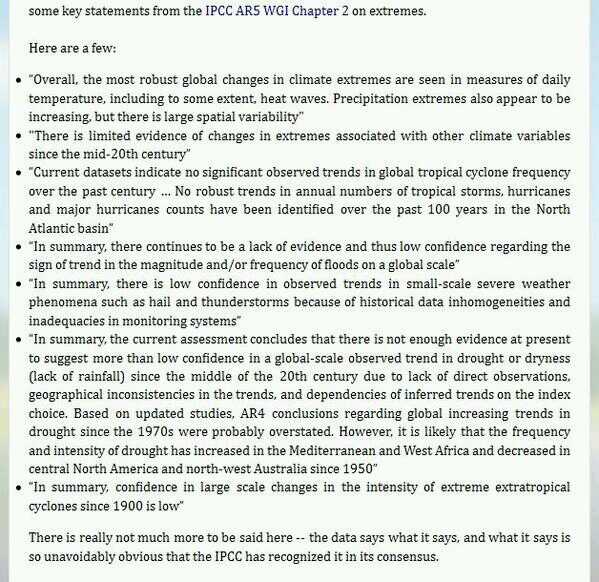
Key statements from the IPCC AR5 on extremes, courtesy of Dr. Roger Pielke, Jr.:


Met Office blames global warming for floods. But then it also predicted below average precipitation for this winter. [@afneil on Twitter]

Wednesday, November 27, 2013

New Report Concludes That Extreme Weather Events Are Not Increasing

New Report Concludes That Extreme Weather Events Are Not Increasing

A Review Of The State Of Science


A new report published today by the Global Warming Policy Foundation concludes that there has been no increase in extreme weather events in recent decades.

Whenever an extreme weather event (such as a heat-wave, a flood, a drought or a tropical storm) is widely reported by the news media, a heated debate about its possible link with global warming is set off.

The latest example of this kind of speculation was triggered by the disastrous typhoon Haiyan that killed thousands of people in the Philippines in early November.

In his report The Global Warming-Extreme Weather Link: A Review Of The State Of Science Dr Madhav Khandekar, a former meteorologist from Environment Canada, examines several recent extreme weather events and discusses them the context of the ongoing climate debate.


Full Report: The Global Warming-Extreme Weather Link: A Review Of The State Of Science

Tuesday, January 7, 2014

Record cold from global warming causing 'polar vortex' debunked

The global warming apologists are struggling to explain the record cold on global warming due to an alleged slowdown in the jet stream keeping a 'polar vortex' alive. However, a recent paper finds no evidence of any unusual or unprecedented changes in the latitude or speed of the North Atlantic jet stream over the past 142 years since 1871. Another 2 papers confirm there is no evidence that climate change has slowed the jet stream or increased frequency of jet stream blocking which controls the polar vortex.

Once again, the global warming apologists are caught out again in the face of real-world data. Dr. Roy Spencer sums it up in a post today:

Does Global Warming Theory Predict Record Cold?
January 6th, 2014 by Roy W. Spencer, Ph. D.
 
NO.
Related:

New paper debunks claims that 'Arctic amplification' causes extreme weather

A new paper published in Geophysical Research Letters debunks claims that "Arctic amplification" is causing an increase of extreme weather in North America or the North Atlantic, finding such claims are "an artifact of the methodology" and not real. The paper finds no evidence of an increased frequency of jet stream blocking or a decrease of jet stream speed, a result corroborated by a recent paper finding no significant changes of the jet stream over the past 140 years. The paper debunks claims by climate alarmists such as Heidi Cullen [and Jennifer Francis] that "Arctic amplification" is causing a "constipated jet stream" leading to increased extreme weather in North America.


Other related links via Climate Depot:

Scientists reject claims of record cold being caused by ‘global warming’ – Time Mag. blamed ‘polar vortex’ on ‘global cooling’ in 1974 – Special Report

Time Magazine Goes Both Ways On The Polar Vortex: ‘In 1974, Time Mag blamed the cold polar vortex on global cooling’ — In 2014: ‘Time Magazine blames the cold polar vortex on global warming’ (Via Real Science)

U.S. News: ‘Is Climate Change Causing the ‘Polar Vortex’? Article rebuts: Claim ‘appears unsupported by the observations’

Wash Post Throws Cold Water on Idea that Global Warming Is Causing Record Cold: ‘It’s still heavily debated…Elizabeth Barnes of Colorado State disputed the link’

Meteorologist Dr. Ryan Maue rejects claim that global warming is causing record cold: ‘This polar vortex episode is the global warming media’s most recent ‘Snapchat’ message: after a few seconds, explanation just dissolves’

Princeton Physicist Dr. Will Happer refutes claims that global warming is causing record cold: ‘Polar vortices have been around forever. They have almost nothing to do with more CO2 in the atmosphere’

Is Climate Change Causing the 'Polar Vortex'?
A blast of severe cold is sweeping across the country

By TERESA WELSH January 6, 2014 US News & World Report


A blast of severe cold is sweeping across the country.

Large portions of the United States are currently experiencing the effects of a "polar vortex," an area of low pressure bringing dangerously cold air over the country. Temperatures in the Midwest and Northeast are below zero in many areas, with wind chills as low as -50 degrees.

Temperatures in many cities are expected to hit record lows, 30 to 50 degrees below typical averages. Thousands of flights have been cancelled, and schools across the country have been closed.

Jennifer Francis, a research professor with Rutgers University’s Institute of Marine and Coastal Sciences, said that such extreme weather events can be caused by global warming. Despite the fact that the extreme weather is bitter cold in this case, warming of the arctic can have such an effect because it changes the flow of the jet stream. Sea ice melts, leaving more water surface area exposed to absorb sunlight, leading to further warming. [Dr. Judith Curry on Jennifer Francis' credibility and Dr. Elizabeth Barnes' rebuttal of Francis' claims]

"Extra heat entering the vast expanses of open water that were once covered in ice is released back to the atmosphere in the fall," Francis said. "All that extra heat being deposited into the atmosphere cannot help but affect the weather, both locally and on a large scale."

The arctic is warming about twice as quickly as the rest of Earth, according to Francis, and this shrinking temperature difference slows down the jet stream. It then gets stuck, leaving weather patterns lingering longer than usual.

Yet a study by Colorado State Professor Elizabeth A. Barnes suggests that this explanation oversimplifies the impacts of Arctic warming, as well as the subsequent impacts on severe weather:

We conclude that the mechanism put forth by previous studies … that amplified polar warming has led to the increased occurrence of slow-moving weather patterns and blocking episodes, appears unsupported by the observations.

Tuesday, August 6, 2013

Scientists assert there is less global weather variability than most people believe

Environment & Energy reports on the Nature paper we highlighted 2 weeks ago finding no increase of climate variability over the past 50 years. According to the authors, "Our findings contradict the view that a warming world will automatically be one of more overall climatic variation" and "Evidence from Greenland ice cores shows that year-to-year temperature variability was probably higher in some past cold periods." Furthermore, the paper finds, "Many climate models predict that total variability will ultimately decrease under high greenhouse gas concentrations..." The paper corroborates other peer-reviewed papers, the IPCC SREX Report, and the Congressional testimony of Dr. Roger Pielke, Jr. & Dr. John Christy finding no evidence of any increase of extreme weather or climate variability with global warming.


Scientists assert there is less weather variability, globally, than most people believe

Climate change is a broad and complicated topic, often too complicated for the average person. Instead, most of us get our grasp of climate change by looking out the window or stepping out the front door.
It explains why many people in North America and Europe -- recent victims of sweltering heat waves, droughts, floods and other extreme weather events -- believe climate change is causing ever more drastic weather extremes (ClimateWire, July 24).
That may not be the case around the world, however, according to a recent study by a team of British scientists published in the journal Nature. While regions like North America and Europe have been experiencing greater temperature variability, wild shifts from extreme heat to extreme cold, some parts of the world have been seeing more consistent temperatures.
When taken as a whole, global temperature variability has been nearly constant over the last 50 years, according to Chris Huntingford, lead author of the study and a climate modeler at the U.K. Centre for Ecology and Hydrology, part of Britain's government-funded Natural Environment Research Council.
"The general view of the scientific community is that there will be parts of the world where variability does go down, so to colleagues this is not necessarily a complete surprise," he said. Still, changing climate variability is a complicated and hotly debated subject, and Huntingford said the study was simply for "show and tell" purposes conveying their modeling results.
The study, which calculated the range of average global temperature by year using 50 years of data, nevertheless sparked a ripple of discussion through the scientific community. Jennifer Francis, a research professor at the Institute of Marine and Coastal Sciences at Rutgers University, discussed the paper with a group of other scientists shortly after it was released. 
Francis said she thought the title of the study, "No increase in global temperature variability despite changing regional patterns," was "kind of misleading." By looking only at annual temperature differences, she said, the study didn't account for smaller-scale variability relevant to sudden and short-lived extreme weather events.
The study "smooths out a lot of variability that's really relevant for extreme weather events and the kind of changes and patterns that have been happening lately," Francis said.

Misperception in the media

The study doesn't ignore regional variability, said James Screen, a research fellow at the University of Exeter who was not involved in the study. He added that people tend to ignore global variability trends in favor of their local experiences. "There's always a bias towards the regions where people live and where events happen, and they cause massive economic losses and hardship to people," he said.
The study noted that the greatest recent year-to-year changes have occurred in much of North America and Europe, something confirmed by a separate study last year. The result, according to several scientists, is a misperception across the West that the weather extremes occurring there are occurring everywhere.
According to Gavin Schmidt, a climate modeler for the NASA Goddard Institute for Space Studies, that misperception makes the study's findings "not a particularly dramatic result."
"General statements about extremes are almost nowhere to be found in the literature but seem to abound in the popular media," Schmidt said. "It's this popular perception that global warming means all extremes have to increase all the time, even though if anyone thinks about that for 10 seconds they realize that's nonsense."
What has managed to avoid attention so far is the decrease in climate variability in the tropics, something scientists have been aware of for a while, according to Francis. "As the world warms up in the future, the tropics are basically going to expand, so the fact that they're becoming less variable, I think, is really a reflection of that," she said.

Variability may decrease as world warms

Huntingford and his co-authors do identify one global trend in climate variability likely to pick up speed: a decrease in annual temperature variability. They write that there is already observational evidence that such variability is now decreasing in Europe and North America as the regions overall become warmer.
"If you were in a warming world," Huntingford said, "the years regarded as extreme could definitely become more routine." They suggested -- cautiously, according to Huntingford -- that rapid sea ice melt in the Arctic is one possible driver behind this future decreased variability.
Recent research suggests melting sea ice has been contributing to extreme weather, but as more sea ice melts in warmer months, the variability it provokes could slowly plateau. "We were given the opportunity by Nature to write a speculative last paragraph, and we think that sea ice probably has a major role in this," Huntingford said.
He added, however, that "the [climate] drivers into the future is something that will require a lot more research." Francis expressed a similar sentiment, arguing that many other factors could be contributing to a decreasing variability. "The fact that both basically are steadily changing doesn't mean that they're connected. There are a lot of things in the climate system that are steadily changing," she said.

Wednesday, September 19, 2012

Article in nature says extreme weather events can't currently be attributed to global warming

An editorial published in the current issue of nature notes that "Better models are needed before exceptional events can be reliably linked to global warming."  The article notes, "At a workshop last week in Oxford, UK, convened by the Attribution of Climate-related Events group — a loose coalition of scientists from both sides of the Atlantic — some speakers questioned whether event attribution was possible at all. It currently rests on a comparison of the probability of an observed weather event in the real world with that of the ‘same’ event in a hypothetical world without global warming. One critic argued that, given the insufficient observational data and the coarse and mathematically far-from-perfect climate models used to generate attribution claims, they are unjustifiably speculative, basically unverifiable and better not made at all."

Extreme weather

Better models are needed before exceptional events can be reliably linked to global warming.
19 September 2012  nature

As climate change proceeds — which the record summer melt of Arctic sea-ice suggests it is doing at a worrying pace — nations, communities and individual citizens may begin to seek compensation for losses and damage arising from global warming. Climate scientists should be prepared for their skills one day to be probed in court. Whether there is a legal basis for such claims, such as that brought against the energy company ExxonMobil by the remote Alaskan community of Kivalina, which is facing coastal erosion and flooding as the sea ice retreats, is far from certain, however. So lawyers, insurers and climate negotiators are watching with interest the emerging ability, arising from improvements in climate models, to calculate how anthropogenic global warming will change, or has changed, the probability and magnitude of extreme weather and other climate-related events. But to make this emerging science of ‘climate attribution’ fit to inform legal and societal decisions will require enormous research effort.
Attribution is the attempt to deconstruct the causes of observable weather and to understand the physics of why extremes such as floods and heatwaves occur. This is important basic research. Extreme weather and changing weather patterns — the obvious manifestations of global climate change — do not simply reflect easily identifiable changes in Earth’s energy balance such as a rise in atmospheric temperature. They usually have complex causes, involving anomalies in atmospheric circulation, levels of soil moisture and the like. Solid understanding of these factors is crucial if researchers are to improve the performance of, and confidence in, the climate models on which event attribution and longer-term climate projections depend.
Event attribution is one of the proposed ‘climate services’ — seasonal climate prediction is another — that are intended to provide society with the information needed to manage the risks and costs associated with climate change. Advocates of climate services see them as a counterpart to the daily weather forecast. But without the computing capacity of a well-equipped national meteorological office, heavily model-dependent services such as event attribution and seasonal prediction are unlikely to be as reliable.
“To make this emerging science of ‘climate attribution’ fit to inform legal and societal decisions will require enormous research effort.”
At a workshop last week in Oxford, UK, convened by the Attribution of Climate-related Events group — a loose coalition of scientists from both sides of the Atlantic — some speakers questioned whether event attribution was possible at all. It currently rests on a comparison of the probability of an observed weather event in the real world with that of the ‘same’ event in a hypothetical world without global warming. One critic argued that, given the insufficient observational data and the coarse and mathematically far-from-perfect climate models used to generate attribution claims, they are unjustifiably speculative, basically unverifiable and better not made at all. And even if event attribution were reliable, another speaker added, the notion that it is useful for any section of society is unproven.
Both critics have a point, but their pessimistic conclusion — that climate attribution is a non-starter — is too harsh. It is true that many climate models are currently not fit for that purpose, but they can be improved. Evaluation of how often a climate model produces a good representation of the type of event in question, and whether it does so for the right reasons, must become integral to any attribution exercise. And when communicating their results, scientists must be open about shortcomings in the models used.
It is more difficult to make the case for ‘usefulness’. None of the industry and government experts at the workshop could think of any concrete example in which an attribution might inform business or political decision-making. Especially in poor countries, the losses arising from extreme weather have often as much to do with poverty, poor health and government corruption as with a change in climate. The United Nations is planning to set up a fund with the aim of reducing loss and damage due to climate change, but the complexity of such issues is making negotations difficult.
These caveats do not mean that event attribution is a lost cause. But they are a reminder that designers of climate services must think very clearly about how others might want to use the knowledge that climate scientists produce. That could be a task for social scientists, who have good methods for analysing decision-making and social trans-actions. They need to be more involved in shaping the production and dissemination of climate knowledge.
Nature
 
489,
 
335–336
 
(20 September 2012)
 
doi:10.1038/489335b

Thursday, July 11, 2013

Could the media be biased? Networks Do 92 Climate Change Stories; Fail to Mention 'Lull' in Warming All 92 Times

Wikipedia definition of propaganda: 
"Propaganda is a form of communication aimed towards influencing the attitude of the community toward some cause or position by presenting only one side of an argument. Propaganda statements may be partly false and partly true. Propaganda is usually repeated and dispersed over a wide variety of media in order to create the chosen result in audience attitudes."
Networks Do 92 Climate Change Stories; Fail to Mention 'Lull' in Warming All 92 Times


ABC, CBS and NBC ignore 'mystery' warming plateau in favor of alarmism about sea levels, allergies, weather.

By JULIA A. SEYMOUR

From the Media Research Center

WSJ.COM 7/11/13: Recent years' slowdown in global warming completely ignored by networks 92 climate change stories in 2013.
Stories citing experts or the latest studies promoting alarmism get covered more than 8 times as often as critical experts and studies.
Although many scientists say no, ABC, CBS and NBC continue to link weather events like tornadoes, hurricanes, heat waves and more to climate change nearly one-fourth of the time.
President Barack Obama's new climate change initiative will purportedly share "a national plan to reduce carbon pollution, prepare our country for the impacts of climate change and lead global efforts to fight it." Although he intends to demand action, most Americans do not see climate change as a "major threat," according to Pew Research.
The Washington Post reported Obama will include "a plan to limit carbon-dioxide emissions from existing power plants." That's an agenda item the media will love. It was just a month ago when CBS "This Morning" interviewed Time magazine senior writer Jeffrey Kluger on May 11 who said "we have to curb the use of fossil fuels."
No doubt the broadcast networks will cheer the president's efforts, since they've spent years warning of the threat of climate change, even in the face of science that challenges their view. This year they've worried about many things including "raging infernos, surging seas, howling winds," reported alarmist claims that weren't accurate and connected weather to climate when scientists disagree. The networks have also completely ignored the "lull" in warming in recent years, in all 92 stories about climate change they reported in 2013.
One ABC report was typical, warning: "Many cities had record warmth, including Washington, D.C. where a lack of action on manmade climate change is likely to mean 2012 is just a glimpse into an unpleasant future, according to many scientists."
Just since Jan. 1, 2013, ABC, CBS and NBC morning and evening news programs have aired 92 stories about "climate change" or "global warming." Not a single one of those stories mentioned the "warming plateau" reported even by The New York Times on June 10. The Times wrote, "The rise in the surface temperature of earth has been markedly slower over the last 15 years than in the 20 years before that. And that lull in warming has occurred even as greenhouse gases have accumulated in the atmosphere at a record pace." Even though the Times piece wasn't published until June 10, a warming slowdown had been reported by foreign media outlets in November 2012, and by The Economist online in March, Reuters in April and BBC online in May of 2013.
The problems with climate forecasting models weren't mentioned either, even though a researcher at Sweden's University of Gothenburg found that many climate models couldn't correctly model known temperatures in China. Investor's Business Daily reported on March 28 that "Only half of the 21 analyzed climate models were able to reproduce the changes in some regions of China," he said. "Few models can well reproduce the nationwide change."
In an interview with Der Spiegel on June 20, German climate scientist Hans von Storch of the Meteorological Institute of the University of Hamburg pointed to the major problems of climate modeling. "So far, no one has been able to provide a compelling answer to why climate change seems to be taking a break. We're facing a puzzle. Recent CO2 emissions have actually risen even more steeply than we feared. As a result, according to most climate models, we should have seen temperatures rise by around 0.25 degrees Celsius (0.45 degrees Fahrenheit) over the past 10 years. That hasn't happened. In fact, the increase over the last 15 years was just 0.06 degrees Celsius (0.11 degrees Fahrenheit) -- a value very close to zero. This is a serious scientific problem that the Intergovernmental Panel on Climate Change (IPCC) will have to confront when it presents its next Assessment Report late next year," he explained.
The Media Research Center's Business and Media Institute looked at all the "climate change" or "global warming" stories from Jan. 1, 2013, through June 15, 2013, aired on ABC, CBS and NBC morning and evening news programs. BMI found that out there were more than 8 times as many stories that cited a study or included a scientist promoting global warming alarmism than cited a study or included a scientist challenging alarmism (25 stories to 3 stories). Nearly one-fourth of the stories this year (22 of 92) also connected (or at least asked if there was a connection) weather events like hurricanes, tornadoes, snow or flooding to climate change, in spite of the many scientific critics of those claims.
Of course in 2010, when the weather seemed to contradict the message of global warming alarmism Jane Lubchenco, head of the National Oceanic and Atmospheric Administration, said, "It is important that people recognize that weather is not the same thing as climate."
8 Times the Alarmism
New reports, studies or scientists that warned of the threat of climate change from concern over penguin populations, to predictions of sea level rise continued to be promoted by the networks in 2013. There were stories or news briefs warning that flying would become more turbulent because of climate change, connecting allergies to global warming, and others worrying about glacial melt and sea level rise.
There were 25 networks reports that mentioned a new report or analysis or that cited a scientist who promoted the climate alarmist viewpoint. That was 8 times as many as the other side; there were only three stories that cited a report or included such a scientist challenging alarmism.
The networks consulted scientists from NASA and NOAA as well as activists like Michael Oppenheimer from Princeton, who has gotten climate predictions wrong in the past. "Nightly News" interviewed Kenneth Kunkel from NOAA's National Climatic Data Center on May 25 who continued the hype, saying "If we continue to increase atmospheric concentrations of greenhouse gases in the atmosphere, we will warm the globe and that will bring certain risks into play or increase the risks of certain types of extremes."
The networks also included other people promoting alarmism who were not counted in this analysis because they weren't on to discuss a new study and they aren't scientists. Editors and reporters from Time magazine went on network broadcasts and hyped the threat of climate change. And NBC interviewed global warming activist and former Vice President Al Gore in three separate stories.
One of those times was Jan. 29, on "Today." Matt Lauer and Gore were discussing Gore's latest book and Lauer asked the former vice president about skepticism of the danger of global warming.
"I want to talk to you about some polling. If you talk to Americans, about four in five people in this country believe that climate change is happening, global warming is real and it's going to present a problem. But there's a group inside that large group, and it's not an insignificant group, and they don't believe that climate change is manmade or exacerbated by humans. Does that surprise you?" Lauer asked.
Gore then slammed anyone with a different point of view claiming that "there's been a lavishly funded, well-organized effort to convince – to try to convince people of falsehoods ..."
In spite of science, networks continue to link weather to climate
Weather events that did a lot of damage and claimed lives, like the recent Oklahoma tornado and last year's "Superstorm Sandy" were cited as incontrovertible proof of climate change. Scientists who argued otherwise were left out of the broadcasts. Even snowfall, wildfires and droughts were mentioned in some reports as examples of what one reporter called "globalweirding."
On Jan. 8, NBC "Nightly News" anchor Brian Williams mentioned a new report on the cost of extreme weather saying "natural disasters caused a total of $160 billion damage around the world in 2012 ... These new numbers coincide with a new official look at just how hot our past year was." Anne Thompson followed up his introduction by linking the "year of extreme weather" to "nature and man made climate change."
Meteorologist Joe Bastardi has vehemently opposed such connections and told Forbes.com columnist Larry Bell, "The fact is that those alarmist claims [about weather getting more extreme because of man made climate change] simply aren't true."
Another natural disaster had NBC "wondering" on May 25. NBC's Lester Holt cited the Moore, Okla., tornado saying it "has a lot of us wondering if things have gotten even more extreme than usual." John Yang's follow-up report mentioned "devastating tornadoes. Searing heat waves. Withering droughts and related wildfires and powerful hurricanes."
Yang later directly blamed weather on climate change citing "government scientists" who say it is at least "partly the result of manmade climate change."
Just one day earlier, NBC's Matt Lauer tried to get New Jersey Governor Chris Christie to blame Superstorm Sandy on global warming. He called it a "distraction." But "Today's" Al Roker had his mind made up about Sandy's relationship with climate.
On April 3, Willie Geist, Natalie Morales and Roker were discussing a public policy poll of "20 widespread conspiracy theories." One of those "theories" was that "global warming is a hoax." Roker was astounded to learn that 37 percent of Americans "don't believe in global warming," and exclaimed: "Two words: Superstorm Sandy."
CBS was less certain of the connection between Sandy and global warming, but the network was no less adamant that climate change is a problem. On the May 28 "Evening News" Norah O'Donnell said, "Earlier in the broadcast, we showed you the devastation caused by Superstorm Sandy. Whether climate change is to blame for it is the subject of debate. But there's not doubt that the climate is changing. Dean Reynolds introduces you to some folks who are out to prove it."
But was warming to blame for Sandy and for hurricanes as some have claimed? Professor of Environmental Studies Dr. Roger Pielke Jr. from the University of Colorado has said: "There is no evidence that disasters are getting worse because of climate change." "There's really no evidence that we're in the midst of an extreme weather era – whether man has influenced climate or not," Pielke added.
The networks made a big deal of the "extreme" weather and claims that 2012 was the "hottest year ever." ABC's Diane Sawyer said it was the hottest year the U.S. had seen, "hotter, not by a little, but by a landslide ... the red flags of warning about extreme heat all across the globe."
Over on CBS "This Morning" May 24, Bryan Walsh of Time magazine was discussing the hurricane forecast for 2013. Charlie Rose said, "I assume there are many causes, but is climate change one of them?" Walsh declared that "It is one of them. I mean, scientists are always working on this. But what we think is that it does make these storms stronger if not more frequent."
What he didn't clarify is that hurricanes are not happening more frequently. In fact, NOAA data shows that hurricanes have been on the decline and the worst decade for category 3, 4 and 5 hurricanes in the U.S. was the 1940s.
The networks were wrong on both counts: extreme weather and the supposedly "hottest" year on record. NOAA had put out a press release about 2012 being the warmest year, but was only referring to the lower 48 states. That's a big difference!
As for the supposedly "extreme" weather year of 2012, things were also not as they appeared. Strong tornadoes have been on the decline in the U.S. since the 1950s, and climatologist Roy Spencer pointed out that since there was warming during this time "Obviously, the conclusion should be that warming causes fewer strong tornadoes, not more (Or, maybe a lack of tornadoes causes global warming!)."
ABC's "World News with Diane Sawyer" provided a rare admission on June 3 when Sawyer said, "a lot of us were wondering this weekend if climate change is somehow creating a lot more tornadoes than usual. The answer is no."
Sadly, the networks' bias on climate change has been happening for decades. In 2007, BMI found that global warming proponents overwhelmingly outnumbered those with dissenting opinions. On average for every skeptic there were nearly 13 proponents featured. ABC did a slightly better job with a 7-to-1 ratio, while CBS's ratio was abysmal at nearly 38-to-1.
Another BMI Special Report, Fire and Ice, noted that print media have warned about impending climate doom four different times in 100 years. Only they can't decide if mankind will die from warming or cooling. BMI conducted an extensive analysis of print media's climate change coverage back to the late 1800s.
It found that many publications now claiming the world is on the brink of a global warming disaster said the same about an impending ice age – in the 1970s. Several major ones, including The New York Times, Time magazine and Newsweek, have reported on three or even four different climate shifts since 1895.
Methodology
The MRC's Business and Media Institute analyzed all stories mentioning "climate change" or "global warming' on ABC's "Good Morning America," "World News with Diane Sawyer," "World News Saturday" and "World News Sunday," CBS's "This Morning," and "Evening News" and NBC's "Today" and "Nightly News" from Jan. 1, 2013, to June 15, 2013. A few casual mentions, such as the mention of climate change in a a fashion story, were excluded from the analysis.

Wednesday, August 21, 2013

New paper debunks claims that 'Arctic amplification' causes extreme weather

A new paper published in Geophysical Research Letters debunks claims that "Arctic amplification" is causing an increase of extreme weather in North America or the North Atlantic, finding such claims are "an artifact of the methodology" and not real. The paper finds no evidence of an increased frequency of jet stream blocking or a decrease of jet stream speed, a result corroborated by a recent paper finding no significant changes of the jet stream over the past 140 years. The paper debunks claims by climate alarmists such as Heidi Cullen that "Arctic amplification" is causing a "constipated jet stream" leading to increased extreme weather in North America.

Full draft of paper available here

Additional material on this paper from the warmists at the Capital Weather Gang

Revisiting the evidence linking Arctic Amplification to extreme weather in midlatitudes

Elizabeth A. Barnes
Previous studies have suggested that Arctic Amplification has caused planetary-scale waves [the jet stream] to elongate meridionally and slow-down, resulting in more frequent blocking patterns and extreme weather. Here, trends in the meridional extent of atmospheric waves over North America and the North Atlantic are investigated in three reanalyses, and it is demonstrated that previously reported positive trends are an artifact of the methodology. No significant decrease in planetary-scale wave phase speeds [jet stream speeds] are found except in OND, but this trend is sensitive to the analysis parameters. Moreover, the frequency of [jet stream] blocking occurrence exhibits no significant increase in any season in any of the three reanalyses, further supporting the lack of trends in wave speed and meridional extent. This work highlights that observed trends in midlatitude weather patterns are complex and likely not simply understood in terms of Arctic Amplification alone.

Monday, February 10, 2014

Climate models robustly predicted the opposite of what has caused the record cold US weather

An article published today "Winter weirdness: Is Arctic warming to blame?" notes "this winter has brought unseasonable warmth to Alaska, frigid temperatures to much of the Eastern US, and more drought to California. The jury is still out on whether a warmer Arctic is behind the extreme weather." "When persistent weather patterns have brought drought or heat waves or repeated invasions of cold air to usually mild locations in winter, these links to the Arctic have become a go-to explanation among many commentators and policymakers."

But is there any credibility to such claims?

The author interviews several climate scientists active in this debate including Dr. Elizabeth Barnes, who has previously debunked claims that 'Arctic amplification' causes extreme weather, as well as dueling hyper-alarmist Jennifer Francis, and others, demonstrating there is trace to no credible scientific evidence supporting such claims.

Of particular note, the article points out that climate models actually predicted the opposite pattern to occur with the jet stream drawn north, with fewer jet stream dips, and no change in jet stream blocking:
"These [modeling] studies suggest that a warming Arctic will draw the jet stream's average track north. Blocking patterns will decrease. Moreover, the models indicate no "robust" decrease in the jet stream's speed, notes Elizabeth Barnes, a climate scientist at Colorado State University in Fort Collins who focuses on the jet stream's behavior and the factors affecting it. To be sure, the models could be wrong, she acknowledges. But when different teams with different models converge on the same answer, that inspires more confidence in the result."
Interesting how climate fraudsters like Michael Mann claim the opposite of what the observational evidence shows & climate models predict. It's all for the cause

Furthermore, the article notes "Long-term swings in Atlantic sea-surface temperatures, known as the [natural] Atlantic multidecadal oscillation, appear to have the same effect on the jet stream's meanders and blocking patterns that Arctic warming and sea ice are purported to have.

When the AMO enters its warm phase – its condition since the 1990s – the jet stream tends to weaken and buckle. Blocking patterns increase, and colder temperatures prevail at mid-latitudes.

"This also supports the colder winters of recent years," Magnusdottir says, adding that the results seem robust, since they show up in real-world data as well as in computer simulations."

Winter weirdness: Is Arctic warming to blame?

This winter has brought unseasonable warmth to Alaska, frigid temperatures to much of the Eastern US, and more drought to California. The jury is still out on whether a warmer Arctic is behind the extreme weather.

By Pete Spotts, Staff writer / February 9, 2014  CSMonitor.com
Ice from her breath forms around the face of a woman in Minneapolis. Temperatures plunged in early January as the polar vortex enveloped much of the Eastern US.

For Alaskans who have basked in record warmth, Atlantans who abandoned cars during a January snowstorm, or Californians enduring drought, this winter's extremes have been nothing if not memorable.

Drought or unusual warmth is in sync with the effects that climate scientists expect from global warming. But what about wintertime invasions of Arctic air into the US Deep South or into China, where, a new study indicates, record cold events became more frequent over the past 10 to 20 years?

For some climate scientists, January's extremes and the atmospheric patterns that nurtured and sustained them are fresh bits of information to apply to these intriguing questions: Has global warming's effect on the Arctic set the stage for persistent weather patterns that lead to extremes? If so, is the decline in Arctic sea ice the stage manager for the wintry events?

Nearly two years ago, two researchers identified atmospheric features that appear to tie a warming Arctic to mid-latitude weather extremes. Since then, when persistent weather patterns have brought drought or heat waves or repeated invasions of cold air to usually mild locations in winter, these links to the Arctic have become a go-to explanation among many commentators and policymakers.

Researchers working on the issue, however, caution that while they are uncovering intriguing hints of this tie-in,Ice from her breath forms around the face of a woman in Minneapolis. Temperatures plunged in early January as the polar vortex enveloped much of the Eastern US.

Nor is it merely an arcane debating point. If the proposition holds up, in principle it could help improve seasonal forecasts for temperature and precipitation.

"That would have huge economic implications," says Cecilia Bitz, a climate scientist at the University of Washington in Seattle who specializes in the role that Arctic sea ice plays in the climate system.

The state of this science today is comparable to that of tropical cyclones and global warming following hurricane Katrina in 2005, suggests Jennifer Francis, an atmospheric scientist at Rutgers University in New Brunswick, N.J. For those phenomena, dueling studies appeared, and evidence for an existing fingerprint of global warming on patterns of tropical cyclone activity was equivocal.[actually not, cyclone activity is at record low levels and climate models predict decreased cyclone activity from global warming]

"We are in the same situation," says Dr. Francis, who, along with colleague Stephen Vavrus at the University of Wisconsin-Madison, published the hypothesis about Arctic links to weather extremes in the journal Geophysical Research Letters in March 2012.

The duo starts by noting that warming in the Arctic has occurred at two to three times the pace of warming for the rest of the Northern Hemisphere, reducing the temperature difference between the Arctic and mid-latitudes. As the contrast shrinks, the jet stream slows.

The jet stream is a river of high-altitude winds that steers and spawns storms and in effect serves as an atmospheric boundary for cold Arctic air. A slower jet stream produces longer meanders, the pair says. This would bring cold air farther south and warm air farther north than otherwise would be the case.

At the same time, the two say, circulation patterns that block the migration of these meanders appear more frequently and persist. This would cause specific weather patterns to either creep along or dally for days to weeks.

Other researchers have connected a warming Arctic to weather extremes in specific regions. At a two-day workshop on the topic at the University of Maryland in College Park last September, climate scientist James Screen of the University of Exeter in England pointed to studies that link shrinking sea ice to cold winters in North America and Eurasia, wet summers in Europe, extreme rainfall in the Mediterranean, and the behavior of the East Asian monsoon.

But Dr. Screen also cautioned against claiming too much for the connections – at least at this point. An apparent link doesn't say much about cause and effect, he and others noted.

The case for the link between the shrinking extent of Arctic sea ice and cold winters in Eurasia was the strongest, he offered. Even here, however, the influence is barely detectable and often not statistically significant.


The caution that he and others express centers in no small part on the radically different effects that Francis and Dr. Vavrus see compared with a decade's worth of modeling studies.

These studies suggest that a warming Arctic will draw the jet stream's average track north. Blocking patterns will decrease. Moreover, the models indicate no "robust" decrease in the jet stream's speed, notes Elizabeth Barnes, a climate scientist at Colorado State University in Fort Collins who focuses on the jet stream's behavior and the factors affecting it.


To be sure, the models could be wrong, she acknowledges. But when different teams with different models converge on the same answer, that inspires more confidence in the result.
The scientists' caution also hinges on the relatively short time that the Arctic has undergone rapid warming, Francis adds, noting that it has occurred only in the past 10 or 15 years. Model projections can help, but "it's going to take maybe another decade" before any signs of an Arctic influence can be confidently detected, she says.

Francis and colleagues also have looked specifically at sea ice loss and winter weather extremes, finding a link.

In effect, the ever-shrinking amount of sea ice in the fall makes more moisture available for snow. Increased snowfall over the North American or Eurasian Arctic earlier in the fall-winter season cools the air more quickly than a later snowfall would.

This more southerly mass of cold air affects pressure patterns in ways that boost the likelihood of blocking patterns and cold snaps.

This idea appears to draw some support from modeling work that was published last August and conducted by Yannick Peings and Gudrun Magnusdottir of the University of California, Irvine.

When they plugged the average Arctic sea ice decline between 2007 and 2012 into the model, it yielded cold conditions at mid-latitudes, mainly over Asia. The model also produced some increase in the depth of the jet stream's meanders, although the statistical significance was small. All this tended to take place in February.

But by 2090, according to their model projection, the Arctic warmed so much that wintertime cold extremes at mid-latitudes remained only as frequent as they were in 2010.

Further work by Dr. Magnusdottir and colleagues has added another wrinkle. Long-term swings in Atlantic sea-surface temperatures, known as the [natural] Atlantic multidecadal oscillation, appear to have the same effect on the jet stream's meanders and blocking patterns that Arctic warming and sea ice are purported to have.

When the AMO enters its warm phase – its condition since the 1990s – the jet stream tends to weaken and buckle. Blocking patterns increase, and colder temperatures prevail at mid-latitudes.

"This also supports the colder winters of recent years," Magnusdottir says, adding that the results seem robust, since they show up in real-world data as well as in computer simulations.

Others looking for predicted circulation patterns have a hard time finding anything. In a study published last month in Geophysical Research Letters, Dr. Barnes of Colorado State and colleagues used three independent approaches to identifying blocking patterns in climate data. They reported finding trends in isolated regions and at specific periods, but no trend was significant and common to all three approaches.

"Blocking is so variable from year to year that there's no evidence that anything out of the ordinary is occurring," Barnes says. Nor has she found trends in changes to the jet stream's meanders or travel time around the hemisphere.


Does this mean that Francis and Vavrus are wrong? "Not at all," Barnes says. [For more on Francis & Barnes see Dr. Curry's post here]

The evidence may be masked for now by the "noise" of natural variability. And other factors affect the jet stream. Perhaps "you have a tug of war going on" between the influence of sea ice and something else, Barnes says.

For her part, Francis acknowledges that for now, several of the links tying Arctic warming to patterns that foster bouts of extreme weather are still weak. On the other hand, no one is finding that the meanders in the jet stream are getting any smaller, she adds.

"Everybody's seeing a hint that this is happening," she says, "but we can't say it's definitely happening yet."

Related:

New consensus rediscovers 'polar vortex' jet stream dips are due to global cooling

Does Global Warming Theory Predict Record Cold?
January 6th, 2014 by Roy W. Spencer, Ph. D.
 
NO.

Is global warming causing the polar vortex?

by Judith Curry In a word, no.
JC message to Jennifer Francis:  I’ve found that your credibility is reduced and your own motivations are questioned when you attack the motives of another scientist [Barnes], particularly a young scientist without any apparent agenda beyond doing good science and advancing her academic career.  The high ground is a much better place to be, and not just in a hurricane.