Showing posts sorted by relevance for query Maxwell's Theory of Heat. Sort by date Show all posts

Thursday, May 1, 2014

Maxwell established that gravity & atmospheric mass create so-called greenhouse effect

from a comment by climate scientist Pehr Bjornbom at the Stockholm Initiative, a Swedish climate science discussion site that is currently discussing the Hockey Schtick post Why Earth's climate is self-regulating and independent of CO2, Dr. Bjornbom notes that in 1888 the famous physicist Maxwell wrote that gravity establishes the temperature gradient [adiabatic lapse rate] of the atmosphere, which is independent of radiative forcing from greenhouse gases and dependent only upon gravity and heat capacity of the atmosphere [lapse rate = -gravity/heat capacity]. Thus, an atmosphere comprised of only non-greenhouse gases such as nitrogen & oxygen [over 99% of Earth's atmosphere] would create a temperature gradient/adiabatic lapse rate/"greenhouse effect" and not be isothermal as claimed by conventional radiative greenhouse proponents. 

67  Pehr Björnbom  05.01.2014 at. 00:29

Maxwell discussed convective equilibrium in his book Theory of Heat, 1888, pp. 330-331:
”The second result of our theory relates to the thermal equilibrium of a vertical column. We find that if a vertical column of a gas were left to itself, till by the conduction of heat it had attained a condition of thermal equilibrium, the temperature would be the same throughout [i.e. isothermal"], or, in other words, gravity produces no effect in making the bottom of the column hotter or colder than the top. This result is important in the theory of thermodynamics, for it proves that gravity has no influence in altering the conditions of thermal equilibrium in any substance, whether gaseous or not. For if two vertical columns of different substances stand on the same perfectly conducting horizontal plate, the temperature of the bottom of each column will be the same ; and if each column is in thermal equilibrium of itself, the temperatures at all equal heights must be the same. In fact, if the temperatures of the tops of the two columns were different, we might drive an engine with this difference of temperature, and the refuse heat would pass down the colder column, through the conducting plate, and up the warmer column; and this would go on till all the heat was converted into work, contrary to the second law of thermodynamics. But we know that if one of the columns is gaseous, its temperature is uniform. Hence that of the other must be uniform, whatever its material.”
[the above paragraph from Maxwell is cited by some to claim it applies to the atmosphere, but as Dr. Bjornbom notes Maxwell goes on to say this assumption does not apply to the atmosphere because of convective equilibrium;]
This result is by no means applicable to the case of our atmosphere. Setting aside the enormous direct effect of the sun’s radiation in disturbing thermal equilibrium, the effect of winds in carrying large masses of air from one height to another tends to produce a distribution of temperature of a quite different kind, the temperature at any height being such that a mass of air, brought from one height to another without gaining or losing heat, would always find itself at the temperature of the surrounding air. In this condition of what Sir William Thomson has called the convective equilibrium of heat, it is not the temperature which is constant, but the quantity ϕ [entropy], which determines the adiabatic curves.
In the convective equilibrium of temperature, the absolute temperature is proportional to the pressure raised to the power (γ-1)/γ, or 0,29. 
The extreme slowness of the conduction of heat in air, compared with the rapidity with which large masses of air are carried from one height to another by the winds, causes the temperature of the different strata of the atmosphere to depend far more on this condition of convective equilibrium than on true thermal equilibrium.”

UPDATE: Maxwell's statement "In the convective equilibrium of temperature, the absolute temperature is proportional to the pressure raised to the power (γ-1)/γ, or 0,29." is referring to γ defined as the "heat capacity ratio" = Cp/Cv [ratio of specific heat capacity at constant pressure to specific heat capacity at constant volume]

also referred to as the Poisson relation based on the ideal gas law & 1st law, which shows remarkable agreement with the gravito-thermal "greenhouse effect" found on all the planets with thick atmospheres [fig 5 & 6 below]:

image
Figure 5. Atmospheric near-surface Thermal Enhancement (NTE) as a function of mean total surface pressure (Ps) for 8 celestial bodies listed in Table 1. See Eq. (7) for the exact mathematical formula. Source: Nikolov & Zeller
image
Figure 6. Temperature/potential temperature ratio as a function of atmospheric pressure according to the Poisson formula based on the Gas Law (Po = 100 kPa.). Note the striking similarity in shape with the curve in Fig. 5.
Derivation from the first law of thermodynamics and ideal gas law [EQ 4] shown here:

Sunday, November 23, 2014

Derivation of the entire 33°C greenhouse effect without radiative forcing from greenhouse gases

We will derive the entire 33°C greenhouse effect using the 1st law of thermodynamics and ideal gas law without use of radiative forcing from greenhouse gases, nor the concentrations of greenhouse gases, nor the emission/absorption spectra of greenhouse gases at any point in this derivation, thus demonstrating that the entire 33C greenhouse effect is dependent upon atmospheric mass/pressure/gravity, rather than radiative forcing from greenhouse gases. Secondly, we will show why multiple observations perfectly confirm the mass/gravity/pressure theory of the greenhouse effect, and disprove the radiative forcing theory of the greenhouse effect.

Note, this physical derivation is absolutely not suggesting the ~33C greenhouse effect doesn't exist. On the contrary, the physical derivation and observations demonstrate the 33C greenhouse effect does exist, but is explained by a different mechanism not dependent on radiative forcing from greenhouse gases. Also note, it is impossible for both explanations of the greenhouse effect to be true, since the global temperature would have to increase by an additional 33C (at least) above the present. You cannot have it both ways. We will show how the 
mass/gravity/pressure theory causes the temperature gradient and that the emission spectra of greenhouse gases seen from space are a consequence rather than the cause of that temperature gradient. 

This derivation uses very well-known physical principles and barometric formulae possibly first described by the great physicist Maxwell in 1872, who demonstrated that the atmospheric temperature gradient and greenhouse effect are due to pressure from Earth's gravitational field, not radiative forcing. Maxwell makes no mention of any influence of radiation as the cause of the temperature gradient of the atmosphere, but rather relates temperature at a given height to pressure. He discusses the convective (dominated) equilibrium of the atmosphere in his book Theory of Heat, pp. 330-331:

"...In the convective equilibrium of temperature, the absolute temperature is proportional to the pressure raised to the power (γ-1)/γ, or 0,29..."
Twenty four years later, Arrhenius devised his radiative forcing theory of the greenhouse effect, which unfortunately makes a huge false assumption that convection doesn't dominate over radiative-convective equilibrium in the lower atmosphere, and thus Arrhenius completely ignored the dominant negative-feedback of convection over radiative forcing in his temperature derivations. Johns Hopkins physicist RW Wood completely demolished Arrhennius' theory in 1909, as did other published papers in 1963, 1966, 1973, (and others below), but it still refuses to die given its convenience to climate alarm.

We now know from Robinson & Catling's paper in Nature 2014 (and others) that radiative-convective equilibrium on all planets with thick atmospheres in our solar system (including Earth of course) is dominated by convection/pressure/lapse rate in the troposphere up to where the tropopause begins at pressure = 0.1bar. When P < 0.1 bar, the atmosphere is too thin to sustain convection and radiation from greenhouse gases takes over to cause cooling of the stratosphere and above. 

Since Maxwell's book was published in 1872, many others have confirmed that the greenhouse effect is due to atmospheric mass/pressure/gravity, rather than radiative forcing from greenhouse gases, including Hans JelbringConnolly & ConnollyNikolov & ZellerMario Berberan-Santos et alClaes Johnson and hereVelasco et alGiovanni Vladilo et alHeinz ThiemeJacques HenryStephen WildeAlberto MiatelloGerhard Gerlich and Ralf D. TscheuschnerVerity JonesWilliam C. Gilbert & hereRichard C. TolmanLorenz & McKayPeter Morecombe, Robinson and Catling, and many others, so this concept is not new and preceded the Arrhenius theory. 


Step 1: Derivation of the dry adiabatic lapse rate from the 1st Law of Thermodynamics and ideal gas law:

First, the basic assumption can be adopted that the atmosphere, in hydrostatic terms, is a self-gravitating system in constant hydrostatic equilibrium due to the balance of the two opposing forces of gravity and the atmospheric pressure gradient, according to the equation:

 dP/dz = - ρ × g (1)

where ρ is the density (mass per volume) and g the acceleration due to gravity. This equation, from a mathematical point of view, can be derived by considering the hydrostatic equilibrium function as a system of partial derivatives depending on P and ρ and considering all three spatial dimensions:

 ∂P/∂x = ρ × X, ∂P/∂y = ρ × Y, ∂P/∂z = ρ × Z (2)

As, within a fluid mass in equilibrium, pressure and density does not vary along the horizontal axes (X and Y), the related partial derivatives equal zero. But, in the remaining vertical dimension, the partial derivative is non-zero, with density and pressure varying inversely as a function of fluid height (density and pressure decrease with increasing height relative to the bottom) and, considering gravitational force as a constant connected to the measure of density, thus equation (2) can be derived.

For a precise calculation involving the valid parameters, the 1st Law of Thermodynamics can be used:

 Δ U = Q – W (3)

where U is the total internal energy of the system, Q its heat energy, and W the mechanical work the system is undergoing. Applying this relationship to Earth's atmosphere, yields:

 U = C(p)T + gh (4)

where U is the total energy of atmospheric system in hydrostatic equilibrium and equal to the sum of the thermal energy (kinetic plus dissipative and vibro-rotational), the specific heat C(p) multiplied by the temperature T plus the gravitational potential energy, with gravitational force g at height h of the gas. In this case, because the force of gravity has a negative sign as the system is undergoing work, the potential energy ( -g × h) can be equated to the mechanical work (-W) that the system undergoes in the 1st Law of Thermodynamics.

Based on this equation, the atmosphere's "average" temperature change can be found for any point with the system in equilibrium; for now and for simplicity, weather phenomena and disturbances at specific locations are not considered because, with the system in overall hydrostatic and macroscopic equilibrium, any local internal, microclimatic perturbation by definition triggers a rebalancing reaction. In fact, to calculate the energy change of the system in equilibrium (here U is constant) as a function of temperature and height change, differentiation yields: 

dU = 0 = C(p)dT + gdh,

which becomes: 

dT/dh = -g/C(p), or dT = (-g/C(p))dh.  [Dry adiabatic lapse rate equation]

This is a splendid equation, describing precisely the temperatures’ distribution of a gas (as the air of Earth’s atmosphere) in hydrostatic equilibrium between the 2 forces of the lapse-rate (preventing the collapse of the atmosphere at the Earth’s surface) and gravity (preventing the escape of the atmosphere in the void of space). 

In other words, temperature variation (dT) is a function of altitude variation (dh), whose solution at any point of height (h°) and for any temperature (T°), can be found by integrating as follows:

∫dT = -g/C(p) × ∫dh (5)

and whose solution is:

 T - T° = -g/C(p) × (h - h°)   (6)

where:

T – T° = ∆ T (or dT) = Interval of temperatures
g = Gravitational acceleration constant = 9.8 m/s^2
h – h° = ∆ h (or dh) = Space interval (vertical) in the atmosphere
Cp = heat capacity at constant pressure

Step 2: Determine the height at the center of mass of the atmosphere

We are determining the temperature gradient within the mass of the atmosphere using a linear function of atmospheric mass (the lapse rate), therefore the equilibrium temperature is located at the center of mass. The "effective radiating level" or ERL of planetary atmospheres is located at the approximate center of mass of the atmosphere where the temperature is equal to the equilibrium temperature with the Sun. The equilibrium temperature of Earth with the Sun is commonly assumed to be 255K or -18C as calculated here. As a rough approximation, this height is where the pressure is ~50% of the surface pressure. It is also located at the approximate half-point of the troposphere temperature profile set by the linear adiabatic lapse rate, since to conserve energy in the troposphere, the increase in temperature from the ERL to the surface is offset by the temperature decrease from the ERL to the tropopause.


Fig 1. From Robinson & Catling, Nature, 2014 with added notations in red showing at the center of mass of Earth's atmosphere at ~0.5 bar the temperature is ~255K, which is equal to the equilibrium temperature with the Sun. Robinson & Catling also demonstrated that the height of the tropopause is at 0.1 bar for all the planets in our solar system with thick atmospheres, as also shown by this figure, and that convection dominates over radiative-convective equilibrium in the troposphere to produce the troposphere lapse rates of each of these planets as shown above. R&C also show the lapse rates of each of these planets are remarkably similar despite very large differences in greenhouse gas composition and equilibrium temperatures with the Sun, once again proving pressure, not radiative forcing from greenhouse gases, determines tropospheric temperatures. 

Step 3: Determine the surface temperature

For Earth, surface pressure is 1 bar, so the ERL is located where the pressure ~0.5 bar, which is near the middle of the ~10 km high troposphere at ~5km. The average lapse rate on Earth is 6.5C/km, intermediate between the 10C/km dry adiabatic lapse rate and the 5C/km wet adiabatic lapse rate, since the atmosphere on average is intermediate between dry and saturated with water vapor. 

Plugging the average 6.5C/km lapse rate and 5km height of the ERL into our equation (6) above gives

T = -18 - (6.5 × (h - 5)) 

Using this equation we can perfectly reproduce the temperature at any height in the troposphere as shown in Fig 1. At the surface, h = 0, thus temperature at the surface Ts is calculated as

Ts = -18 - (6.5 × (0 - 5)) 

Ts = -18 + 32.5  

Ts = 14.5°C or 288°K

which is the same as determined by satellite observations and is ~33C above the equilibrium temperature with the Sun.

Thus, we have determined the entire 33C greenhouse effect, the surface temperature, and the temperature of the troposphere at any height, entirely on the basis of the 1st law of thermodynamics and ideal gas law, without use of radiative forcing from greenhouse gases, nor the concentrations of greenhouse gases, nor the emission/absorption spectra of greenhouse gases at any point in this derivation, demonstrating that the entire 33C greenhouse effect is dependent upon atmospheric mass/pressure/gravity, rather than radiative forcing from greenhouse gases.

The greenhouse gas water vapor does have a very large negative-feedback cooling effect on the surface and atmospheric temperature by reducing the lapse rate by half from the 10C/km dry rate to the 5C/km wet rate. Increased water vapor increases the heat capacity of the atmosphere Cp, which is inversely related to temperature by the lapse rate equation above:

dT/dh = -g/Cp

Plugging these lapse rates into our formula for Ts above:

Ts = -18 - (10 × (0 - 5)) = 32C using dry adiabatic lapse rate

Ts = -18 - (5 × (0 - 5)) = 7C using wet adiabatic lapse rate [fully saturated]

showing a cooling effect of up to 25C just from changes in the lapse rate from water vapor. Water vapor also cools the planet via evaporation and clouds, and which is confirmed by observations. Water vapor is thus proven by observations and theory to be a strong negative-feedback cooling agent, not a positive-feedback warming agent as assumed by the overheated climate models to amplify warming projections by a factor of 3-5 times. 

What about CO2? At only 0.04% of the atmosphere, CO2 contributes negligibly to atmospheric mass and only slightly increases the heat capacity Cp of the atmosphere, which as we have shown above, is inversely related to temperature. CO2 would thus act as a cooling agent by slightly increasing troposphere heat capacity. Increased CO2 also increases the radiative surface area of the atmosphere to enhance outgoing radiation to space, analogous to putting a larger heat sink on your microprocessor which increases radiative surface area and convection to cause cooling. 

It is well-known that CO2 and ozone are the primary cooling agents of the stratosphere up to the thermosphere, but even the warmist proponents are unable to agree on a coherent explanation why CO2 would assume the opposite role of a warming agent in the troposphere. As the mass/gravity/pressure greenhouse theory shows, and just like water vapor, CO2 also acts to cool the troposphere, and the rest of the atmosphere by increasing radiative surface loss and outgoing radiation to space. 

Millions of weather balloon observations confirm that there is no greenhouse gas-induced "hot spot" in the mid-upper troposphere, which is the alleged "fingerprint of AGW." The 2nd law of thermodynamics principle of maximum entropy production also explains why such a "hot spot" will not form. However, observations do show a cooling of the stratosphere over the satellite era, which would be consistent with increased CO2 increasing outgoing radiation to space. Observations also show an increase of outgoing longwave radiation to space over the past 62 years, which is entirely consistent with increased outgoing radiation from greenhouse gases and a decrease of "heat trapping", the opposite of AGW theory. 

In essence, the radiative theory of the greenhouse effect confuses cause and effect. As we have shown, temperature is a function of pressure, and absorption/emission of IR from greenhouse gases is a function of temperature. The radiative theory tries to turn that around to claim IR emission from greenhouse gases controls the temperature and thus pressure and heat capacity of the atmosphere, which is absurd and clearly disproven by basic thermodynamics and observations. The radiative greenhouse theory also makes the absurd assumption a cold body can make a hot body hotter, disproven by Pictet's experiment 214 years ago, the 1st and 2nd laws of thermodynamics, the principle of maximum entropy production, Planck's law, the Pauli exclusion principle, and quantum mechanics. There is one and only one greenhouse effect theory compatible with all of these basic physical laws and millions of observations. Can you guess which one it is?

Update: The atmospheric center of mass assumption in step 2 above also appears to be applicable to Titan, the closest Earth analog with a thick atmosphere in our solar system. For Titan, the surface temperature is 94K, equilibrium temperature with the Sun is 82K, and surface pressure is 1.47 bar. 

Thus, the center of mass of the atmosphere is located at ~1.47/2 = ~0.74 bar, which observations show is where Titan's atmospheric temperature is ~82K, the same as the equilibrium temperature with the Sun. I have added the notations in red to Robinson and Catling's graph below:


Update 2: Some still claim the ERL is set by radiative forcing, but this is false because:

1) A purely radiative model of the atmosphere without convection sets the ERL too high, at ~7km instead of ~5 km where observations show it is located. At 7km altitude, observations show the temperature to be 242K instead of the equilibrium temperature of 255K.

Solely radiative "greybody" model of the atmosphere without convection shown in blue. I have added in red the actual temperatures from the US Standard Atmosphere calculator. Note how the purely radiative model is up to 20K hotter, e.g. at the top of the troposphere, than the observations show. This is because convection dominates and "short-circuits" radiative forcing in the troposphere to cause cooling.


Open symbols show no relationship between tropopause height and troposphere temperatures
That's because, as Robinson and Catling have shown, the height of the troposphere and the adiabatic lapse rate that extends from the 0.1 bar tropopause all the way to the surface is controlled by pressure, not temperature nor radiative forcing from greenhouse gases:
"At higher pressures [P > 0.1 bar], atmospheres become opaque to thermal radiation, causing temperatures to increase with depth and convection to ensue. A common dependence of infrared opacity on pressure, arising from the shared physics of molecular absorption, sets the 0.1 bar tropopause"

3. We have already shown that temperature is a function of pressure, and radiance and emission spectra from greenhouse gases are in turn a function of temperature, not the other way around.  

Thursday, December 4, 2014

US Standard Atmosphere Model & Observations Prove Maxwell's Mass/Gravity/Pressure Theory of the 'Greenhouse Effect' is Correct & Falsifies CAGW

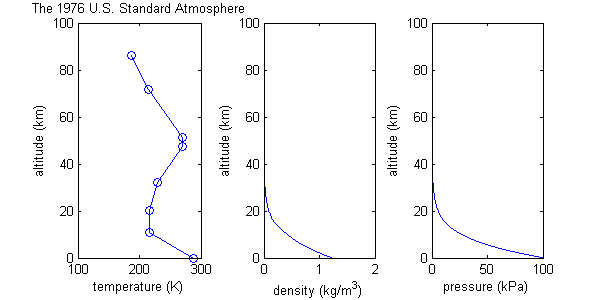
Early in the "space race" of the 1950's, US Air Force Research Laboratory meteorologist and "rocket design climatologist" Norman Sissenwine "recognized the urgent need for complete data on the properties of the atmosphere" and thus became "a catalyst between the aerospace and meteorological community" to develop the US Standard Atmosphere physical model of Earth's atmospheric pressure, density, and temperature profile by altitude from the surface all the way up to the edge of space at ~100,000+ meters altitude.

This massive effort was critical to the entire space program and aeronautics, and hundreds of rocket scientists, physicists, meteorologists, aeronautical engineers, and atmospheric scientists contributed to this project necessary to physically model and then verify with millions of observations from weather balloons, research flights, and rocket launches, that their physical 1-D vertical model of the atmosphere was correct. The 1958 first edition of the US Standard Atmosphere was followed by revisions, mostly of the far upper atmosphere at the edge of space, as more data became available from the space program, with revisions published in 1962, 1966, and the final 1976 version still widely used as the gold standard today. 

This effort to model the atmosphere for NASA, NOAA, and the US military during the cold war began long before the field of 'climate science' or 'climatologists' even existed, long before anyone ever thought or knew about alleged "radiative forcing from greenhouse gases" causing "catastrophic man-made global warming or climate change," and twenty years before the first 'climatologists' gave us the ice age scare of the 1970's, immediately followed by the global warming scare of the 1980's that is still haunting us today [but now called 'climate change' since it's not warming]. 

These early atmospheric scientists began this effort to model the atmosphere with the basic physics of gases and air known since the 1800's from the ideal gas law, 1st Law of Thermodynamics, Newton's second law of motion (F=ma=mg), the physical chemistry of molecular weights, partial pressures of each gas, heat capacities of individual gases and air at both constant pressure and constant volume, the gravitational acceleration constant, barometric formulae, Boltzmann's constant, Avogadro's number, mean atmospheric molecular weights, number density of individual species, total number density, atmospheric mass density, mole volume, scale height, geopotential height of gravitational potential energy (PE), mean air-particle speed, mean free-path of air molecules, mean collision frequency, calculated speed of sound, dynamic viscosity, kinematic viscosity, coefficient of thermal conductivity, and on and on...

And never once used any "radiative forcing" from any IR-active greenhouse gases or any radiative calculations from any greenhouse gases whatsoever to produce an accurate 1-D model that could calculate Earth's entire pressure, mass density, temperature, and molecular-scale temperature as a function of geopotential altitude (geopotential height ~ geopotential altitude ~ gravitational potential energy (PE)) profile from the surface to the edge of space. 


Fig. 3 from the 1976 US Standard Atmosphere document below. Note the "Molecular-scale temperature is a function of the geopotential altitude." Thus, the kinetic temperature of the particular molecular masses and compositions of the atmosphere is a function of the geopotential height (which is the gravitational potential energy (PE) accumulated at that height) which adiabatically sets the pressure at that geopotential height. This is another way of saying temperature is a function of atmospheric mass/gravity/pressure, which is exactly what the Maxwell atmospheric mass/gravity/pressure 33C greenhouse effect claims, not "radiative forcing" from greenhouse gases. 

The entire US Standard Atmosphere physical model was derived from physical laws assuming a completely dry atmosphere without any water vapor (the so called primary greenhouse gas) or any natural or man-made CO2 whatsoever (since CO2 at 0.03-0.04% contributes negligibly to atmospheric mass). It was only after the entire dry atmosphere model was finished that the average water vapor in Earth's atmosphere was added back in solely by changing one essentially constant parameter (on an annual & global basis):

the heat capacity of air at constant pressure (Cp) (on a global annual average basis)

of the atmosphere to calculate the tropospheric lapse rate, since water vapor has a high heat capacity more than double that of N2, O2, and CO2 (which are all lower and close to the same). This is the primary means (other than clouds) by which water vapor cools the Earth surface and atmosphere, since by the lapse rate equation

dT/dh = -g/Cp

where 

dT = change in temperature
dh = change in altitude
g = gravitational acceleration constant
Cp = heat capacity at constant pressure

the change in temperature dT is inversely related to a change in heat capacity (Cp). Note also that temperature T is a function of the constants gravity (g) and (Cp), and that neither g or Cp (within the temperature range of Earth's atmosphere) are a function of temperature (T). 

Since water vapor increases heat capacity (Cp) in the lapse rate equation, it decreases the temperature (T) at any altitude (h) including the surface where (h) = 0, and decreases the lapse rate by half from the dry rate 9.8 C/km to the wet rate of 5 C/km if the atmosphere is fully saturated with water vapor. 

The scientists involved with the US Standard Atmosphere calculated the global average lapse rate of 6.5 K/km on the basis of the known heat capacity constants of water vapor and measured global average water vapor concentrations, to calculate and confirm with observations that it is ~6.5 C/km, intermediate as expected between the dry and wet fully saturated adiabatic lapse rates, and thus this is the value used to calculate the global annual average temperature, pressure, and density profile of the Standard Atmosphere. We now know from weather balloon and satellite measurements that the global average total water vapor is quite constant, and there is little agreement about whether it has stayed the same or slightly increased or decreased over the past 35 years of the satellite era. 

The tiny 0.03-0.04% of CO2 in the atmosphere does not contribute in any significant way to atmospheric molecular mass, molecular density, partial pressures, heat capacity (Cp), etc., thus in the multiple versions of the US Standard Atmosphere models, the calculated CO2 effect on the atmospheric temperature was so negligible that the atmospheric scientists thereafter completely discarded CO2 from their model calculations of the atmosphere. The same potential effects were calculated for what is called today the "20 times stronger greenhouse gas than CO2" methane; these atmospheric scientists found the mass contribution and heat capacity to the atmosphere from methane was far too negligible to consider, thus, it was also discarded from the model along with CO2.

Thus, these hundreds of scientists were in effect "deniers" of the man-made CO2 global warming hypothesis that would come much later, and didn't recognize any "radiative forcing" from any "greenhouse gases" at the time they provided an accurate physically derived & straightforward model of the atmosphere. Hansen's (falsified) climate models and the CAGW hypothesis scare didn't arrive until ~30 years later. These atmospheric scientists never once used any radiative calculations of "back-radiation" or "radiative forcing" from IR-active greenhouse gases or clouds, or any absorption/emission spectra from greenhouse gases, all of which are the absolutely essential and critical underpinnings of the entire 33C Arrhenius radiative greenhouse theory a.k.a. the catastrophic man-made CO2 global warming theory.

Why not?

Because they knew, as did scientists including Maxwell in 1872, that the atmospheric temperature gradient is a function of atmospheric mass/gravity/pressure, not the other way around. Temperature is calculated in their model as a function of geopotential height (gravitational potential energy (PE)) and molecular mass of the constituents in each atmospheric layer, from which atmospheric pressure, density, etc. are calculated using the geopotential height (gravitational potential energy (PE) at a given height). After these intermediate parameters are calculated, then the temperature at a particular altitude is calculated as a function of mass/gravity/pressure, not the other way around. The only assumption about temperature made in their atmospheric model was that global surface temperature is, by international agreement and definition, 15C.

Ah, you say, they assumed the surface temperature and thus everything else is a function of that!

It's true that the only assumption made about temperature in their model is the surface temperature, by definition 15C. They, of course, had to do so because that is the surface temperature by definition from international agreement, and also because there were no satellite measurements at that time from the Sun and Earth to determine Earth's equilibrium temperature with the Sun. Therefore, they used 15C by definition as the starting point at the surface, and then calculated the entire remainder of the atmosphere as a function of the geopotential height (gravitational potential energy (PE) at a given height), and given the mass and molecular weights of the constituents of the air observed at each level of the atmosphere (without the greenhouse gases water vapor and CO2).

Now that satellite measurements make it possible to determine the Earth's equilibrium temperature with the Sun (Te = 255K), we can now use the greenhouse equation to bootstrap onto this huge effort by these pioneering atmospheric scientists, and thereby calculate the average global temperature at any altitude (geopotential height) in Earth's atmosphere all the way from the surface to the edge of space at ~100,000 km altitude, entirely without any radiative forcing from greenhouse gases whatsoever, and based only upon the mass/gravity theory of the greenhouse effect (first described by the famous physicist Maxwell in 1872), and calculated atmospheric center of mass, and without knowing the surface temperature or any other atmospheric temperature other than the constant equilibrium temperature with the Sun in advance.

The "Greenhouse Equation" calculates temperature (T) at any location from the surface to the top of the troposphere as a function of atmospheric mass/gravity/pressure and radiative forcing from the Sun only, and without any radiative forcing from greenhouse gases. Note the pressure (P) divided by 2 in the greenhouse equation is the pressure at the center of mass of the atmosphere, where the temperature and height are equal to the equilibrium temperature with the Sun and average "Effective Radiating Level" or ERL, respectively. 
Fig 3 from the 1976 US Standard Atmosphere description document below, with added annotations showing how the center of the tropospheric lapse rate is "triangulated" by the known constants of mass and the center of mass, the height where the center of mass can be calculated which is where the mass above is 1/2 of the total mass and the Pressure (1/2 atm) is 1/2 of the surface pressure (1 atm), and the known constant of equilibrium temperature Te between the Earth and Sun. This is the exact location of the ERL, where the temperature must equal the equilibrium temperature with the Sun. By determining the height of the ERL, the greenhouse equation then extends the linear adiabatic lapse rate up to the top of the troposphere at ~12,000 meters and down to the surface at 0 meters, from which the entire tropospheric temperature profile from the top of the troposphere to the ERL to the surface temperature can be determined by only knowing the constant equilibrium temperature with the Sun = Te = 255K. 

The calculation of not only the entire troposphere temperature profile by the greenhouse equation, but also the calculation of the temperature profiles of all remaining levels of the entire atmosphere all the way to space at ~100,000 meters, by bootstrapping onto this seminal gravito-thermal model of the 1976 US Standard Atmosphere above the troposphere, will be the topic of the next post in this series.  

The entire 241 page 1976 US Standard Atmosphere document and database (which still remains the gold standard today and has not changed despite 39 years of greenhouse gas emissions) is posted below. It is an absolute goldmine of detailed information on the physical derivation of the standard atmospheric model and confirmatory observations. It thus provides overwhelming physical proof and overwhelming observational evidence that the Maxwell gravito-thermal mass/gravity/pressure theory of the 33C "greenhouse effect" is correct, and would necessarily falsify any significant "radiative forcing from greenhouse gases" affecting the lapse rates or various atmospheric temperature gradients, and thus as well negate the theory of catastrophic anthropogenic global warming. Only one of these two competing greenhouse theories can account for the 33C greenhouse effect, since if both were true, the Earth would be an additional 33C warmer than present. 


Thursday, December 11, 2014

Why Atmospheric Temperature is a Linear Function of Mass & Gravity, and Not Influenced by Greenhouse Gas Concentrations

In the previous post of this series, we demonstrated why the US Standard Atmosphere Model & Observations Prove Maxwell's Mass/Gravity/Pressure Theory of the 'Greenhouse Effect' is Correct & Falsifies Anthropogenic Global Warming (CAGW).

We now show why the hundreds of rocket and atmospheric scientists, physicists, and aeronautical engineers who created the gold standard and final 1976 version of the US Standard Atmosphere Database (created during the ice age scare of the 1970's and just one decade prior to the global warming scare of the 1980's) in effect were "deniers" of any significant "radiative forcing," "heat trapping," or "radiative imbalance" from any greenhouse gases in their physical chemical calculations of the temperature profile of Earth's entire atmosphere from the surface all the way to the edge of space at ~100 kilometers altitude. 

In fact, the 241 page document provides overwhelming physical proof from physical chemistry and physics that the average annual temperatures at any altitude are controlled solely by molecular density, molecular weights, gravity, mass, pressure, etc. without any consideration of alleged "radiative forcing" or "heat trapping" from either natural or man-made CO2, nor any "radiative forcing" nor radiative considerations from any other gases including water vapor (now alleged to be the so-called 'primary greenhouse gas') whatsoever. The essential-to-CAGW claims of "radiative forcing," "heat trapping greenhouse gases," and "radiative imbalance from greenhouse gases" did not exist in 1976, and first appeared on the scene more than a decade later with James Hansen and the first IPCC 1990 report.

These pioneering atmospheric scientists calculated the effects of CO2 on the basis of the tiny 0.03-0.04% in the atmosphere (and thus contribution to molecular mass of the total atmosphere only ~0.03-0.04%) and found it to be so tiny and insignificant, that they removed CO2 from their 1-D model of the atmosphere completely. Their model was then used to calculate the US Standard Atmosphere database at every altitude from the surface to 100 km, and then overwhelmingly verified with millions of observations from weather balloons, research flights, rocket launches, etc. and found to accurately reproduce the temperatures on an annual basis at every altitude 0-120km within Earth's atmosphere, while completely omitting any mass, radiative, or any other effects from CO2 whatsoever.

In physics, the Stefan-Boltzmann equation is essential to calculate radiative emissions as a function of temperature (to the fourth power), but does not appear even one single time in any of the calculations in the 241 page US Standard Atmosphere description document or in their atmospheric model calculations. The Stefan-Boltzmann constant, which is absolutely essential to any radiative calculations from greenhouse gases or any gases or solid bodies also does not even appear once in the extensive tables of constants and definitions used in all of the calculations of the standard atmosphere, proving radiative considerations from any greenhouse gases are completely unnecessary to determine the average temperatures anywhere from the surface to the edge of space, and also that greenhouse gases have no radiative influence whatsoever upon the ~7 different lapse rates that occur in each of the ~7 different levels of the atmosphere from the surface to space. 

The Standard Atmosphere document indicates the only effect of water vapor upon the troposphere lapse rate is to reduce it from 9.8C/km to 6.5C/km on average, solely due to the high heat capacity Cp (1.865 Joules per gram per degree Kelvin) of water vapor compared to all of the other atmospheric gases. Per the lapse rate equation 

dT/dh = -g/Cp

where

dT = change in temperature with height
dh = change in height/geopotential altitude
g = gravitational acceleration constant = 9.8 meters/sec/sec
Cp = heat capacity at constant pressure (1 atmosphere constant pressure at the surface)

the temperature at any height or geopotential altitude is a function of and inversely related to heat capacity Cp. Thus any increase of Cp from water vapor will decrease the lapse rate and thus temperature at any height including at the surface (up to 25.5C as we previously calculated). This has absolutely nothing to do with "radiative forcing" from any greenhouse gases including water vapor itself. 

The first 6 of these linear lapse rates are shown in figure 3 below, and calculated entirely on the basis of geopotential altitude (a measure of gravitational potential energy PE) vs. molecular-scale temperature [defined in the scan below of page 9 as the mean molecular weight at that geopotential altitude], which has absolutely nothing to do with any alleged "heat trapping" or "radiative forcing" from any greenhouse gases:


Fig. 3 from the 1976 US Standard Atmosphere document below. Note the "Molecular-scale temperature is a function of the geopotential altitude." Thus, the kinetic temperature of the particular molecular masses and compositions of the atmosphere is a function of the geopotential height (which is the gravitational potential energy (PE) accumulated at that height) which adiabatically sets the pressure at that geopotential height. This is another way of saying temperature is a function of atmospheric mass/gravity/pressure, which is exactly what the Maxwell atmospheric mass/gravity/pressure 33C greenhouse effect claims, not "radiative forcing" from greenhouse gases. 

And we previous demonstrated with the greenhouse equation that we can exactly duplicate the 1976 US Standard Temperature database and model without even knowing anything about the surface temperature or greenhouse gases in advance, entirely based upon solar radiation at the Earth's surface, gravity, mass, and pressure of the atmosphere, proving no measurable effect from CO2. 
The "Greenhouse Equation" calculates temperature (T) at any location from the surface to the top of the troposphere as a function of atmospheric mass/gravity/pressure and radiative forcing from the Sun only, and without any radiative forcing from greenhouse gases. Note the pressure (P) divided by 2 in the greenhouse equation is the pressure at the center of mass of the atmosphere, where the temperature and height are equal to the equilibrium temperature with the Sun and average "Effective Radiating Level" or ERL, respectively. 
Fig 3 from the 1976 US Standard Atmosphere description document below, with added annotations showing how the center of the tropospheric lapse rate is "triangulated" by the known constants of mass and the center of mass, the height where the center of mass can be calculated which is where the mass above is 1/2 of the total mass and the Pressure (1/2 atm) is 1/2 of the surface pressure (1 atm), and the known constant of equilibrium temperature Te between the Earth and Sun. This is the exact location of the ERL, where the temperature must equal the equilibrium temperature with the Sun. By determining the height of the ERL, the greenhouse equation then extends the linear adiabatic lapse rate up to the top of the troposphere at ~12,000 meters and down to the surface at 0 meters, from which the entire tropospheric temperature profile from the top of the troposphere to the ERL to the surface temperature can be determined by only knowing the constant equilibrium temperature with the Sun = Te = 255K. 

Some commenters still doubt this is possible and conveniently claim [without any mathematical or observational proof whatsoever] as a last resort that greenhouse gases somehow control the lapse rates in each atmospheric layer. The US Standard Atmosphere and millions of confirming observations prove this is false, demonstrated by the linear kinematic velocity graph shown from the US Standard Atmosphere report below (from page 19 also scanned further below), which shows an almost perfect linear relationship between geopotential altitude and kinematic velocity from the surface to space, calculated entirely without any radiative forcing whatsoever and confirmed by observations. 

Greenhouse gas concentrations of the primary greenhouse gas water vapor and other greenhouse gases including methane, ozone, (and even CO2 to some extent) vary tremendously from the surface to the ~100 km edge of space, thus if "radiative forcing" from water vapor or any other greenhouse gases had anything to do with the cause of temperatures at any altitude, the kinematic viscosity would be nonlinear instead of linear, and the dynamic viscosity profile would not match the temperature profile (but the standard atmosphere shows it does). 


And the physical definitions and units below show radiance has nothing to do with any of these physical calculations nor interrelationships:

Physical definitions and units of kinematic viscosity, dynamic viscosity, mass density, weight and how they are related. None are defined on the basis of radiance or "radiative forcing"

This proves that only kinematic viscosity effects, not radiative effects, of any gases including greenhouse gases, are what determine the kinematic temperatures at all locations, not "greenhouse gas radiative forcing."  The only true source of radiative forcing is the Sun, not greenhouse gases which are mere passive IR-radiators & heat sinks, which help to cool the atmosphere by radiative loss to space, just like a bigger heat sink on your microprocessor does. 

After all of the above calculations were made by the US Std Atm scientists, the final calculation of the coefficient of thermal conductivity in W/(mK) was as their final step and determined solely as a function of geometric altitude/mass/density/viscosity. The document specifies below (page 20) that their ultimate calculation of the coefficient of thermal conductivity was the effect and not the cause of geometric altitude/mass/density/viscosity exclusively, and thus not "radiation trapping" nor any radiative calculations from any greenhouse gases whatsoever. The profile of these curves also nearly match the US Std Atmosphere temperature and dynamic viscosity graphs above indicating their direct relationship as gravity/mass the cause of and not the effect of any radiative forcing whatsoever.
Therefore, this provides the ultimate physical and observational proof that Maxwell's (33C) mass/pressure/gravity "greenhouse theory" of the (7) atmospheric temperature gradients is absolutely correct, thus falsifying the radiative greenhouse theory that is essential to the CAGW hypothesis. 


It is now absolutely clear that the greenhouse-gas radiative "greenhouse" theory has simply confused cause with effect. The Maxwell mass/gravity/pressure 33C "greenhouse theory" was proved physically and verified with the millions of observations of the 1976 US Standard atmosphere physical and modelled derivation and confirming observations, proving that temperatures everywhere from the surface to space are due to solar radiation plus the effect of atmospheric mass/gravity, thereby excluding any significant radiative effects from greenhouse gases (other than radiative cooling effects essential for the atmosphere to lose heat to space, i.e. the opposite of "trapping heat"). Only one of these two competing 33C "greenhouse effect" theories can be true, you simply cannot have it both ways, because if you did, the Earth would be 33C warmer at the surface than the present (in addition to multiple violations of physical laws). 

In our next post we will show why the radiation spectra of Earth seen from the ground and space are the effect of and not the cause of the entire atmospheric and surface profiles. 


CO2 and water vapor concentrations to number/mass density of the atmosphere are both so small they were calculated and then removed from consideration in the 1-D model of the atmosphere that perfectly reproduces the observations all the way to space.

1976 version of the US Standard Atmosphere

This is the most recent version and differs from previous versions only above 32 km:
Subscript bGeopotential
altitude above MSL[3]
Static pressureStandard temperature
(K)
Temperature Lapse Rate
(m)(ft)(pascals)(inHg)(K/m)(K/ft)
00010132529.92126288.15-0.0065-0.0019812
111,00036,08922632.16.683245216.650.00.0
220,00065,6175474.891.616734216.650.0010.0003048
332,000104,987868.0190.2563258228.650.00280.00085344
447,000154,199110.9060.0327506270.650.00.0
551,000167,32366.93890.01976704270.65-0.0028-0.00085344
671,000232,9403.956420.00116833214.65-0.002-0.0006096
Us standard atmosphere model.png
The conventional radiative theory cannot explain why the linear lapse rates in each of the ~7 atmospheric layers defined in the US Std Atmosphere table above vary from positive to zero to negative on the basis of greenhouse gas radiative forcing, since the concentrations of the various greenhouse gases at each of these 7 levels varies tremendously in each level, often in the opposite direction to the concentrations of the composition and amounts of greenhouse gases in each level. It is frankly impossible for each greenhouse gas to magically have the opposite warming and cooling (or no) effects simply dependent upon the altitudes of the 7 different layers. In addition, the only greenhouse gases above level 4 above are CO2 and O3, which somehow are claimed by radiative proponents to magically warm the stratosphere and thermosphere, but cool the mesosphere. How can CO2 magically change it's radiative effects between layers of allegedly cooling 3 layers, having no effect on 3 layers, and the opposite warming effect on other layers? It cannot. CO2 and other greenhouse gases can only have the same passive IR absorbers/emitters in all 7 layers, increasing radiative surface area and thus cooling of the entire atmosphere to space.
Additional scans from the US Std Atmosphere proving all of the points above: