Showing posts sorted by relevance for query ehrlich. Sort by date Show all posts

Friday, August 30, 2013

Paul Ehrlich's Real Population Bomb

Book Review: 'The Bet' by Paul Sabin

Paul Ehrlich predicted an imminent population catastrophe—Julian Simon wagered he was wrong.

    By 
  • JONATHAN V. LAST
WSJ.COM 8/30/13: It is difficult to comprehend the hysteria about overpopulation that once gripped America. In 1965, the New Republic, one of America's foremost journals of public affairs, wrote that "world population has passed food supply. The famine has started." The magazine was so convinced of the coming cataclysm that it proclaimed world hunger to be the "single most important fact in the final third of the 20th century." This period, in which large portions of America's intellectual and political elites took leave of their senses and predicted something like the literal end of civilization, is the subject of Paul Sabin's brief, but valuable, book "The Bet: Paul Ehrlich, Julian Simon, and Our Gamble Over Earth's Future."

The Bet

By Paul Sabin
Yale, 304 pages, $28.50
image
Ken Fallin
Mr. Ehrlich, a biologist specializing in butterflies, became famous in the 1970s after publishing "The Population Bomb" (1968), in which he updated the 19th-century projections of Thomas Malthus—people were overbreeding, the supply of food and resources couldn't possibly keep up—and dialed the calamity to 11. Within a few short years, hundreds of millions of people would starve to death as civilization unraveled. Or so predicted Mr. Ehrlich. "The Population Bomb" was reprinted 22 times in the first three years alone, and its author would appear as Johnny Carson's guest on "The Tonight Show" at least 20 times, becoming a national figure and an influential player in Democratic politics. Mr. Ehrlich's ideas attracted a remarkable number of passionate adherents. They also attracted the scornful criticism of a little-known economist named Julian Simon.
When he began exploring demographics, Simon, too, had been concerned about overpopulation. But the more he studied the subject, the more he became convinced that Mr. Ehrlich's thesis was fundamentally flawed. Mr. Ehrlich believed that the laws of nature that governed insects also applied to humans, that natural constraints created cycles of population booms and busts. Simon believed that man's rational powers—and the economies man constructed—made those laws nearly obsolete.
So in 1980 Simon made Mr. Ehrlich a bet. If Mr. Ehrlich's predictions about overpopulation and the depletion of resources were correct, Simon said, then over the next decade the prices of commodities would rise as they became more scarce. Simon contended that, because markets spur innovation and create efficiencies, commodity prices would fall. He proposed that each party put up $1,000 to purchase a basket of five commodities. If the prices of these went down, Mr. Ehrlich would pay Simon the difference between the 1980 and 1990 prices. If the prices went up, Simon would pay. This meant that Mr. Ehrlich's exposure was limited while Simon's was theoretically infinite.
Simon even allowed Mr. Ehrlich to rig the terms of the bet in his favor: Mr. Ehrlich was allowed to select the five commodities that would be the yardstick. Consulting two colleagues, John Holdren and John Harte, Mr. Ehrlich chose chromium, copper, nickel, tin and tungsten, each of which his team supposed was especially likely to become scarce. As they settled on their terms, Mr. Sabin notes, Messrs. Ehrlich, Holdren and Harte "felt confident that they would prevail."
They didn't. In October 1990, Mr. Ehrlich mailed a check for $576.07 to Simon. Mr. Sabin diplomatically reports that "there was no note." Although world population had increased by 800 million during the term of the wager, the prices for the five metals had decreased by more than 50%. And they did so for precisely the reasons Simon predicted—technological innovation and conservation spurred on by the market.
Mr. Ehrlich was more than a sore loser. In 1995, he told this paper: "If Simon disappeared from the face of the Earth, that would be great for humanity." (Simon would die in 1998.) This comment wasn't out of character. "The Bet" is filled chockablock with Mr. Ehrlich's outbursts—calling those who disagree with him "idiots," "fools," "morons," "clowns" and worse. His righteous zeal is matched by both his viciousness in disagreement and his utter imperviousness to contrary evidence. For example, he has criticized the scientists behind the historic Green Revolution in agriculture—men like Norman Borlaug, who fed poor people the world over through the creation of scientific farming—as "narrow-minded colleagues who are proposing idiotic panaceas to solve the food problem."
Mr. Sabin's portrait of Mr. Ehrlich suggests that he is among the more pernicious figures in the last century of American public life. As Mr. Sabin shows, he pushed an authoritarian vision of America, proposing "luxury taxes" on items such as diapers and bottles and refusing to rule out the use of coercive force in order to prevent Americans from having children. In many ways, Mr. Ehrlich was an early instigator of the worst aspects of America's culture wars. This picture is all the more damning because Mr. Sabin paints it not with malice but with sympathy. A history professor at Yale, Mr. Sabin shares Mr. Ehrlich's devotion to environmentalism. Yet this affinity doesn't prevent Mr. Sabin from being clear-eyed.
At heart, "The Bet" is about not just a conflict of men; it is about a conflict of disciplines, pitting ecologists against economists. Mr. Sabin cautiously posits that neither side has been completely vindicated by the events of the past 40 years. But this may be charity on his part: While not everything Simon predicted has come to pass, in the main he has been vindicated. As Nobel Prize-winning economist Robert Solow put it, "the world has been exhausting its exhaustible resources since the first cave-man chipped a flint."
Mr. Ehrlich may have been defeated in the wager, but he has continued to flourish in the public realm. The great mystery left unsolved by "The Bet" is why Paul Ehrlich and his confederates have paid so small a price for their mistakes. And perhaps even been rewarded for them. In 1990, just as Mr. Ehrlich was mailing his check to Simon, the MacArthur Foundation awarded him one of its "genius" grants. And 20 years later his partner in the wager, John Holdren, was appointed by President Obama to be director of the White House Office of Science and Technology Policy.
—Mr. Last is a senior writer at the Weekly Standard and the author of "What to Expect When No One's Expecting."

Thursday, April 22, 2010

Quotes from the 1st Earth Day 1970

“We have about five more years at the outside to do something.”
• Kenneth Watt, ecologist

“Civilization will end within 15 or 30 years unless immediate action is taken against problems facing mankind.”
• George Wald, Harvard Biologist

“We are in an environmental crisis which threatens the survival of this nation, and of the world as a suitable place of human habitation.”
• Barry Commoner, Washington University biologist

“Man must stop pollution and conserve his resources, not merely to enhance existence but to save the race from intolerable deterioration and possible extinction.”
• New York Times editorial, the day after the first Earth Day

“Population will inevitably and completely outstrip whatever small increases in food supplies we make. The death rate will increase until at least 100-200 million people per year will be starving to death during the next ten years.”
• Paul Ehrlich, Stanford University biologist

“By…[1975] some experts feel that food shortages will have escalated the present level of world hunger and starvation into famines of unbelievable proportions. Other experts, more optimistic, think the ultimate food-population collision will not occur until the decade of the 1980s.”
• Paul Ehrlich, Stanford University biologist

“It is already too late to avoid mass starvation.”
• Denis Hayes, chief organizer for Earth Day

Tuesday, December 3, 2013

World Agricultural Output Continues to Rise, Despite Predictions of Decline

World Agricultural Output Continues to Rise, Despite Predictions of Decline

By Steve Gorham, The Washington Times

The year 2013 has been a great year for global agriculture. Record world production of rice and healthy production of wheat and corn produced strong harvests across the world. These gains were achieved despite continuing predictions that world agricultural output is headed for a decline.
The US Department of Agriculture (USDA) reports that world rice harvests for 2012/2013 were a record 469 million metric tons. Corn and wheat harvests were also strong, following record harvests for both grains during the 2011/2012 season. The USDA is now projecting world record harvests for corn, wheat, and rice for 2013/2014.

These numbers cap a 50-year trend of remarkable growth in world grain production. Since 1960, global wheat and rice production has tripled, and corn production is almost five times higher.
For decades, doomsayers predicted that food production would fail to keep up with the needs of humanity. In 1972, Donella Meadows and others of the Massachusetts Institute of Technology published The Limits to Growth, which asked the question, “Do these rather dismal statistics mean that the limits of food production on the earth have already been reached?” Paul Ehrlich wrote in The End of Affluence in 1974, “Due to a combination of ignorance, greed and callousness, a situation has been created that could lead to a billion or more people starving to death.”

But Norman Borlaug’s development of disease-resistant, high-yield strains of wheat and rice had already revolutionized twentieth century agriculture. A few years before Meadows and Ehrlich warned about coming famines, Borlaug’s wheat and rice were introduced into Latin America and Asia with astounding results. Mexico’s wheat production soared six-fold by 1970 from levels in the 1940s. India’s wheat production jumped from a huge deficit in 1965 to a surplus only five years later.
Food production continues to grow faster than population. Data from the Food and Agriculture Organization (FAO) of the United Nations shows a 30 percent gain in the per capita agricultural production index from 1980 to 2010. World citizens have access to more grain, meat, dairy products, and fruits and vegetables. Even fish production is climbing with large gains in aquaculture fish farming.

The increased availability of food reduced the undernourished portion of the world’s population from 18.6 percent in 1990 to 12.5 percent in 2010, according to the FAO. A total of 868 million people are still classified as undernourished.

Today’s leading agriculture alarmists are proponents of the ideology of Climatism, the belief that man-made greenhouse gases are destroying Earth’s climate. Earlier this month, a leaked draft report from Working Group II of the Intergovernmental Panel on Climate Change predicted that man-made climate change would reduce global agricultural production yields by up to two percent per decade throughout the twenty-first century.

Lester Brown’s Earth Policy Institute has long been a predictor of agricultural collapse. His website states, “…climate change is heightening the likelihood of weather extremes, like heat waves, droughts, and flooding, that can so easily decimate harvests.” Even the USDA warns that man-made climate change threatens US agriculture.

Yet, one must wonder when the climate-damaging effects on agriculture will appear. The IPCC states that 1983-2012 was likely the warmest 30-year period in the Northern Hemisphere of the last 1,400 years. Certainly we should have seen some negative agricultural impact by now?
Maybe rising agricultural production is like rising polar bear populations―the decline begins tomorrow.

[Originally published in The Washington Times]

Tuesday, February 4, 2014

New paper finds global warming could increase corn yields by 2 to 3 times per 1 degree C

A new paper published in Theoretical and Applied Climatology predicts global warming will sharply improve corn yields in China by twofold to threefold per 1C of warming. Apparently, there is no end in sight to the hockey stick increase in worldwide corn yields and production, unless of course, global cooling sets in. 

Sorry, Paul Ehrlich and fellow alarmists. 
Note to Paul Ehrlich: Note the dip in corn yields during the ice age scare of the 1970's
Theoretical and Applied Climatology

The impacts of long-term and year-to-year temperature change on corn yield in China

Qi Zhang, Jiquan Zhang, Enliang Guo, Denghua Yan, Zhongyi Sun

Abstract: Impacts of climate change on crop yield can be divided into long-term and year-to-year impacts. The goal of this study is to evaluate whether the long-term and the year-to-year impacts are different using historical datasets. Data on corn yields for 1961–2005 in Jilin and Anhui, located in northeastern and Mideastern China, respectively, are combined with datasets on temperature to build the statistical regression models for evaluation of the impacts of long-term and year-to-year temperature change on corn yield. Over half of the yield trends result from non-climatic factors, such as management and technology. Corn yields could increase threefold (measured by method 1) or twofold (method 2) as long-term temperature increased per degree centigrade. And agriculture in northeastern China has benefitted from climate warming. But the year-to-year temperature change could only result in 12 % yield increase, almost 20 times less than the impacts of long-term temperature change. We conclude that the impacts of long-term and year-to-year temperature change on crop yield are quite different. So, the models derived from year-to-year variations cannot be applied to assess the impacts of long-term climate change.

Monday, November 4, 2013

Does Environmentalism Cause Amnesia? Alarmism of famine recycled again & again

Does Environmentalism Cause Amnesia?

Climate-change alarmists warn us about coming food shortages. They said the same in 1968.

By BRET STEPHENS

WSJ.COM 11/4/13: Warming is becoming a major problem. "A change in our climate," writes one deservedly famous American naturalist, "is taking place very sensibly." Snowfall, he notes, has become "less frequent and less deep." Rivers that once "seldom failed to freeze over in the course of the winter, scarcely ever do so now."

And it's having an especially worrisome effect on the food supply: "This change has produced an unfortunate fluctuation between heat and cold, in the spring of the year, which is very fatal to fruits."

That isn't a leaked excerpt from the latest report of the U.N.'s Intergovernmental Panel on Climate Change, but it may as well be. Last week, Canadian journalist Donna Laframboise of the website No Frakking Consensus posted a draft of a forthcoming IPCC report on the alleged effects climate change will have on food production. The New York Times then splashed the news on its front page Saturday. It's another tale of warming woe:

"With or without adaptation," the report warns, "climate change will reduce median yields by 0 to 2% per decade for the rest of the century, as compared to a baseline without climate change. These projected impacts will occur in the context of rising crop demand, projected to increase by 14% per decade until 2050."


Two silly books, now being recycled by global warming alarmists.


If this has a familiar ring, it's because it harks back to the neo-Malthusian forecasts of the 1960s and '70s, when we were supposed to believe that population growth would outstrip food production. This gave us such titles as "Famine 1975!", a 1967 best seller by the brothers William and Paul Paddock, along with Paul Ehrlich's vastly influential "The Population Bomb," a book that began with the words, "The battle to feed all of humanity is over. In the 1970s and 1980s hundreds of millions of people will starve to death in spite of any crash programs embarked upon now."

In case you're wondering what happened with that battle to feed humanity, the U.N.'s Food and Agriculture Organization has some useful figures on its website. In 1968, the year Mr. Ehrlich's book first appeared, Asia produced 46,321,114 tons of maize and 439,579,934 of cereals. By 2011, the respective figures had risen to 270,316,205, up 484%, and 1,289,633,254, up 193%.

It's the same story nearly everywhere else one looks. In Africa, maize production was up 247% between 1968 and 2011, while production of so-called primary vegetables has risen 319%; in South America, it's 308% and 199%. Meanwhile, the world's population rose to just under seven billion from about 3.7 billion, an increase of about 90%. It is predicted to rise by another 33% by 2050.

But what about the supposedly warming climate? According to the EPA, "average temperatures have risen more quickly since the late 1970s," with the contiguous 48 states warming "faster than the global rate." Yet U.S. food production over the same time has also risen by robust percentages even as the number of acres under cultivation has been steadily falling for decades.

In other words, even if you believe the temperature records, a warming climate seems to correlate positively with greater food production. This has mainly to do with better farming practices and the widespread introduction of genetically modified (GMO) crops, and perhaps also the stimulative effects that carbon dioxide has on photosynthesis (though this is debated). Warming also could mean that northern latitudes now not suited for farming might become so in the future.

But whatever the reason, the world isn't likely to be getting any hungrier. Quite the opposite: Purely natural (as opposed to man-made) famines are becoming unknown. As the Irish economist Cormac Ó Gráda noted in a 2010 paper, "in global terms, the margin over subsistence is now much wider than it was a generation ago. This also holds for former famine zones such as India and Bangladesh, whereas China, once the 'land of famine,' nowadays faces a growing problem of childhood obesity." Only in Africa is food scarcity still an issue, but even there recent food crises in Malawi and Niger did not result in major loss of life.

What does hurt people is bad public policy. Exhibit A is the U.S. ethanol mandate—justified in part as a response to global warming—which diverted the corn crop to fuel production and sent global food prices soaring in 2008. Exhibit B is the cult of organic farming and knee-jerk opposition to GMOs, which risk depriving farmers in poor countries of high-yield, nutrient-rich crops. Exhibit C was the effort to ban DDT without adequate substitutes to stop the spread of malaria, which kills nearly 900,000 people, mostly children, in sub-Saharan Africa alone with each passing year. The list goes on and on.

Environmentalists tend to have conveniently short memories, especially when it comes to their own mistakes. They would do better to learn from history. Just take the quote about the warming climate with which this column began. It's from "Notes on the State of Virginia" by Thomas Jefferson, published in 1785.


Thursday, May 24, 2012

Paul Ehrlich's 'population bomb' is now stone-cold dead

America's 21st-Century Population Edge

Birth rates are dropping all over the world, often below replacement rates. But not in the U.S.

By BEN J. WATTENBERG    WSJ.COM  5/24/12
Look around you. For most nations of the world, birth and fertility rates have never fallen so far, so fast, so long, so surprisingly, all across the globe. Except for America.
Seen globally, the population explosion—or what Stanford's Paul Ehrlich called "the population bomb" in the 1960s—is now stone-cold dead. The ramifications are enormous economically, geopolitically, culturally and personally. For one, the United States will become stronger than ever in the games nations play.
Every other major modern nation and every developing country has low or falling birth rates. Japan and Poland see 1.3 children per woman, Brazil and China 1.9, Pakistan 3.6 (down from 6.6 three decades ago). American fertility rates are relatively high, at nearly 2.1.
Having children is an affirmative act, so it's little surprise that surveys—Gallup, Harris and others—show Americans to be the most optimistic nation in the world. (Israel, too, is an optimistic nation with a sense of mission and high birth rates.)
Then there's the effect of immigration. According to the United Nations and the U.S. Census Bureau, the U.S. takes in more immigrants than the rest of the world combined. Think Albert Einstein, Madeleine Albright, Andy Grove, Albert Pujols, Sergei Brin, I.M. Pei or David Hockney.

Drive in the suburbs and exurbs of many major American cities and you will see McMansion homes with three, four or even five children—McPlenty—unheard of anywhere else. American couples can choose to have many children because the U.S. is one of the world's few suburban nations. In suburban settings, some affluent parents are deciding that for a decade or so raising a large family is more important than having two earners.
All this and more yields an America that is projected to have 400 million people in 2050, up from 310 million today and possibly on the way to 500 million by 2100. This may not quite play out—immigration from Mexico will likely fall as Mexican fertility drops off—but the trend lines are far stronger in the U.S. than elsewhere.
wattenberg
Getty Images
A hefty and growing population in America can yield power and influence.
According to one U.N. projection, the world population will fall to three billion or four billion by 2300 from seven billion today. That steep drop in birth rates includes rapidly developing countries such as India, China and Brazil, plus many Arab and Muslim countries. In these countries, birth rates will soon be, or already are, below "replacement levels"—meaning fewer than 2.1 children per woman, the number sufficient to "replace" both parents and account for those children who don't make it to reproductive age. Of developing countries, 33 of 155 have below-replacement rates today, and more are on the way.
Why is this so important to America? A hefty and growing population can yield power and influence. It's been a long time since a nation with a small population influenced how the world works—think the 16th-century Dutch and Portuguese.
Size also yields vast economies of scale. As population grows, through fertility and immigration, a healthy housing market is inevitable. It's either that or tens of millions of Americans sleeping on the streets. Bet on the boom.
There's corporate growth too, across industries. Imagine an American corporation, XYZ, that wants to start doing business in Thailand. Only in a polyglot nation like America can XYZ search out and find the adult children of Thai immigrants who know America inside and out but also know Thai customs and language.
Few if any nations have all these advantages. The demography in play guarantees that the 21st century, like the 20th, will be an "American Century."
Mr. Wattenberg, a senior fellow at the American Enterprise Institute and the Hudson Institute, is working on his 15th book, his third about population, from which this article is drawn.

Tuesday, October 15, 2013

CNN features a Paul Ehrlich impersonator who says population control is the only way to control the weather

Paul Ehrlich impersonator on CNN claims climate is being damaged since the "world's poor masses, increasingly living in cities, manage to get cell phones. Whether the power is pirated or not, they plug in their chargers nightly"; calls for "bringing fewer emitters [a.k.a. babies] into the world."

We don't need another billion people

By Alan Weisman, Special to CNN
updated 3:42 PM EDT, Tue October 15, 2013


But first, check out the final minute of this CNN video explaining "where all the [climate] skepticism comes from" on the IPCC AR5. 


Weisman says the fastest and easiest way to limit carbon emissions is population control

Editor's note: Alan Weisman's new book is "Countdown: Our Last, Best Hope for a Future on Earth?" (Little, Brown and Co). He is also the author of "The World Without Us," a 2007 New York Times and international best-seller translated into 34 languages.

(CNN) -- Charles Darwin once said that we can understand some parts of nature and the universe, but we can't comprehend them.

For instance, take the fact that in the next 12 years, we're projected to add another billion people. Since a billion seconds equal 31.7 years, at the rate people are arriving, we can't even count them.

Or that the Intergovernmental Panel on Climate Change now says that if we want to stay below a 2-degree Celsius (3.6-degree Fahrenheit) increase in average global temperature, we can't emit any more carbon dioxide than what's released by burning 1 trillion tons of carbon. But we've already used more than half our allotment.
Alan Weisman


There's a direct link between those two hard-to-grasp figures -- the more humans, the more carbon.

Every mile we drive, ours cars emit about a pound of carbon dioxide. The average U.S. driver clocks 12,000 miles per year, pushing six tons of carbon up his auto's tailpipe. The quarter-billion cars in the United States expel 150 million tons a year. In the whole world, there are now well over 1 billion cars.

Those numbers are mind-boggling, even before we add the exhaust from our industries, power plants, and home heating and cooling. No, we can't easily comprehend the sheer scale of the problem, let alone imagine what we can do about it. But maybe this helps to frame it.

According to the World Resources Institute, to stay on the safe side of a 2-degree Celsius increase, we'd have to go back to the amount we were expelling in 1990 -- and then cut that in half.

How might we possibly do that? It will depend on how wisely we address the matter of those billion new humans.

Here are four ways to cut greenhouse gases, from the most unlikely to the most plausible:

The first is to trap them before they float skyward and start acting like glass in a greenhouse. This is possible -- theoretically. We know how to capture carbon dioxide from smokestacks (though not from all those cars). We'd then have to dig deep holes to pump it underground and somehow keep it there. One way is to inject the gas into underground saline aquifers, turning their contents into salty carbonic acid, which would then react with surrounding rocks until the carbon dioxide becomes entombed in solid carbonates.

That's very neat but very expensive. The only attempt in the United States, in West Virginia, was abandoned in 2011 by American Electric Power because it would have cost two-thirds of $1 billion, even with the Department of Energy footing half the bill. Realistically, we'll never afford this -- and we're one of the rich countries. Imagine the rest of the world doing it.

The second possibility is finding new ways to produce clean energy. We must keep trying, but so far we can't concentrate enough diffuse sunlight or intermittent wind to run all our cities and factories (and it's hard to hang solar panels or wind turbines on cars).

Also, a 2012 paper in Environmental Research Letters by former Microsoft chief technology officer Nathan Myhrvold and Carnegie Institution physicist Ken Caldeira showed that the carbon debt incurred by construction of renewable energy plants, including mining their materials, takes decades to amortize before their energy is truly emission-free. And exotic methods such as controlled nuclear fusion, which powers the sun's core, are enticing but perpetually decades away.

Third, we can use incentives such as carbon taxes and moral persuasion to bring down energy consumption. Again, these help, and must be encouraged. Although a number of countries and some U.S. states have passed carbon taxes, consumption is exceedingly hard to control in a world where, for example, even the world's poor masses, increasingly living in cities, manage to get cell phones. Whether the power is pirated or not, they plug in their chargers nightly. Despite all our best efforts to conserve and consume less, global carbon emissions reached a record high in 2012, and keep climbing.

Last, however, if we can't control consumption, we can control the number of consumers. This is technology we already have, and it's cheap. Every woman, everywhere, could have contraception.

Most of us would find coercive government limits on child bearing abhorrent. But giving women access to contraception and to education makes draconian edicts unnecessary. An educated woman has an interesting and useful contribution to make to her family and her society. Since she can't easily do that with seven children hanging on her skirts, most women who get through secondary school want two children or fewer. Providing access to contraception and educating women may be the fastest path to giving our planet a break.

In September, the Intergovernmental Panel on Climate Change presented compelling evidence that seas are rising faster than ever in human history. The last time there was this much carbon in the atmosphere, at least 3 million years ago, oceans were 30 to 100 feet higher. Much of the world's most widely consumed foodstuff, rice, is grown near sea level, and the cost of protecting it with coastal dikes would be astronomical.

This month, a team of University of Hawaii climate modelers added in the journal Nature that in just seven years the tropics will be experiencing average temperatures unprecedented in recorded history -- and within a generation, so will the entire planet, unless we stabilize greenhouse gases in the next 20 years.

Population management can't do it all; we need a full-court press on all fronts. But if we want a secure future, we need to start with the fastest, most affordable way we know to limit carbon emissions: by bringing fewer emitters into the world.

Friday, June 13, 2014

The Debate is finally over on “Global Warming” - Because Alarmists Won't Debate

Fired for ‘Diverging’ on Climate: Progressive Professor’s fellowship ‘terminated’ after WSJ OpEd calling global warming ‘unproved science’
Fired for ‘Diverging’ on Climate: Progressive Professor Dr. Caleb Rossiter's fellowship ‘terminated’ after WSJ OpEd calling global warming ‘unproved science’


The Debate is finally over on “Global Warming” – Because Nobody will Debate

By Dr. Caleb Rossiter

I am deserting from the Climate War. I will never write another climate article or give another climate talk, and I’ll bite my tongue and say oooooooooooom when I hear or see the sort of exaggerations and certainties about the dangers of heat-trapping gasses that tend to make my blood boil at their absurdity.  For a decade I’ve been a busy soldier for the scientific method, and hence a “skeptic” to climate alarmism.  I’ve said all I think and know about this repetitive, unresolveable topic.  I’ll save hundreds of hours a year for other pursuits!

This is not like my pledge to my wife after a marathon that “I’ll never do another one.”  This is real.  There is simply too little room for true debate, because the policy space is dominated by people who approach this issue not like scholars weighing evidence, but like lawyers inflaming a jury with suspect data and illogical and emotional arguments.   

The believers in human–induced catastrophic climate change, strongly represented among the liberal and radical left of American and international politics, have won the mainstream media and government battle for the conventional wisdom, but lost the war for policy change.  None of the governmental and few of the institutional and individual actors who claim to fear climate change will take real steps to reduce their use of energy, choosing instead to put on phony shows of “green-ness” and carbon-trading shell games.  So it’s over, on both fronts.  

I guess I should be happy, since in the other two areas, and blogs, in which I expend professional and personal blood, sweat, and tears (the American empire, and school “reform”) I am usually in agreement with the radical left, and never win.  I nod my head happily when reading the Nation magazine and listening to Amy Goodman’s Democracy Now, yet am sadly on the losing end of the policy fights in my areas that they describe.  Politicians and well-paid reformers continue to double down on the disaster of nearly 30 years of the blame-the-teacher, mistest-the-student regime, and U.S. arms and training for dictators have reached new heights under every president from Carter to Obama.  

Finally, I’m a winner, but for all the wrong reasons.  The leaders of the big governments who control global policy aren’t avoiding change because they disagree with the conventional wisdom.  They’re avoiding change because it would be politically uncomfortable for them.  Thank goodness, because the change they’re mouthing would be more than uncomfortable for developing countries.  It would be a disaster, de-industrializing them and taking decades off their citizens’ life expectancy.


* * *

Climate Claims and Fears Can Drive You Crazy


I never expected to be in the Climate War.  I have enough wars to fight as an anti-imperialist and an activist supporting development and democracy in Africa against a U.S. policy of backing dictators and American corporations.  Only by chance did I get drafted for climate duty.  About 10 years ago, when a graduate student in my class on international research statistics wrote a required analysis of any peer-reviewed study in the field, she chose a journal article on some aspect of climate science.  Her paper reported data and conclusions about human-induced global warming that were so weak and illogical in their own terms that I gave her a poor grade, noting: “You can’t have read this study carefully.”  She protested, and brought me the article, and indeed I saw that one of the most respected names in climate science and climate policy was writing flights of fancy and getting them published in refereed journals.  I raised her grade, of course, but not all the way to an A, because she had been so smitten with the credibility of the author and the journal that she forgot to check his logic.

Since then I have assigned hundreds of climate articles as I taught and learned about the physics of climate, the construction of climate models, and the statistical evidence of extreme weather.  My justification to my department has been that there may be no issue in global politics more important to more people worldwide than the claim of catastrophic, human-induced warming.   If it’s true, billions will suffer from its effects if we do not act; if it’s false, billions will suffer from needless restrictions on energy, growth, and life expectancy if we do act.  Africans will be foremost among those suffering in both cases.

As an academic, in both employment and inclination, I wanted to learn, to promote inquiry and debate, and that it why I now need to stop.  My blood simply boils too hot when I read the blather, daily, about climate catastrophe.  It is so well-meaning, and so misguided.  I feel like I am watching the modern version of Phrenology, the racist “science” of skull shape that permeated academia and public opinion about Africans and Africa-Americans throughout the 19th century in Europe and white America.  That conventional wisdom conveniently justified colonialism and segregation as systems in which intelligent and benevolent whites ruled colored people.  And it pains me to see climate hysteria spread, because Africans again could pay the price.  It will inevitably put pressure on Western lenders like the World Bank to reduce funding for power generation in Africa, leading to less economic growth, less personal income, and lower life expectancy.

When the Nobel Peace Prize-winning Intergovernmental Panel on Climate Change (IPCC) butchers basic statistical concepts in its findings and its charts; when students call on their universities to divest from energy companies and their presidents argue financial impact but proffer the assumption that greenhouse gasses are a threat to survival; when advocates of African development call for the World Bank to block energy projects; or when the Nation magazine publishes a call to lower the parts per million of carbon dioxide in the atmosphere from 400 parts per million to 300, which would require an end to all world industry for 100 years, and has a picture of the globe on its cover with the caption, “It’s not warming, it’s dying,” I become a man on the verge of doing something I’ll certainly regret.

I don’t want to be driven to crime like climate alarmist Peter Gleick, who stole, leaked, and attributed forged materials from the pro-growth Heartland Institute in 2012, or the climate skeptics who stole and leaked the “Climategate” memos from the University of East Anglia’s Central Research Unit (CRU) in Britain in 2009, facing certain moral sanction and possible criminal investigation.  I don’t want, to cite Gleick’s partial confession, to wake up and find that “my judgment was blinded by my frustration with the ongoing efforts” that disrupt “the rational public debate that is desperately needed.”    

I don’t want go raving around, making absurd statements like President Obama, UN Secretary General Ban, or World Bank President Kim.  Obama has long been delusional on this issue, speaking of a coming catastrophe and seeing himself as King Canute, stopping the rise in sea-level.  But he really went off the chain in his state of the union address this year.  “For the sake of our children and our future” he issued an appeal to authority with no authority behind it: 

We can choose to believe that Superstorm Sandy, and the most severe drought in decades, and the worst wildfires some states have ever seen were all just a freak coincidence. Or we can choose to believe in the overwhelming judgment of science and act before it's too late.

There is no judgment of science, overwhelming or other, that human-induced warming has led to any of the events cited.  In fact, there is little conclusive science on the causes of these extreme events at all, except to say that like their predecessors at earlier times in recorded history, they require rare coincidences in many weather building blocks and are unpredictable.

Then Obama pulled out the IPCC’s illogical last refuge, the hoary claim that “the 12 hottest years on record have all come in the last 15.”  That record started in 1860, when a 150-year warming began that even the IPCC concedes had nothing to do with industrial emissions in its first 75 years.  At the high point of a warming period you will of course have a concentration of high years!  And of course this trivial claim says nothing about the cause of the warming, or the temperature in previous warm periods, of which we would probably find quite a few since the end of the Ice Age 15,000 years ago, if we had always had today’s measuring devices.  (A 100,000 year oscillation in our orbit of the Sun from perfect circle to five percent elliptical drives temperatures up and down on the order of 20 degrees, and we happen to be at the high end right now.)  

Ban, in a speech on the “Threat of Climate Catastrophe,” recently warned that “if we continue along the current path, we are close to a 6 degree increase.  You all know the potential consequences:  a downward global spiral of extreme weather and disaster; reversals in development gains; increases in displacement; aggravated tensions over water and land; fragile States tipping into chaos.”  Actually, the IPCC’s models, which are fundamentally mathematical data-fitting exercises with little real-life scientific basis, predict a 4 degree rise at most over 100 years, but actual temperatures have been running at about one-third of that rate in the 30 years since the models first made that prediction.  

Kim tells us: “If we do not act to curb climate change immediately we will leave our children and grandchildren an unrecognizable planet.”  That’s sort of like the CRU’s David Viner saying in 2000, a decade before two winters of dramatic snowfall on England’s green and pleasant land: “Children just aren't going to know what snow is.”  Acting for children is definitely a big theme here: an analyst at a left-leaning think-tank wrote about yelling out the names of Obama’s children when subjecting herself to arrest as part of a campaign to block the Keystone oil pipeline.  Fortunately the World Bank has not followed another hip American campaign and tried to reduce today’s 400 parts of carbon dioxide per million in the atmosphere to 350, which would require an end to all industry on earth for 100 years.  The Bank still funds power plants based on coal and gas.  Coal is an inexpensive African resource that can be scrubbed with modern technology to eliminate the real pollution, which is not carbon dioxide but sulfur dioxide, and gas has nearly no dangerous residue when burned. 

* * *

“The Debate is Over” Indeed

“The debate is over on Global Warming.”  That statement has been popular for 25 years with a group I call the catastrophists.  During this period they have held true to their claim, consistently refusing to engage in debate, as opposed to polemics.  As a result, the catastrophists have perversely made it true for all of us, as not just public discourse but scientific inquiry, not just interpretive models and statistical studies but the basic data itself, about human influence on global climate have all been hopelessly politicized in a scurry for money, loyalty, and reputation.  Finally, the catastrophists are right: the debate is over, because the fundamental elements of a useful debate are lacking.

I define a catastrophist as someone who insists that any debate is dilatory and therefore immoral because the evidence is so clear and overwhelming that:

  • the roughly one degree rise in average global temperature since 1860 has been triggered by industrial emissions (I say triggered because the climate models that attribute the one degree rise to emissions do so by tripling their purported impact through theoretical cloud feedbacks to the initial increase in heat);

  • this slight warming has increased storms, droughts, and sea levels; and

  • these effects will turn into a catastrophe that threatens life on earth if we don’t replace fossil fuels with other forms of energy.

Catastrophists are generally environmental activists, politicians, and journalists.  They come from the rich tradition of Malthusians, Luddites, and Greens, by which I generally mean the apocalyptic, anti-growth, environmental left.  They still celebrate tarnished figures and institutions, such as:

  • Rachel Carson, author of the 1962 book The Silent Spring, who called the pesticide DDT cancerous to humans without any evidence (and the CDC has found that there still is none), resulting in an effective ban on DDT that led to millions of deaths in Africa from malaria before it was reversed;

  • Paul Ehrlich, author of the 1968 book The Population Bomb, who predicted billions of deaths from starvation and the end of nations from India to the United Kingdom within decades, only to see the greatest increase in well-being in human history over the next thirty years.  Population did double, but energy production and real average income tripled, and life expectancy rose 15 years in poor countries and 12 years worldwide.  (Poor Professor Ehrlich – his belief in scarcity due to high demand caused him to lose his famed 1980 bet on commodity prices with economist Julian Simon, who held that scarcity is redefined constantly by technology and human ingenuity.)

  • Mother Jones magazine, which claimed in 1982 that men’s sperm counts were falling to infertile levels because of industrial chemicals and radioactivity, a claim that had little basis then and has been thoroughly debunked by now.  However, as in the case of Erin Brockovitch, portrayed in an Oscar-winning movie for suing over a harmful chemical in a town’s water when that chemical is not harmful in water, the facts have never caught up with the sensational allegation.   

  • The late Stephen Schneider, a leading warming alarmist who in the 1970’s was a cooling alarmist, as was the first director of the data and modeling pinnacle of warming alarmism today, the CRU.

Catastrophists have taken over the workings of the Intergovernmental Panel on Climate Change (IPCC), a United Nations body comprised not of scientists, but of governments.  The IPCC was formed in 1988 not to test the assumption that emissions were driving heat and heat was driving dangerous “climate change,” but to broadcast it.  The IPCC was supposed to be the gold standard for climate claims, but as it become a politicized forum, pushing out scientists who were frustrated by the way careful discussions of findings and theories in its working papers were distilled into political alarms in the summary materials used by politicians and the press.  

The IPCC uses tricks that scientists and statisticians rage about, almost like a mimicking of the classic text, How to Lie with Statistics.  For example, the IPCC claims “90 percent certainty” in its attribution of most of the warming of the past 50 years to human causes.  All scientists know that using this phrase implies that a statistical test has been performed on random data, leaving only a ten percent chance that the conclusion is incorrect.  But there is no testing, and there are no statistics, involved in the IPCC’s statement -- just a number pulled from thin air.  

The IPCC also featured a misleading trend line chart in its latest report, in which convenient starting points and different time periods were used to show a constantly “accelerating” change in temperature when there was no true acceleration.  The chart was eventually pulled, but the IPCC’s favorite physicist, catastrophist guru James Hansen, continues to use similar tricks in showing temperature and shifts in number of hot days, comparing different time periods of different lengths.  

The IPCC's tricks show that it is too politicized to trust.  In addition to its repeated claims about the recent number of “hottest years on record” it has reversed its earlier judgment that proxy data like tree rings showed that global average temperature was much higher just a few hundred years ago, during the Medieval Warming period.  In either case, the proxy data is so rough that nothing conclusive or meaningful can be said about past temperatures at anywhere near the scale of accuracy we use today, but the reversal was politically significant.  

The reversal resulted from a concerted campaign by catastrophists who saw that the Medieval warming might imply that the cooling afterwards was an oscillation, caused by nothing but the natural regression to a long-term mean.  That, in turn, might imply that the recent warming is just another natural counter to that, without the need for SUV’s to explain it.  The reversal was fraudulent in two ways: technical, by using data manipulation and ignoring error margins to create a “hockey stick” that shows a recent spike up in temperature (the stick’s blade) after a thousand year flat-line (its handle), and theoretical, by arguing that logically the recent increase from a flat-line, even if true, is somehow evidence of human cause.

Finally, the IPCC is flat out wrong about the computer models of the atmosphere that sit at the core of its claim that the recent correlation of carbon dioxide levels and temperatures is a causal relationship.  (Note that the models say nothing useful about the effects of temperature on weather events, which is the holy grail of catastrophists.  Those claims are made from statistical studies of the frequency of rare events, are handicapped by poor data for the past, and are generally inconclusive even in their own terms.) 

  • The IPCC argues that the models are based on physical science, unlike social science models.  This is not true.  While the models use physical equations about the theoretical rate of heat transfer, like social science models they rely on estimates and parameters for those equations, and more importantly are just as helpless before the many interactions of key variables. 

  • The IPCC argues that the models take the numerical relationships that best explain the temperature record of the past 150 years and simply apply them to the next 100.  This is not true.  Models as big as these run away, up or down, very quickly, and arrive at nonsensical answers.  They must be “tuned” carefully, not just for the past but for the future.

  • The IPCC argues that the models reveal a strong “sensitivity” of temperature to increases in carbon dioxide.  This is not true.  The models build in a theoretical sensitivity and then triple it through proposed feedbacks in cloud formation. 

  • The IPCC argues, and this is its supposed clinching argument, that the fit between physics and temperature in the model is best captured by its claims on carbon sensitivity, and that no other variable works as well.  This is preposterously incorrect.  Physicist Richard Lindzen caustically calls this “proof by lassitude,” since it implies that if the modelers can’t think of any other reasons for warming, there must be none.  (The proof is a little strange, when you think that the mechanism through which the 100,000 year, 20 degree cycle based on the earth’s ellipse is also physically unknown.)  But the problem is far greater than that.  With just a bit of the level of scrubbing the IPCC models undergo, one could indeed fit the temperature series beautifully to baseball scores, or snail lengths, or any series of data.  That is the nature of modeling, and why Wall Street geniuses go broke with close-fit models of the past: they may have no predictive value for the future, because the associations are correlational, not causal. 

There are a few scientists, statisticians, and mathematical modelers among the catastrophists, but most of their peers don’t qualify, because of our caution about data and models.  Let me summarize the more cautious position:

  • We know that, all things being equal, industrial emissions lead to warming because their frequencies of oscillation match some of the frequencies of infra-red heat leaving the earth -- although the warming response generally lessens over time as the absorption bands in those frequencies become full. 

  • But we also know that all things are never equal.  It is the interactions and feedbacks that determine the true impact of a physical change, and there is little physical evidence to support the assumption in the IPCC’s models that the feedback from initial emissions-based warming is on the order of a tripling. 

  • Finally, we know that the lack of decent long-term data on all sorts of contributing variables keeps us from concluding much of anything about the effects of the roughly one degree rise in temperature since 1860 on hurricanes, drought, floods, storms, wild-fires, sea-level, and other present-day “climate catastrophes.”

As a statistician who teaches about the fundamental uncertainties of global climate models and the difficulty of finding data series that are good enough and long enough to find a recent trend in extreme weather and sea levels, I have for years scoffed at claims that “the debate is over.”  The climate system is so complex and chaotic, and its many interactions so poorly understood on so many time scales, that I more think that there is little useful information with which to begin, let alone end, a debate.  

“Anti-intellectual, and anti-science,” I would complain, as the catastrophists dominated mainstream debate, turning the noble scientific title of “skeptic” into the horrific libel of being a “denier” of a coming Holocaust.  At least I could be thankful that the domination of mainstream and leftist debate did not translate into domination of policy.  Both rich and poor countries continue to talk down fossil fuels while using them every chance they get, because these low-cost forms of energy have been the source of the economic growth and longer life expectancy the world has experienced in two dramatic waves: the industrialization of Europe, the United States and Japan in the 19th century and the industrialization of Korea, China, India, and others in Asia and to a lesser extent in Latin America and Africa in the 20th century.  

But after a decade of trying to engage in public discourse on the various issues relating to carbon power, now I have concluded that the catastrophists are finally right – the debate IS over on global warming:

  • Both sides have their scientists (Lindzen versus Hansen, Happer versus the pack)), both sides have their media (Washington Post versus Wall Street JournalTime versus Forbes, Fox versus ABC). 

  • Both sides even have their own data streams (CRU’s ground instrument set and the University of Alabama at Huntsville’s satellite wave-length set) that require significant and judgment-laden adjustments.  (Unlike the case of the U.S. Consumer Price Index, the measurements and corrections are not handled by an unbiased, protected team, but by the protagonists themselves!) 

  • Both sides have their central websites that constantly compile articles and arguments for the media and public: the catastrophists’ realclimate.org and Union of Concerned Scientists versus the skeptics’ staid Science and Environmental Policy “The Week that Was” at sepp.org and the wild and wooly climatedepot.org.  (Wonderful exceptions to all this gloom about partisanship are environmental scientist Roger Pielke Jr.’s blog and climate physicist Fred Taylor’s books, which show a clarity and restraint I admire but can no longer replicate.  Their scientific expertise, of course, I never could.)

  • Both sides shamelessly, immediately, and viciously attack the findings and background of those they oppose.

  • Both sides resort to silly arguments that would be laughed out of an introductory statistics or logic course.  The catastrophists seize on a decade of rising temperatures in the 1980’s, some hot days and rain storms, and recent extreme weather and damages, and they issue ingenious interpretation of ancient proxies to show a current high, along with misleading charts.  The skeptics similarly seize on a decade of flat temperatures in the 2000’s, some cool days and snow storms, and extreme weather and damages in decades past, and they issue their own interpretations of ancient proxies to show higher temperatures a thousand years ago, and their own misleading charts.  None of these tricks, none, are relevant to determining the cause and effect of the one degree rise in global temperature since 1860.

  • But only one side, the catastrophists, won’t debate, fearing to give credibility to their opponents and preferring to cast them as kooks.  I have given up on inviting my colleagues from environmental and left-leaning think tanks to debate me and more distinguished skeptics on my campus.  They just won’t do it.

Useful inquiry cannot be conducted in this politicized environment, and without useful inquiry, relevant public discourse is impossible.  So much money, and so many jobs and reputations, are wrapped up in the core creation of data and models and the analysis of proposed policies that the debate is effectively over.

Even the language of the issue is politicized.  At first, catastrophists used the term “global warming.”  While not quite accurate (the warming has been concentrated on the higher latitudes, suspiciously near the entirely natural North Atlantic Oscillation), it is something that can at least be measured with a consistent methodology, at least since 1980 and the advent of satellite sensing with global coverage.  One can say today if the average global temperature is rising, and if it is rising in some regions but not others, with much more certainty than before 1980.  In that earlier era, and in the series the IPCC still uses today, global temperature was estimated from averaging data from weather collection stations that stood in as proxies for thousands of square miles of land and ship collection stations that stood in for hundreds of thousands of square miles of sea.  Hilariously, the pre-1980 estimates are accorded respect down to the tenth of a degree, and included in comparisons with the satellite data, when their uncertainty is many orders more massive.

Then, coincident with the satellite data showing a flat line in global temperature for five-year averages from the mid-1990’s to today, the term “climate change” completely replaced “global warming.”  Now, climate is always changing, so this doesn’t mean anything more than when my students tell me that studying abroad “changed their life.”  I always ask: how did their life change, and was it for the worse or the better?

“Climate change” has inappropriately become short-hand for “extreme heat and droughts, extreme rainfall and snowfall (which seem contradictory…), extreme winds, and floods that emerge from them.”  It includes by incorporation a rise in sea-level from warmer water (which expands in size) and melting ice on land (melting sea ice, as in the Arctic, already displaces its weight in sea-level).  Every time the phrase is used, it is loaded, a claim already assumed.  The New York Times reported a rise in carbon dioxide levels with this headline: “CO2 at Level Not Seen in Millions of Years, Portending Major Climate Changes.”  The article provided no evidence, of course, about which changes were portended – and that word itself implies calamitous changes. 

What finally brought me to my retirement from the Climate War was my attempt to think through the claims in a recent film about the Maldives Islands that my think-tank had sponsored.  The former president had been a darling of the catastrophists, holding a cabinet meeting under water to show how his country would look if the wicked West didn’t stop warming the planet.  A trip through journal articles, particularly one by a noted sea-level expert, Nils Axel-Morner, that disputed the rise in detail, showed me that the president’s claim is very hard to evaluate.  Nowhere could I find evidence for dramatic changes over the past 40 years in the Maldives -- which of course does not rule out dramatic changes being on the way -- and I discovered that land sinks, and rises, to the clock of its underlying tectonic plates and geological formations as well as to the sea’s clock.  Sea level is difficult to measure because it sloshes around, over tens of thousands of miles, and the measuring devices must be relative to some standard – the land, a dock, the bottom, all of which are always changing.  

So here we are again on the Maldives, facing a question that relies on good historical data, systematic corrections and interpretations, and careful modeling.  I could tell even before I read competing studies how the dispute would go.  Just as with temperature, hurricanes, droughts, and global sea level, interested parties on both sides, skeptics and catastrophists, control the data and its manipulation, as well as the modeling.  Even disinterested scientists are forced into line by the high political stakes, finding themselves either hailed and rewarded or castigated and exiled based on their results.  I realized that no matter how much I studied the issue, I could never trust the data, the manipulation, and the models, because of the partisanship.  And that is why the debate is over.

I’m gonna miss a lot of it – the excitement of learning about modeling, paleoclimate, satellite sounding, the 100,000 year cycles, how ice cores can provide temperature estimates, and the fun of watching students grapple with the possibility that everything they have been taught about climate change in college might be wrong.  But I’m not gonna miss the stress of being the odd man out in my lefty think-tank, or of being in agreement with my usual foes.  All I can say is, to people in both developed and developing countries, I hope I’ve helped just a little bit by being part of the resistance to the plan to de-industrialize your economies.  So far, so good -- not because we skeptics convinced anybody about the dangers of emissions, but because people remain convinced of their benefits.  

Tuesday, May 21, 2013

The Lewandowsky Papers

The Lewandowsky Papers

This essay was written for Spiked-Online, and will be published on Spiked at some point.

As the influence of environmental thinking has increased its hold over the political establishment, the failure to win the public support that might create the basis for decisive action to save the planet has also increasingly been blamed on climate sceptics operating on the internet. On this view, bloggers have thwarted international and domestic action to prevent climate change. Accordingly, the nature of the blogosphere and the workings of the minds of climate sceptics have become the focus of academic research, just as the mechanics of the climate system have been the subject of climate scientists. But this attempt to form a pathological view of a complex debate says much more about the researchers than the objects of their study.

A recent study by academic psychologist, Stephan Lewandowsky at the University of Western Australia aimed to identify climate change sceptics’ tendency towards conspiracy theories. According to Lewandowsky’s paper published in Psychological Science, links were placed on climate blogs, inviting readers to take part in a survey that measured each respondents’ political orientation, attitude to climate change science, and adherence to popular conspiracy theories such as those about the deaths of JFK, Martin Luther King and Diana, the 911 attacks, aliens in Roswell, and the 1969 moon landing. Hence, the title of the paper NASA faked the moon landing — Therefore (Climate) Science is a Hoax: An Anatomy of the Motivated Rejection of Science, which claimed to find a correlation between belief in the principle of a free-market, rejection of climate change science and ‘conspiracy ideation’.

However, in spite of the title of the paper linking the idea that the moon landings were faked with scepticism of climate science, just 10 of 1145 respondents either ‘agreed’ or ‘strongly agreed’ with the statement ‘The Apollo moon landings never happened and were staged in a Hollywood film studio’. Of those 10, six of them either ‘agreed’ or ‘strongly agreed’ with statements representing the scientific consensus on climate change. Of the remaining four who disagreed with the climate consensus, two ‘strongly agreed’ with every conspiracy theory, another agreed either ‘strongly’ or ‘very strongly’ with each of the 14 conspiracy theories listed in survey. The single remaining climate sceptic either genuinely believed that the moon landings were faked, or was another person seeking to game the survey’s results with a more sophisticated approach than his colleagues’.

A title that better reflected the survey’s results, then, might have been NASA faked the moon landing — Therefore (Climate) Science is Real. But the problems with the study don’t stop with the researcher’s haste to give his work a compelling name.
The paper, now known as LOG12, was published on Lewandowsky’s website last July, well ahead of its publication in the journalPsychological Science in March. In spite of not yet having been published,  a ‘pre-press’ version drew a great deal of attention from people across the climate debate. For environmentalists it was proof that their counterparts were textbook nut-jobs. For sceptics, it was a poorly-conceived and improperly-executed smear job with only superficial academic credibility. The paper was circulated by the green media and blogosphere and taken apart by sceptics on the web.

Many problems with the paper emerged. The authors had claimed to have asked the operators of blogs popular with people at different ends of the climate debate to invite their readers to take part in the survey. As the research admits, none of the sceptic blogs responded, leading to the criticism that sceptics had not in fact been asked to participate. More fatally for the paper, it seemed that the researchers had let slip their intention to link climate scepticism with a tendency to produce conspiracy theories, and some blog commenters openly discussed their intentions to respond as sceptics to influence the outcome. Even worse, the paper drew criticism from Lewandowsky’s own colleagues.

Lewandowsky amplified these problems by refusing to answer questions about the survey, choosing instead to write a series of blog posts attacking his critics who were trying to understand his method and analysis. Through the acrimony, it emerged that Lewandowsky had anticipated that as he was well known for his own hostility to climate scepticism, sceptical bloggers would not be willing to participate in his survey. In order to overcome the problem, he asked the University’s ethics committee for permission to send the invitation from other researchers. However, though these emails were found, they had been ignored by the blog owners as the kind of spam bloggers often get, and were discarded, meaning that, nonetheless, sceptics hadn’t really been invited to participate.

Consequently, only 127 people that could be described as sceptics of climate science responded to the survey against the 1018 respondents that Lewandowsky categorises as ‘pro-science’. This should strike us immediately as a ridiculous starting point for an investigation. We would not survey the users of a Star Wars fan website to find out why some people don’t like science fiction movies. Nonetheless, from just 127 suspect responses, Lewandowsky proceeded to make statements about the phenomenon of climate scepticism.

But worse than Lewandowsky’s approach to gathering data is his method for analysing it. Whereas most surveys give results than can be understood fairly simply — eight out of ten cats prefer… — Lewandowsky’s approach was more complicated than his task warranted. And whereas we might expect significant differences between different groups of people to show up when their responses to questions are averaged, in fact few differences between the groups emerge when the data from the surveys is analysed through simpler methods than those deployed by Lewandowsky.

For instance, if we divide the respondents into ‘sceptics’ and ‘warmists’ on the basis of their assent to/dissent from the statement, ‘I believe that burning fossil fuels increases atmospheric temperature to some measurable degree’, and then compare those groups’ assent to/dissent from popular conspiracy theories, we get the following result:
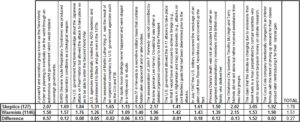


As this table demonstrates, the average (and on this test, it must be noted, fairly militant) sceptic is not much more prone towards conspiracy theories than his putatively ‘pro-science’ counterpart. In fact, the ‘warmist’ is more likely (though only just) to buy into conspiracy theories relating to the 911 and Oklahoma attacks and the assassination of Martin Luther King. Both groups are broadly inclined away from conspiracy theories, with the exception being the only positive assent to the conspiracy theory that — ‘The claim that the climate is changing due to emissions from fossil fuels is a hoax perpetrated by corrupt scientists who wish to spend more taxpayer money on climate research’.

Similarly, a graph showing sceptics’ attitudes to consensus science reveals that not much separates the two groups.
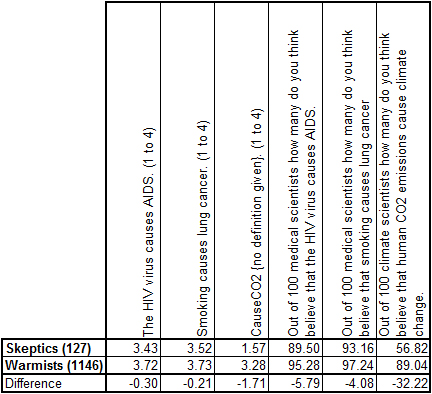


As we can see, and as we might expect, sceptics and warmists only really disagree on matters relating to climate science.
The third variable that Lewandowsky sought to relate to sceptics’ attitude to climate science and conspiracy theories was their views on the economy. (In some of these statements, the scoring was reversed, so that 1 = agreement, 4 = disagreement, denoted by ‘R’.) Here we see slightly more disagreement.
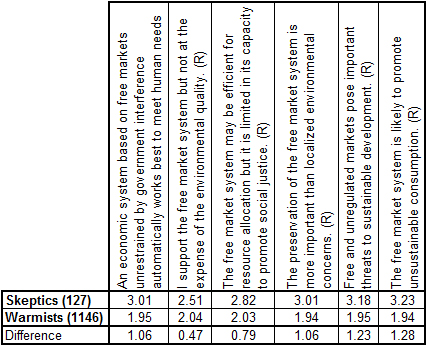


However, this part of the survey asks questions that, in the main, in fact ask the respondent to prioritise the economy versus the environment, rather than to express his views on the economy independently of his views on the environment. This is a problem for Lewandowsky’s subsequent claim that a person’s views on the economy can ‘predict’ his view on the environment. Yet nonetheless, the survey results simply do not suggest that a big difference exists between sceptics and warmists. The average sceptic is, after all, with a score of 2.51, precisely undecided about whether or not ‘I support the free market system but not at the expense of the environmental quality’. Meanwhile, if these statements really reflect opposite ends of some kind of eco-economic axis, we would expect people who are ‘pro-science’ (i.e. ‘warmists’) to dissent more strongly from the statement ‘Free and unregulated markets pose important threats to sustainable development’.

Across these three groups of statements, there is very little disagreement on much other than on the environment. Yet Lewandowsky claimed that ‘Rejection of climate science was strongly associated with endorsement of a laissez-faire view of unregulated free markets‘, and that ‘A second variable that was associated with rejection of climate science as well as other scientific propositions was conspiracist ideation‘.

It seems fairly obvious that Lewandowsky was at best mistaken. The data simply do not support his conclusions. His claims differ remarkably from what the difference between an averaged profile of a ‘sceptic’ and his counterpart look like.
What produced Lewandowsky’s result is a statistical technique called structural-equation modelling (SEM). SEM is a complex process used mainly in the social and behavioural sciences to test and explore assumptions about relationships in observational data. Though this may be an appropriate tool in some cases, its usefulness to the job of shedding light on what people think about complex political and scientific issues is debateable, and may in fact reveal more about Lewandowsky than sceptics. First, there is the problem of Lewandowsky’s assumptions: he confuses categories of economic and environmental ideas; he fails to test for conspiracy theories that might be more coincident with environmentalism than the ones he chose, (for example the idea that climate scepticism is a phenomenon produced by covert PR operations, paid for by fossil fuel companies); and he fails to achieve a robust definition of climate scepticism. Second, a much more simple method — averaging — show that, no matter what the slight statistical tendency of sceptics is, on aggregate, there is no clear line dividing lunatic sceptics from the enlightened climate scientists and their disciples. The more complex method, though, has the virtue of being a larger fig leaf for Lewandowsky’s bad faith.

This would not have been Lewandowsky’s only experiment with statistics-abuse. In June last year, using what he called ‘simple mathematics’, but which in fact depended on Bayesian statistical methods, he made a series of extraordinary claims, concluding that,‘greater uncertainty about the evolution of the climate should give us even greater cause for concern‘, that ‘greater uncertainty means that things could be worse than we thought’ and that ‘greater uncertainty means that the expected damages from climate change will necessarily be greater than anticipated’. This astonishing claim barely needs unpacking to demonstrate as so much nonsense cloaked in mathematical jargon.

This should raise questions about exactly what it is that Lewandowsky is trying to achieve through the use of dubious statistical methods, and his attempt to understand the minds of climate sceptics: is the point to advance understanding and knowledge, or is it a strategic move in a political battle that there can be no doubt he has taken a stand in.
But to suggest that either bad faith or incompetence has driven Lewandowsky would be, on his view, a conspiracy theory. This was his claim in a subsequent paper published in March by open access journal, Frontiers in Personality Science and Individual Differences, in which Lewandowsky and colleagues attempted to draw conclusions about responses from the climate sceptic blogosphere to his previous paper, LOG12.

In the paper, Recursive fury: Conspiracist ideation in the blogosphere in response to research on conspiracist ideation, Lewandowsky claimed to, ‘identify and trace the hypotheses that emerged in response to LOG12 and that questioned the validity of the paper’s conclusions. Using established criteria to identify conspiracist ideation, we show that many of the hypotheses exhibited conspiratorial content and counterfactual thinking.’

This involved compiling a database of the criticisms made against the first paper and categorising them. For example, one such comment posted by Richard Betts at the Bishop Hill website run by author of the Hockey Stick Illusion, Andrew Montford read as follows:
The thing I don’t understand is, why didn’t they just make a post on sceptic blogs themselves, rather than approaching blog owners. They could have posted as a Discussion topic here at Bishop Hill without even asking the host, and I very much doubt that [Montford] would have removed it. Climate Audit also has very light-touch moderation and I doubt whether Steve McIntyre would have removed such an unsolicited post. Same probably goes for many of the sceptic blogs, in my experience. So it does appear to that they didn’t try very hard to solicit views from the climate sceptic community.

This comment was put into a table with about 110 others that Lewandowsky et al reckoned to be evidence that their authors ‘Espouse conspiracy theories’. Each of the comments were put under different category of ‘conspiracy theory’, such as ‘didn’t email deniers’,‘Warmists faked data’, and ‘Emailed warmists before deniers’. However, this raises the problem, much as with the previous study, in the way categories are defined before they are tabulated and analysed.

If Betts’s comment is evidence of climate sceptics doing ‘conspiracy theory ideation’, then the test for it is set very low indeed — the comment was a straightforward criticism of Lewandowsky’s attempt to gather data, not speculation about why he had taken such liberties. Saying that Lewandowsky’s attempts to get responses from sceptics was inadequate is nothing like saying that the CIA killed Martin Luther King. Bogus categories and a seemingly objective method allowed Lewandowsky’s prejudices to prevail — a statistical technique serving as a fig leaf, again.

Even more unfortunate for Lewandowsky, however, the comment in question did not belong to a climate change sceptic at all. Richard Betts is a climate scientist, an IPCC lead author, and head of climate impacts research at the UK Meteorological Office.

The fact that Lewandowsky could put Betts into a category of ‘climate sceptic’, and his comment into a category of ‘conspiracy theory’ should be an object lesson about letting prejudice influence research for those seeking to understand and explain the climate debate. Lewandowsky’s confusion is owed to the fact of Betts’s very different and unusual approach to overcoming the climate debate: actually having the debate. Betts was able to criticise Lewandowsky after taking the opinions and discussion between climate sceptics seriously, rather than by taking it for granted that they were wrong.

Lewandowsky worked from his prejudice — that all sceptics are, a priori, wrong. His objective was to expose the ‘motivated reasoning’ that lies behind climate scepticism. But in doing so, he managed only to expose his own bad faith. This raises serious questions, not only about the categories and perceptions of ‘climate scepticism’ that dominate the language of anti-scepticism, but also broader questions about how such naked politicking can be passed off as academic research.
Across three papers based on the same data (a third appearing in the journal, Nature Climate Change), Lewandowsky, either unwittingly or deliberately allowed his prejudices to form the basis from which his study proceeded. On his view, climate scepticism is a ‘rejection of climate science’, which sits in contrast to ‘pro science’ opinion. But debunking this claim is easy. We can find climate scientists who give lower estimates of climate’s sensitivity to CO2 whose arguments are better grounded in science than any number of eco-warriors whose arguments are irrational, emotional, and lack any sense of proportion. One can either believe or disbelieve in the idea of anthropogenic climate change independently of science.

Second, Lewandowsky wanted to claim that this rejection of science is ‘motivated reasoning’ — that something else prefigures in the minds of sceptics, that causes them to reject climate science. This too, is easily countered, not just with a more straightforward analysis of Lewandowsky’s own data, which shows otherwise, but also by questioning this conception of ‘motivated reasoning’ itself.

All reasoning is, to a greater or lesser extent, ‘motivated’ — why would we reason, were it not as a means to some ends or other? However, the implication of Lewandowsky’s claim is that those who believe in climate change have transcended such human faults. Yet we can see that a great deal of presupposition and ‘ideology’ exists prior to the science in the arguments put forward in the debate about the environment. As I have argued previously on Spiked, in order to make the claim that climate change is dangerous, many environmentalists have to presuppose that society’s sensitivity to climate is equivalent to climate’s sensitivity to CO2 — a highly deterministic claim which is not borne out by history, let alone has any grounding in science, and which necessarily precludes the possibility of development mediating the vulnerability of society to climate.

Environmentalism’s presuppositions prefigure much more in Lewandowsky’s analyses than anything he can identify working in the minds of sceptics. This calls into question the ability of psychology to offer insight into the climate debate. For instance, much is made of the scientific consensus on climate change by researchers hoping to understand the phenomenon of climate scepticism, for example by asking whether or not respondents agree or disagree with positions that are assumed to represent the consensus position. However, this method is highly sensitive to the researcher’s ability to accurately represent the consensus, and to elicit from the respondent an accurate picture of his opinion. But as we have already seen, psychologists can quite easily put climate scientists into the category of climate sceptics. Researchers with misconceived ideas about what the science pertains to at best measures the public’s agreement with their own misconceptions.

Unfortunately for Lewandowsky and others engaged in the same attempts to form an understanding of climate scepticism from the psychological perspective, the objects of their study may well have a much better understanding of climate science and its problems than they possess. In this way, complex arguments and nuances are lost in the researcher’s desire to reduce multi-dimensional arguments into categories of right and wrong, good and bad, pro-science and anti-science.

Thus, the consensus on climate science is removed from its scientific context, and becomes a consensus without an object: it can mean whatever climate change psychologists want it to mean. Research into the public understanding of science, where that science has implications for public policy, becomes a vehicle for researchers to manifest their own prejudices as policy.
So what might appear at first pass as an inconsequential squabble on the internet between an arrogant researcher and recalcitrant bloggers in fact has significance for the debate about science’s role in public life. How was it that such shoddy, prejudiced, and partial research passed the seemingly objective tests of peer-review, and that such errors of category, method and analysis were nonetheless deemed worthy of publication by editors of scientific publications?

The answer here is twofold. First, there is the insidiousness of the objectless consensus: the mythology of the climate debate precedes the climate debate. The idea of there being scientists on the one hand, opposed by irrational sceptics on the other has been established so concretely that few editors, peer-reviewers or journalists even bother to ask questions about the content of the consensus, much less about how it is contradicted by the substance of climate sceptics’ arguments. Climate change orthodoxyallowed Lewandowsky’s work to go unchallenged by the checks and balances we might expect to catch out, or at least, criticise, such bare-faced framing of the debate.

Second, there is the political utility of the scientific consensus. The desire for policies to have a grounding in science is ubiquitous amongst a class of ‘policymakers’ (PKA politicians) and institutional science. Research such as Lewandowsky’s would not be significant, were it not for the (wrong) belief that climate scepticism’s influence over public opinion is the chief impediment to climate policies. For instance, in February, Parliament’s Science and Technology Select Committee called for submissions to an inquiry into the public’s understanding of climate change, following a report that had advised that ‘should scepticism continue to increase, democratic governments are likely to find it harder to convince voters to support costly environmental policies aimed at mitigation of, or adaptation to, climate change.’

In the era of ‘evidence-based policy-making’, public opinion is an afterthought rather than the measure of a democratic mandate. Only once a political consensus has been achieved between political parties do today’s ‘policymakers’ seek ways of convincing the public that their policies are a good idea. The extent of this upside-down form of politics is revealed by one of the questions asked by the select committee: ‘Does the Government have sufficient expertise in social and behavioural sciences to understand the relationship between public understanding of climate science and the feasibility of relevant public policies?

The academy increasingly replaces the ballot box in public affairs. And in particular, the science academy. On the face of it, it looks like a good idea. Expertise, is of course, almost always better placed to answer technical questions than is the man-on-the-street. But when the man-on-the-street becomes the object of the ‘social and behavioural sciences’, which are, in turn, employed to elicit his obedience, politics undergoes a radical transformation.

Material and social scientists have not been forthcoming in their criticism of the growing compact between the academy and the state. Indeed it much better serves those who we might expect to be the best critics of power to serve it instead. Lewandowsky, who has now moved from Australia to be the Chair in Cognitive Psychology in the School of Experimental Psychology, at the University of Bristol, has been given the Royal Society’s Wolfson Research Merit Award — a scheme designed ‘for outstanding scientists who would benefit from a five year salary enhancement to help recruit them to or retain them in the UK’. Says the university:

‘Professor Lewandowsky receives the award for his project entitled ‘The (mis)information revolution: information seeking and knowledge transmission’, which addresses how people navigate the blizzard of information with which we are faced on a daily basis, not all of which is accurate or truthful. The project emphasises how people update their memories and under what conditions they are able to discount information that turns out to be false. The project also examines how people interact with, and influence, each other to understand how information spreads through a society.’

Lewandowsky is well placed to speak about filling the public sphere with information ‘not all of which is accurate or truthful’. But what contribution to either science, or society has he really made that is worthy of such an award? And why would the Royal Society be so keen to chuck £tens of thousands at what can be called at best, cod psychology? If this award reflects the Royal Society’s priorities, it says a great deal about them.

As I’ve reported previously on Spiked, the Royal Society has sought an ever expanding role in policy-making, mostly in environmental matters. In particular, the academy published the results of a two year study into population and the environment last year, which coincided with their award to another researcher notable for his failures — population environmentalist and neo-malthusian doomsayer, Paul Ehrlich. It would seem that the closer the Royal Society get to policy-making, the more distance is put between itself and science. In spite of the failures of Ehrlich and Lewandowsky, their claims still have political utility.

It follows that the science academy’s growing desire for influence in the public sphere causes it to seek evidence that the public aren’t capable of managing their own affairs without it. The premise of a technocracy is, after all, the inadequacies of democracy. Thus we see in the Apocalyptic rants of the likes of Paul Ehrlich FRS and Lewandowsky the beneficiary of their generosity not simply claims about the material world, but claims about the shortcomings of human faculties. Between them, these men paint a picture, from the psychology of the individual, through to the functioning of the planet’s natural processes, in which humanity simply cannot help but steer a course for catastrophe without their intervention.

To point this out, though — to point to the problems with the science, or to ask questions about the political assumptions and consequences of these arguments — is to seem to be ‘anti-science’, or to betray a mindset that is preoccupied with conspiracy theories. To point out that the science is, in fact, groundless and speculative crap, and that it is intended, not to advance knowledge, but to serve a political function is to seem to stand out as a denier of science.

Scientists such as Lewandowsky are better at self-justification than scientific research. Rather than being an investigation into the workings of the material world, Lewandosky’s ‘research’ — a poorly executed and error-prone online survey, seen through dodgy statistical methods and bogus categories — is a naked attempt to explain why people dare challenge scientific authority. But there are good reasons for challenging it. Science has turned its gaze on the public as politicians have sought to remedy their diminishing public support by recruiting the academy. It is not a coincidence that the scientific agenda increasingly reflects the prejudices and problems of elite politics.

This would be an anti-science conspiracy theory if it were a claim that Lewandowsky and the Royal Society were engaged in science proper, and were aware of what they were doing. But what Lewandowsky reveals is the consequence of confusing science as a process — a method — and science as an institution. A shonky web survey is given respectability by its author’s professorship and tenure at a university, by peer-review, and by publication. The institutional apparatus of science allowed prejudice and politics to be passed off as objective study. Criticism of the survey — i.e. about the research’s adherence to (or departure from) the scientificmethod –  was defended against on the basis that it challenged, not the scientific argument (i.e. science as a process), but scientific authority (i.e institutional science).

A culture of intransigence has developed in the shadow of the compact between politics and science, which can be seen in the Lewandowsky affair in microcosm. Lewandowsky’s work unwittingly demonstrates that what is passed off as peer-reviewed and published ‘science’, even in today’s world, is no more scientific than the worst ramblings of the least qualified and nuttiest climate change denier on the internet. It looks like science, certainly, but the product only survives a superficial inspection. The only difference being the institutional muscle that Lewandowsky has access to, but which unhinged climate change deniers do not. The object of the Professor’s study is his really his own refusal to debate with his lessers.

The consequence of this should be alarming to everyone who takes an interest in the climate and other scientific debates, no matter what their view on climate change. Lewandowsky demonstrates that the academic institutions do not produce dialogue that has any more merit than the petty exchanges — flame wars –that the internet is famous for. Dressing political arguments up in scientific terminology risks the value of science being lost to society — its potential squandered for an edge in a political fight. After all, if Lewandowsky’s work is representative of the quality of scientific research in general and the standards the academy expects of academics, what does that say about climate science and the quality of the scientific consensus on climate change? If the scientific argument about the link between anthropogenic CO2 and climate change is only as good as Lewandowsky’s claim that ‘Rejection of climate science [is] strongly associated with endorsement of a laissez-faire view of unregulated free markets’, then perhaps climate sceptics should be taken more seriously.