Showing posts sorted by relevance for query amo. Sort by date Show all posts

Sunday, April 6, 2014

New paper finds natural ocean oscillations responsible for record cold US winter, not CO2

A new paper published in Environmental Research Letters finds the natural ocean oscillations the Atlantic Multidecadal Oscillation [AMO] and the North Atlantic Oscillation [NAO] may be responsible for the recent resurgence of record cold extreme temperatures in the Eastern US and Europe, and that extreme cold winters in these regions will persist as long as the AMO remains positive. The AMO shifted from negative to positive around the year 2000, along with the "pause" in global warming. A typical AMO cycle lasts ~60-70 years, and thus the current positive phase of the AMO and extreme cold US winters could occur for another ~18 or so years.

According to the authors, "Our statistical analyses suggest that the AMO signal precedes the NAO by 10–15 years with an interesting predictability window for decadal forecasting... As in observations, the positive phase of the AMO results in more frequent negative NAO—and blocking episodes in winter that promote the occurrence of cold extreme temperatures over the eastern United States and Europe. Thus, it is plausible that the AMO plays a role in the recent resurgence of severe winter weather in these regions and that wintertime cold extremes will be promoted as long as the AMO remains positive."


Warmists such as Jennifer Francis have made the silly claim that the record US cold winter was due to man-made global warming causing jet stream blocking, but this paper and many others prove natural cycles are responsible, not CO2. In addition, both the AMO and NAO, as well as other ocean & atmospheric oscillations, have been linked to solar activity. 
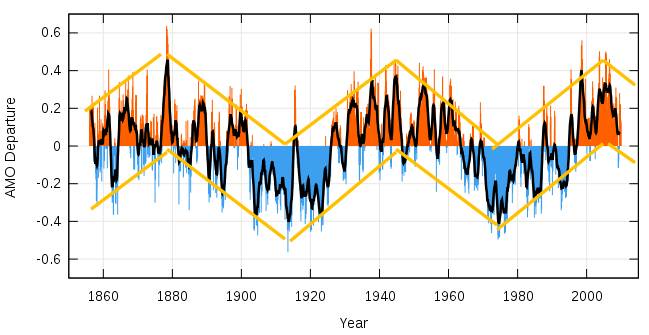

AMO index with a Fourier analysis showing a cycle length of ~60-70 years. The AMO shifted to the positive phase [above zero] around the beginning of the 21st century, so the positive phase has another ~18 or so years to go. 

Wavelet analysis shows predominant periodicity of AMO is ~64 years. How to read wavelet analyses.


Forcing of the wintertime atmospheric circulation by the multidecadal fluctuations of the North Atlantic ocean

OPEN ACCESS


Yannick Peings and Gudrun Magnusdottir

Tag this article PDF (3.18 MB) View article

The North Atlantic sea surface temperature exhibits fluctuations on the multidecadal time scale, a phenomenon known as the Atlantic Multidecadal Oscillation (AMO). This letter demonstrates that the multidecadal fluctuations of the wintertime North Atlantic Oscillation (NAO) are tied to the AMO, with an opposite-signed relationship between the polarities of the AMO and the NAO. Our statistical analyses suggest that the AMO signal precedes the NAO by 10–15 years with an interesting predictability window for decadal forecasting. The AMO footprint is also detected in the multidecadal variability of the intraseasonal weather regimes of the North Atlantic sector. This observational evidence is robust over the entire 20th century and it is supported by numerical experiments with an atmospheric global climate model. The simulations suggest that the AMO-related SST anomalies induce the atmospheric anomalies by shifting the atmospheric baroclinic zone over the North Atlantic basin. As in observations, the positive phase of the AMO results in more frequent negative NAO—and blocking episodes in winter that promote the occurrence of cold extreme temperatures over the eastern United States and Europe. Thus, it is plausible that the AMO plays a role in the recent resurgence of severe winter weather in these regions and that wintertime cold extremes will be promoted as long as the AMO remains positive.

Saturday, September 6, 2014

Multiple papers ignored by IPCC document the effect of natural ocean oscillations on climate

Google translation from german (apologies) plus light editing, from Die Kalte Sonne:
IPCC co-founder Bert Bolin had already known the climatic role of the ocean cycles very well
Die Kalte Sonne
A common argument of the IPCC proponents against ocean cycles and their relevance as an important climate factor is that the modern temperature measurements date back only two to three 60-year cycles. Thus, one can not prove the quasi-cyclic nature. This is a nice attempt, but not if considered in light of the supporting literature. Several research teams have reconstructed the various ocean cycles which can now be traced back far into the past. The quasi-cyclic nature is therefore well documented and the attempt to defend the climate alarm goes nowhere. Below we take a look at the latest work on the subject. Additional literature is also mentioned in our book "The cold sun".
Reconstruction of ocean cycles in the past
Deng et al. 2013 : Reconstruction of the PDO since 1853 using corals in the South China Sea
Olafsdottir et al. 2013 : Reconstruction of the AMO and NAO in Iceland for the past 3000 years
Svendsen et al. 2014: reconstruction of the AMO for the last 200 years
Chylek et al. 2012: reconstruction of the AMO for the last 660 years based on ice cores 
excerpt from the Executive Summary: A longer time scale AMO component of 45-65 years, Which HAS BEEN CLEARLY seen in the 20th century SST data, is detected only in central Greenland ice cores . We find a significant difference in between the AMO cycles falling on the Little Ice Age (LIA) and the Medieval Warm Period (MWP). The LIA what dominated by a ~ 20 year AMO cycle with no other decadal or multidecadal scale variability above the noise level. HOWEVER, falling on the MWP preceding- the 20 year cycle what Replaced by a longer scale cycle centered near a period of 43 years with a 11.5 year periodicity Further.
Chiessi et al. 2013: AMO in Brazil during the last 5000 years
Olsen et al. 2012 : NAO the last 5200 years 
excerpt from the Executive Summary: The North Atlantic Oscillation Influences climate in the Arctic region and northern Europe.Reconstructions of circulation patterns associated with the North Atlantic Oscillation from a 5,200-year-long lake sediment record did suggest the atmospheric circulation Responded to significant transitions in Northern Hemisphere climate. See also report in The Hockeyschtick .


Ocean cycles fired heating 1977-1998
A Swedish scientist told us that the IPCC must certainly have known the importance of the ocean cycles in the early phase of his ministry. One of the IPCC's co-founder, who died in 2007, Bert Bolin said to have spoken at a meeting in the establishment phase of the IPCC in the 1980s openly about the 60-year cycle of the ocean cycles. At that time predicted warming Bolin 30 years since the previous 30 years were rather characterized by cooling. The following is the text of the email:
I have heard from a participant at this meeting, with politicians and party Officials, Bolin Explained: The last 30 years we have had a slight cooling. Before 1910-1940 did we had a warming period. Before it did what cooling. It Seems did the temperature is going up and down with a period of 60 years, so it is reasonable to expect the next 30 years did want to be warm. Bolin obviously had some idea of ​​PDO influence on climate already at this time.
30 years heating it then but it was not entirely, but the forecast of the IPCC Bolin was initially planning reliability and credibility among the population. The IPCC would have had a harder many times when he would have been founded around the turn of the millennium, the beginning of the still ongoing temperature plateaus.
Even the art is now becoming increasingly clear that during the heating phase 1977-1998, all is not received with the right things and the alleged power of the CO 2 is to a large extent rather to the account "supporting means", so the warming effect of the ocean cycles. Thus wrote Large & Yeager, 2012 in the Journal of Climate that the warming 1984-2006 of "natural variability" (herewith are probably meant the ocean cycles) was dominated and the long-term climate change played only a minor role.
In March 2014, published research group led by Petr Chylek in the Geophysical Research Letters an important work titled "The Atlantic Multidecadal Oscillation as a dominant factor of oceanic influence on climate". In it, the authors expect to one-third of global warming 1977-1998 the warming positive phase of the AMO-ocean cycle. The work was extensively discussed on WUWT ( here , here , here ). Excerpt from the abstract:
The anthropogenic effects account for about two Thirds of the post-1975 global warming with one third being due to the positive phase of the AMO.
End of May 2014 put a team around Jacques Servain in the journal Climate Dynamics and interpreted according to the warming from 1977 to 1998 in the Atlantic also associated with the warm phase of the AMO.

Ocean cycles prevent further warming since 1998
Gradually it dawns experts also that probably the current warming pause the cooling phase of the ocean cycles is owed. We had already reported several times at this point:

Even the PIK Potsdam Institute mitlerweile recognizes the cooling role of the AMO in connection with the current Erwärmungshiatus (seeSchleussner et al. 2,014 ).
Case studies for climate-influencing effect of ocean cycles are not lacking. In the book of Salomon Kroonenberg ("The thousand-year cycle") is a chapter on the development of water level of the Caspian Sea, which is influenced mainly by the 60-year-old PDO / AMO cycle. The same is also in the Great Salt Lake in Utah is the case, as Wang et al. 2010 documented. And also the climate of Myanmar was under the PDO control, asD'Arrigo and Ummenhofer (2014) were able to show. In February 2014 wrote Mendoza et al. in the journal Atmospheric Research, the climate in Mexico is also controlled by the PDO, with probably the changing Cloud cover plays an important role. In Germany could Lohmann et al. (2013)demonstrate ocean cycles in cave stalactites. The 60-year-old AMO and NAO-cyclicality also appeared in Italy in a snow statistics for the past 300 years, as in Enzi et al. 2014 is read. And the deep-water temperatures in the Arctic Svalbard behaved cyclically, conducted by the NAO ( Ferré et al. 2,012 ).

Possible solar influence on ocean cycles
There is much evidence that the 60-year rhythm of the ocean cycles pulsates freely independently in the climate system. However, there seems to be such studies indicate some interactions with the solar activity and perhaps the planetary orbits. How could Harry van Loon and Gerald Meehl 2014 show in the Geophysical Research Letters, that it does play a role in climate, whether the PDO and NAO occurs in phase with the 11-year solar cycle or in phase opposition.
In February 2014, published group to Mads Knudsen Faurschou in Nature Communications, a work that describes a clear influence of the AMO by solar activity. Here is the short version:
Evidence for external forcing of the Atlantic Multidecadal Oscillation since termination of the Little Ice Age
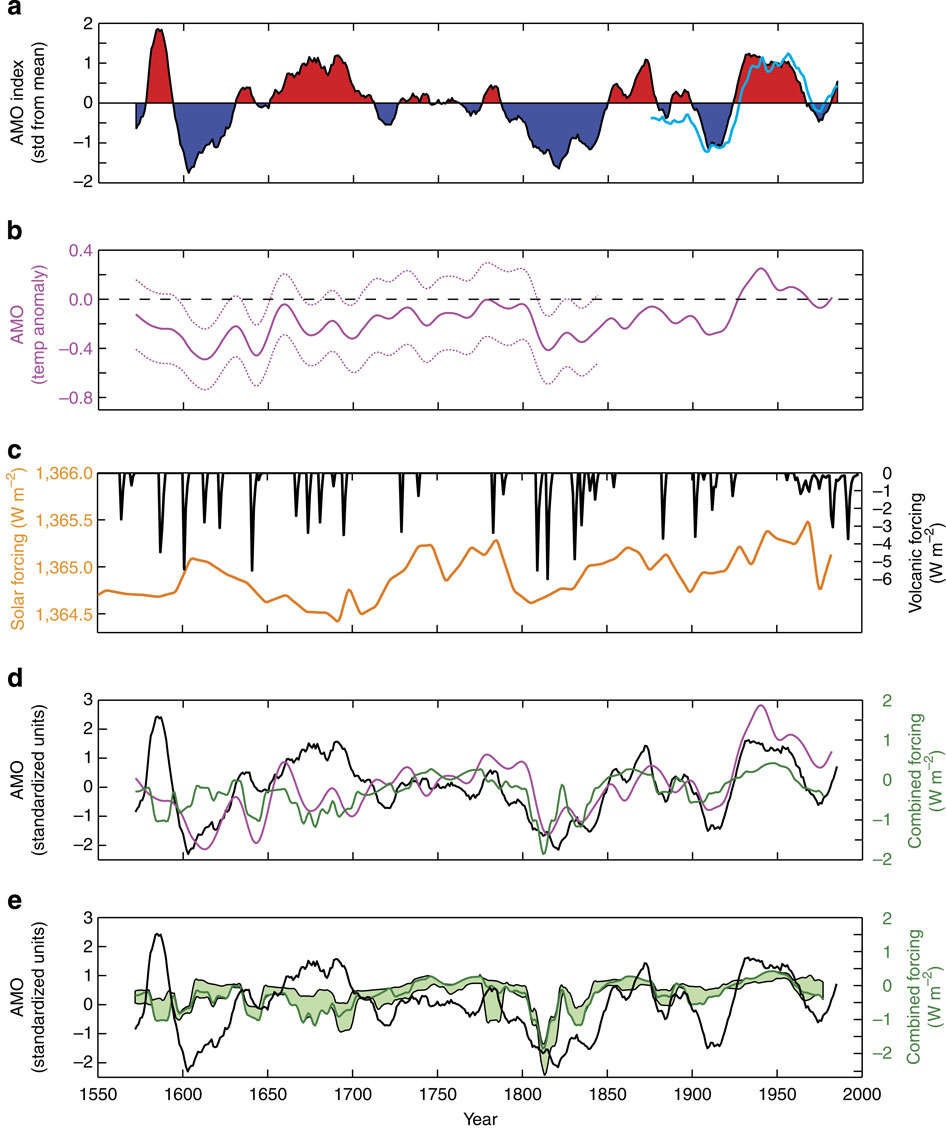
The Atlantic Multidecadal Oscillation (AMO) Represents a significant driver of Northern Hemisphere climate, but the forcing mechanisms pacing the AMO REMAIN poorly be understood. Here we use the available proxy records to investigate the influence of solar and volcanic forcing on the AMO over the load ~ 450 years. The evidence did Suggests external forcing played a dominant role in pacing the AMO after termination of the Little Ice Age (LIA; ca. 1400-1800), with at instantaneous impact on mid-latitude sea-surface Temperatures did spread across the North Atlantic over the ensuing ~ 5 years. In contrast, the role of external forcing what more ambiguous falling on the LIA. Our study Further Suggests did the Atlantic Meridional Overturning Circulation is Important for linking external forcing with North Atlantic sea-surface Temperatures, a conjecture did reconciles two opposing theories Concerning the origin of the AMO.
And Lin et al. 2014 report in a publication in Climate of the Past of a solar influence of the AMO. Previously had Muthers et al. , such interaction interpreted. A solar context, the NAO with the solar activity was of Boberg & Lundstedt 2002 reports.

Prediction
While it used to always meant the ocean cycles were unpredictable and arbitrary, but it has now recognized that there is a system and forecast possibilities. For the AMO this last set Hazeleger et al. 2013 in the Journal of Geophysical Research tight.
Li et al. 2,013 go in the Geophysical Research Letters even go a step further and developed a temperature forecast for the next 15-20 years based on the NAO and AMO-development. Here is the summary of your work:
NAO implicated as a predictor of Northern Hemisphere mean temperature Multidecadal variability
The twentieth century Northern Hemisphere mean surface temperature (NHT) is Characterized by a multidecadal warming-cooling-warming pattern Followed by a flat trend since about 2000 (recent warming hiatus). Here we demonstrate the North Atlantic Oscillation did (NAO) is implicated as a useful predictor of NHT multidecadal variability. Observational analysis shows did the NAO leads Detrended Both the NHT and oceanic Atlantic Multidecadal Oscillation (AMO) by 15-20 years. Theoretical analysis illuminates did the NAO precedes NHT multidecadal variability through its delayed effect on the AMO due to the large thermal inertia associated with slow oceanic Processes. An NAO-based linear model is established to predict the NHT THEREFORE, Which gives an excellent hindcast for NHT in 1971-2011 with the recent flat trend well predicted. NHT in 2012-2027 is predicted to fall slightly over the next Decades, due to the recent NAO decadal weakening did temporarily offsets the anthropogenically induced warming.
Did you catch the last sentence of the abstract? The temperature of the northern hemisphere is slightly cool to 2027, as the NAO will weaken.Nothing else stood in 2012 in our book "The cold sun" ...

Sunday, August 10, 2014

Arctic sea ice could continue to recover for next 30+ years of negative AMO

The natural ~60-90 year Atlantic Multidecadal Oscillation [AMO] has been in its positive warming phase since 1976 and after ~30+ years of warming is "pausing" and transitioning to its ~30-45 year negative phase [cooling]:


Coincidentally, satellite observations of Arctic sea ice began in 1979 at the start of the positive warming phase of the AMO. The AMO transfers heat from the tropics to the Arctic and melts Arctic sea ice, thus the AMO and Arctic Sea Ice Index are inversely related:


Five year moving average of the Arctic Sea Ice Index [red line] is inversely correlated to the Atlantic Multidecadal Oscillation [AMO] five year moving average shown in green. 
The AMO index "paused" right around the same time global temperatures "paused," perhaps related to solar control of climate and ocean oscillations. 


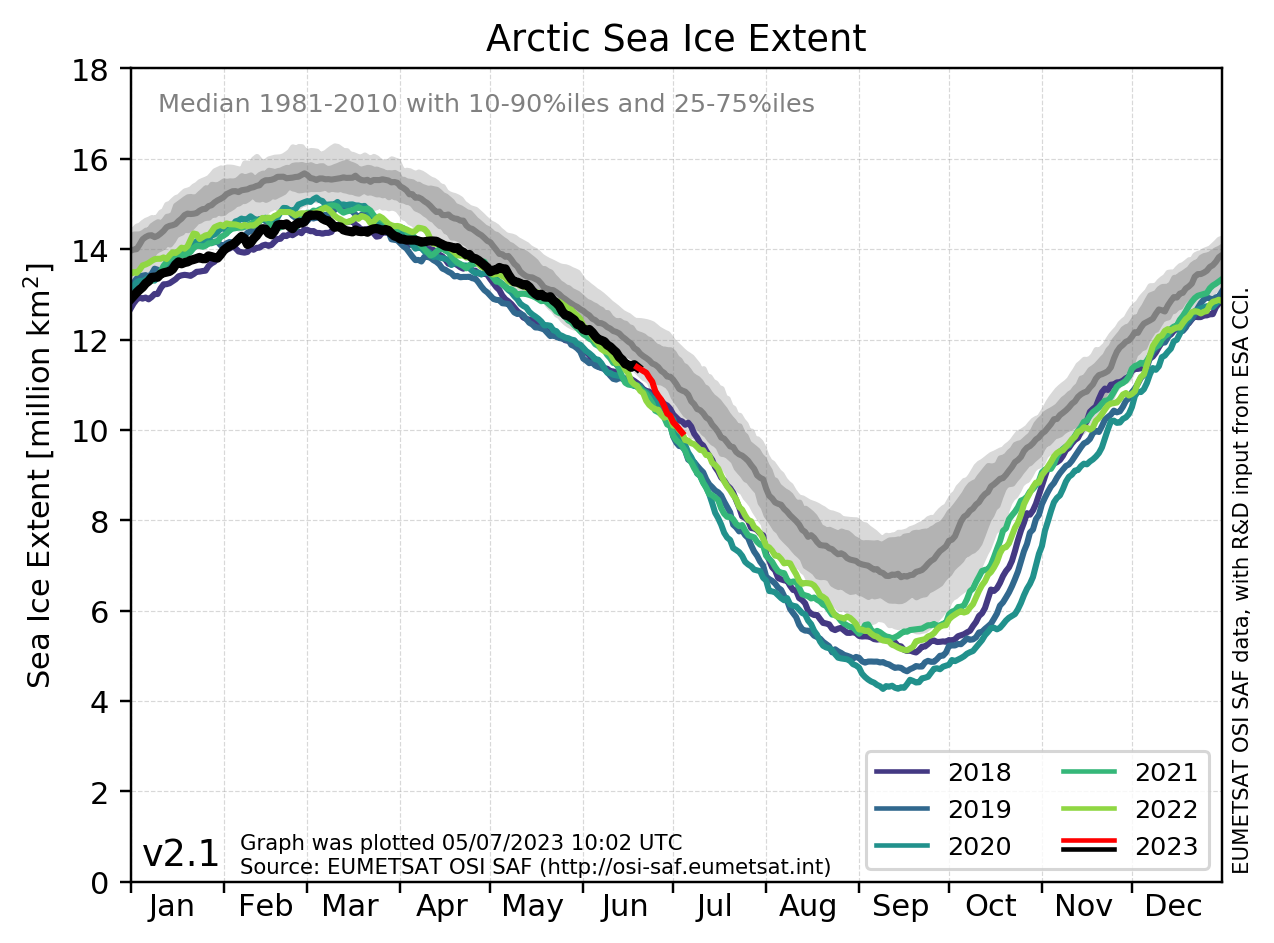
Perhaps this is why Arctic sea ice is having a dramatic recovery this year and is within one standard deviation of the mean:


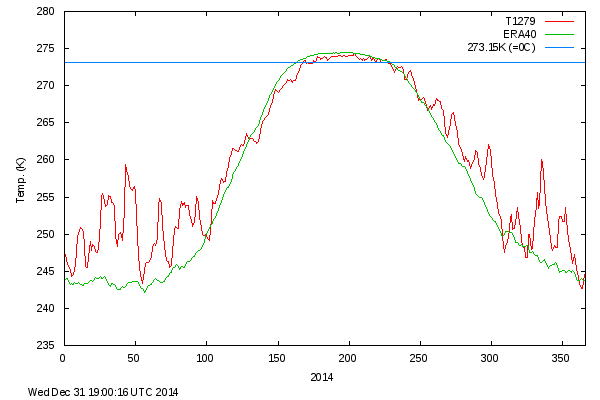
Might this explain why Arctic temperatures have been below the mean every single day during this summer's melt season?:


Thanks to the Arctic sea ice recovery and record high levels of Antarctic sea ice, global sea ice is now back to levels seen 35 years ago


The AMO may now be entering a new ~30-45 year negative phase. If this nutty denier theory is correct, Arctic sea ice could continue to recover for the next 30+ years of the negative phase of the AMO, even if you hang on to your dirty carbon-pollution-spewing SUV. 

Climate experts claim Arctic sea ice and just about everything else in climate is governed by a man-made CO2 "control knob" and most definitely not related to natural ocean oscillations such as the AMO (which in turn are controlled by solar activity), ocean warming from accumulated solar energy, and storm activity. 

Repost:

New paper finds Arctic sea ice is controlled by natural cycles
A paper published today in Geophysical Research Letters finds Arctic sea ice extent is determined primarily by the natural ~60-90 year cycle of the Atlantic Multidecadal Oscillation [AMO], not greenhouse gases.

According to the authors, "Arctic sea ice is intrinsically linked to Atlantic multidecadal [natural] variability" finding a ~60-90 year cycle of "Covariability between sea ice and Atlantic multidecadal variability as represented by the Atlantic Multidecadal Oscillation (AMO) index is evident during the instrumental record."

The paper adds to many other peer-reviewed publications finding changes in Arctic sea ice are primarily related to natural variability of ocean and atmospheric oscillations, storm and wind activity, and not changes in greenhouse gases.

A Signal of Persistent Atlantic Multidecadal Variability in Arctic Sea Ice

Martin W. Miles et al


Satellite data suggest an Arctic sea ice–climate system in rapid transformation, yet its long-term natural modes of variability are poorly known. Here, we integrate and synthesize a set of multi-century historical records of Atlantic Arctic sea ice, supplemented with high-resolution paleo proxy records, each reflecting primarily winter/spring sea ice conditions. We establish a signal of pervasive and persistent multidecadal (~60–90 year) fluctuations that is most pronounced in the Greenland Sea, and weakens further away. Covariability between sea ice and Atlantic multidecadal variability as represented by the Atlantic Multidecadal Oscillation (AMO) index is evident during the instrumental record, including an abrupt change at the onset of the early 20th century warming (ETCW). Similar covariability through previous centuries is evident from comparison of the longest historical sea ice records and paleo proxy reconstructions of sea ice and the AMO. This observational evidence supports recent modelling studies that have suggested that Arctic sea ice is intrinsically linked to Atlantic multidecadal [natural] variability. This may have implications for understanding the recent negative trend in Arctic winter sea ice extent, although because the losses have been greater in summer, other processes and feedbacks are also important.


The AMO, PDO, and NAO have all been linked to solar activity as the driver [possible lunar tidal influence as well].

Monday, March 31, 2014

Important new paper finds solar amplification mechanism by which the Sun controlled climate over past 250 years

A new paper published in Nature Communications finds a "clear correlation" between solar and volcanic activity and a 5-year lagged response of the Atlantic Multidecadal Oscillation [AMO] over the past 250 years, which in turn drives the climate of the Northern Hemisphere. This may represent yet another solar amplification mechanism by which tiny variations in solar activity have large-scale effects on climate. 

According to the paper, "The results actually showed that during the last approximately 250 years -- since the period known as the Little Ice Age -- a clear correlation can be seen where the external forces, i.e. the Sun's energy cycle and the impact of volcanic eruptions, are accompanied by a corresponding temperature fluctuation with a time lag of about five years."

"This phenomenon is called the Atlantic Multidecadal Oscillation (AMO), which consists of relatively warm periods lasting thirty to forty years being replaced by cool periods of the same duration. The researchers were able to read small systematic variations in the water temperature in the North Atlantic in measurements taken by ships during the last 140 years."

"Although the temperature fluctuations are small -- less than 1°C -- there is a general consensus among climate researchers that the AMO phenomenon has had a major impact on the climate in the area around the North Atlantic for thousands of years, but until now there has been doubt about what could cause this slow rhythm in the temperature of the Atlantic Ocean."

"Another model explains the AMO as being driven by fluctuations in the amount of solar energy received by the Earth, and as being affected by small changes in the energy radiated by the Sun itself and the after-effects of volcanic eruptions. Both these factors are also known as 'external forces' that have an impact on the Earth's radiation balance."

"However, there has been considerable scepticism towards the idea that a phenomenon such as an AMO could be driven by external forces at all -- a scepticism that the Aarhus researchers now demonstrate as unfounded"


"It should also be pointed out that these fluctuations occur on the basis of evenly increasing ocean temperatures during the last approximately fifty years -- an increase connected with global warming,"

"During the last century, the AMO has had a strong bearing on significant weather phenomena such as hurricane frequency and droughts -- with considerable economic and human consequences. A better understanding of this phenomenon is therefore an important step for efforts to deal with and mitigate the impact of climate variations," 

"The results provide a new and very important perspective on the AMO phenomenon because they are based on data and not computer models, which are inherently incomplete. The problem is that the models do not completely describe all the physical correlations and feedbacks in the system, partly because these are not fully understood. And when the models are thus unable to reproduce the actual AMO signal, it is hard to know whether they have captured the essence of the AMO phenomenon."

"An interesting new theory among solar researchers and meteorologists is that the Sun can control climate variations via the very large variations in UV radiation, which are partly seen in connection with changes in sunspot activity during the Sun's eleven-year cycle. UV radiation heats the stratosphere in particular via increased production of ozone, which can have an impact on wind systems and thereby indirectly on the global ocean currents as well," 


Temperature fluctuations: Atlantic Ocean dances with the sun and volcanoes

March 31, 2014

Source: Aarhus University

Summary:


Natural fluctuations in the ocean temperature in the North Atlantic have a significant impact on the climate in the northern hemisphere. These fluctuations are the result of a complex dance between the forces of nature, but researchers can now show that solar activity and the impact of volcanic eruptions have led this dance during the last two centuries.


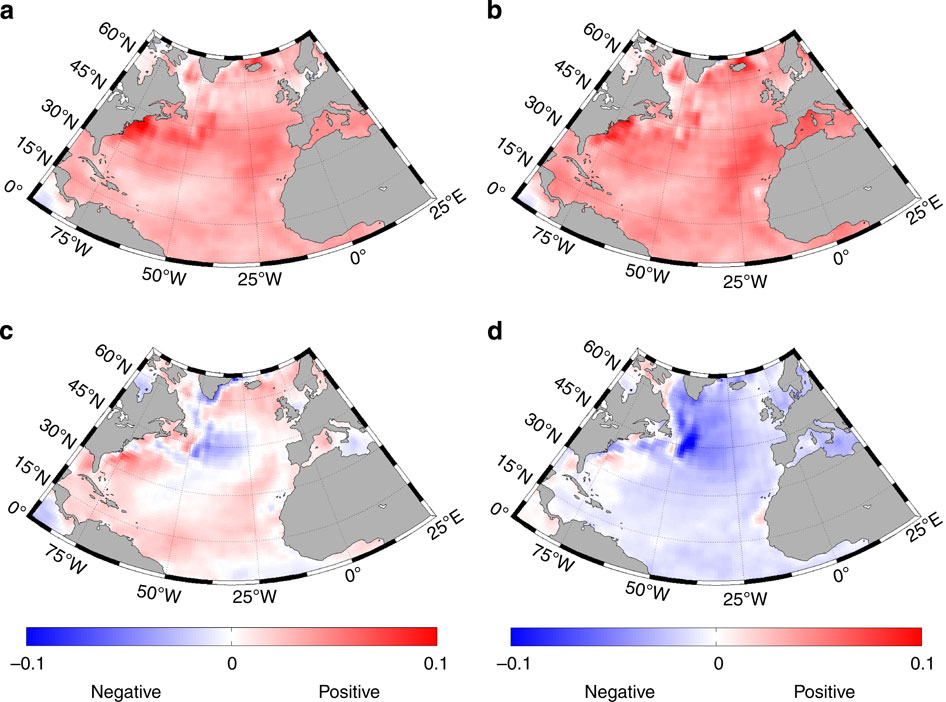
Ocean temperature has been regularly measured since 1870, which makes it possible to calculate a mean temperature at each point for the period for the period 1870 to the present day. Ocean temperature varies throughout the year and there are significant variations due to weather systems and over longer timescales. These illustrations show how the average temperatures over 20-year intervals have varied between cold (blue) and warm (red) periods. This variation is called the Atlantic Multidecadal Oscillation, abbreviated to AMO.

Imagine a ballroom in which two dancers apparently keep in time to their own individual rhythm. The two partners suddenly find themselves moving to the same rhythm and, after a closer look, it is clear to see which one is leading.

It was an image like this that researchers at Aarhus University were able to see when they compared studies of solar energy release and volcanic activity during the last 450 years, with reconstructions of ocean temperature fluctuations during the same period.

The results actually showed that during the last approximately 250 years -- since the period known as the Little Ice Age -- a clear correlation can be seen where the external forces, i.e. the Sun's energy cycle and the impact of volcanic eruptions, are accompanied by a corresponding temperature fluctuation with a time lag of about five years.

In the previous two centuries, i.e. during the Little Ice Age, the link was not as strong, and the temperature of the Atlantic Ocean appears to have followed its own rhythm to a greater extent.

The results were recently published in the scientific journal Nature Communications.

In addition to filling in yet another piece of the puzzle associated with understanding the complex interaction of the natural forces that control the climate, the Danish researchers paved the way for linking the two competing interpretations of the origin of the oscillation phenomenon.

Temperature fluctuations discovered around the turn of the millennium


The climate is defined on the basis of data including mean temperature values recorded over a period of thirty years. Northern Europe thus has a warm and humid climate compared with other regions on the same latitudes. This is due to the North Atlantic Drift (often referred to as the Gulf Stream), an ocean current that transports relatively warm water from the south-west part of the North Atlantic to the sea off the coast of Northern Europe.

Around the turn of the millennium, however, climate researchers became aware that the average temperature of the Atlantic Ocean was not entirely stable, but actually fluctuated at the same rate throughout the North Atlantic. This phenomenon is called the Atlantic Multidecadal Oscillation (AMO), which consists of relatively warm periods lasting thirty to forty years being replaced by cool periods of the same duration. The researchers were able to read small systematic variations in the water temperature in the North Atlantic in measurements taken by ships during the last 140 years.

Although the temperature fluctuations are small -- less than 1°C -- there is a general consensus among climate researchers that the AMO phenomenon has had a major impact on the climate in the area around the North Atlantic for thousands of years, but until now there has been doubt about what could cause this slow rhythm in the temperature of the Atlantic Ocean. One model explains the phenomenon as internal variability in the ocean circulation -- somewhat like a bathtub sloshing water around in its own rhythm. Another model explains the AMO as being driven by fluctuations in the amount of solar energy received by the Earth, and as being affected by small changes in the energy radiated by the Sun itself and the after-effects of volcanic eruptions. Both these factors are also known as 'external forces' that have an impact on the Earth's radiation balance.

However, there has been considerable scepticism towards the idea that a phenomenon such as an AMO could be driven by external forces at all -- a scepticism that the Aarhus researchers now demonstrate as unfounded


"Our new investigations clearly show that, since the Little Ice Age, there has been a correlation between the known external forces and the temperature fluctuations in the ocean that help control our climate. At the same time, however, the results also show that this can't be the only driving force behind the AMO, and the explanation must therefore be found in a complex interaction between a number of mechanisms. It should also be pointed out that these fluctuations occur on the basis of evenly increasing ocean temperatures during the last approximately fifty years -- an increase connected with global warming," says Associate Professor Mads Faurschou Knudsen, Department of Geoscience, Aarhus University, who is the main author of the article.

Convincing data from the Earth's own archives

Researchers have attempted to make computer simulations of the phenomenon ever since the discovery of the AMO, partly to enable a better understanding of the underlying mechanism. However, it is difficult for the computer models to reproduce the actual AMO signal that can be read in the temperature data from the last 140 years.

Associate Professor Knudsen and his colleagues instead combined all available data from the Earth's own archives, i.e. previous studies of items such as radioactive isotopes and volcanic ash in ice cores. This provides information about solar energy release and volcanic activity during the last 450 years, and the researchers compared the data with reconstructions of the AMO's temperature rhythm during the same period.

"We've only got direct measurements of the Atlantic Ocean temperature for the last 140 years, where it was measured by ships. But how do you measure the water temperature further back in time? Studies of growth rings in trees from the entire North Atlantic region come into the picture here, where 'good' and 'bad' growth conditions are calibrated to the actual measurements, and the growth rings from trees along the coasts further back in time can therefore act as reserve thermometers," explains Associate Professor Knudsen.

The results provide a new and very important perspective on the AMO phenomenon because they are based on data and not computer models, which are inherently incomplete. The problem is that the models do not completely describe all the physical correlations and feedbacks in the system, partly because these are not fully understood. And when the models are thus unable to reproduce the actual AMO signal, it is hard to know whether they have captured the essence of the AMO phenomenon.

Impact of the sun and volcanoes


An attempt to simply explain how external forces such as the Sun and volcanoes can control the climate could sound like this: a stronger Sun heats up the ocean, while the ash from volcanic eruptions shields the Sun and cools down the ocean. However, it is hardly as simple as that.

"Fluctuations in ocean temperature have a time lag of about five years in relation to the peaks we can read in the external forces. However, the direct effect of major volcanic eruptions is clearly seen as early as the same year in the mean global atmospheric temperature, i.e. a much shorter delay. The effect we studied is more complex, and it takes time for this effect to spread to the ocean currents,"
explains Associate Professor Knudsen.

"An interesting new theory among solar researchers and meteorologists is that the Sun can control climate variations via the very large variations in UV radiation, which are partly seen in connection with changes in sunspot activity during the Sun's eleven-year cycle. UV radiation heats the stratosphere in particular via increased production of ozone, which can have an impact on wind systems and thereby indirectly on the global ocean currents as well," says Associate Professor Knudsen. However, he emphasises that researchers have not yet completely understood how a development in the stratosphere can affect the ocean currents on Earth.

Towards a better understanding of the climate

"In our previous study of the climate in the North Atlantic region during the last 8,000 years, we were able to show that the temperature of the Atlantic Ocean was presumably not controlled by the Sun's activity. Here the temperature fluctuated in its own rhythm for long intervals, with warm and cold periods lasting 25-35 years. The prevailing pattern was that this climate fluctuation in the ocean was approximately 30-40% faster than the fluctuation we'd previously observed in solar activity, which lasted about ninety years. What we can now see is that the Atlantic Ocean would like to -- or possibly even prefer to -- dance alone. However, under certain circumstances, the external forces interrupt the ocean's own rhythm and take over the lead, which has been the case during the last 250 years," says Associate Professor Bo Holm Jacobsen, Department of Geoscience, Aarhus University, who is the co-author of the article.

"It'll be interesting to see how long the Atlantic Ocean allows itself to be led in this dance. The scientific challenge partly lies in understanding the overall conditions under which the AMO phenomenon is sensitive to fluctuations in solar activity and volcanic eruptions," he continues.

"During the last century, the AMO has had a strong bearing on significant weather phenomena such as hurricane frequency and droughts -- with considerable economic and human consequences. A better understanding of this phenomenon is therefore an important step for efforts to deal with and mitigate the impact of climate variations," Associate Professor Knudsen concludes.

Story Source:

The above story is based on materials provided by Aarhus University. The original article was written by Christina Troelsen. Note: Materials may be edited for content and length.

Journal Reference:
Mads Faurschou Knudsen, Bo Holm Jacobsen, Marit-Solveig Seidenkrantz, Jesper Olsen. Evidence for external forcing of the Atlantic Multidecadal Oscillation since termination of the Little Ice Age. Nature Communications, 2014; 5 DOI:10.1038/ncomms4323


Evidence for external forcing of the Atlantic Multidecadal Oscillation since termination of the Little Ice Age

Nature Communications
 
5,
 
Article number:
 
3323
 
doi:10.1038/ncomms4323
Received
 
Accepted
 
Published
 

Abstract


The Atlantic Multidecadal Oscillation (AMO) represents a significant driver of Northern Hemisphere climate, but the forcing mechanisms pacing the AMO remain poorly understood. Here we use the available proxy records to investigate the influence of solar and volcanic forcing on the AMO over the last ~450 years. The evidence suggests that external forcing played a dominant role in pacing the AMO after termination of the Little Ice Age (LIA; ca. 1400–1800), with an instantaneous impact on mid-latitude sea-surface temperatures that spread across the North Atlantic over the ensuing ~5 years. In contrast, the role of external forcing was more ambiguous during the LIA. Our study further suggests that the Atlantic Meridional Overturning Circulation is important for linking external forcing [the Sun] with North Atlantic sea-surface temperatures, a conjecture that reconciles two opposing theories concerning the origin of the AMO.

Wednesday, September 4, 2013

New paper finds natural ocean oscillations explain southwest US drought & half of the warming of the latter 20th century

A paper published today in Climate Dynamics finds the natural Atlantic multi-decadal oscillation (AMO) was responsible for half of the warming of the Southwestern US during the late 20th century. 

According to the authors, "We find that in the early twentieth century the warming was dominated by a positive phase of the Atlantic multi-decadal oscillation (AMO) with minor contributions from increasing solar irradiance and concentration of greenhouse gases. The late twentieth century warming was about equally influenced by increasing concentration of atmospheric greenhouse gases (GHGs) and a positive phase of the AMO. The current southwestern US drought is associated with a near maximum AMO index occurring nearly simultaneously with a minimum in the Pacific decadal oscillation (PDO) index. A similar situation occurred in mid-1950s when precipitation reached its minimum within the instrumental records." 

The authors also find, "the current climate models have not been able to predict the behavior of the AMO and PDO indices. The regression model does support the climate models (CMIP3 and CMIP5 AOGCMs) projections of a much warmer and drier southwestern US only if the AMO changes its 1,000 years cyclic behavior and instead continues to rise close to its 1975–2000 rate. If the AMO continues its quasi-cyclic behavior the US SW temperature should remain stable and the precipitation should significantly increase during the next few decades."

,
Open Access

Imprint of the Atlantic multi-decadal oscillation and Pacific decadal oscillation on southwestern US climate: past, present, and future

Full paper available here as open access:

Abstract

The surface air temperature increase in the southwestern United States was much larger during the last few decades than the increase in the global mean. While the global temperature increased by about 0.5 °C from 1975 to 2000, the southwestern US temperature increased by about 2 °C. If such an enhanced warming persisted for the next few decades, the southwestern US would suffer devastating consequences. To identify major drivers of southwestern climate change we perform a multiple-linear regression of the past 100 years of the southwestern US temperature and precipitation. We find that in the early twentieth century the warming was dominated by a positive phase of the Atlantic multi-decadal oscillation (AMO) with minor contributions from increasing solar irradiance and concentration of greenhouse gases. The late twentieth century warming was about equally influenced by increasing concentration of atmospheric greenhouse gases (GHGs) and a positive phase of the AMO. The current southwestern US drought is associated with a near maximum AMO index occurring nearly simultaneously with a minimum in the Pacific decadal oscillation (PDO) index. A similar situation occurred in mid-1950s when precipitation reached its minimum within the instrumental records. If future atmospheric concentrations of GHGs increase according to the IPCC scenarios (Solomon et al. in Climate change 2007: working group I. The Physical Science Basis, Cambridge, 996 pp, 2007), climate models project a fast rate of southwestern warming accompanied by devastating droughts (Seager et al. in Science 316:1181–1184, 2007; Williams et al. in Nat Clim Chang, 2012). However, the current climate models have not been able to predict the behavior of the AMO and PDO indices. The regression model does support the climate models (CMIP3 and CMIP5 AOGCMs) projections of a much warmer and drier southwestern US only if the AMO changes its 1,000 years cyclic behavior and instead continues to rise close to its 1975–2000 rate. If the AMO continues its quasi-cyclic behavior the US SW temperature should remain stable and the precipitation should significantly increase during the next few decades.