Showing posts sorted by relevance for query maxwell greenhouse equation. Sort by date Show all posts

Tuesday, December 2, 2014

Debunking Myths & Strawmen about the Gravito-Thermal Greenhouse Effect & Radiative Greenhouse Effect

This post will be continuously updated with a list of all posts concerning the gravito-thermal greenhouse effect, the derivation and use of the greenhouse equation of the gravito-thermal greenhouse effect, as well as numbered responses to common objections.

This is in lieu of constantly repeating information in responses to new comments here & elsewhere, to link to the numbered list below referring to a specific post which addresses the argument in question for or against the two competing 33C greenhouse effect theories (because one and only one of these greenhouse theories can be correct, otherwise Earth would be at least 33C warmer than present): 
1) The Arrhenius radiative greenhouse effect theory (the catastrophic man-made CO2 global warming theory)
vs.
2) The Maxwell gravito-thermal greenhouse effect theory


3] Why Greenhouse Gases Don't Affect the Greenhouse Equation or Lapse Rate (debunks claim that greenhouse gases are necessary for convection or a lapse rate to occur or that greenhouse gas radiative forcing can affect the lapse rate)


6] Why the atmosphere is in horizontal thermodynamic equilibrium but not vertical equilibrium (debunks claims that the gravito-thermal greenhouse effect assumes thermodynamic equilibrium in all three x, y, and z planes).


13] Why can't radiation from a cold body make a hot body hotter?

Answers these queries:

  • Can radiation from a cold body increase the temperature of a warmer body?
  • Are the Stefan-Boltzmann and Planck Laws applied correctly in calculating the greenhouse effect?
  • How can radiation from a cold body not be thermalized [cause an increase in temperature] of a warmer body?
  • How does quantum mechanics explain why a cold body can't make a warm body warmer still?
  • How do photons "know" how to do this?
  • Does water vapor warm or cool the planet?
  • Do clouds warm or cool the planet?
  • Why are cloudy nights warmer?
  • Do clouds cause 25% of the radiative greenhouse effect theory as claimed?

  • 17] New paper demonstrates climate models don't even have the 'basic physics' of the greenhouse effect correct


    Short summary of the 33C gravito-thermal greenhouse effect 


    The ~33C gravito-thermal greenhouse effect, first described by the great physicist Maxwell in 1872 by the barometric Poisson Relation, describes the temperature gradient from the 220K tropopause all the way down to the 288K Earth surface. As we have shown, the "average temperature" within the distribution of this quasi-linear [lapse rate] temperature gradient of the troposphere matches the energy input from the Sun, thus conserving energy:

    (288K + 220K)/2 = 254K ~ 255K = Equilibrium temperature with the Sun (located at center of mass of atmosphere)

    288K (at surface) - 255K (at center of mass of the atmosphere) = 33C gravito-thermal greenhouse effect

    Thus fulfilling the 1st law requirement of conservation of energy. (Before someone comments, I know you can't properly average temperatures, and that temperature is not a direct proxy for heat energy because calorimetry requires the mass, specific heats, heats of fusion and vaporization, and all phase changes be accounted, but use of temperature as a proxy of heat is done for illustrative purposes and simplification of the explanation)

    The temperature (a rough proxy for heat energy) distribution on either side of equilibrium temperature with the Sun Te = 255 is approximately an equal distribution around the center of atmospheric mass in the ~middle of the troposphere at ~5100 meters, thus conserving energy and placing Te = 255K at the center of mass (where P=1/2 of surface pressure) of the gravito-thermal greenhouse effect.


    Common myths & strawmen arguments & rebuttals:

    18] Myth: The Arrhenius radiative greenhouse theory is incontrovertible "basic physics"

    Rebuttal
    : Twenty-six years before Arrhenius devised his radiative greenhouse theory, the greatest physicist in history on the topics of heat and radiation, James Clerk Maxwell, said that the gravito-thermal greenhouse effect is what creates the atmospheric temperature gradient, not radiation from greenhouse gases. The Arrhenius radiative greenhouse theory makes at least three huge incorrect physical assumptions:

    1) cold bodies can make much hotter bodies much hotter (in violation of the 2nd law of thermodynamics which says transfer of any heat from cold to hot would cause an impossible decrease of entropy, since the second law requires total entropy to always increase),

    2) that radiation dominates over convection in the troposphere (disproven by countless papers and observations),

    3) gravitational forcing upon atmospheric mass (as described by the barometric formulae) does not create the temperature gradient in the troposphere (disproven by Maxwell, the barometric formulae, and millions of observations).

    Thus, all of the major physical assumptions of the Arrhenius radiative greenhouse effect are false. One and only one 33C greenhouse theory, either gravitational or radiative, can explain the entire 33C greenhouse effect; you cannot have it both ways and both cannot have merit, otherwise the Earth would be 33C warmer than at present. In addition the "Maxwell theory" is the only one compatible with the 18-26 year "pause" or "hiatus" of global warming along with a 20% increase in CO2 levels.


    19] Myth: “Every pressurised container would be hot if pressure increases temperature”

    Rebuttal:
    Let's use a bicycle tire analogy. When you use a pump to pressurize the tire it gets hotter for awhile, but then cools to ambient room temp by the tire convecting that heat to the atmosphere.

    Second situation is we have a leaky tire that we have to keep pumping to maintain the same pressure, so that tire remains hotter as long as compression of the air is a continuous process.

    The atmosphere is only analogous to the second situation, since air packets are continuously warming at the surface then rise/expand/cool until equilibrium with surrounding air in upper atmosphere, then due to gravitational potential energy these air packets have accumulated then fall/compress/warm down to the surface.

    This is how the troposphere temperature gradient from 220K-288K is entirely controlled by these barometric processes and perfectly predicted by the barometric formula.

    Thursday, July 2, 2015

    New paper finds increased CO2 or methane will have 'essentially no effect' upon global temperature or climate

    A new paper by USC Professor Emeritus of Geology, Dr. George Chilingar (with three co-authors), finds that increasing levels of the greenhouse gases CO2 & methane will have "essentially no effect" upon global temperatures or climate. 

    The authors utilize a one-dimensional adiabatic model of climate to demonstrate that the entire tropospheric temperature profile of the atmosphere on both Earth and Venus may be mathematically derived solely on the basis of atmospheric pressure/mass and solar activity, confirmed by observations on both planets, despite vast differences in atmospheric composition and mass/pressure on Earth and Venus. The paper corroborates the 33C Maxwell/Clausius/Carnot greenhouse theory and thereby excludes the alternative 33C Arrhenius radiative greenhouse theory.

    Excerpts:
    "The writers investigated the greenhouse effect using their adiabatic model, which relates the global temperature of troposphere to the atmospheric pressure and solar radiation. This model allows one to analyze the global temperature changes due to variations in mass and chemical composition of the atmosphere. Even significant releases of anthropogenic carbon dioxide and methane into the atmosphere do not change average parameters of the Earth’s heat regime and have no essential effect on the Earth’s climate warming. Moreover, based on the adiabatic model of heat transfer, the writers showed that additional releases of CO2 and CH4 lead to cooling (and not to warming as the proponents of the conventional theory of global warming state) of the Earth’s atmosphere. The additional methane releases possess a double cooling effect: First, they intensify convection in the lower layers of troposphere; Second, the methane together with associated water vapor intercept part of the infrared solar irradiation reaching the Earth. Thus, petroleum production and other anthropogenic activities resulting in accumulation of additional amounts of methane and carbon dioxide in the atmosphere have practically no effect on the Earth’s climate."
    Physically, an explanation of the cooling effect of the atmosphere with the high content of “greenhouse gases” is the high efficiency of the convective heat transfer from the planet’s surface to the lower stratosphere, from which this heat is rapidly dissipating into the outer space through radiation. As the greenhouse gases absorb the Earth’s heat radiation in the lower layers of troposphere, its energy transforms into the heat oscillations of the gas molecules. This, in turn, leads to expansion of the gas mixture and its rapid ascent to the stratosphere where the heat excess is lost through radiation into the outer space.  
    To replace these volumes of the warm air, the already cooled air descends from the upper troposphere. As a result, the global average atmospheric temperature slightly decreases. One particular consequence of it is that with an increase in the carbon dioxide and methane contents in troposphere the convective mass exchange of the atmospheric gases must substantially accelerate. Thus, it is not out of the question that the intensification of synoptic processes in Earth troposphere (but not temperature increase) may be a result of the carbon dioxide and other “greenhouse gases” accumulation."
    The primary equation of the paper [2] is similar to the 'greenhouse equation' described in a recent series of posts on the 33C Maxwell/Clausius/Carnot greenhouse theory. 

    The "Greenhouse Equation" calculates temperature (T) at any location from the surface to the top of the troposphere as a function of atmospheric mass/gravity/pressure and radiative forcing from the Sun only, and without any radiative forcing from greenhouse gases. Note the pressure (P) divided by 2 in the greenhouse equation is the pressure at the center of mass of the atmosphere (after density correction), where the temperature and height are equal to the equilibrium temperature with the Sun and ERL respectively.

    The primary differences between Chilingar et al equation [2] and the 'greenhouse equation' are:

    1. Chilingar et al introduce a correction for solar insolation based on the Earth's precession angle of 23.44 degrees 

    2. Chilingar et al assume an Earth surface temperature of 288K or 15C, whereas the HS 'greenhouse equation' only assumes the equilibrium temperature of the Earth with the Sun (255K or -18C) & atmospheric mass/pressure to derive the surface temperature, as well as that of the entire troposphere, replicating the 1976 US Standard Atmosphere. 

    An upcoming post will join the mathematics of these two equations to explain the entire temperature profile of the atmosphere from the surface to the edge of space at 100+ km geopotential altitude, without incorporating 'radiative forcing' from CO2. 


    Thursday, December 4, 2014

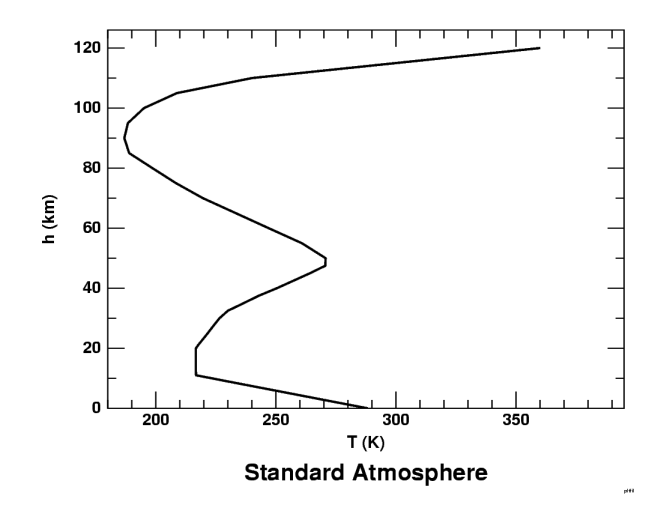
    US Standard Atmosphere Model & Observations Prove Maxwell's Mass/Gravity/Pressure Theory of the 'Greenhouse Effect' is Correct & Falsifies CAGW

    Early in the "space race" of the 1950's, US Air Force Research Laboratory meteorologist and "rocket design climatologist" Norman Sissenwine "recognized the urgent need for complete data on the properties of the atmosphere" and thus became "a catalyst between the aerospace and meteorological community" to develop the US Standard Atmosphere physical model of Earth's atmospheric pressure, density, and temperature profile by altitude from the surface all the way up to the edge of space at ~100,000+ meters altitude.

    This massive effort was critical to the entire space program and aeronautics, and hundreds of rocket scientists, physicists, meteorologists, aeronautical engineers, and atmospheric scientists contributed to this project necessary to physically model and then verify with millions of observations from weather balloons, research flights, and rocket launches, that their physical 1-D vertical model of the atmosphere was correct. The 1958 first edition of the US Standard Atmosphere was followed by revisions, mostly of the far upper atmosphere at the edge of space, as more data became available from the space program, with revisions published in 1962, 1966, and the final 1976 version still widely used as the gold standard today. 

    This effort to model the atmosphere for NASA, NOAA, and the US military during the cold war began long before the field of 'climate science' or 'climatologists' even existed, long before anyone ever thought or knew about alleged "radiative forcing from greenhouse gases" causing "catastrophic man-made global warming or climate change," and twenty years before the first 'climatologists' gave us the ice age scare of the 1970's, immediately followed by the global warming scare of the 1980's that is still haunting us today [but now called 'climate change' since it's not warming]. 

    These early atmospheric scientists began this effort to model the atmosphere with the basic physics of gases and air known since the 1800's from the ideal gas law, 1st Law of Thermodynamics, Newton's second law of motion (F=ma=mg), the physical chemistry of molecular weights, partial pressures of each gas, heat capacities of individual gases and air at both constant pressure and constant volume, the gravitational acceleration constant, barometric formulae, Boltzmann's constant, Avogadro's number, mean atmospheric molecular weights, number density of individual species, total number density, atmospheric mass density, mole volume, scale height, geopotential height of gravitational potential energy (PE), mean air-particle speed, mean free-path of air molecules, mean collision frequency, calculated speed of sound, dynamic viscosity, kinematic viscosity, coefficient of thermal conductivity, and on and on...

    And never once used any "radiative forcing" from any IR-active greenhouse gases or any radiative calculations from any greenhouse gases whatsoever to produce an accurate 1-D model that could calculate Earth's entire pressure, mass density, temperature, and molecular-scale temperature as a function of geopotential altitude (geopotential height ~ geopotential altitude ~ gravitational potential energy (PE)) profile from the surface to the edge of space. 


    Fig. 3 from the 1976 US Standard Atmosphere document below. Note the "Molecular-scale temperature is a function of the geopotential altitude." Thus, the kinetic temperature of the particular molecular masses and compositions of the atmosphere is a function of the geopotential height (which is the gravitational potential energy (PE) accumulated at that height) which adiabatically sets the pressure at that geopotential height. This is another way of saying temperature is a function of atmospheric mass/gravity/pressure, which is exactly what the Maxwell atmospheric mass/gravity/pressure 33C greenhouse effect claims, not "radiative forcing" from greenhouse gases. 

    The entire US Standard Atmosphere physical model was derived from physical laws assuming a completely dry atmosphere without any water vapor (the so called primary greenhouse gas) or any natural or man-made CO2 whatsoever (since CO2 at 0.03-0.04% contributes negligibly to atmospheric mass). It was only after the entire dry atmosphere model was finished that the average water vapor in Earth's atmosphere was added back in solely by changing one essentially constant parameter (on an annual & global basis):

    the heat capacity of air at constant pressure (Cp) (on a global annual average basis)

    of the atmosphere to calculate the tropospheric lapse rate, since water vapor has a high heat capacity more than double that of N2, O2, and CO2 (which are all lower and close to the same). This is the primary means (other than clouds) by which water vapor cools the Earth surface and atmosphere, since by the lapse rate equation

    dT/dh = -g/Cp

    where 

    dT = change in temperature
    dh = change in altitude
    g = gravitational acceleration constant
    Cp = heat capacity at constant pressure

    the change in temperature dT is inversely related to a change in heat capacity (Cp). Note also that temperature T is a function of the constants gravity (g) and (Cp), and that neither g or Cp (within the temperature range of Earth's atmosphere) are a function of temperature (T). 

    Since water vapor increases heat capacity (Cp) in the lapse rate equation, it decreases the temperature (T) at any altitude (h) including the surface where (h) = 0, and decreases the lapse rate by half from the dry rate 9.8 C/km to the wet rate of 5 C/km if the atmosphere is fully saturated with water vapor. 

    The scientists involved with the US Standard Atmosphere calculated the global average lapse rate of 6.5 K/km on the basis of the known heat capacity constants of water vapor and measured global average water vapor concentrations, to calculate and confirm with observations that it is ~6.5 C/km, intermediate as expected between the dry and wet fully saturated adiabatic lapse rates, and thus this is the value used to calculate the global annual average temperature, pressure, and density profile of the Standard Atmosphere. We now know from weather balloon and satellite measurements that the global average total water vapor is quite constant, and there is little agreement about whether it has stayed the same or slightly increased or decreased over the past 35 years of the satellite era. 

    The tiny 0.03-0.04% of CO2 in the atmosphere does not contribute in any significant way to atmospheric molecular mass, molecular density, partial pressures, heat capacity (Cp), etc., thus in the multiple versions of the US Standard Atmosphere models, the calculated CO2 effect on the atmospheric temperature was so negligible that the atmospheric scientists thereafter completely discarded CO2 from their model calculations of the atmosphere. The same potential effects were calculated for what is called today the "20 times stronger greenhouse gas than CO2" methane; these atmospheric scientists found the mass contribution and heat capacity to the atmosphere from methane was far too negligible to consider, thus, it was also discarded from the model along with CO2.

    Thus, these hundreds of scientists were in effect "deniers" of the man-made CO2 global warming hypothesis that would come much later, and didn't recognize any "radiative forcing" from any "greenhouse gases" at the time they provided an accurate physically derived & straightforward model of the atmosphere. Hansen's (falsified) climate models and the CAGW hypothesis scare didn't arrive until ~30 years later. These atmospheric scientists never once used any radiative calculations of "back-radiation" or "radiative forcing" from IR-active greenhouse gases or clouds, or any absorption/emission spectra from greenhouse gases, all of which are the absolutely essential and critical underpinnings of the entire 33C Arrhenius radiative greenhouse theory a.k.a. the catastrophic man-made CO2 global warming theory.

    Why not?

    Because they knew, as did scientists including Maxwell in 1872, that the atmospheric temperature gradient is a function of atmospheric mass/gravity/pressure, not the other way around. Temperature is calculated in their model as a function of geopotential height (gravitational potential energy (PE)) and molecular mass of the constituents in each atmospheric layer, from which atmospheric pressure, density, etc. are calculated using the geopotential height (gravitational potential energy (PE) at a given height). After these intermediate parameters are calculated, then the temperature at a particular altitude is calculated as a function of mass/gravity/pressure, not the other way around. The only assumption about temperature made in their atmospheric model was that global surface temperature is, by international agreement and definition, 15C.

    Ah, you say, they assumed the surface temperature and thus everything else is a function of that!

    It's true that the only assumption made about temperature in their model is the surface temperature, by definition 15C. They, of course, had to do so because that is the surface temperature by definition from international agreement, and also because there were no satellite measurements at that time from the Sun and Earth to determine Earth's equilibrium temperature with the Sun. Therefore, they used 15C by definition as the starting point at the surface, and then calculated the entire remainder of the atmosphere as a function of the geopotential height (gravitational potential energy (PE) at a given height), and given the mass and molecular weights of the constituents of the air observed at each level of the atmosphere (without the greenhouse gases water vapor and CO2).

    Now that satellite measurements make it possible to determine the Earth's equilibrium temperature with the Sun (Te = 255K), we can now use the greenhouse equation to bootstrap onto this huge effort by these pioneering atmospheric scientists, and thereby calculate the average global temperature at any altitude (geopotential height) in Earth's atmosphere all the way from the surface to the edge of space at ~100,000 km altitude, entirely without any radiative forcing from greenhouse gases whatsoever, and based only upon the mass/gravity theory of the greenhouse effect (first described by the famous physicist Maxwell in 1872), and calculated atmospheric center of mass, and without knowing the surface temperature or any other atmospheric temperature other than the constant equilibrium temperature with the Sun in advance.

    The "Greenhouse Equation" calculates temperature (T) at any location from the surface to the top of the troposphere as a function of atmospheric mass/gravity/pressure and radiative forcing from the Sun only, and without any radiative forcing from greenhouse gases. Note the pressure (P) divided by 2 in the greenhouse equation is the pressure at the center of mass of the atmosphere, where the temperature and height are equal to the equilibrium temperature with the Sun and average "Effective Radiating Level" or ERL, respectively. 
    Fig 3 from the 1976 US Standard Atmosphere description document below, with added annotations showing how the center of the tropospheric lapse rate is "triangulated" by the known constants of mass and the center of mass, the height where the center of mass can be calculated which is where the mass above is 1/2 of the total mass and the Pressure (1/2 atm) is 1/2 of the surface pressure (1 atm), and the known constant of equilibrium temperature Te between the Earth and Sun. This is the exact location of the ERL, where the temperature must equal the equilibrium temperature with the Sun. By determining the height of the ERL, the greenhouse equation then extends the linear adiabatic lapse rate up to the top of the troposphere at ~12,000 meters and down to the surface at 0 meters, from which the entire tropospheric temperature profile from the top of the troposphere to the ERL to the surface temperature can be determined by only knowing the constant equilibrium temperature with the Sun = Te = 255K. 

    The calculation of not only the entire troposphere temperature profile by the greenhouse equation, but also the calculation of the temperature profiles of all remaining levels of the entire atmosphere all the way to space at ~100,000 meters, by bootstrapping onto this seminal gravito-thermal model of the 1976 US Standard Atmosphere above the troposphere, will be the topic of the next post in this series.  

    The entire 241 page 1976 US Standard Atmosphere document and database (which still remains the gold standard today and has not changed despite 39 years of greenhouse gas emissions) is posted below. It is an absolute goldmine of detailed information on the physical derivation of the standard atmospheric model and confirmatory observations. It thus provides overwhelming physical proof and overwhelming observational evidence that the Maxwell gravito-thermal mass/gravity/pressure theory of the 33C "greenhouse effect" is correct, and would necessarily falsify any significant "radiative forcing from greenhouse gases" affecting the lapse rates or various atmospheric temperature gradients, and thus as well negate the theory of catastrophic anthropogenic global warming. Only one of these two competing greenhouse theories can account for the 33C greenhouse effect, since if both were true, the Earth would be an additional 33C warmer than present. 


    Thursday, December 11, 2014

    Why Man-Made Global Warming Theory Confuses the Cause With the Effect

    This next post in a series demonstrating physical & mathematical proofs why Maxwell's atmospheric mass/gravity/pressure (33C) greenhouse effect is the only correct explanation of the greenhouse effect will now show why the entire physical basis of the competing anthropogenic global warming theory (now out of necessity called "man-made climate change" since it hasn't warmed for 18-26 years), somehow conveniently ignored the well-established basic and atmospheric physics, physical chemistry, and barometric relations that had been well-established for more than the past two centuries, and effectively hide this in their overheated & untouchable black-box computer models. 

    The models then serve the purpose of providing a veritable & impenetrable safety deposit box of ancient Fortran computer code, completely secured from inspection by anyone who doesn't have the key, or understand poorly-documented Fortran.  

    The CAGW computer modelers also completely ignored the hundreds of physicists, atmospheric and rocket scientists, physical chemists, and other scientists who just a decade earlier (during the 1970's ice age scare) provided the immense, overwhelming physical, chemical, and observational proof of the gold standard 1976 US Standard Atmosphere calculations and the first computer model of the atmosphere (and the only model which has been verified with (millions) of observations), offering overwhelming evidence that greenhouse gases have no significant "radiative forcing" or "radiative imbalance" effects upon the Earth's atmosphere whatsoever, from the surface to edge of space. 

    The Standard Atmosphere model does no radiative calculations from greenhouse gases or other gases, since these hundreds of scientists had previously established any such effects to be negligible. The calculations and std. atmosphere model do not ever utilize the absolutely essential Stefan-Boltzmann equation, nor any absorption/emission spectra from any IR-active gases at all to determine temperatures from "radiative imbalance," or "heat trapping," or "radiative forcing from greenhouse gases."

    Bad things can happen when climate modelers conveniently ignore over 200 years of well-established physics, including confusing a cause with an effect, but that is unfortunately what has happened. We will now show additional reasons why man-made or natural CO2 cannot be the Earth's climate control knob, demonstrating how the IR emission spectra from greenhouse gases are simply an effect of and not the cause of the mass densities/gravity/pressure/viscosities of all gases present in each layer of the atmosphere all the way from the surface to the edge of space, which in-turn are entirely responsible for the resulting temperatures (via the Ideal Gas Law and other physical laws) at every altitude, not IR backradiation from passive IR absorbers/emitting gases (so-called "greenhouse gases" for the first time a decade later). 

    The cause must always precede the effect, and the cause never follows the effect. As the greatest physicist in history on the topics of radiation and heat, J Clerk Maxwell, wrote in 1872, the atmospheric temperatures and gradients are a function of and caused by atmospheric pressure/density/specific heat capacity of the particular gases in the atmosphere, not the other way around as falsely assumed by CAGW proponents and the falsified & overheated climate models. 

    Atmospheric pressure/density/specific heat capacity of the particular gases in the atmosphere produce temperature gradients without violating the 1st and 2nd laws of thermodynamics, increasing the surface temperature by ~33C above the equilibrium temperature with the Sun, and decreasing the top of the troposphere by even more 35C below of the equilibrium temperature with the Sun (an anti-greenhouse effect). By way of illustration (ignoring that temperature cannot be properly "averaged"):


    Temperature at top of the troposphere at ~11,000 meters average ~220K (35C colder than the equilibrium temperature with the Sun of 255K

    Temperature at the surface average ~288K (33C warmer than the equilibrium temperature with the Sun of 255K

    (220 + 288)/2 = 254K ~ 255K

    Thus energy is conserved as required by the 1st law of thermodynamics: 

    dU = Q + W = 0 change in internal energy

    where

    dU = change in internal energy which must be zero or infinitesimally small in order to conserve energy
    Q = any heating source of the system (i.e. the Sun only)
    W = work done 

    Thus

    Q = -W (note the minus sign in front of the Work done, which must be exactly equal and opposite)

    which in the case of the atmosphere, the Q is radiative forcing from the Sun, and Work done is the adiabatic compression and expansion of gases in the troposphere, which must be equal and opposite for energy to be conserved:


    The climate modelers claim, however, that passive IR absorbers/radiators greenhouse gases somehow add 33C of heat energy to the planet to the 255K already provided by the Sun, causing the 255+33K = 288K surface temperature. However, they never mention (for very good reasons) that the US Standard Atmosphere above and observations show the troposphere also has an even greater 35C negative greenhouse effect from 255K falling to 220K at the top of the troposphere. 

    How can any greenhouse gas allegedly "know" that it is supposed to heat only the troposphere by 33C below ~5100 meters altitude while simultaneously cooling the remainder of the troposphere by 35C from ~5100 - 11,000 meters altitude? They cannot, nor can computer models, without violating the 1st and 2nd laws of thermodynamics, and common sense. 

    According to the radiative greenhouse proponents, the emission/absorption spectra shown below somehow prove greenhouse gases are the cause of and not the effect of the tropospheric lapse rate temperature gradient


    But the annotations below show that the big notch in the emission spectra due to H2O and CO2 is simply the exact same temperatures all along the linear adiabatic lapse rate corresponding Planck blackbody curves. As we have shown many times, the lapse rate is controlled only by gravity and atmospheric heat capacity and not affected in the least by greenhouse gas concentrations. This proves that the greenhouse gases in the atmosphere are simply radiating at the temperatures set by the lapse rate equation, as expected:

    dT/dh = -g/Cp

    thus the temperature is a function of and an effect of gravity/molecular mass, not the other way around from greenhouse gas "radiative forcing" or "backradiation." Irradiance or "backradiation" from greenhouse gases is in turn a function of the 4th power of temperature (by the Stefan Boltzmann equation), not the cause of the temperatures to begin with.


    The cause absolutely cannot follow the effect. Mass/gravity/pressure cause the Maxwell greenhouse effect and lapse rates, which causes the resulting temperature, which in-turn causes the greenhouse gases at each atmospheric temperature thus established to passively radiate IR at the above blackbody curves and absorption/emission spectra, not the other way around. You cannot have it both ways. One and only one 33C greenhouse effect theory can be correct, not both since otherwise the surface would be at least 33C warmer. 

    In the next post of this series we will introduce newly improved and greatly simplified versions of the greenhouse equation proving all atmospheric temperatures can be derived without any knowledge of the surface temperature in advance, only the equilibrium temperature of Earth and the Sun plus the barometric formulae:


    Tuesday, September 1, 2015

    Why the effective radiating level (ERL) is always located at the center of mass of the atmosphere & not controlled by greenhouse gas concentrations

    The Arrhenius radiative greenhouse effect proponents, having abandoned "back-radiation" from greenhouse gases as the explanation of the greenhouse effect, now claim global warming is instead due to an increase of the "effective radiating height" or "effective radiating level" [ERL] of greenhouse gases in the atmosphere. So the theory goes, an increase of CO2 levels will cause longwave (~15 micron) infrared emissions from CO2 to occur from colder heights in the atmosphere, and since colder blackbodies emit less radiation, more radiation will allegedly be "trapped" by the colder CO2 "blackbody" in the fabled tropospheric "hot spot" & unable to escape to space. 

    In contrast, the competing 33C gravito-thermal greenhouse effect of Maxwell, Clausius, Carnot, Boltzmann, Feynman, Poisson, Helmholtz, et al, shows that the "effective radiating level" or ERL is fixed at the center of mass (COM) of the atmosphere.

    As we can see in Fig 1a, the observed ERL or "emission level for OLR (Outgoing Longwave Radiation)" global average is right around 500 millibars or 0.49 atmospheres ~ 0.5 atmospheres, exactly at the center of mass of the entire atmosphere as predicted in the HS greenhouse equation below. 

    The HS greenhouse equation "triangulates" the geopotential height of the 255K ERL at the center of mass using:

    1. The center of mass (COM) of the atmosphere where P=0.5 atmospheres (after density correction), i.e. exactly one-half of the surface pressure
    2. The adiabatic lapse rate = -(gravitational acceleration constant g)/(heat capacity at constant pressure Cp)
    3. The equilibrium temperature of Earth with the Sun = 255K

    all of which are essentially constants in the atmosphere, and without any knowledge of the surface temperature, greenhouse gas concentrations, or Arrhenius "radiative forcing" from greenhouse gases.  

    Why use the center of mass of the atmosphere in calculation of the gravito-thermal greenhouse effect? Because the force of gravity by Newton's Second Law is F = ma = mg, and for a system of particles like our atmosphere, one must determine the center of mass in applying Newton's 2nd Law F = mg to the force of gravity. 

    Thus, since the height of the ERL is fixed at the COM, and the COM is essentially a constant, the height of the ERL will not change, regardless of greenhouse gas concentrations.

    In addition, in the longwave infrared band of Earth’s thermal radiation, the only band in which CO2 absorbs and emits is centered at ~15 microns. The kinetic temperature of the surrounding atmosphere and the CO2 molecules has nothing to do with the fact that CO2 emits at a fixed ~15 microns in the longwave IR due to its fixed molecular structure bending transitions. The entire atmosphere surface to space is warmer than the CO2 “equivalent partial blackbody” fixed band-emitting temperature of 193K at ~15 microns.

    Also, absorption followed by emission of a photon by CO2 only takes microseconds, and all the bouncing around at the speed of light between greenhouse gases in the atmosphere only delays the average photon a few milliseconds on its way from the surface to space. Thus, the only "slowing of cooling" or "heat trapping" by CO2 absorption/emission is a few milliseconds and easily reversed and erased over a 12 hour night. 


    Addition of more CO2 increases the few milliseconds delay by adding a few more milliseconds, but once again is easily reversed and erased over a 12 hour night.

    More importantly, increased CO2 increases radiative surface area, which increases radiative loss to space. That’s why increased CO2 cools the stratosphere through thermosphere, and troposphere as well as I’ve shown.

    And even more importantly, the probability of CO2 transferring heat by collisions with N2/O2 in the troposphere is about 2 orders of magnitude higher than emitting a photon, which increases convective cooling.

    An earlier post also provides nine additional reasons why the effective radiating level (ERL) is always located at the center of mass of the atmosphere & not controlled by greenhouse gas concentrations.

    Thus, the false notion that global warming is instead due to an increase of the "effective radiating height" or "effective radiating level" [ERL] of greenhouse gases in the atmosphere is effectively disproven.

    The HS greenhouse equation and quick & dirty explanation below, followed by the derivation from first principles:
    The "Greenhouse Equation" calculates temperature (T) at any location from the surface to the top of the troposphere as a function of atmospheric mass/gravity/pressure and radiative forcing from the Sun only, and without any radiative forcing from greenhouse gases. Note the pressure (P) divided by 2 in the greenhouse equation is the pressure at the center of mass of the atmosphere (after density correction), where the temperature and height are equal to the equilibrium temperature with the Sun and ERL respectively.

    http://hockeyschtick.blogspot.com/2014/11/quick-and-dirty-explanation-of.html

    We will use the ideal gas law, 1st law of thermodynamics, Newton's second law of motion (F = ma), and well-known barometric formulae in this derivation to very accurately determine Earth's surface temperature, the height in the atmosphere at which the effective equilibrium temperature of Earth with the Sun is located, and show that this height is located as expected at the center of mass of the atmosphere on Earth and Titan.

    We will show that the mass/pressure greenhouse effect theory can also be used to accurately determine the temperatures at any height in the troposphere from the surface to the tropopause, and compute the mass/gravity/pressure greenhouse effect to be 33.15C, the same as determined from radiative climate models and the conventional radiative greenhouse effect theory. 

    1. Conservation of energy and the ideal gas law

    We will start once again with the ideal gas law 

    PV = nRT (1)

    an equation of state that relates the pressure P, volume V, temperature T, number of moles n of gas and the gas law constant R = 8.3144621 J/(mol K). 

    The properties of gases fall into two categories: 

    1. Extensive variables are proportional to the size of the system: volume, mass, energy
    2. Intensive variables do not depend on the size of the system: pressure, temperature, density

    To conserve energy (and to ensure that no radiative imbalances from greenhouse gases are affecting this derivation) of the mass/gravity/pressure greenhouse effect, we assume

    Energy incoming from the Sun (Ein) = Energy out (Eout) from Earth to space

    Observations indeed show Ein = Eout = 240 W/m2 (2)

    which by the Stefan-Boltzmann law equates to a blackbody radiating at 255 K or -18C, which we will call the effective or equilibrium temperature (Te) between the Sun and Earth. As seen by satellites, the Earth radiates at the equilibrium temperature 255K from an average height referred to as the "effective radiating level" or ERL or "effective radiating height."

    2. Determine the "gravity forcing" upon the atmosphere

    Returning to the ideal gas law above, pressure is expressed using a variety of measurement units including atmospheres, bars, and Pascals, and for this derivation we will use units in atmospheres, which is defined as the pressure at mean sea level at the latitude of Paris, France in terms of Newtons per square meter [N/m2]

    Newtons per square meter corresponds to the force per unit area [or "gravity forcing" upon the atmospheric mass per unit area of the Earth surface]. 

    Now let's determine the mass of the atmosphere above one square meter at the Earth surface:

    By Newton's 2nd law of motion equation, force (F) is 

    F = ma  (3)   where m = mass and a = acceleration

    As we noted above, the atmospheric pressure is a force or forcing per unit area. The force in this case is the weight (note weight is not the same as mass and is in physical definitions of mass, length, time-2) or mass of the atmosphere times the gravitational acceleration, therefore

    F = mg  (4) where g is the gravitational constant 9.8 m/s2, i.e. the acceleration due to gravity in meters per second squared.

    If we assume that g is a constant for the entire column of the atmosphere above the 1 meter2 area (A) we obtain

    m = PA/g = (1.0325 x 10^5 N/m2 )(1 m2 )/(9.8 m/s2 ) = 1.05 x 10^4 kg

    thus, the weight of the atmosphere over 1 square meter of the surface is 10,500 kilograms, quite a remarkable gravitational forcing upon the atmosphere.

    If m is the mass of the atmosphere and g is the gravitational acceleration, the gravitational force is thus

    F = mg (4)

    The density (p) is the mass (m) per unit Volume (V), thus,

    p = m/V

    SI units of pressure refer to N/m2 as the Pascal (Pa). There are 1.0325 x 10^5 Pa per atmosphere (unit). 

    Starting again with equation (3) above

    F = ma  (3)

    F = mg  (4)

    F = (PA/g)g = PA  (5)

    P = F/A = mg/A = phAg/A = phg (6) 

    where 

    h=height along either a gas or liquid column under pressure or gravity field
    g = gravitational constant
    p = density = mass/volume

    3. Determine the atmospheric pressures from gravitational forcing, and the height of the effective equilibrium temperature (ERL)

    Now we will determine the atmospheric pressures in a gravitational field using (6) above

    First let's determine the pressure at the ERL since the temperature must equal the equilibrium temperature of 255K at the ERL.

    The pressure is a function of height 

    P(h) = ρgh (7)

    and the change in pressure dP is related to the change in height dh by 

    dP = -ρg dh (8)

    The minus sign arises from the fact that pressure decreases with height, subject to an adjustment for density which changes with height. We will determine this adjustment from the ideal gas law. The density is 

    ρ = nM/V  (9)

    where n is the number of moles, M is the molar mass, and V is the volume. We can obtain n/V from the ideal gas law: 

    n/V = P/RT (10)

    thus 

    ρ = MP/RT  (11)

    We can now substitute the density into the pressure vs. height formula:

    dP = -(MPg/RT)dh  (12)

     ∫dP/P = -(Mg/RT) ∫dh  (13) (the first integral is from 1 to P, second from 0 to h)  

    ln(P) = -(Mgh/RT)  (14)

    P = e^-((Mgh/(RT))  (15)

    We will now determine the height (h) at the ERL where the temperature = the effective equilibrium temperature = 255K, and without use of radiative forcing from greenhouse gases.

    Plugging in numbers of M = 29 grams/mole (0.029 kg/mole) as average molar mass for atmosphere, g = 9.8 m/s^2, Pressure = 0.50 atmospheres at the approximate center of mass of the atmosphere, R=8.31, and T=Te=255K effective equilibrium temperature we obtain:

    0.50 atmosphere P at the ERL= e^-((.029*9.8*5100)/(8.31*255))

    So the height of the ERL set by gravity forcing is located at 5100 meters and is where T=Te=255K and pressure = 0.5 atmospheres, right at the center of mass of the atmosphere as we predicted from our gravity forcing hypothesis. 

    4. Determine the temperatures at any location in the troposphere, and the magnitude of the mass/pressure greenhouse effect

    Now that we have solved for the location of the ERL at 5100 meters, we can use the adiabatic lapse rate equation to determine all troposphere temperatures from the surface up to the ERL at 255K and then up to the top of the troposphere. The derivation of the lapse rate equation from the ideal gas law and 1st law of thermodynamics is described in this post, thus will not be repeated here, except to mention that the derivation of the lapse rate 

    dT/dh = -g/Cp where Cp = heat capacity of the atmosphere at constant pressure

    is also completely independent of any radiative forcing from greenhouse gases, greenhouse gas concentrations, emission/absorption spectra from greenhouse gases, etc., and is solely a function of gravity and heat capacity of the atmosphere. 

    Plugging the average 6.5C/km lapse rate and 5100 meter or 5.1 km height of the ERL we determine above into our derived lapse rate equation (#6 from prior post) gives

    T = -18C - (6.5C/km × (h - 5.1km)) 

    Using this equation we can perfectly reproduce the temperature at any height in the troposphere as shown in Fig 1. At the surface, h = 0, thus temperature at the surface Ts is calculated as

    Ts = -18 - (6.5 × (0 - 5.1)) 

    Ts = -18 + 33.15C (gravity forced greenhouse effect)

    Ts = 15.15°C or 288.3°K at the surface

    which is exactly the same as determined by satellite observations and is 33.15C above the equilibrium temperature -18C or 255K with the Sun as expected.

    Thus, we have determined the entire 33.15C greenhouse effect, the surface temperature, and the temperature of the troposphere at any height, and the height at which the equilibrium temperature with the Sun occurs at the ERL entirely on the basis of the Newton's 2nd law of motion, the 1st law of thermodynamics, and the ideal gas law, without use of radiative forcing from greenhouse gases, nor the concentrations of greenhouse gases, nor the emission/absorption spectra of greenhouse gases at any point in this derivation, demonstrating that the entire 33C greenhouse effect is dependent upon atmospheric mass/pressure/gravity, rather than radiative forcing from greenhouse gases. Also note, it is absolutely impossible for the conventional radiative theory of the greenhouse effect to also be correct, since if that was the case, the Earth's greenhouse effect would be at least double (66C+ rather than 33C). 

    In essence, the radiative theory of the greenhouse effect confuses cause and effect. As we have shown, temperature is a function of pressure, and absorption/emission of IR from greenhouse gases is a function of temperature. The radiative theory tries to turn that around to claim IR emission from greenhouse gases controls the temperature, the heights of the ERL and tropopause, and thus the lapse rate, pressure, gravity, and heat capacity of the atmosphere, which is absurd and clearly disproven by basic thermodynamics and observations. The radiative greenhouse theory also makes the absurd assumption a cold body can make a hot body hotter,disproven by Pictet's experiment 214 years ago, the 1st and 2nd laws of thermodynamics, the principle of maximum entropy production, Planck's law, the Pauli exclusion principle, and quantum mechanics. There is one and only one greenhouse effect theory compatible with all of these basic physical laws and millions of observations. Can you guess which one it is?