Showing posts sorted by relevance for query maxwell gravito-thermal. Sort by date Show all posts

Tuesday, December 2, 2014

Debunking Myths & Strawmen about the Gravito-Thermal Greenhouse Effect & Radiative Greenhouse Effect

This post will be continuously updated with a list of all posts concerning the gravito-thermal greenhouse effect, the derivation and use of the greenhouse equation of the gravito-thermal greenhouse effect, as well as numbered responses to common objections.

This is in lieu of constantly repeating information in responses to new comments here & elsewhere, to link to the numbered list below referring to a specific post which addresses the argument in question for or against the two competing 33C greenhouse effect theories (because one and only one of these greenhouse theories can be correct, otherwise Earth would be at least 33C warmer than present): 
1) The Arrhenius radiative greenhouse effect theory (the catastrophic man-made CO2 global warming theory)
vs.
2) The Maxwell gravito-thermal greenhouse effect theory


3] Why Greenhouse Gases Don't Affect the Greenhouse Equation or Lapse Rate (debunks claim that greenhouse gases are necessary for convection or a lapse rate to occur or that greenhouse gas radiative forcing can affect the lapse rate)


6] Why the atmosphere is in horizontal thermodynamic equilibrium but not vertical equilibrium (debunks claims that the gravito-thermal greenhouse effect assumes thermodynamic equilibrium in all three x, y, and z planes).


13] Why can't radiation from a cold body make a hot body hotter?

Answers these queries:

  • Can radiation from a cold body increase the temperature of a warmer body?
  • Are the Stefan-Boltzmann and Planck Laws applied correctly in calculating the greenhouse effect?
  • How can radiation from a cold body not be thermalized [cause an increase in temperature] of a warmer body?
  • How does quantum mechanics explain why a cold body can't make a warm body warmer still?
  • How do photons "know" how to do this?
  • Does water vapor warm or cool the planet?
  • Do clouds warm or cool the planet?
  • Why are cloudy nights warmer?
  • Do clouds cause 25% of the radiative greenhouse effect theory as claimed?

  • 17] New paper demonstrates climate models don't even have the 'basic physics' of the greenhouse effect correct


    Short summary of the 33C gravito-thermal greenhouse effect 


    The ~33C gravito-thermal greenhouse effect, first described by the great physicist Maxwell in 1872 by the barometric Poisson Relation, describes the temperature gradient from the 220K tropopause all the way down to the 288K Earth surface. As we have shown, the "average temperature" within the distribution of this quasi-linear [lapse rate] temperature gradient of the troposphere matches the energy input from the Sun, thus conserving energy:

    (288K + 220K)/2 = 254K ~ 255K = Equilibrium temperature with the Sun (located at center of mass of atmosphere)

    288K (at surface) - 255K (at center of mass of the atmosphere) = 33C gravito-thermal greenhouse effect

    Thus fulfilling the 1st law requirement of conservation of energy. (Before someone comments, I know you can't properly average temperatures, and that temperature is not a direct proxy for heat energy because calorimetry requires the mass, specific heats, heats of fusion and vaporization, and all phase changes be accounted, but use of temperature as a proxy of heat is done for illustrative purposes and simplification of the explanation)

    The temperature (a rough proxy for heat energy) distribution on either side of equilibrium temperature with the Sun Te = 255 is approximately an equal distribution around the center of atmospheric mass in the ~middle of the troposphere at ~5100 meters, thus conserving energy and placing Te = 255K at the center of mass (where P=1/2 of surface pressure) of the gravito-thermal greenhouse effect.


    Common myths & strawmen arguments & rebuttals:

    18] Myth: The Arrhenius radiative greenhouse theory is incontrovertible "basic physics"

    Rebuttal
    : Twenty-six years before Arrhenius devised his radiative greenhouse theory, the greatest physicist in history on the topics of heat and radiation, James Clerk Maxwell, said that the gravito-thermal greenhouse effect is what creates the atmospheric temperature gradient, not radiation from greenhouse gases. The Arrhenius radiative greenhouse theory makes at least three huge incorrect physical assumptions:

    1) cold bodies can make much hotter bodies much hotter (in violation of the 2nd law of thermodynamics which says transfer of any heat from cold to hot would cause an impossible decrease of entropy, since the second law requires total entropy to always increase),

    2) that radiation dominates over convection in the troposphere (disproven by countless papers and observations),

    3) gravitational forcing upon atmospheric mass (as described by the barometric formulae) does not create the temperature gradient in the troposphere (disproven by Maxwell, the barometric formulae, and millions of observations).

    Thus, all of the major physical assumptions of the Arrhenius radiative greenhouse effect are false. One and only one 33C greenhouse theory, either gravitational or radiative, can explain the entire 33C greenhouse effect; you cannot have it both ways and both cannot have merit, otherwise the Earth would be 33C warmer than at present. In addition the "Maxwell theory" is the only one compatible with the 18-26 year "pause" or "hiatus" of global warming along with a 20% increase in CO2 levels.


    19] Myth: “Every pressurised container would be hot if pressure increases temperature”

    Rebuttal:
    Let's use a bicycle tire analogy. When you use a pump to pressurize the tire it gets hotter for awhile, but then cools to ambient room temp by the tire convecting that heat to the atmosphere.

    Second situation is we have a leaky tire that we have to keep pumping to maintain the same pressure, so that tire remains hotter as long as compression of the air is a continuous process.

    The atmosphere is only analogous to the second situation, since air packets are continuously warming at the surface then rise/expand/cool until equilibrium with surrounding air in upper atmosphere, then due to gravitational potential energy these air packets have accumulated then fall/compress/warm down to the surface.

    This is how the troposphere temperature gradient from 220K-288K is entirely controlled by these barometric processes and perfectly predicted by the barometric formula.

    Tuesday, October 20, 2015

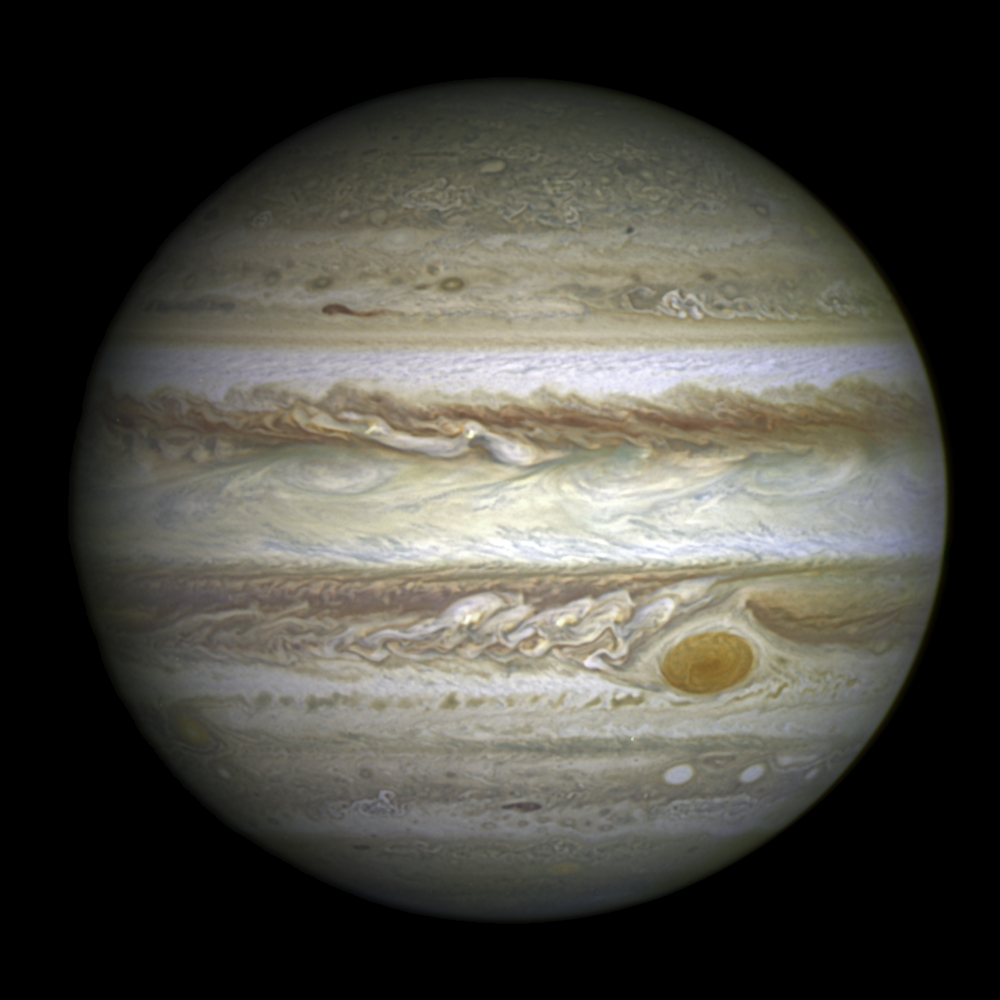
    Jupiter emits 67% more radiation than it receives from the Sun -only explanation is the gravito-thermal greenhouse effect, not greenhouse gases

    An article published at The Conversation asks Is the Red Spot shrinking superstorm evidence of climate change on Jupiter?and indeed finds that this and other observed changes are evidence of climate change (of unknown cause) on Jupiter. 

    The article incidentally notes that,
    "We do know that Jupiter emits 67% more radiation than it receives from the Sun. This is due to an internal heat source, which is thought to drive much of Jupiter\'s weather, including, presumably, the Great Red Spot. The heat likely is generated by the gradual contraction of matter under Jupiter's enormous gravity."
    Warmists claim gravity cannot be the cause of any so-called "greenhouse effect" (or the "gravito-thermal greenhouse effect") on Earth, Jupiter, nor any other planet, yet overwhelming observational evidence for every planet in our solar system (with adequate observational data - 8 planets at this point) clearly demonstrates that surface and atmospheric temperatures are a sole function of gravity/mass/pressure and independent of greenhouse gas concentrations. 

    In the case of Jupiter, a gas planet composed almost entirely of the non-IR-active, non-greenhouse gases hydrogen and helium, there is no solid planetary surface nor greenhouse gases to allegedly "trap" solar radiation, yet Jupiter has an "internal heat source" that causes a thermal enhancement ("gravito-thermal greenhouse effect") resulting in emission of 67% more radiation than it receives from the Sun. The only possible explanation of this is gravity, not radiative forcing from the Sun nor greenhouse gases, and hence the mass/pressure/gravity gravito-thermal greenhouse effect of Maxwell, Clausius, Carnot, Boltzmann, Helmholtz, Feynman, US Std Atmosphere, the HS greenhouse equation is corroborated on 9 planets.

    Likewise, the ice planet Uranus has recently been observed to have storms at the top of the atmosphere radiating at blackbody temperatures hotter than required to melt steel. In addition, 
    "the base of the troposphere on the planet Uranus is 320K, considerably hotter than on Earth [288K], despite being nearly 30 times further from the Sun. The base of the troposphere on Uranus is 320K at 100 bars pressure, despite the planet only receiving 3.71 W/m2 energy from the Sun. By the Stefan-Boltzmann Law, a 320K blackbody radiates 584.6 W/m2. This is 157.5 times the energy received from the Sun, due to the atmospheric temperature gradient produced within a planetary gravity field. The temperature at the base of the troposphere is determined by the ideal gas law PV=nRT, where pressure from gravity and atmospheric mass raise the temperature at the base of the troposphere from the equilibrium temperature with the Sun of Uranus of 89.94K to 320K, regardless of the atmospheric mixture of greenhouse gases."
    Once again, the only possible explanation of both of these phenomena on Uranus is the Maxwell et al gravito-thermal greenhouse effect, thus bringing the number of planets for which very strong evidence exists to a total of ten. 

    On Venus, we know from the NASA Fact Sheet:


    Venus Atmosphere

    Surface pressure: 92 bars = 92000 mbar 
    Surface density: ~65. kg/m3 = 65000 g/m3
    Scale height: 15.9 km
    Total mass of atmosphere:  ~4.8 x 10²⁰ kg
    Average temperature: 737 K (464 C)
    Diurnal temperature range: ~0 
    Wind speeds: 0.3 to 1.0 m/s (surface)
    Mean molecular weight: 43.45 
    Atmospheric composition (near surface, by volume): 
        Major:       96.5% Carbon Dioxide (CO2), 3.5% Nitrogen (N2) 
        Minor (ppm): Sulfur Dioxide (SO2) - 150; Argon (Ar) - 70; Water (H2O) - 20;
                     Carbon Monoxide (CO) - 17; Helium (He) - 12; Neon (Ne) - 7

    We can easily calculate the gravito-thermal greenhouse effect surface temperature of Venus using the ideal gas law 

    T = PV/nR = 92000/(65000/43.45*0.083144621) = 739K 

    which is within 2K (or 2C) of NASA observations of 737K as noted above, leaving essentially no room for any sort of Arrhenius radiative greenhouse effect on Venus. Note below also, the blackbody temperature of Venus is 184.2K, therefore mass/gravity/pressure alone has thermally enhanced the surface temperature of Venus by a factor of

    737K/184.2K = 4 times

    Thus, the Arrhenius radiative greenhouse effect is falsified on the basis of observations and first physical principles, and the only possible alternative greenhouse theory of Maxwell et al confirmed. 


    Bulk parameters Venus vs. Earth

                                       Venus          Earth     Ratio (Venus/Earth)
    Mass (1024 kg)                      4.8676         5.9726         0.815 
    Volume (1010 km3)                  92.843        108.321          0.857
    Equatorial radius (km)            6051.8         6378.1          0.949     
    Polar radius (km)                  6051.8         6356.8          0.952
    Volumetric mean radius (km)        6051.8         6371.0          0.950
    Ellipticity (Flattening)            0.000          0.00335        0.0  
    Mean density (kg/m3)               5243           5514            0.951 
    Surface gravity (eq.) (m/s2)        8.87           9.80           0.905 
    Surface acceleration (eq.) (m/s2)   8.87           9.78           0.907 
    Escape velocity (km/s)             10.36          11.19           0.926
    GM (x 106 km3/s2)                   0.3249         0.3986         0.815
    Bond albedo                         0.90           0.306          2.94
    Visual geometric albedo             0.67           0.367          1.83  
    Visual magnitude V(1,0)            -4.40          -3.86             -
    Solar irradiance (W/m2)            2613.9         1367.6          1.911
    Black-body temperature (K)          184.2          254.3          0.724 
    Topographic range (km)               15             20            0.750 
    Moment of inertia (I/MR2)           0.33           0.3308         0.998
    J2 (x 10-6)                         4.458       1082.63           0.004  
    Number of natural satellites          0              1
    Planetary ring system                No             No


    Thermal enhancement or gravito-thermal greenhouse curve for 8 planets

    Is shrinking superstorm evidence of climate change on Jupiter?

    Is shrinking superstorm evidence of climate change on Jupiter?
    Andrew Coates is Professor of Physics, Head of Planetary Science at the Mullard Space Science Laboratory, UCL. 
    (CNN) It makes our most turbulent terrestrial storms look like mere pipsqueaks. But remarkable new Hubble footage shows that Jupiter\'s Great Red Spot -- an anticyclonic storm system twice the size of Earth -- is shrinking and turning orange. Is this evidence of Jovian climate change? And could the planet\'s violent storm finally be giving way to more clement conditions, at least by Jupiter\'s dramatic standards?
    Jupiter, the largest planet in our solar system, is a gas giant dominated by hydrogen with some helium and smaller amounts of other gases, a mixture that resembles the composition of the early solar nebula and results in some staggeringly beautiful weather. The planet\'s cloud systems, which counter-rotate in zones and belts, with eastward and westward winds reaching 100 meters per second, are among the solar system\'s most spectacular sights and come in a blaze of different colors -- red due to ammonia, white due to ammonium hydrosulphide, and brown and blue due to additions to water ice.
    A raging storm
    But one of the most recognizable and persistent features of Jupiter\'s atmosphere is the Great Red Spot (GRS). Swirling around the planet\'s southern hemisphere, it covers a huge 10 degrees of latitude. (2-3 times the size of Earth)
    This vast anticyclonic (high pressure) storm system has been observed raging for perhaps 350 years -- the first likely observations were reported in 1664-1655 by Robert Hooke and Gian-Dominique Cassini. It is cooler than its surroundings, rotates anticlockwise with a four to six day period, and is located between zonal winds moving at 100 meters per second.
    The Great Red Spot\'s stability over such a long period of time is remarkable. A fluid instability would disappear in a few days to weeks, as in the case of the scars caused when several fragments of the comet Shoemaker-Levy 9 struck Jupiter in 1994 -- so an energy source must be powering it. Models have been suggested, but none fully explain the Great Red Spot: is it really a hurricane, a shear instability, an eddy or a solitary wave?
    Inside the pressure cooker
    We do know that Jupiter emits 67% more radiation than it receives from the Sun. This is due to an internal heat source, which is thought to drive much of Jupiter\'s weather, including, presumably, the Great Red Spot. The heat likely is generated by the gradual contraction of matter under Jupiter\'s enormous gravity. In the planet\'s deeper layers, for example, hydrogen enters a liquid metallic state and the pressure is 3m atmospheres.
    We also know that after years of relative stability, the Great Red Spot is now changing. Since 2012, Hubble observations as part of the Outer Planets Atmospheres Legacy (OPAL) program have shown that the spot has been shrinking -- and that the rate of shrinkage has increased in recent years. The latest measurement, published by Amy Simon and colleagues, show a further reduction of 240km, although this rate of shrinkage is less than in preceding years and there are not enough observations yet to know if this is a periodic feature as seen with Neptune\'s great dark spot.
    It is not just a matter of size, however. The Hubble results also show that the spot\'s shape is continuing its evolution from oval to circular, and that a new wispy filament, spiralling inwards and driven by winds of at least 150 meters per second, has developed within the Great Red Spot. The core region has also been shrinking, consistent with the overall trend, and is also becoming less distinct. It is also now deep orange in color.
    Jovian climate change
    There are other changes in the Jovian atmosphere, too. The Hubble observations show a new wave structure about 16 degrees north of Jupiter\'s equator, in a region of cyclones and anticyclones. It is similar to the only previous observation of such a structure by Voyager 2 in 1979 and may herald the birth of a new cyclone there.
    It\'s clear that Jupiter\'s atmosphere is changing, and the Great Red Spot is evolving. The question is: why? Is the Great Red Spot fizzling out, or oscillating over time?
    The jury is still out, but continued observations by the annual OPAL campaign, combined with in-situ measurements of the atmospheric dynamics and interior structure, may yet reveal intriguing new clues. The JUNO polar orbiter will also reach Jupiter in July next year and doubtless offer answers of its own.
    Jupiter\'s mysterious Great Red Spot may be shrinking, then, but the world will be talking about Jupiter\'s weather for a good while yet.

    Tuesday, July 28, 2015

    Physicist Richard Feynman proved the Maxwell gravito-thermal greenhouse theory is correct & does not depend upon greenhouse gas concentrations

    The great physicist Richard Feynman adds to three other giants of physics, Maxwell, Clausius, and Carnot, who have explained the "greenhouse effect" is solely a consequence of gravity, atmospheric mass, pressure, density, and heat capacities, and is not due to "trapped radiation" from IR-active or 'greenhouse' gas concentrations. 

    Only one 33C greenhouse theory can be correct, either the 33C Arrhenius radiative greenhouse theory (the basis of CAGW alarm and climate models) or the 33C Maxwell/Clausius/Carnot/Feynman gravito-thermal greenhouse effect, since if both were true, the surface temperature would be an additional 33C warmer than the present. As we have previously shown, the Arrhenius greenhouse theory confuses the cause (gravito-thermal) with the effect (radiation from greenhouse gases).

    In addition, the US Standard Atmosphere, the International Standard Atmosphere, the HS 'greenhouse equation,' Chilingar, et al derive the observed atmospheric temperature profile without use of a single greenhouse gas radiative transfer equation or calculation, and using the same basic atmospheric physics discussed by Feynman in his lecture below. Feynman does not make a single mention of radiation, radiative transfer, greenhouse gases, CO2, nor does he derive any radiative transfer equations to derive the atmospheric temperature profile, and instead utilizes the barometric and statistical mechanics formulas necessary to describe the gravito-thermal greenhouse effect of Maxwell et al (who Feynman quotes extensively below). Feynman demonstrates that an atmosphere comprised solely of the non-greenhouse gases N2 & O2 (99.94% of our atmosphere, but 100% in Feynman's demonstrations) would establish the temperature gradient/"greenhouse effect" observed in the troposphere.

    Feynman demonstrates that the conservative force of gravity does indeed do continuous thermodynamic Work upon the atmosphere (a common false argument by those who do not accept the gravito-thermal GHE theory is that gravity allegedly can't do Work upon the atmosphere), and describes gravitational potential energy (PE) accumulated as air parcels rise/expand/cool, which is then exchanged for kinetic energy (KE) as the air parcel descends/compresses/warms, creating the temperature gradient & greenhouse effect. 

    Another online version here with larger print

    Wednesday, June 15, 2016

    New paper demonstrates the gravito-thermal greenhouse effect on Jupiter is due to pressure, not greenhouse gases

    A paper published in Science June 3, 2016, Peering through Jupiter's clouds with Radio Spectral Imaging, demonstrates the gravito-thermal greenhouse effect on Jupiter and that atmospheric temperatures are a function of pressure, independent of greenhouse gas concentrations. Jupiter is a gaseous planet with an atmosphere comprised almost entirely of the non-greenhouse gases hydrogen and helium, yet is capable of generating 67% more radiation than it receives from the Sun, and has estimated temperatures at the Jovian core of more than 20,000°C, more than three times as hot as the surface of the Sun. Jupiter, however, only receives 3.6% as much solar radiation per meter squared as the Earth. The only possible explanation for this "temperature enhancement" or "greenhouse effect" is atmospheric mass/pressure/gravity (the gravito-thermal greenhouse effect of Maxwell/Poisson/Clausius et al), and which is entirely independent of greenhouse gas concentrations. 

    Prior work has confirmed the gravito-thermal greenhouse effect on 6 8 planets including Earth, and why this falsifies the theory of catastrophic man-made global warming. On the basis of this new paper, we find the gravito-thermal greenhouse effect also holds for Jupiter and that the pressure vs. temperature curve satisfies the Poisson Relation of the gravito-thermal greenhouse effect.

    Referring to fig. 1 of the paper, we find at 0.1 bar pressure on Jupiter, the corresponding temperature is~112°K, and at 11 bars pressure corresponds to 400°K or 260°F:


    Fig 1 from the paper. The dotted line is the atmospheric temperature vs. pressure curve on Jupiter. At 11 bars pressure, the temperature is 400°K or 127°C or 260°F.  
    This satisfies the Poisson Relation (which in turn is derived from the Ideal Gas Law) previously demonstrated on 6 8 other celestial bodies in our solar system:


    T/To = (P/Po)^0.286 ~= 400°K/112°K = (11 bar/0.1 bar)^.286

    and once again demonstrates that the catastrophic anthropogenic global warming (CAGW) theory is a myth, that atmospheric temperatures are controlled by mass/gravity/pressure and are independent of greenhouse gas concentrations on any of these 9 planets with atmospheres, including Earth. Adding additional CO2 plant food to the atmosphere will undoubtedly green the Earth, but Earth's climate sensitivity to CO2 is effectively zero. 


    Fig. 7. 
    a)   Dry adiabatic response of the air/surface temperature ratio to pressure changes in the free atmosphere according to Poisson’s formula. The reference pressure is arbitrarily assumed to be po=100 kPa;b) The SB radiation law expressed as a response of a blackbody temperature ratio to variation in photon pressure (see text for details).


    image
    image
    Figure 6. Temperature/potential temperature ratio as a function of atmospheric pressure according to the Poisson formula based on the Gas Law (Po = 100 kPa.). Note the striking similarity in shape with the curve in Fig. 5.

    NASA Jupiter Fact Sheet


    Jupiter

    Jupiter/Earth Comparison


    Bulk parameters

                                       Jupiter      Earth   Ratio (Jupiter/Earth)
    Mass (1024 kg)                      1,898.19    5.9724      317.83 
    Volume (1010 km3)                 143,128     108.321      1321.33
    Radius (1 bar level) (km)
        Equatorial                     71,492       6,378.1      11.209    
        Polar                          66,854       6,356.8      10.517
    Volumetric mean radius (km)        69,911       6,371.0      10.973
    Ellipticity                         0.06487     0.00335      19.36 
    Mean density (kg/m3)                1,326       5,514         0.240 
    Gravity (eq., 1 bar) (m/s2)        24.79        9.80          2.530 
    Acceleration (eq., 1 bar) (m/s2)   23.12        9.78          2.364 
    Escape velocity (km/s)             59.5        11.19          5.32
    GM (x 106 km3/s2)                 126.687       0.39860     317.83 
    Bond albedo                         0.343       0.306         1.12
    Visual geometric albedo             0.52        0.367         1.42  
    Visual magnitude V(1,0)            -9.40       -3.86           -
    Solar irradiance (W/m2)            50.26     1361.0           0.037
    Black-body temperature (K)        109.9       254.0           0.433
    Moment of inertia (I/MR2)           0.254       0.3308        0.768 
    J2 (x 10-6)                        14,736    1082.63         13.611    
    Number of natural satellites       67           1
    Planetary ring system             Yes          No
    

    Orbital parameters

                                       Jupiter      Earth   Ratio (Jupiter/Earth)
    Semimajor axis (106 km)             778.57      149.60        5.204   
    Sidereal orbit period (days)      4,332.589     365.256      11.862   
    Tropical orbit period (days)      4,330.595     365.242      11.857
    Perihelion (106 km)                 740.52      147.09        5.034      
    Aphelion (106 km)                   816.62      152.10        5.369
    Synodic period (days)               398.88        -             -
    Mean orbital velocity (km/s)         13.06       29.78        0.439    
    Max. orbital velocity (km/s)         13.72       30.29        0.453        
    Min. orbital velocity (km/s)         12.44       29.29        0.425       
    Orbit inclination (deg)               1.304       0.000         -
    Orbit eccentricity                    0.0489      0.0167      2.928
    Sidereal rotation period (hours)      9.9250*    23.9345      0.415  
    Length of day (hrs)                   9.9259     24.0000      0.414
    Obliquity to orbit (deg)              3.13       23.44        0.134 
    Inclination of equator (deg)          3.13       23.44        0.134                                               
    
    * System III (1965.0) coordinates

    Jovian Atmosphere

    Surface Pressure: >>1000 bars  
    Temperature at 1 bar: 165 K (-108 C)
    Temperature at 0.1 bar: 112 K (-161 C)
    Density at 1 bar: 0.16 kg/m3
    Wind speeds
       Up to 150 m/s<30 40="" degrees="" latitude="" m="" s="" to="" up="">
    Scale height: 27 km
    Mean molecular weight: 2.22 
    Atmospheric composition (by volume, uncertainty in parentheses)
        Major:       Molecular hydrogen (H2) - 89.8% (2.0%); Helium (He) - 10.2% (2.0%)
        Minor (ppm): Methane (CH4) - 3000 (1000); Ammonia (NH3) - 260 (40);
                     Hydrogen Deuteride (HD) - 28 (10); Ethane (C2H6) - 5.8 (1.5);
                     Water (H2O) - 4 (varies with pressure)
        Aerosols:    Ammonia ice, water ice, ammonia hydrosulfide

    Tuesday, December 2, 2014

    How Gravity continuously does Work on the atmosphere to control pressure & temperature

    Some commenters claim gravity is not continuously performing thermodynamic Work upon the atmosphere to generate the thermal gradient from the continuous compression/expansion of gas parcels or packets continuously moving up and down within the lower atmosphere. This is the source of the 33C gravito-thermal greenhouse effect, so we will now demonstrate why this misconception is incorrect by using the 1st Law of Thermodynamics (law of conservation of energy), ideal gas law, and barometric formulae. 

    Beginning with the 1st Law of Thermodynamics: 


    \Delta U = Q\, - \, W\,\,\,\,\mathrm{(sign\,convention\,of\,Clausius\,and\,generally\,in\,this\,article)}\, ,

    where
     \Delta U is change in internal energy 
     Q and W are quantities of heat supplied to the system by its surroundings and of work done by the system on its surroundings, respectively. 

    When a system expands [e.g. the inflation of the atmosphere by solar radiative forcing] in a fictive quasistatic process, the work done by the system on the environment is the product, +P dV,  of pressure, P, and volume change, dV, whereas the work done on the system is  -P dV.  Using either sign convention for work, the change in internal energy of the system is:

    \mathrm d U = \delta Q - P \, \mathrm d V\,\,\,\,\text{(quasi-static process)},

    The two sides of the 1st law equation must balance with change in internal energy for the atmosphere ~0. Note the Work done on the right side of the equation is the work done by gravitational forcing on the atmosphere = F = ma = mg for the atmosphere by the continuous compression of cold, descending air packets and the gravitational potential energy PE that convecting warm air packets accumulate as they rise, expand, and cool. In the 1st law above, the Work done on the right side is from the expansion/compression of air packets continuously rising and falling in the atmosphere ad infinitum. 
    This continuous compression by gravity of cold gas packets descending adiabatically from the upper atmosphere down to the surface is what is continuously doing Work (W = pda = Pressure*change in specific volume (a)) upon the atmosphere. By the ideal gas law, this continuous work or compression of gas packets increases their pressure as they descend toward the surface, thus creating the temperature gradient within the troposphere.
    Also note, greenhouse gases are passive IR absorbers/emitters and not a source of any heat energy on the left side of the equation.

    Applying the 1st Law to gases or the atmosphere provides these various forms for a gas of mass m:


    Note "changes in temperature result from either expansion or contraction" and "adiabatic processes play a large role in deep convective processes"


    The Poisson Relation as the entire source of the atmospheric temperature gradient (gravito-thermal greenhouse effect), not radiative forcing from greenhouse gases, was perhaps first described by the great physicist Maxwell. These same barometric relations are the basis of all the barometric formulae and the greenhouse equation. 


    Thus, gravity is continuously doing the work upon air packets/parcels ascending (which are accumulating gravitational potential energy) and air packets/parcels descending (which in the process are using up their gravitational potential energy in exchange for the work done by gravity on continuous compression of air packets/parcels). 

    This demonstrates how gravity creates the thermal gradient above and below the equilibrium temperature with the Sun, while conserving energy:

    Equilibrium temperature with the Sun = 255K
    Ts = temperature at Earth's surface = 288K
    Tt = temperature at the tropopause = 220K at around 15,000 km height

    "Average temperature" of the quasi-linear [lapse rate] temperature gradient of the troposphere:

    (288K + 220K)/2 = 254K ~ 255K = Equilibrium temperature with the Sun

    288K - 255K = 33C gravito-thermal greenhouse effect

    Thus fulfilling the 1st law requirement of conservation of energy. (Before someone comments, I know you can't properly average temperatures, and that temperature is not a direct proxy for heat energy because calorimetry requires the mass, specific heats, heats of fusion and vaporization, and all phase changes be accounted, but use of temperature as a proxy of heat is done for illustrative purposes and simplification of the explanation)

    Note the units of pressure used in the greenhouse equation are in unit atmospheres, and by definition 1 atmosphere of pressure at the surface = 1.01325×10Newtons/meter squared, which is the continuous gravitational forcing F = mg upon the atmosphere by gravity which is producing the gravito-thermal greenhouse effect. Newton's 2nd law of motion F = ma = mg appears in the greenhouse equation as annotated below to calculate this gravitational forcing upon the atmospheric mass:


    Also note, we previously calculated the adiabatic lapse rate and temperature distribution in a theoretical Earth atmosphere of 100% Nitrogen, a non-greenhouse gas, and found the adiabatic lapse rate and troposphere temperature distribution almost the same as our Earth, surface temperature warmer on the theoretical 100% Nitrogen atmosphere Earth, thus proving greenhouse gases act as cooling agents rather than warming. 

    Thursday, May 1, 2014

    Maxwell established that gravity & atmospheric mass create so-called greenhouse effect

    from a comment by climate scientist Pehr Bjornbom at the Stockholm Initiative, a Swedish climate science discussion site that is currently discussing the Hockey Schtick post Why Earth's climate is self-regulating and independent of CO2, Dr. Bjornbom notes that in 1888 the famous physicist Maxwell wrote that gravity establishes the temperature gradient [adiabatic lapse rate] of the atmosphere, which is independent of radiative forcing from greenhouse gases and dependent only upon gravity and heat capacity of the atmosphere [lapse rate = -gravity/heat capacity]. Thus, an atmosphere comprised of only non-greenhouse gases such as nitrogen & oxygen [over 99% of Earth's atmosphere] would create a temperature gradient/adiabatic lapse rate/"greenhouse effect" and not be isothermal as claimed by conventional radiative greenhouse proponents. 

    67  Pehr Björnbom  05.01.2014 at. 00:29

    Maxwell discussed convective equilibrium in his book Theory of Heat, 1888, pp. 330-331:
    ”The second result of our theory relates to the thermal equilibrium of a vertical column. We find that if a vertical column of a gas were left to itself, till by the conduction of heat it had attained a condition of thermal equilibrium, the temperature would be the same throughout [i.e. isothermal"], or, in other words, gravity produces no effect in making the bottom of the column hotter or colder than the top. This result is important in the theory of thermodynamics, for it proves that gravity has no influence in altering the conditions of thermal equilibrium in any substance, whether gaseous or not. For if two vertical columns of different substances stand on the same perfectly conducting horizontal plate, the temperature of the bottom of each column will be the same ; and if each column is in thermal equilibrium of itself, the temperatures at all equal heights must be the same. In fact, if the temperatures of the tops of the two columns were different, we might drive an engine with this difference of temperature, and the refuse heat would pass down the colder column, through the conducting plate, and up the warmer column; and this would go on till all the heat was converted into work, contrary to the second law of thermodynamics. But we know that if one of the columns is gaseous, its temperature is uniform. Hence that of the other must be uniform, whatever its material.”
    [the above paragraph from Maxwell is cited by some to claim it applies to the atmosphere, but as Dr. Bjornbom notes Maxwell goes on to say this assumption does not apply to the atmosphere because of convective equilibrium;]
    This result is by no means applicable to the case of our atmosphere. Setting aside the enormous direct effect of the sun’s radiation in disturbing thermal equilibrium, the effect of winds in carrying large masses of air from one height to another tends to produce a distribution of temperature of a quite different kind, the temperature at any height being such that a mass of air, brought from one height to another without gaining or losing heat, would always find itself at the temperature of the surrounding air. In this condition of what Sir William Thomson has called the convective equilibrium of heat, it is not the temperature which is constant, but the quantity Ï• [entropy], which determines the adiabatic curves.
    In the convective equilibrium of temperature, the absolute temperature is proportional to the pressure raised to the power (γ-1)/γ, or 0,29. 
    The extreme slowness of the conduction of heat in air, compared with the rapidity with which large masses of air are carried from one height to another by the winds, causes the temperature of the different strata of the atmosphere to depend far more on this condition of convective equilibrium than on true thermal equilibrium.”

    UPDATE: Maxwell's statement "In the convective equilibrium of temperature, the absolute temperature is proportional to the pressure raised to the power (γ-1)/γ, or 0,29." is referring to Î³ defined as the "heat capacity ratio" = Cp/Cv [ratio of specific heat capacity at constant pressure to specific heat capacity at constant volume]

    also referred to as the Poisson relation based on the ideal gas law & 1st law, which shows remarkable agreement with the gravito-thermal "greenhouse effect" found on all the planets with thick atmospheres [fig 5 & 6 below]:

    image
    Figure 5. Atmospheric near-surface Thermal Enhancement (NTE) as a function of mean total surface pressure (Ps) for 8 celestial bodies listed in Table 1. See Eq. (7) for the exact mathematical formula. Source: Nikolov & Zeller
    image
    Figure 6. Temperature/potential temperature ratio as a function of atmospheric pressure according to the Poisson formula based on the Gas Law (Po = 100 kPa.). Note the striking similarity in shape with the curve in Fig. 5.
    Derivation from the first law of thermodynamics and ideal gas law [EQ 4] shown here:

    Saturday, August 22, 2015

    New paper confirms the gravito-thermal greenhouse effect on 6 planets including Earth, falsifies CAGW

    An important new paper published in Advances in Space Research determines that the Earth surface temperature (as well as the surface temperatures of 5 other rocky planets in our solar system) can be very accurately determined (R2 = 0.9999! & tiny standard error Ïƒ=0.0078) solely on the basis of two variables: 

    1) atmospheric pressure at the surface, and 

    2) solar irradiance at the top of the atmosphere, 

    and without any consideration of any greenhouse gas concentrations or 'radiative forcing' from greenhouse gases whatsoever. 

    Thus, the paper adds to the works of at least 40 others (partial list below) who have falsified the Arrhenius radiative theory of catastrophic global warming from increased levels of CO2, and also thereby demonstrated that the Maxwell/Clausius/Carnot/Boltzmann/Feynman atmospheric mass/gravity/pressure greenhouse theory is instead the correct explanation of the 33C greenhouse effect on Earth, and which is independent of "radiative forcing" from greenhouse gases. 

    Using observed data from the planets Earth, Venus, the Moon, Mars, Titan, and Triton, the authors,
    "apply the Dimensional Analysis (DA) methodology to a well-constrained data set of six celestial bodies representing highly diverse physical environments in the solar system, i.e. Venus, Earth, the Moon, Mars, Titan (a moon of Saturn), and Triton (a moon of Neptune). Twelve prospective relationships (models) suggested by DA are investigated via non-linear regression analyses involving dimensionless products comprised of solar irradiance, greenhouse-gas partial pressure/density and total atmospheric pressure/density as forcing variables, and two temperature ratios as dependent (state) variables. One non-linear regression model is found to statistically outperform the rest by a wide margin. Our analysis revealed that GMATs [Global Mean Atmospheric Temperatures] of rocky planets can accurately be predicted over a broad range of atmospheric conditions [0% to over 96% greenhouse gases] and radiative regimes only using two forcing variables: top-of-the-atmosphere solar irradiance and total surface atmospheric pressure [a function of atmospheric mass & gravity]. The new model displays characteristics of an emergent macro-level thermodynamic relationship heretofore unbeknown to science that deserves further investigation and possibly a theoretical interpretation."


    Fig. 4. 
    Dependence of the relative atmospheric thermal enhancement (Ts/Tna) on mean surface air pressure according to Eq. (10a) derived from data representing a broad range of planetary environments in the Solar System. Saturn’s moon Titan has been excluded from the regression analysis leading to Eq. (10a). Error bars of some bodies are not clearly visible due to their small size relative to the scale of the axes. See Table 2 for the actual error estimates.
    "The above comparisons indicate that Eq. (10b) rather accurately reproduces the observed variation of mean surface temperatures across a wide range of planetary environments characterized in terms of solar irradiance (from 1.5 W m-2 to 2,602 W m-2), total atmospheric pressure (from near vacuum to 9,300 kPa), and greenhouse-gas concentrations (from 0.0% to over 96% per volume). While true that Eq. (10a) is only based on data from 6 planetary bodies, one should keep in mind that these represent all objects in the Solar System meeting our criteria (discussed in Section 2.3) for the quality of available data. The fact that only one of the investigated twelve non-linear regressions yielded a tight relationship suggests that Model 12 might be describing a macro-level thermodynamic property of planetary atmospheres heretofore unbeknown to science . A function of such predictive skill spanning the breadth of the Solar System may not be just a result of chance. Indeed, complex natural systems consisting of myriad interacting agents have been known to exhibit emergent behaviors at higher levels of hierarchical organization that are amenable to accurate modeling using top-down statistical approaches (e.g. Stolk et al. 2003). Equation (10) also displays several other characteristics that lend further support to the above conjecture."


    Comparison of the two best-performing regression models according to statistical scores presented inTable 5. Vertical axes use linear scale to better illustrate the difference in skills between the models.
    Added: The top model incorporates greenhouse gas partial pressures and has a standard error over 20 times worse than the bottom model which does not consider greenhouse gas concentrations or radiative forcing whatsoever. 
    Fig. 5. 
    Absolute differences between predicted average global surface temperatures (Eq. 10b) and observed GMATs (Table 2) for studied celestial bodies. Titan represents an independent data point, since it was excluded from the non-linear regression analysis leading to Eq. (10a). 
    Added: The surface temperatures of 5 planets are determined within hundredths of degrees C using the Eqn 10a as a sole function of surface pressure and solar insolation. 
    Fig. 7. 
    a)   Dry adiabatic response of the air/surface temperature ratio to pressure changes in the free atmosphere according to Poisson’s formula (Eq. 12). The reference pressure is arbitrarily assumed to be po=100 kPa;b) The SB radiation law expressed as a response of a blackbody temperature ratio to variation in photon pressure (see text for details). Note the similarity in shape between these two curves and the one portrayed in Fig. 4 depicting Eq. (10a).

    The authors have used a new empirical non-linear regression method of determining the gravito-thermal greenhouse effect on 6 planets, and "might be describing a macro-level thermodynamic property of planetary atmospheres heretofore unbeknown to science," but are apparently unaware of and do not cite any of the over 36 scientific works/papers (partial list below) which have described the theoretical basis of the same 33C Maxwell/Clausius/Carnot gravito-thermal effect of atmospheric pressure, some of which also utilize the Poisson relation as illustrated in Fig 7. from the paper above. 

    Only one possible explanation of the 33C 'greenhouse' effect temperature gradient on Earth can be possible, otherwise the greenhouse effect would be twice as large (i.e. 66C):


    OR

    2) The 33C Maxwell/Clausius/Carnot gravito-thermal effect, proven by this new paper and the works/papers of at least 36 others (and very accurately predicts the surface and atmospheric temperatures of all rocky planets with an atmosphere in our solar system):


    The HS greenhouse equation

    The Maxwell/Clausius et al gravito-thermal 'greenhouse effect'
    Richard Feynman
    Boltzmann
    Chilingar et al
    1976 US Standard Atmosphere
    International Standard Atmosphere & here
    Hans Jelbring
    Connolly & Connolly
    Nikolov & Zeller
    Mario Berberan-Santos et al
    Claes Johnson and here
    Velasco et al
    Huffman
    Giovanni Vladilo et al


    Highlights

    Dimensional Analysis is used to model the average temperature of planetary bodies.
    The new model is derived via regression analysis of measured data from 6 bodies.
    Planetary bodies used by the model are Venus, Earth, Moon, Mars, Titan and Triton.
    Two forcing variables are found to accurately predict mean planetary temperatures.
    The predictor variables include solar irradiance and surface atmospheric pressure.

    Abstract

    The Global Mean Annual near-surface Temperature (GMAT) of a planetary body is an expression of the available kinetic energy in the climate system and a critical parameter determining planet’s habitability. Previous studies have relied on theory-based mechanistic models to estimate GMATs of distant bodies such as extrasolar planets. This ‘bottom-up’ approach oftentimes relies on case-specific parameterizations of key physical processes (such as vertical convection and cloud formation) requiring detailed measurements in order to successfully simulate surface thermal conditions across diverse atmospheric and radiative environments. Here, we present a different ‘top-down’ statistical approach towards the development of a universal GMAT model that does not require planet-specific empirical adjustments. Our method is based on Dimensional Analysis (DA) of observed data from the Solar System. DA provides an objective technique for constructing relevant state and forcing variables while ensuring dimensional homogeneity of the final model. Although widely utilized in some areas of physical science to derive models from empirical data, DA is a rarely employed analytic tool in astronomy and planetary science. We apply the DA methodology to a well-constrained data set of six celestial bodies representing highly diverse physical environments in the solar system, i.e. Venus, Earth, the Moon, Mars, Titan (a moon of Saturn), and Triton (a moon of Neptune). Twelve prospective relationships (models) suggested by DA are investigated via non-linear regression analyses involving dimensionless products comprised of solar irradiance, greenhouse-gas partial pressure/density and total atmospheric pressure/density as forcing variables, and two temperature ratios as dependent (state) variables. One non-linear regression model is found to statistically outperform the rest by a wide margin. Our analysis revealed that GMATs of rocky planets can accurately be predicted over a broad range of atmospheric conditions and radiative regimes only using two forcing variables: top-of-the-atmosphere solar irradiance and total surface atmospheric pressure. The new model displays characteristics of an emergent macro-level thermodynamic relationship heretofore unbeknown to science that deserves further investigation and possibly a theoretical interpretation.